Everything else we can and cannot say about the length of human attention is on the attention span page.
TL;DR
- The claim that human attention fell from 12 seconds to 8, less than a goldfish, has no study behind it. The chain ends at a commercial statistics website that never produced any data.
- Microsoft did not find the number. Microsoft reprinted it, credited the website, and its own report argued the opposite of what it is now quoted for.
- When the BBC contacted the two institutions listed as sources, neither had any record of the research.
- Nobody has ever measured a goldfish attention span. Goldfish are a standard laboratory model for studying memory.
- Something real did change, but it is not your attention span. It is how long a window stays in the foreground, and that was measured with two different instruments.
Where did the claim come from?
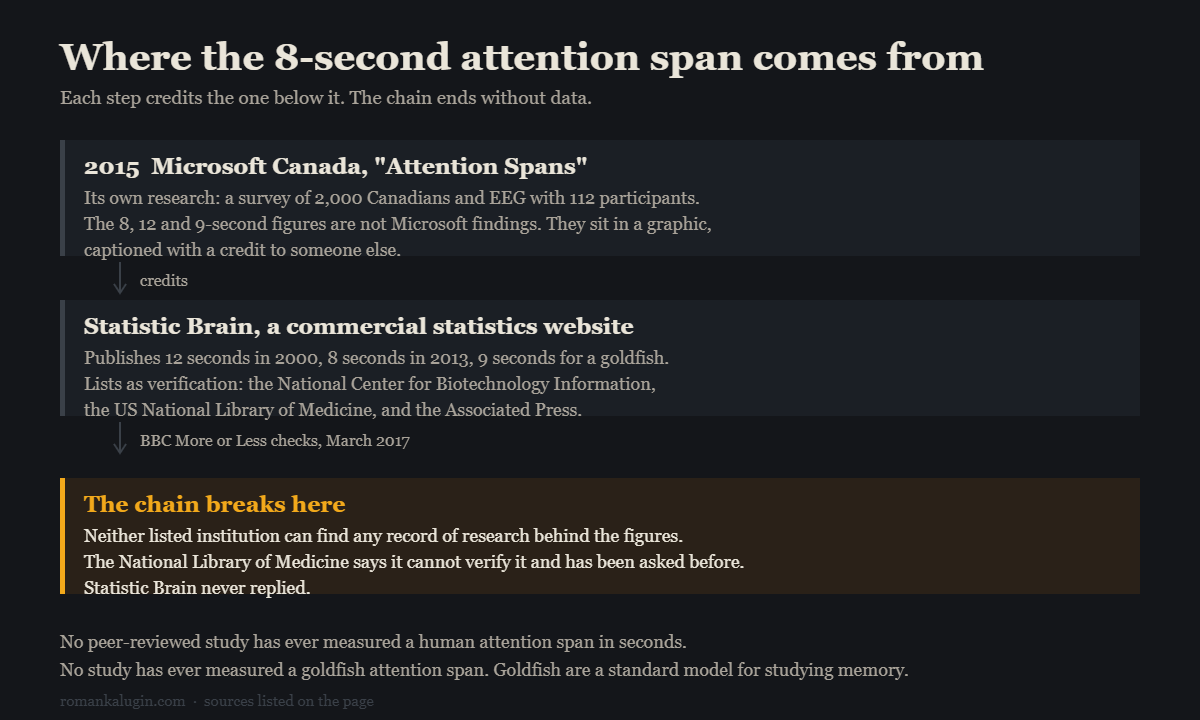
The claim is specific enough to sound researched: the average human attention span was 12 seconds in 2000, fell to 8 seconds by 2013, and is now shorter than a goldfish’s 9 seconds. Here is the chain, followed to the bottom.
Step one, the vector. In spring 2015, Microsoft Canada’s consumer insights team published a report called Attention Spans. It travelled the world. The 12, 8 and 9-second figures appear in it, in a graphic, captioned with a credit to a website called Statistic Brain. They are not Microsoft’s findings. Microsoft’s own research in that report was a survey of 2,000 Canadians and EEG work with 112 participants, and neither produced those numbers.
Worth noting, since the report is cited as the source of digital doom: its own headline conclusion runs the other way. It tells marketers to think again about the idea that digital is killing attention.
Step two, the source. Statistic Brain published the figures with a “statistic verification” line naming the National Center for Biotechnology Information, the US National Library of Medicine, and the Associated Press. It also listed a 2008 web-usage study, which measured how long people spent on web pages, with 25 participants, and which predates the “2013” figure it is supposed to support.
Step three, the break. In March 2017 the BBC programme More or Less went looking for the underlying research. What the reporter found is worth quoting exactly: “when I contact the listed sources — the National Center for Biotechnology Information at the US National Library of Medicine, and the Associated Press — neither can find any record of research that backs up the stats. My attempts to contact Statistic Brain came to nothing too” (Maybin, BBC, 2017).
The National Library of Medicine has separately told researchers asking the same question that it cannot verify the figure and has had similar requests before.
The goldfish half is worse. There is no published measurement of a goldfish attention span. None. The 9-second figure has no traceable origin at all. And the irony is that goldfish are a standard model organism for studying how memory forms. As the behavioural biologist quoted by the BBC put it, goldfish can perform all the kinds of learning described for mammals and birds.
What do the top results cite?
We measured this rather than assuming it. On 27 July 2026 we read Google’s first page for the query that names the statistic, and separately every article ranking for four “attention span” queries.
On the query that names it, the picture is better than expected: five of the seven article results debunk the figure. Google has largely cleaned up this page of results. Two of the remaining articles still repeat it uncritically, and one of those is a 2015 piece by a major news magazine, still ranking first, still unamended, with no correction notice.
Where the myth survives is in the queries where nobody is checking. Of the thirteen pages ranking for the four general attention-span queries, one repeats it and none debunk it. That one is a focus-app vendor, and it states the average adult attention span is 8.25 seconds.
Look at that decimal. It appears in no original source. It was added to an invented number to make it look measured. The same page then reports that attention spans fell by nearly 25% between 2000 and 2015, which is arithmetic performed on figures that do not exist.
Is there a real case for the claim?
If we only said “there is no study” and left it there, the first reader to find a real measurement would stop believing the rest of this page. So here is the best version of the argument, and it is not nothing.
Something measurable did change. In 2004, researchers shadowing information workers found they spent an average of 2 minutes 53 seconds on a computer before switching (González & Mark, 2004). By 2016, automated logging of which window was in the foreground gave a mean of 47 seconds, median 40 (Mark et al., 2016). That is a real drop in real data, published in peer-reviewed venues, and it is the honest core of the popular claim.
Now the problems, which every page quoting the trend leaves out.
The instruments differ. The 2004 figure came from a human observer with a stopwatch. The 2016 figure came from software logging window focus. A person with a clipboard cannot record a two-second glance at a notification. Software records it as a switch. Some of the decline is behaviour; some is the measuring device getting sharper. Nobody has separated the two.
The samples differ. Fourteen people at one company against forty at another, different years, different industries. The 2004 measure also counted paper documents, not only screens.
It is not an attention span. Dwell time on a foreground window is a measure of how a person works with interruptible software. It is not a measure of the capacity of a mind. Converting “how long a window stays in front” into “how long a human can pay attention” is the move that turns a finding into a myth, and it happens silently, usually in the headline.
What holds up?
Strip the invented numbers and there is a real literature underneath. It says less dramatic things and says them properly.
Work is fragmented, and we know by how much. Twenty-four information workers were shadowed for more than 700 hours. They spent an average of 11 minutes 4 seconds on a working sphere before switching or being interrupted (Mark, González & Harris, 2005). Note the standard deviation the popular versions never quote: 18 minutes 9 seconds, larger than the mean itself. The average worker in that dataset barely exists.
The lecture-hall version of this myth has also been traced. The claim that students lose attention after 10 to 15 minutes runs, through a chain of teaching textbooks, to a single 1978 paper. That paper is a review of note-taking, not attention, and contains no primary data on the question (Bradbury, 2016). His summary is blunt: the most cited source for a rapid decline in student attention barely discusses attention at all.
Goldfish remember things, and this is measurable. Eight goldfish learned that food arrived in a one-hour window once every 24 hours, timed the interval, and kept anticipating it for a limited number of days after the food stopped (Gee, Stephenson & Wright, 1994). Goldfish trained to swim a fixed 70-centimetre distance can estimate it using visual flow (Sibeaux et al., 2022). And in lesion work on avoidance learning, intact fish retained the conditioned response across the full retention phase, medial-pallium lesions abolished it in both procedures, and lateral-pallium lesions did so only when the task put a five-second gap between the warning light and the shock (Portavella et al., 2004).
Being honest about the other direction: none of this means goldfish memory is limitless, and we are not going to swap one unsourced number for another. The popular claims that goldfish remember for three months, or six, are not peer-reviewed either. The defensible statement is narrower and still fatal to the myth: goldfish form durable associations, retain them for days at minimum, and are studied precisely because they remember.
Does believing it do any damage?
A wrong number about fish sounds harmless. It is not, in three specific ways.
It licenses self-diagnosis. A figure that says everyone’s attention has collapsed makes a real, recent, personal change in concentration look like the background condition of modern life. New and worsening difficulty concentrating is a reason to check sleep, mood and health, not to conclude you are a person in 2026.
It is used to justify design that makes things worse. “You have eight seconds” is the premise behind shorter everything: shorter videos, shorter paragraphs, shorter courses. The premise is invented, and the output trains exactly the behaviour it claims to accommodate.
It is a reliable test of a source. A page that opens with the goldfish has not checked its other claims either. Use it that way, and on the next round number you meet: the 21-day habit rule came from a plastic surgeon’s observation, not a study.
What should you do instead?
The shift: drop the seconds question — it has no unit. Ask what you can measure and change.
First move, on any statistic like this one: find the primary source before you repeat it. Two questions do most of the work — who measured it, and on how many people. The 8-second figure fails the first. The 47-second figure survives the first and then tells you it measured window focus in forty office workers, which is a much smaller claim than the one being made in its name.
First move, on your own attention: pick something with a unit. How long you read before reaching for the phone. How many days this week you slept under seven hours. How many times you touched the phone during one specific task. Those are countable, they respond to intervention, and none of them is an attention span.
If what you want to know is how long recovery takes once you cut back, that has its own answer, and the honest version is uncomfortable: see how long it takes to get your attention back.
The book that blames smartphones for a teenage mental health crisis is checked in The Anxious Generation, against the evidence.
The boring bottom line
The number is invented, the goldfish comparison is invented, and the company blamed for spreading it was reprinting someone else’s graphic while arguing the opposite in its own text. The chain ends at a website that would not answer the phone.
What is true is smaller and duller. Fragmented work is real and measured. Interruption is real and measured. Dwell time on a screen fell between 2004 and 2016, using two different instruments, in two small samples, and it describes software use rather than human capacity. None of that is an attention span, because attention span is not a thing anyone measures.
Sources
- Maybin S (2017). Busting the attention span myth. BBC News / More or Less. 10 March 2017. Contacted the listed sources; neither had any record of the research bbc.com
- Microsoft Canada Consumer Insights (2015). Attention Spans. Own research: survey of 2,000 Canadians and EEG with 112 participants; the 8-second figure is credited in the report to a third-party website niplav.site
- Gonzalez, V. M.; Mark, G. (2004). Constant, constant, multi-tasking craziness: managing multiple working spheres. Proceedings of the SIGCHI Conference on Human Factors in Computing Systems. Gonzalez VM, Mark G (2004). Constant, constant, multi-tasking craziness. 113-120. N = 14; 2 min 53 s per computer event doi:10.1145/985692.985707
- Mark, G.; Iqbal, S. T.; Czerwinski, M.; Johns, P.; Sano, A. (2016). Neurotics Can't Focus: An in situ Study of Online Multitasking in the Workplace. Proceedings of the 2016 CHI Conference on Human Factors in Computing Systems. Mark G, Iqbal ST, Czerwinski M, Johns P, Sano A (2016). Neurotics can't focus. 1739-1744. N = 40; mean 47.0 s, median 40.2 s doi:10.1145/2858036.2858202
- Mark G, Gonzalez VM, Harris J (2005). No task left behind? Examining the nature of fragmented work. Proceedings of CHI 2005. 321-330. N = 24, 700+ hours; 11 min 4 s per working sphere, SD 18 min 9 s doi:10.1145/1054972.1055017
- Bradbury NA (2016). Attention span during lectures: 8 seconds, 10 minutes, or more? Advances in Physiology Education , 40(4), 509-513. Advances in Physiology Education. doi:10.1152/advan.00109.2016
- Hartley J, Davies IK (1978). Note-taking: a critical review. Programmed Learning and Educational Technology. 15(3), 207-224. The single source behind the 10-15 minute lecture claim; a review of note-taking doi:10.1080/0033039780150305
- Gee P, Stephenson D, Wright DE (1994). Temporal discrimination learning of operant feeding in goldfish. Journal of the Experimental Analysis of Behavior. 62(1), 1-13. N = 8; anticipation persisted six days into extinction doi:10.1901/jeab.1994.62-1
- Sibeaux A, Karlsson C, Newport C, Burt de Perera T (2022). Distance estimation in the goldfish. Proceedings of the Royal Society B. 289(1984), 20221220 doi:10.1098/rspb.2022.1220
- Portavella M, Torres B, Salas C (2004). Avoidance response in goldfish: emotional and temporal involvement of medial and lateral telencephalic pallium. Journal of Neuroscience. 24(9), 2335-2342 doi:10.1523/JNEUROSCI.4930-03.2004