You typed a phrase that science does not measure. There is no instrument in cognitive psychology that returns your «attention span» as a number of seconds, and no normal range to compare it against. That is not pedantry, and it is not good news either. It means most of what you will read on this subject is measuring something else and calling it attention.
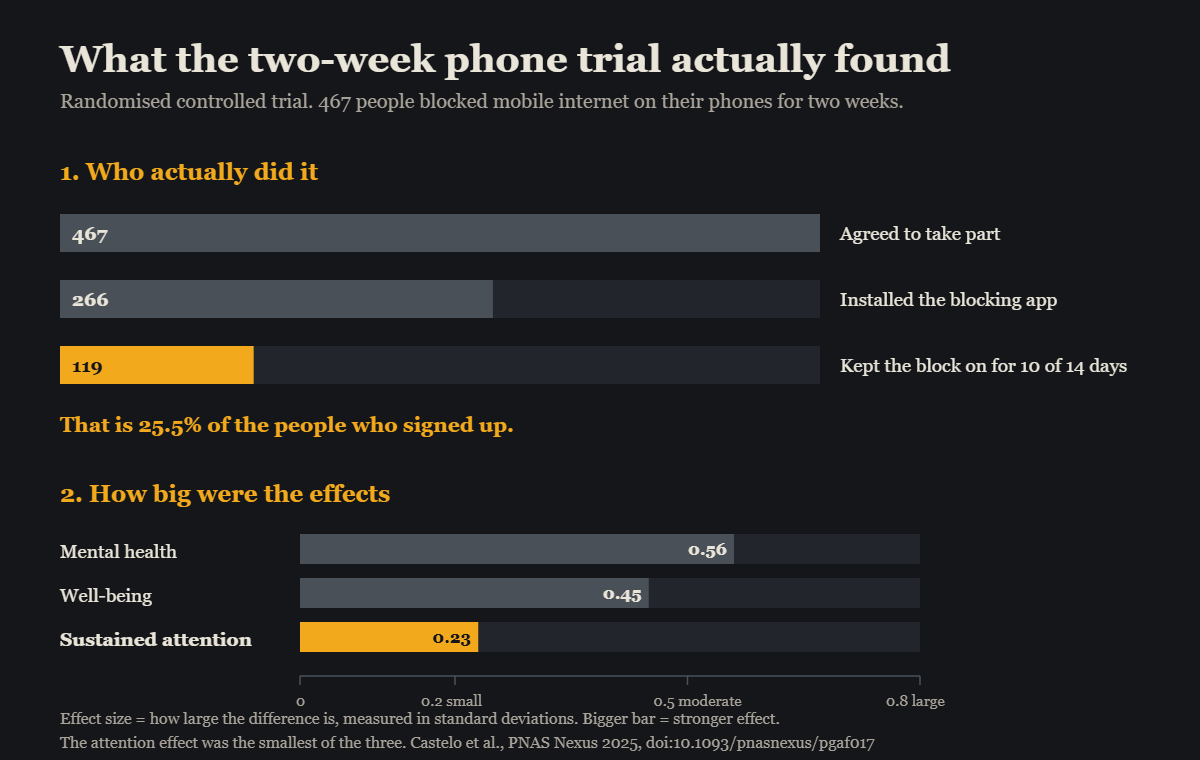
Here is the finding that should frame everything else. In the largest randomised trial on the question, 467 people agreed to block mobile internet on their phones for two weeks. Sustained attention improved. But only 119 of them — 25.5% — actually managed to keep the block on for ten of the fourteen days, and the attention gain was the smallest of the three effects the study measured (Castelo et al., 2025).
The headline everywhere was «two weeks off your phone rolls back ten years of cognitive ageing.» The compliance rate was not in the headline. This page is what the evidence looks like when nothing is left out.
What the top ten results actually cite
Before writing this page we read the competition instead of guessing about it. On 27 July 2026 we took Google’s first page for four queries — how to improve attention span, why is my attention span so short, can I fix my attention span, and how long does it take to fix attention span — and read every distinct article that ranked.
Thirteen pages. Of those thirteen:
- 2 cite an identifiable primary study — an author, journal, year or link you could follow.
- 0 state a sample size for any study they invoke.
- 4 state any limitation, boundary condition or conflicting evidence.
- 2 answer the question «how long does it take», and neither one sources its estimate.
- 3 tell you when a focus problem warrants seeing a doctor.
The dominant strategy is a named expert quoted without a study attached. It reads like evidence and is not.
What we did not check, so you can discount this properly. One page rendered only partially, so its count could be off by one. One long interview transcript was read in part, not in full. We excluded forum threads and videos, which is a real exclusion because a Reddit thread was the top result on five of the eight queries we looked at. Results came from one location, one day, one browser, and Google personalises. This is a snapshot of a search result, not a survey of the literature. Someone repeating it next month should expect different numbers.
We are not claiming those pages are wrong. We are pointing at a gap: on the query that asks how long recovery takes, the first page of Google contains no sourced answer at all.
E1. «Attention span» is not a measurement
Attention is not one capacity. Researchers separate at least three: selective attention, which filters competing input; sustained attention, which holds performance steady over minutes; and executive control, which switches and inhibits. They dissociate. You can be poor at one and fine at another, and improving one does not automatically move the others.
None of them is reported as a span in seconds. The task used in the trial above is the gradual-onset continuous performance task, and what it returns is d-prime: a signal-detection score describing how well you separate targets from non-targets over five minutes. It is a sensitivity index, not a duration.
So when a page tells you the average attention span is now some number of seconds, it is doing one of two things. Either it is quoting a figure with no study behind it, or it has taken a measurement of something specific — how long a knowledge worker leaves one window in the foreground, for instance — and quietly relabelled it as the capacity of the human mind.
The shift. Retire the question of how long your attention span is. Ask which of the three functions is failing, under what conditions, and against what baseline. First move: for one week, note the moment you disengage and what you switched to. Switching to something more demanding is a different problem from switching to something easier.
E2. The eight-second goldfish number is invented
The claim is that human attention fell from twelve seconds in 2000 to eight seconds in 2013, which is less than a goldfish. It has been printed by major outlets and repeated in thousands of posts.
There is no study. The figure entered circulation through a 2015 Microsoft Canada consumer report, which sourced it to a commercial statistics website. When the BBC programme More or Less asked that website for the underlying research, it could not produce any, and the two institutions it had listed as sources had no record of it. The goldfish half is no better: there is no measurement of goldfish attention span, and goldfish retain trained responses for months.
Google has largely cleaned this up. On the query that names the statistic, five of the seven article results now debunk it. But it survives where nobody is looking: in our thirteen-page corpus, one page still opens with it — a focus-app vendor, which states the average adult attention span is 8.25 seconds. That decimal appears in no original source. It was added to make an invented number look measured.
The same page then asserts attention spans fell by nearly 25% between 2000 and 2015, which is arithmetic performed on the fabricated figures.
The full chain, traced step by step to the website that would not answer the phone, is in the goldfish myth.
Why this matters beyond trivia. A fabricated statistic tells you nothing is wrong with you, because it was never about you. It is also a useful test: a page that opens with the goldfish has not checked its other claims either.
A second lecture-hall myth deserves the same treatment. The claim that students lose attention after ten to fifteen minutes traces back, through a chain of textbooks, to a single 1978 paper — and that paper is a review of note-taking, not attention, and reports no primary data on the question (Bradbury, 2016). The actual 1978 experiment on medical students found attention rose for the first ten to twenty minutes and then declined slowly, never dropping below where it started.
E3. The 47-second trend compares two different instruments
The most repeated modern statistic in this field is that office workers now hold their attention on one screen for about 47 seconds, down from roughly two and a half minutes in 2004. Five of the thirteen pages we read use it as their opening hook. Not one of them mentions the problem with it.
Both endpoints are real work by the same researcher. They were not measured the same way.
- 2004. Fourteen people at one company, 477 hours, measured by a human observer shadowing them with a stopwatch. The published average time on a computer was 2 minutes 53 seconds per event (González & Mark, 2004). The paper’s own summary says «somewhat more than two minutes». The round «two and a half minutes» appears in interviews and a trade book, not in the paper.
- 2016. Forty people, measured by automated logging of which window was in the foreground. Mean 47.0 seconds, median 40.2 (Mark et al., 2016).
Stopwatch-and-clipboard against software logging, fourteen people at one firm against forty at another, and a 2004 measure that counted paper documents as well as screens. A human observer cannot record a two-second glance at a notification; window-logging software records it as a switch. Some of the decline is real. Some of it is the instrument getting sharper. Nobody has separated the two, and any page presenting this as a clean time series is presenting a comparison the underlying papers do not support.
The related peer-reviewed number is more solid and less dramatic: information workers spent an average of 11 minutes 4 seconds on a working sphere before switching or being interrupted, with a standard deviation of 18 minutes 9 seconds (Mark, González & Harris, 2005). Note that standard deviation. It is larger than the mean. The average worker in that dataset is close to a fiction.
E4. The phone trial, read honestly
This is the best evidence available, and it deserves better treatment than it has had.
Four hundred and sixty-seven adults, recruited on Prolific in the US and Canada, iPhone users, mean age 32, were randomised to block all mobile internet on their phones for two weeks — calls and texts still worked, laptops still worked. The delayed group blocked in the second fortnight instead, so everyone eventually received the intervention.
| What the study reports | The number |
|---|---|
| Randomised | 467 |
| Installed the blocking app | 266 |
| Met the pre-registered compliance definition | 119 (25.5%) |
| Completed all three measurement points | 313 (67%) |
| Effect on mental health | dz = 0.56 |
| Effect on subjective well-being | dz = 0.45 |
| Effect on sustained attention | dz = 0.23 |
| Daily screen time | 314 min to 161 min |
Four things follow that the coverage left out.
The attention effect is the smallest one. The famous comparison — an improvement «about the same magnitude as ten years of age-related decline» — is attached to dz = 0.23, the weakest of the three results, and refers specifically to d-prime on a five-minute lab task. The authors add their own caveat that their sample and intervention differ substantially from the clinical populations these benchmarks come from. Nobody got younger.
Nothing explained the attention gain. The study measured five candidate mechanisms: time spent offline, time consuming media, social connectedness, self-control, and sleep. All five mediated the improvements in mood and mental health. The paper states plainly that none of them mediated the effect on sustained attention. The mechanism is unknown.
Attention was not shown to persist. Two weeks after the block ended, well-being and mental health were still above baseline. The persistence sentence does not mention attention, and no follow-up beyond that point exists. Screen time had already rebounded from 161 to 265 minutes a day.
The 91% figure is weaker than it sounds. «91% improved on at least one outcome» is real — 90.7%, to be exact — but it counts any upward movement on any of three measures, with no threshold for meaningful change. In the control group, during a fortnight of doing nothing, 46–52% also «improved» on each measure. Read the two numbers together or the first one misleads.
What survives all of that is still worth having: two weeks of substantially less phone internet produced a real, replicated-within-study improvement in mood and mental health, and a smaller one in a lab measure of attention. And the authors themselves draw the practical conclusion, which is the opposite of the popular one: because the effects held even including the 74% who did not comply, «fully blocking mobile internet is not necessary to produce benefits.»
E5. The «mere presence» effect did not replicate
You have read that having your phone on the desk drains cognitive capacity even when it is face down and switched off. It comes from a 2017 study of 520 and 275 participants, which found that phone location affected working memory span and fluid intelligence (Ward et al., 2017).
Two things are almost always dropped in the retelling.
First, the original study found no effect on sustained attention. That was not an oversight; it was the point. The authors argued phones consume the allocation of attention without interrupting its orientation. So citing this paper to explain why you cannot focus for long misstates it.
Second, a pre-registered direct replication with a larger sample — 383 against the original 275 — found nothing. Not a smaller effect: nothing. Phone location produced F(2, 377) = 0.10, p = .91 on the working memory task (Ruiz Pardo & Minda, 2022). Their conclusion: «the mere presence of one’s smartphone may not be enough to affect cognitive performance.»
The meta-analyses disagree with each other, which is the honest state of play. The largest and most method-restrictive pooled 33 studies and 4,368 participants and found essentially zero, d = −0.02, with evidence of publication bias among published articles (Hartanto et al., 2024). A second found an effect for working memory only, and warned it is smaller than theorised.
Verdict: contested, leaning null. Putting your phone in another room is cheap and may help you for reasons of habit and temptation. But the specific claim that its mere presence taxes your brain is not something the current evidence supports.
E6. Where the 40% productivity number came from
«Task switching costs you up to 40% of your productive time» is one of the most cited claims in productivity writing. It is attributed to a 2001 experiment on task switching.
That experiment is real (Rubinstein, Meyer & Evans, 2001). It measured how much longer people take when alternating between two rules instead of repeating one. Participants were undergraduates, roughly twelve to thirty-six per experiment, in one-hour sessions. One experiment was card sorting timed with a stopwatch. The costs are measured in fractions of a second.
The paper contains no workplace data, no productivity measure and no percentage. The 40% came from one author speculating to journalists in August 2001, and even then he said «20 to 40 percent» and prefaced it with «may mean». A conditional estimate in a phone interview became a statistic with a citation attached.
Switch costs are real and worth designing around. The number quantifying them is not.
E7. What has survived testing
Short list, because it is a short list. Two popular candidates are not on it: the mere-presence effect above, and brown noise, which no trial has ever tested for focus.
Partial reduction beats total abstinence. A three-arm experiment assigned 619 people to a week of complete smartphone abstinence, a week of using it one hour less per day, or nothing. Both interventions helped. The reduction group did better, and the benefits lasted longer at follow-up (Brailovskaia et al., 2023). This converges with the compliance data above: the sustainable dose outperforms the heroic one. Weekend detoxes and total bans are the two versions people actually attempt, and they are the two the evidence supports least.
Batching notifications works better than switching them off. In a field experiment with 237 participants, receiving notifications in three scheduled batches per day improved attention and well-being relative to normal delivery. Hourly batching did not help, and receiving none had mixed results (Fitz et al., 2019). Three times a day is a specific dose, and it beat both extremes.
Sleep restriction degrades attention in a dose-dependent way, and three nights does not fix it. Sixty-six people spent a week on three, five, seven or nine hours in bed, then three recovery nights of eight hours. Attention lapses tracked the dose. In the five and seven hour groups, performance did not return to baseline after three recovery nights (Belenky et al., 2003). If you are running a sleep debt, no attention technique is being tested fairly.
What we cannot tell you is the dose. This is not for want of trying, and the honest version matters. One randomised trial has related the amount of reduction to an objective attention measure: 76 people cut social media by a target of 50% or 10% for a week. Neither the assigned condition nor how much people actually cut back predicted the attention result (van Wezel et al., 2021). The trials that varied duration, up to four weeks of abstinence, measured loneliness and well-being rather than attention (Hall et al., 2021). And the trial with the longest follow-up, four months, measured mood, life satisfaction and usage, not attention. The full timeline question, including what sleep research shows a real recovery curve looks like, is worked through in how long it takes to get your attention back. So the position is not that nobody has looked. It is that the one attempt to relate dose to attention found nothing, and the studies built to answer the timing question were measuring something else.
E8. The competing explanation nobody screens for
Difficulty concentrating is one of the least specific symptoms in medicine. It is a diagnostic criterion or common feature of ADHD, major depression, generalised anxiety, obstructive sleep apnoea, iron deficiency, thyroid dysfunction, perimenopause, long COVID, grief, and ordinary chronic sleep restriction. Only three of the thirteen pages we read mention seeing a doctor at all — while «Do I have ADHD or just a short attention span?» appears in Google’s own People Also Ask on two separate queries in this area.
Two things are worth knowing before you self-diagnose from a browser tab.
A poor score on an attention task does not identify a condition. A meta-analysis of 83 executive-function studies found that adults and children with ADHD do perform worse on these tasks — at medium effect sizes, around 0.46 to 0.69 — but that the deficits are neither necessary nor sufficient to explain the condition (Willcutt et al., 2005). Group differences of that size overlap heavily. An online test cannot tell you which side of the overlap you are on.
Being able to focus intensely on things you enjoy rules nothing in or out. It is neither evidence for ADHD nor against it, and it is not a distinguishing feature of anything.
If you can name the month it changed, start with the sudden-onset checklist rather than with a productivity method. The useful question is not «what do I have» but «what changed». Attention that has been poor since childhood, across settings, is a different investigation from attention that fell off a cliff eight months ago. The second pattern is the one that most often has a treatable cause behind it, and the one most likely to be wasted on productivity advice.
A disclosure, since this page corrects other people
I spent twenty years teaching most of what this page takes apart. Two decades ago I told audiences to concentrate by force of will — advice I would now compare to fencing against a machine gun — and I taught that focused thought attracts what you want. My own summary of that period is the honest one: the advice sometimes worked, and the explanation lied.
The beliefs I dropped after checking them include willpower as a muscle that depletes, which the multi-laboratory replication cited on this page put at d = 0.04 with a confidence interval straddling zero, and the twenty-one-day habit rule, which traces back to a plastic surgeon’s observation about patients adjusting to a new face rather than to any study of habits. I was not lying at the time. I was faithfully repeating what looked like settled knowledge, and I did not check.
This is disclosure, not a credential. One person’s revised opinions prove nothing about attention, and nothing in this section is evidence of anything. It is here so the bias is visible: this page is written by someone who has already been wrong in public about this subject. That is also why every claim above carries a source you can check without taking my word for it.
Where the evidence ends
The honest boundaries of this page, stated in one place rather than buried.
There is no recovery timeline. No study has established how long attention takes to recover from heavy phone use, in what order functions return, or whether gains persist. The best trial measured attention once, at the end of two weeks, and did not report whether the improvement lasted.
Lab tasks are not your working life. Sustained attention here means d-prime on a five-minute computer task. Nobody has shown that a change in that score means you will read a chapter, finish a report, or sit through a meeting differently.
Nobody was blinded. Participants in the phone trial knew they had signed up for a study about phones and well-being. The control was a waiting list, not a plausible alternative treatment. Expectancy effects are not ruled out, and the authors say so.
The samples are narrow. Prolific volunteers, iPhone users, US and Canada, mean age 32, and 83% of them already motivated to cut their phone use. People who completed the study had better baseline attention and better mental health than those who dropped out, which limits generalisation to exactly the people most likely to be reading this.
Medical note. Nothing here is medical advice, and nothing here diagnoses anything. Persistent difficulty concentrating that is new, worsening, or accompanied by low mood, loss of interest, heavy snoring or witnessed pauses in breathing, unexplained fatigue, unintended weight change, or thoughts of harming yourself is a reason to see a doctor rather than to optimise a routine. If concentration problems started after a head injury, a new medication, or an illness, that is a clinical question, not a productivity one.
Sort yourself first
Most advice fails because it is aimed at the wrong mechanism. Find your row before you pick a method.
You can focus, but you keep choosing not to. You open the phone deliberately.
This is avoidance, not attention. The task carries a feeling you are escaping.
First move: read what the procrastination research finds. Attention methods will not touch this.
You sit down willing and alert, and forty minutes vanish anyway.
Environmental interruption and switch cost.
First move: batch notifications to three fixed times a day. Not off, batched. What the recovered hour is then for is in how to reach a flow state.
You are willing but foggy, rereading the same paragraph.
Sleep debt, or a physical cause.
First move: fix sleep for two weeks before testing anything else. If nothing changes, see a doctor.
Fine on things you chose, impossible on things you were given.
Motivation and effort cost, not capacity.
First move: shrink the first action until refusing it would be unreasonable. Then look at energy.
Lifelong, across every setting, since school.
Possibly a clinical picture.
First move: assessment by a clinician. Do not self-diagnose from an online test.
Clearly worse than a year ago, with a start date you can name.
Something changed, and it is often treatable.
First move: see a doctor before you see a productivity system.
Sources
- Castelo N, Kushlev K, Ward AF, Esterman M, Reiner PB (2025). Blocking mobile internet on smartphones improves sustained attention, mental health, and subjective well-being. PNAS Nexus, 4(2), pgaf017. 467 randomised, 25.5% compliant. PMID 39967678. doi:10.1093/pnasnexus/pgaf017
- Ward AF, Duke K, Gneezy A, Bos MW (2017). Brain drain: the mere presence of one’s own smartphone reduces available cognitive capacity. Journal of the Association for Consumer Research, 2(2), 140-154. N = 520 and 275. doi:10.1086/691462
- Ruiz Pardo AC, Minda JP (2022). Reexamining the brain drain effect: a replication of Ward et al. (2017). Acta Psychologica, 230, 103717. N = 383, null result. PMID 36007374. doi:10.1016/j.actpsy.2022.103717
- Hartanto A, Lua VYQ, Kasturiratna KTAS, Koh HP, Tng GYQ, Kaur M, Quek FYX, Chia JL, Majeed NM (2024). A critical meta-analysis of the smartphone mere presence effect. Technology, Mind, and Behavior, 5(1). 33 studies, N = 4,368, d = -0.02. doi:10.1037/tmb0000123
- Brailovskaia J, Delveaux J, John J, Wicker V, Noveski A, Kim S, Schillack H, Margraf J (2023). Finding the sweet spot of smartphone use. Journal of Experimental Psychology: Applied, 29(1), 149-161. N = 619, three arms. doi:10.1037/xap0000430
- Fitz N, Kushlev K, Jagannathan R, Lewis T, Paliwal D, Ariely D (2019). Batching smartphone notifications can improve well-being. Computers in Human Behavior, 101, 84-94. N = 237. doi:10.1016/j.chb.2019.07.016
- Mark G, Gonzalez VM, Harris J (2005). No task left behind? Examining the nature of fragmented work. Proceedings of CHI 2005, 321-330. N = 24, 700+ hours of observation. doi:10.1145/1054972.1055017
- Mark G, Iqbal ST, Czerwinski M, Johns P, Sano A (2016). Neurotics can’t focus: an in situ study of online multitasking in the workplace. Proceedings of CHI 2016, 1739-1744. N = 40, mean 47.0 s. doi:10.1145/2858036.2858202
- Gonzalez VM, Mark G (2004). Constant, constant, multi-tasking craziness: managing multiple working spheres. Proceedings of CHI 2004, 113-120. N = 14, 2 min 53 s per computer event. doi:10.1145/985692.985707
- Rubinstein JS, Meyer DE, Evans JE (2001). Executive control of cognitive processes in task switching. Journal of Experimental Psychology: Human Perception and Performance, 27(4), 763-797. 12-36 undergraduates per experiment. PMID 11518143. doi:10.1037/0096-1523.27.4.763
- Bradbury NA (2016). Attention span during lectures: 8 seconds, 10 minutes, or more? Advances in Physiology Education, 40(4), 509-513. doi:10.1152/advan.00109.2016
- Belenky G, Wesensten NJ, Thorne DR, Thomas ML, Sing HC, Redmond DP, Russo MB, Balkin TJ (2003). Patterns of performance degradation and restoration during sleep restriction and subsequent recovery. Journal of Sleep Research, 12(1), 1-12. N = 66. doi:10.1046/j.1365-2869.2003.00337.x
- van Wezel MMC, Abrahamse EL, Vanden Abeele MMP (2021). Does a 7-day restriction on the use of social media improve cognitive functioning and emotional well-being? Addictive Behaviors Reports, 14, 100365. N = 76, two dose levels, null for objective attention. doi:10.1016/j.abrep.2021.100365
- Hall JA, Xing C, Ross EM, Johnson RM (2021). Experimentally manipulating social media abstinence: results of a four-week diary study. Media Psychology, 24(2), 259-275. N = 130, five durations, well-being outcomes only. doi:10.1080/15213269.2019.1688171
- Willcutt EG, Doyle AE, Nigg JT, Faraone SV, Pennington BF (2005). Validity of the executive function theory of attention-deficit/hyperactivity disorder: a meta-analytic review. Biological Psychiatry, 57(11), 1336-1346. 83 studies. doi:10.1016/j.biopsych.2005.02.006
- Radtke T, Apel T, Schenkel K, Keller J, von Lindern E (2022). Digital detox: an effective solution in the smartphone era? Mobile Media & Communication, 10(2), 190-215. 21 studies, N = 3,625. doi:10.1177/20501579211028647
Continue reading
- The Anxious Generation: A Real Crisis, and a Cause Still on Trial · 9 min
- Does Music Help You Focus? From the Mozart Effect to Lo-Fi · 11 min
- Does Brown Noise Help You Focus? Zero Studies Have Tested It · 10 min
- Why Is My Attention Span So Short All of a Sudden? · 7 min
- The Goldfish Myth: Your Attention Span Is Not 8 Seconds · 8 min
- How Long Does It Take to Get Your Attention Back? · 10 min
- The Odyssey and the Mind: What Nolan’s Film Does, and What Psychology Can Say · 7 min
- GTD vs. Deep Work vs. Time Blocking: Picking a Time System That Fits · 8 min
- How to Reach Flow State (and Stay There Longer) · 10 min