The most repeated number in habit advice is 66 days. It comes from a single study of 96 volunteers, it is a median rather than a typical case, individual times ran from 18 to 254 days, and the curve behind it fitted well for 39 of the people who started. Where the 66-day figure comes from, and where the older 21-day one came from, is a story about two different kinds of nothing.
The most repeated technique is stacking a new habit onto an existing one. In 2021 it was finally tested head to head against something far less charming: a time of day. Across 192 adults and 84 days of daily reports, the anchor did not win. That trial, and the fifteen ranking pages that never mention it, are in does habit stacking actually work.
Neither result says habit change is hopeless. Both say the same thing about the advice around it. It is confident where the evidence is thin, and quiet in the places where people actually get stuck.
This page is the entry point to everything we have on habits and discipline. It is built around one idea: the phrase habit problem covers four different problems, and they do not share a solution.
Four different problems, one word
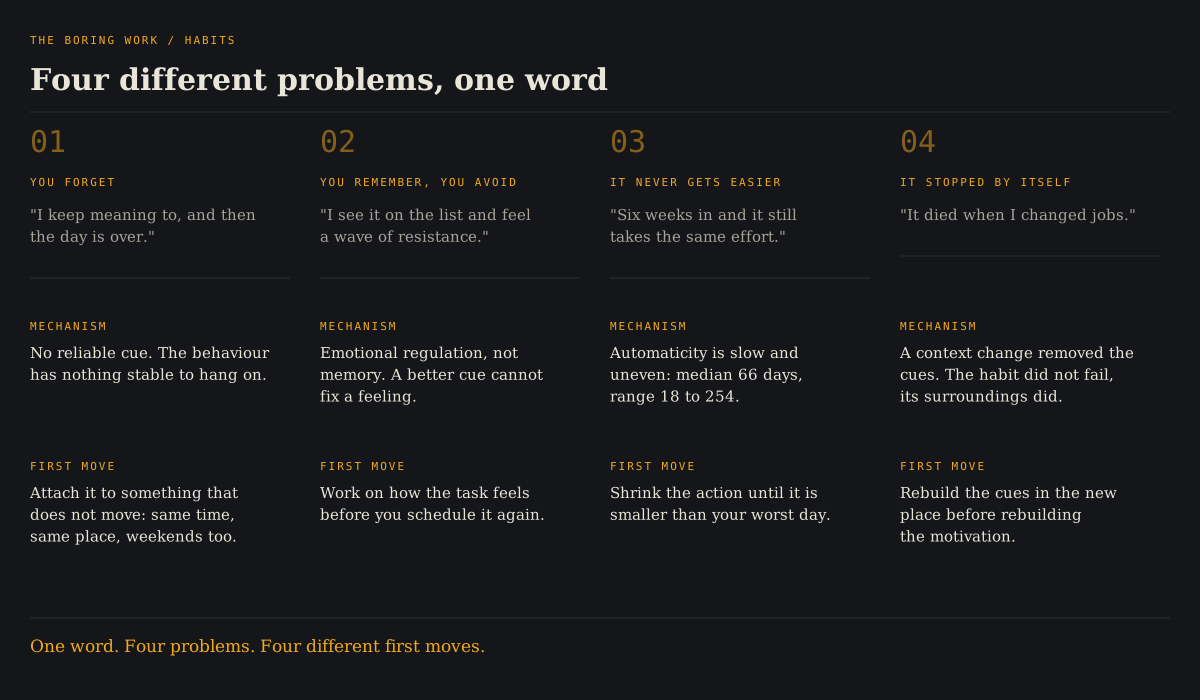
You forget. You mean to do it, the day fills up, and by the time you remember it is eleven at night. This is the only one of the four that is genuinely a cue problem, and it is the one almost all habit advice is written for. The fix is a trigger that does not move: same time, same place, weekends included.
You remember, and you avoid. The task is on the list, you see it, and something in you slides away from it. No cue will help here, because nothing was forgotten. This is emotional regulation rather than memory, and it belongs to a different section of this site entirely: the evidence on avoidance and delay.
It never gets easier. You have done it for six weeks and it still costs the same effort it did on day one. Automaticity is slower and far more variable than the round numbers suggest: in the study everyone quotes, the median was 66 days and the range ran from 18 to 254. Effortful behaviours sit at the slow end, and some never arrive.
It stopped by itself. It was automatic, then you moved, changed jobs, had a child, or your gym closed. Habits are held in place by the context around them, and when the context goes the behaviour goes with it. In one study of students transferring to a new university, well-practised habits collapsed precisely when the surroundings changed. Nothing about your character changed. The room did. It also explains the reverse case, where an old habit returns intact the moment its old surroundings do: your brain never deletes a bad habit.
These four fail in different ways and recover in different ways. Reaching for a habit tracker when the real problem is avoidance, or for motivation when the real problem is a moved desk, is the most common reason a reasonable plan produces nothing.
The same distinction matters when reading habit books. Our critical review of Atomic Habits separates the mechanics that help an action repeat from broader claims about progress, mastery, automaticity, context and identity.
What ranks for this, and what it leaves out
On 27 July 2026 we read every page we could open that ranks for does habit stacking work, is habit stacking evidence based and habit stacking science. Fifteen opened. We counted only claims made in the body text.
- 12 of 15 describe the method as backed by science or research.
- 4 of 15 name a single study by author and year. The rest offer «research shows» or «researchers at Stanford».
- 0 of 15 mention any trial that compared the method against another kind of cue.
- 9 of 15 discuss the conditions under which it fails, and four do so in any depth.
Two claims in that set fall apart on contact. One page credits «researchers at Stanford» with an 80% gain in adherence and links to a behaviour diagram rather than a study. A second figure circulating well beyond the top results, a 2025 paper in the Journal of Applied Psychology reporting a 64% improvement, has no traceable source at all.
The limits of our count are worth stating plainly: one search tool, United States results, one day, one location. Personalised results will differ and the order will have moved by the time you read this. The counts describe those fifteen pages, not the whole internet.
Sort your problem in four questions
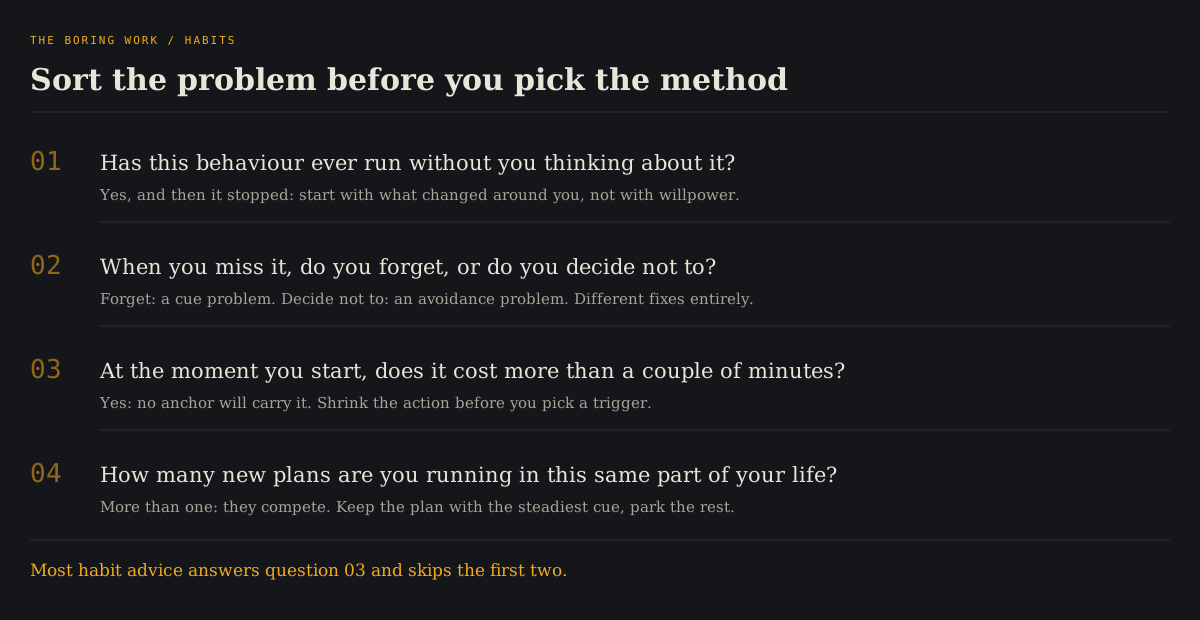
01. Has this behaviour ever run without you thinking about it? If it has, and then it stopped, you are not starting from zero and you do not need a new system. Start with what changed around you.
02. When you miss it, do you forget, or do you decide not to? Forgetting is a cue problem and everything on this page applies. Deciding not to is avoidance, and it needs different tools.
03. At the moment you start, does it cost more than a couple of minutes of effort? If yes, no trigger will carry it. Shrink the action until it is smaller than your worst day, then attach it to something.
04. How many new plans are you running in this same part of your life? Plans that target the same area compete with each other; plans in unrelated areas do not. Keep the one with the steadiest cue and park the rest for a month.
Most habit advice answers question 03 and skips the first two.
Where the evidence stops
The planning research underneath most habit advice is real and it is smaller than advertised. The figure that travels, an effect of 0.65, comes from a 2006 review. In 2025 the same authors pooled 642 tests and reported 0.36; their own bias analysis calls the asymmetry in that literature substantial, and a robust Bayesian correction takes the estimate down to 0.15. That is still a real effect obtained cheaply. It is not the effect the slogans imply.
Three things nobody can currently tell you, and you should be suspicious of any page that pretends otherwise. How many behaviours can be chained onto one anchor before performance drops: untested. What strength an existing routine needs before it can carry a new action: no measure exists. Whether a single planning intervention holds for years without reminders: unstudied beyond the short term.
Most of these studies also measure habit by asking people how automatic something feels. Where researchers switched to objective monitoring, effects generally shrank. Read every number on this page as an estimate with a wide interval, not a dial setting.
And a limit that matters more than the statistics. If the behaviour you cannot start is sleep, eating, medication or basic self-care, and it has been that way for weeks, this is not a cue design problem. Persistent difficulty in those areas is a reason to talk to a clinician, and nothing on this site is medical advice.
Sources
- Keller, J., Kwasnicka, D., Klaiber, P., Sichert, L., Lally, P., & Fleig, L. (2021). Habit formation following routine-based versus time-based cue planning: A randomized controlled trial. British Journal of Health Psychology. doi:10.1111/bjhp.12504
- Lally, P., van Jaarsveld, C. H. M., Potts, H. W. W., & Wardle, J. (2010). How are habits formed: Modelling habit formation in the real world. European Journal of Social Psychology. doi:10.1002/ejsp.674
- Sheeran, P., Listrom, O., & Gollwitzer, P. M. (2025). The when and how of planning: Meta-analysis of the scope and components of implementation intentions in 642 tests. European Review of Social Psychology, 36(1), 162-194. doi:10.1080/10463283.2024.2334563
- Wood, W., Tam, L., & Guerrero Witt, M. (2005). Changing circumstances, disrupting habits. Journal of Personality and Social Psychology, 88(6), 918-933. doi:10.1037/0022-3514.88.6.918
- Stawarz, K., Cox, A. L., & Blandford, A. (2015). Beyond self-tracking and reminders: Designing smartphone apps that support habit formation. Proceedings of CHI 2015, 2653-2662. doi:10.1145/2702123.2702230
- Stecher, C., Chen, C., Codella, J., Cloonan, S., Hendler, J., et al. (2024). Combining anchoring with financial incentives to increase physical activity: A randomized controlled trial among college students. Journal of Behavioral Medicine, 47, 751-769. doi:10.1007/s10865-024-00492-4
- Verhoeven, A. A. C., Adriaanse, M. A., de Ridder, D. T. D., de Vet, E., & Fennis, B. M. (2013). Less is more: The effect of multiple implementation intentions targeting unhealthy snacking habits. European Journal of Social Psychology, 43(5), 344-354. doi:10.1002/ejsp.1963
- Webb, T. L., & Sheeran, P. (2006). Does changing behavioral intentions engender behavior change? A meta-analysis of the experimental evidence. Psychological Bulletin, 132(2), 249-280. doi:10.1037/0033-2909.132.2.249