TL;DR
- Four techniques get recommended for breaking a habit, and their evidence bases differ by an order of magnitude. One has 586 patients behind it, one has 22,509, one has 23 studies, and one has no consistent evidence at all.
- Replacing the response, the «swap it for something else» advice, is measured at SMD −0.43 in tic disorders and −1.22 in trichotillomania. Both are diagnoses, and that is where nearly all the measurement is.
- Tapering down gradually is the most common advice on the topic. Pooled across 22 trials and 9,219 participants, it comes out level with stopping abruptly: RR 1.01, 95% CI [0.87, 1.17].
- If-then plans are weaker at removing a behaviour than at adding one: d = 0.29 against d = 0.51 in the same meta-analysis. In the laboratory the advantage disappeared entirely when the reward was real food.
- Most relapse happens in the first eight days. The words «immediately» and «permanently», which people type into search boxes about this, have nothing behind them.
Every article about breaking a bad habit serves the same four dishes: swap the habit for another one, remove the trigger, write an if-then plan, and wean yourself off gradually. All four have been measured, and the portions of evidence behind them are absurdly unequal, one rests on 586 clinic patients, another on 22,509 smokers, and the gradual-weaning one, the internet’s favourite, turns out to tie with stopping outright (Lindson et al., 2019).
Two of the most common search phrasings ask how to break a habit «immediately» or «permanently». Neither word survives contact with the relapse data, and this page says so early rather than late. It also names no dose, no substance protocol and no schedule, and the last section says which version of this question belongs to a clinician.
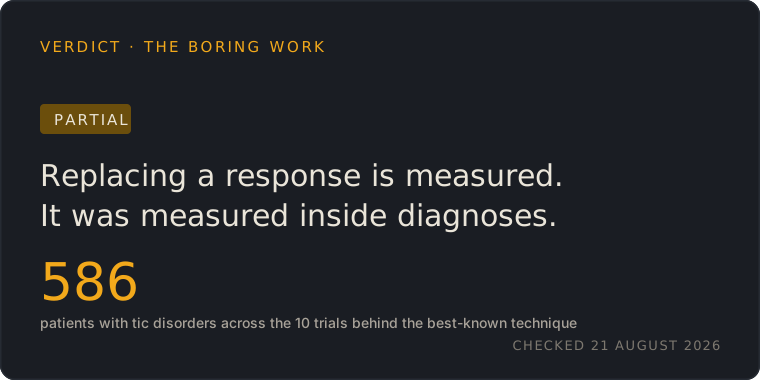
Four techniques, four different amounts of evidence
| Technique | Measured on whom | Effect | Verdict |
|---|---|---|---|
| Replace the response | 586 patients with tic disorders across 10 trials; 857 participants with trichotillomania across 24 trials | SMD −0.43 [−0.71, −0.16]; SMD −1.22 [−1.71, −0.73] | Partial: real, and measured almost entirely inside diagnoses |
| Taper rather than stop | 22,509 participants across 51 smoking trials; 697 in the largest single trial | RR 1.01 [0.87, 1.17] pooled; RR 0.80 [0.66, 0.93] favouring abrupt in the single trial | Refuted as advice: nothing shows tapering ahead |
| If-then plan against a behaviour | 23 studies of eating behaviour | d = 0.29 for removing, against d = 0.51 for adding | Partial: smaller for subtraction, and it fails with real rewards |
| Sit with the urge until it passes | 9 cue-exposure studies; 10 trials of mindfulness for smoking | No consistent evidence; no significant effect, with publication bias detected | Refuted in the forms that were tested |
| Monitoring your own behaviour | 138 studies, N = 19,951 | d+ = 0.40 [0.32, 0.48] on goal attainment | Confirmed, and modest |
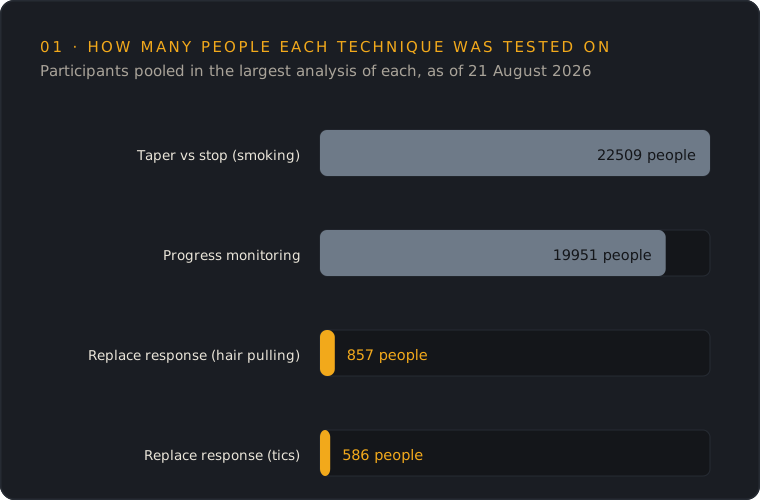
Replacing the response, and who it was tested on
«You cannot delete a habit, only replace it» is the most quoted sentence in this genre, and it does trace back to a real technique with a name and a birth year. Habit reversal, 1973: learn to feel the habit starting, practise a competing move your hands physically cannot do at the same time, and recruit an ally to cheer you on (Azrin & Nunn, 1973).
It has been tested. Ten randomised trials covering 586 patients with tic disorders pool to SMD −0.43, 95% CI [−0.71, −0.16], with the size of the effect depending on what the control group received. In trichotillomania, 24 trials covering 857 participants give behavioural therapy with habit-reversal components an SMD of −1.22, 95% CI [−1.71, −0.73], the largest effect of any treatment in that review, larger than the drug comparisons it sat beside (Farhat et al., 2020). Those drug figures appear in that paper as comparisons and appear here for scale only; nothing on this page is a statement about medication.
The largest adult sample gives a sense of the magnitude. In 122 people aged 16 to 69, tic severity fell from 24.0 to 17.8 against 21.8 to 19.3 in a supportive-treatment control, effect size 0.57, with 24 of 63 rated much improved against 4 of 63 (Wilhelm et al., 2012).
Now the fine print that belongs in the same breath: every one of those patients had a diagnosis, tic disorders or compulsive hair-pulling, and much of the tic evidence comes from children in treatment. Nobody has ever run a randomised trial of «replace the habit» on pen-chewing, phone-checking or desk-snacking in ordinary adults. The technique is real; the internet’s favourite use of it is an unmeasured extrapolation, and no page ranking for this question mentions either half.
Abruptly or gradually
The most consequential piece of advice in the search results is to reduce gradually. It has been compared directly, and the two sources disagree in an instructive way.
The largest single trial randomised 697 adults in English primary care either to stop abruptly or to cut down by 75% over the two weeks before quit day, with both arms receiving nurse support and nicotine replacement. At four weeks, 39.2% of the gradual group were abstinent against 49.0% of the abrupt group, RR 0.80 [0.66, 0.93]. At six months, 15.5% against 22.0%, RR 0.71 [0.46, 0.91] (Lindson-Hawley et al., 2016).
Hidden in that trial is a twist worth the whole page: people who wanted to quit gradually did worse than people who preferred cold turkey, regardless of method. Preference travelled with outcome. Some of what looks like «gradual quitting fails» may be «the people drawn to gradual quitting were always going to have a harder time», the ones negotiating with the habit rather than divorcing it.
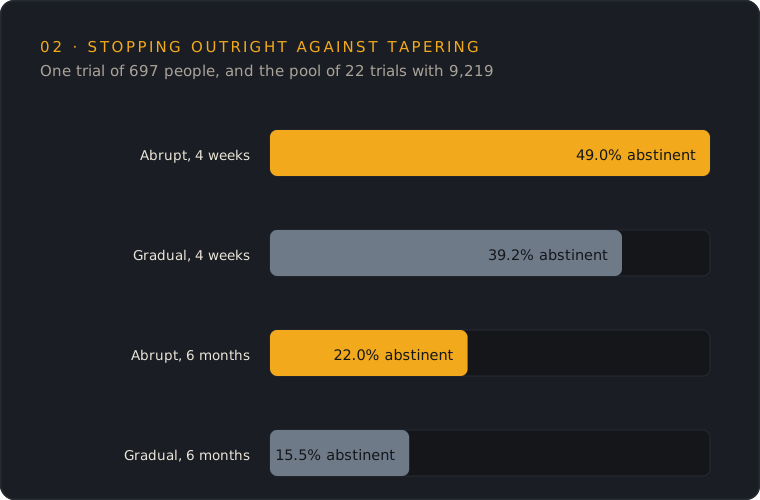
Set against that trial, the pooled answer. A Cochrane review identified 51 trials with 22,509 participants, and for the direct comparison of reduction-to-quit against abrupt quitting found «neither approach resulted in superior quit rates»: RR 1.01, 95% CI [0.87, 1.17], I-squared 29%, across 22 studies and 9,219 participants, at moderate certainty. Eighteen of the 51 trials were at high risk of bias, and restricting the analysis to the five at low risk or the 28 at unclear risk did not significantly change the result.
Honest scoreboard: a draw overall, with the biggest single trial leaning toward cold turkey, and nothing anywhere showing tapering ahead. Yet a famous clinic page recommends tapering «for most bad habits», citing nothing. The most-given advice on the internet about quitting is the one piece the evidence cannot back.
One archival note belongs here. An earlier Cochrane review on the same question was formally withdrawn in 2019 and superseded by the one above (Lindson-Hawley et al., 2019). Anyone finding the older version should know it carries that status.
Where people stop, and when
The shape of failure is measurable, and it explains why the words in the search box are the wrong ones. A systematic review of relapse curves among people quitting without treatment found that most relapse occurs in the first 8 days, and that 3 to 5% achieve prolonged abstinence for 6 to 12 months after a given attempt (Hughes et al., 2004).
The authors are unusually direct about the state of that evidence: the number of studies was too small and the data too heterogeneous for meta-analysis, and they close by asking for more reports of relapse curves. Eight curves from two studies and five control groups is what the field has on the most basic question anyone asks.
The far end of the curve was pooled separately. Across eight trials, the annual incidence of relapse after the first year of abstinence came to 10%, with a confidence interval from 5% to 17% that the authors call imprecise (Hughes et al., 2008).
Two conclusions fall out. «Permanently» is not a place you arrive; it is a curve that flattens and never quite touches zero, about one relapse per ten ex-quitters per year, even after a clean year. And since most failure is packed into days one through eight, the question that matters is not «which method is best» but «what exactly happens in the first week», which almost nobody has studied and no listicle discusses.
Why planning is weaker at subtraction
If-then plans get recommended in both directions (to start something and to stop something), and the same meta-analysis measured both. Across 23 studies of eating behaviour, implementation intentions produced d = 0.51 for adding a healthy item and d = 0.29 for reducing an unhealthy one (Adriaanse et al., 2011). The authors add that the adding figure may be inflated, because studies aiming to increase healthy eating tended to use weaker control conditions.
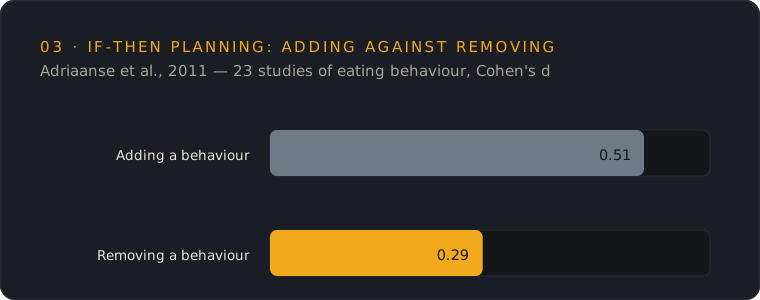
Laboratory work sharpens the limit. Four experiments used a task in which people must respond to still-valuable outcomes and suppress responses to outcomes that have lost their value. If-then instructions helped suppress the old response when the outcomes were abstract. When the outcomes were snack food, they gave no advantage over an ordinary intention (Verhoeven et al., 2018).
Put the lab and the meta-analysis together and the pattern is almost comic: if-then plans suppress old responses beautifully when the temptation is an abstraction, and lose their advantage the moment the temptation is an actual snack. It works best precisely where the difficulty is smallest, the opposite of the situation people reach for it in.
Sitting with the urge
The technique with the most cultural momentum is meeting the craving instead of acting on it. It comes in two research forms and both have been pooled.
Cue exposure, deliberate contact with the trigger until the response weakens, was meta-analysed across nine studies alongside a review of the animal extinction literature. The conclusion: «there is no consistent evidence for the efficacy of cue-exposure treatment as currently implemented», and the procedures that maximise extinction in animal work are rarely used in the clinical versions (Conklin & Tiffany, 2002). That is a criticism of implementation rather than of the principle, and it means the technique as delivered has not been shown to work.
The popular version is mindfulness-based, and it became famous through one trial: 88 participants, eight sessions over four weeks, 31% abstinence against 6% at week 17 (Brewer et al., 2011). A later systematic review pooled ten randomised trials of mindfulness meditation for smoking cessation and found no significant effects on abstinence or cigarettes per day against comparators. Only one of the ten was rated good quality with adequate power, and publication bias was detected (Maglione et al., 2017).
One charismatic trial versus a pooled null with publication bias behind it is one of the most familiar silhouettes in behavioural science, and it is why this row reads Refuted rather than Untested. The urge-surfing idea may yet be rescued by better trials. The version that was tested did not survive.
The one thing with a large, general base
Something on this topic does have broad evidence, and it is the least dramatic item on the list. Across 138 studies and 19,951 people randomly allocated to a progress-monitoring intervention or a control, monitoring raised goal attainment by d+ = 0.40, 95% CI [0.32, 0.48]. Effects were larger when the information was physically recorded or made public, and the change in monitoring frequency mediated the effect on attainment (Harkin et al., 2016).
That base is a hundred times wider than the habit-reversal literature and covers general behaviours rather than diagnoses. It is also a modest effect, and the review measures attainment of goals broadly rather than the removal of a habit specifically.
Why the old response comes back
The framework tying the relapse curve to the techniques is extinction learning. Stopping a response does not erase the association that produced it; it lays new learning over the top, which is why the old response returns in the original context and can reappear after time has passed (Bouton, 2014). The mechanism side of this is covered on the site in the piece on whether the brain deletes bad habits, and this page deliberately does not repeat it.
What the extinction framework changes is the meaning of a slip. Quitting never erases the old wiring; it drapes new learning over it, and the old response reappearing in the old kitchen is the system behaving exactly as documented, not a revelation about your character. That is a description, not a consolation, and it is also the best reframe in the whole literature.
Where this evidence ends
The gap at the centre of this page is worth naming plainly. The technique with the best evidence was measured on tic disorders and trichotillomania. The abrupt-versus-gradual comparison was measured on smoking. Cue exposure was measured in addiction treatment. If-then planning was measured on eating. Nobody has run a randomised trial of «replace the habit with another one» on ordinary everyday habits in a non-clinical sample, and the advice that fills the search results is an extrapolation across all four boundaries at once.
Population limits stack on top. The 697-person trial ran in English primary care with a mostly white sample. A substantial share of the tic evidence comes from children, and nothing here is addressed to anyone under eighteen. The relapse curves come from people quitting smoking without treatment, which is one behaviour with one pharmacology.
And one version of this question is not for a page at all. Stopping alcohol or certain prescribed medications abruptly can be physically dangerous, and that is a matter for a doctor rather than an article; no protocol appears here for any substance. Where the behaviour has a diagnosis attached (tics, hair pulling, skin picking, dependence), the techniques above exist as treatments delivered by clinicians, and the numbers on this page describe those treatments rather than instructing anyone. For the four different problems that hide under the phrase «habit problem», the habits hub sorts them; for the adding side rather than the subtracting side, the habit-stacking piece covers what has been measured; and for how long the forming side takes, the piece on habit formation time has the numbers. Verdict labels are defined on the method page.
The shift: from «how do I break it» to «which of these four things was measured on someone like me».
First: the replacement technique has real numbers and they come from clinics. SMD −0.43 in tic disorders and −1.22 in trichotillomania describe treatments for diagnoses, not a general method for everyday behaviour.
Second: tapering has never been shown to beat stopping outright. Twenty-two trials and 9,219 participants put the two level, and the largest single trial favours the abrupt arm.
Third: the first eight days carry most of the risk, which makes «permanently» a description of a curve rather than a target. The one component with a wide general base is recording what you do, at d = 0.40 across 138 studies.
The boring bottom line
Replacing a response works, at SMD −0.43 in 586 tic patients and −1.22 in 857 people with trichotillomania, and almost nobody has tested it outside a diagnosis. Tapering, the advice given most often, ties with stopping abruptly across 22 trials and 9,219 people, and loses to it in the largest single trial. If-then plans are weaker at removal than at addition and stop working when the reward is real. Sitting with the urge has no consistent evidence in the cue-exposure form and a pooled null with publication bias in the mindfulness form.
Most relapse happens in the first eight days, and after a year of abstinence about one person in ten relapses annually, with an interval running from five to seventeen. An eleven-item list of tips with one citation in it is not a summary of that; it is a substitute for having read it.
Sources
- Lindson, N., Klemperer, E., Hong, B., Ordonez-Mena, J. M., & Aveyard, P (2019). Smoking reduction interventions for smoking cessation. Cochrane Database of Systematic Reviews. Issue 9, CD013183. The largest pooled comparison of stopping suddenly against tapering, and it comes out level. doi:10.1002/14651858.CD013183.pub2
- Lindson-Hawley, N., Banting, M., West, R., Michie, S., Shinkins, B., & Aveyard, P (2016). Gradual versus abrupt smoking cessation: A randomized, controlled noninferiority trial. Annals of Internal Medicine. 164(9), 585-592. The single largest trial, and the one that disagrees with the pool by favouring the abrupt arm. doi:10.7326/M14-2805
- Yu, L., Li, Y., Zhang, J., Yan, C., Wen, F., Yan, J., Wang, F., Liu, J., & Cui, Y (2020). The therapeutic effect of habit reversal training for Tourette syndrome: A meta-analysis of randomized control trials. Expert Review of Neurotherapeutics. 20(11), 1189-1196. The size of the effect for replacing a response, in the population where replacing a response has been tested. doi:10.1080/14737175.2020.1826933
- Farhat, L. C., Olfson, E., Nasir, M., Levine, J. L. S., Li, F., Miguel, E. C., & Bloch, M. H (2020). Pharmacological and behavioral treatment for trichotillomania: An updated systematic review with meta-analysis. Depression and Anxiety. 37(8), 715-727. The strongest evidence that replacing a response does something, and it sits inside a diagnosis. doi:10.1002/da.23028
- Wilhelm, S., Peterson, A. L., Piacentini, J., Woods, D. W., Deckersbach, T., Sukhodolsky, D. G., et al (2012). Randomized trial of behavior therapy for adults with Tourette syndrome. Archives of General Psychiatry. 69(8), 795-803. The largest adult sample in this literature, and it is still a clinical sample. doi:10.1001/archgenpsychiatry.2011.1528
- Adriaanse, M. A., Vinkers, C. D. W., De Ridder, D. T. D., Hox, J. J., & De Wit, J. B. F (2011). Do implementation intentions help to eat a healthy diet? A systematic review and meta-analysis of the empirical evidence. Appetite. 56(1), 183-193. The asymmetry between adding and subtracting, in one paper, with the authors noting the adding number may be inflated. doi:10.1016/j.appet.2010.10.012
- Verhoeven, A. A. C., Kindt, M., Zomer, C. L., & de Wit, S (2018). An experimental investigation of breaking learnt habits with verbal implementation intentions. Acta Psychologica. 184, 124-136. The technique held up against abstract rewards and stopped holding up against food. doi:10.1016/j.actpsy.2017.05.008
- Conklin, C. A., & Tiffany, S. T (2002). Applying extinction research and theory to cue-exposure addiction treatments. Addiction. 97(2), 155-167. Why sitting with a craving until it passes is not the settled technique it sounds like. doi:10.1046/j.1360-0443.2002.00014.x
- Hughes, J. R., Keely, J., & Naud, S (2004). Shape of the relapse curve and long-term abstinence among untreated smokers. Addiction. 99(1), 29-38. The shape of the first week, and an honest statement that almost nobody has measured it. doi:10.1111/j.1360-0443.2004.00540.x
- Hughes, J. R., Peters, E. N., & Naud, S (2008). Relapse to smoking after 1 year of abstinence: A meta-analysis. Addictive Behaviors. 33(12), 1516-1520. The second half of the curve, reported with its own uncertainty attached. doi:10.1016/j.addbeh.2008.05.012
- Maglione, M. A., Maher, A. R., Ewing, B., Colaiaco, B., Newberry, S., Kandrack, R., et al (2017). Efficacy of mindfulness meditation for smoking cessation: A systematic review and meta-analysis. Addictive Behaviors. 69, 27-34. The pooled answer to the single trial that made this approach famous. doi:10.1016/j.addbeh.2017.01.022
- Brewer, J. A., Mallik, S., Babuscio, T. A., Nich, C., Johnson, H. E., Deleone, C. M., et al (2011). Mindfulness training for smoking cessation: Results from a randomized controlled trial. Drug and Alcohol Dependence. 119(1-2), 72-80. The trial behind the popular version of this technique. Cited as the object of examination, next to the pooled result that followed it. doi:10.1016/j.drugalcdep.2011.05.027
- Harkin, B., Webb, T. L., Chang, B. P. I., Prestwich, A., Conner, M., Kellar, I., Benn, Y., & Sheeran, P (2016). Does monitoring goal progress promote goal attainment? A meta-analysis of the experimental evidence. Psychological Bulletin. 142(2), 198-229. The one component in this article with a large, general evidence base, and its number is 0.40. doi:10.1037/bul0000025
- Azrin, N. H., & Nunn, R. G (1973). Habit-reversal: A method of eliminating nervous habits and tics. Behaviour Research and Therapy. 11(4), 619-628. Cited for the origin and construction of the technique, not as evidence of how well it works. doi:10.1016/0005-7967(73)90119-8
- Bouton, M. E (2014). Why behavior change is difficult to sustain. Preventive Medicine. 68, 29-36. The framework that makes relapse expected rather than a personal failure. doi:10.1016/j.ypmed.2014.06.010
- Lindson-Hawley, N., Aveyard, P., & Hughes, J. R (2019). WITHDRAWN: Reduction versus abrupt cessation in smokers who want to quit. Cochrane Database of Systematic Reviews. Cited so that anyone finding the older review knows its status. Cochrane records both, and one of them is marked withdrawn. doi:10.1002/14651858.CD008033.pub4