Why Learning, Planning, and Optimizing Can Quietly Replace Real Change
TL;DR
- You’re not lazy. The most informed generation in history is also the most paralyzed — because procrastination mutated, and now hides inside “useful” learning.
- Learning is an alibi. Fluent, beautifully packaged content sells the feeling of competence while removing the friction that builds it.
- Planning is a loan. Dopamine fires on the plan, not the finish line — so the brain collects the reward now and bills your future self.
- Optimizing is rejection. A borrowed goal never integrates; your paralysis is the psyche ejecting a foreign goal the way a body rejects a transplanted organ.
- The bill comes due. Expectations climb in a straight line while real progress flattens — and where the two curves cross, the Sisyphean Turning Point, is where burnout begins.
- The fix is subtraction. You don’t escape by consuming more about escaping; you escape by refusing the advance and letting the friction back in.
Introduction — The Exhaustion of Potential
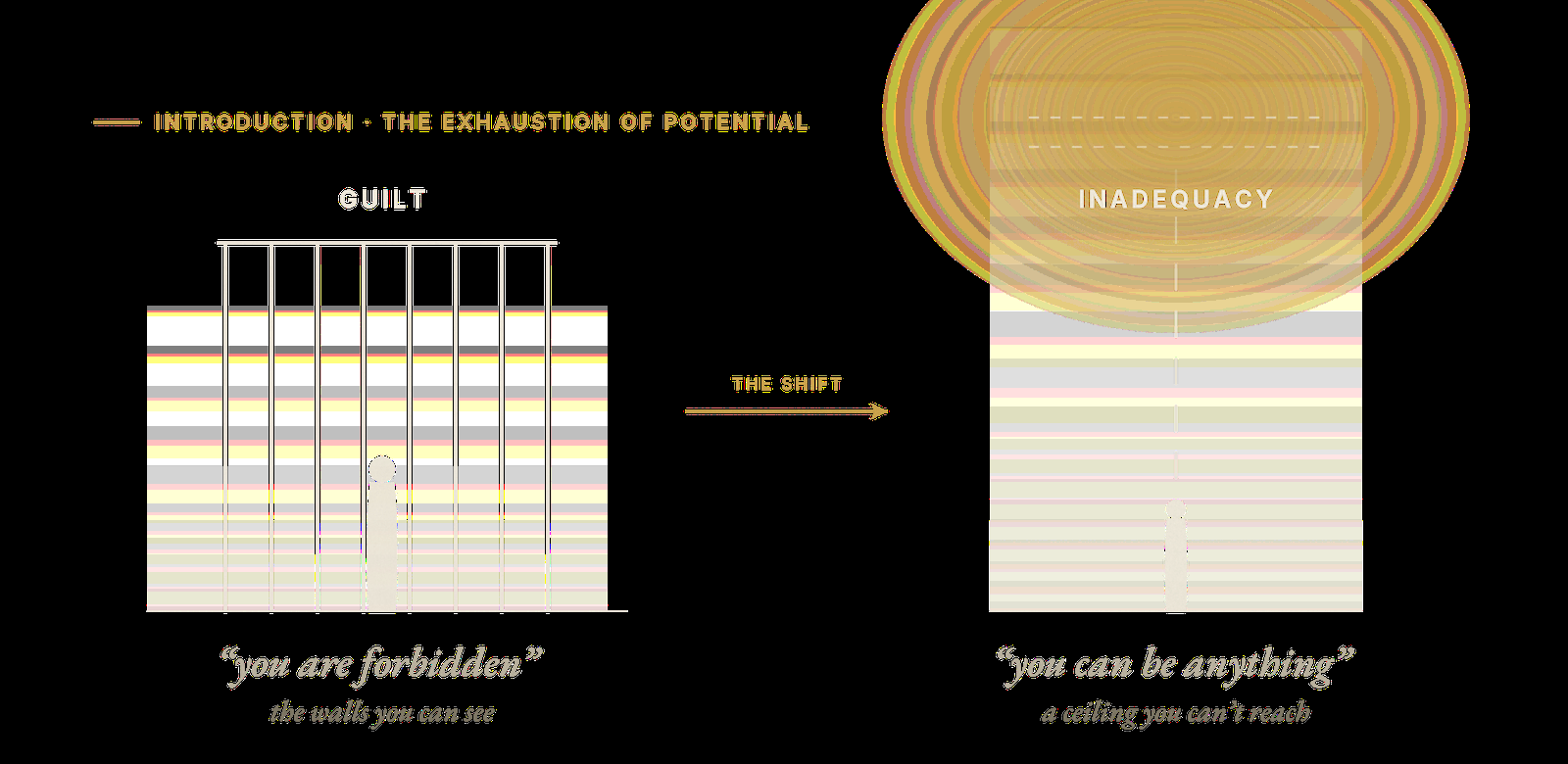
There is a specific kind of person who has read everything and changed nothing. You probably know him. You might be him. He has forty-three books on productivity, three abandoned journaling systems, a Notion workspace so elaborate it deserves its own postal code, and a browser with nineteen open tabs, each one a doorway to the better life he is absolutely, definitely, starting on Monday. He can explain dopamine to you. He can explain habit stacking, deep work, ultradian rhythms, and the precise neurochemical reason you shouldn’t check your phone in the first hour of the morning. He checks his phone in the first hour of the morning. For most of the last century, we had a tidy explanation for this man, and the explanation was an insult. We called him lazy. We said he lacked willpower, discipline, grit — that missing muscle everyone else apparently got at birth. It was a satisfying story because it required nothing further from us. Case closed. Suspect convicted. The suspect is innocent. The laziness theory has one fatal problem: it cannot explain why the most informed generation in human history is also, by nearly every measure of follow-through, the most paralyzed. Lazy people don’t spend four hours researching the optimal morning routine. Lazy people don’t take notes on a lecture about beating procrastination. The man with forty-three unread-in-practice books is drowning in a very particular kind of effort — the kind that feels like progress and produces none. Laziness does not explain it. To see what does, you have to understand the room the crime happens in. And the room changed shape about thirty years ago. The French sociologist Alain Ehrenberg noticed it first, in a book with a title that lands like a diagnosis: The Weariness of the Self. For most of history, he argued, human suffering ran on guilt — the tension between what you wanted and what you were forbidden to do. The rules were external. The prison had walls, and you could at least see them. Then the walls came down. Somewhere in the late twentieth century, “you are forbidden” became “you can be anything.” And that sounded like freedom. It wasn’t. Because if you can be anything, then whatever you are is now entirely your fault. The philosopher Byung-Chul Han finished the thought with surgical cruelty in The Burnout Society:
Excess work and performance escalate into auto-exploitation. This is more efficient than allo-exploitation, for the feeling of freedom attends it. The exploiter is simultaneously the exploited. Perpetrator and victim can no longer be distinguished.
This is the setting. Not a world too harsh to improve in, but a world that made improvement compulsory — an endless, unwinnable performance review with an audience of one. And where there is compulsory anxiety, there is a market. An entire industry, which the sociologists Edgar Cabanas and Eva Illouz named with a perfect sneer, Happycracy, arrived to sell the cure. Courses. Coaches. Apps. Frameworks. A frictionless supermarket of self-optimization, open twenty-four hours, always one purchase away from the person you’re supposed to be. Here is the elegant, cynical genius of that industry: it profits most when you never arrive. Its business model is the gap between who you are and who you could be, and it has no incentive to close it. It needs the wound to keep selling the bandage. All of which is true. All of which is a comforting place to stop. But blaming the industry is too easy, and too flattering. It casts you as a victim of clever marketing, when the real mechanism is far stranger and far more intimate. The self-help industry did not invent the trap. It just found a bug that was already running in your brain — a bug that hands out the emotional reward for change before the change has happened, and then deletes the motivation to follow through. Learning. Planning. Optimizing. Three habits that feel like the engine of transformation. Three habits that are, under the hood, three different ways of draining the same account. The first one is the one that feels most like virtue. It’s the one you’re doing right now.
Part I — Learning: The Fluency Trap
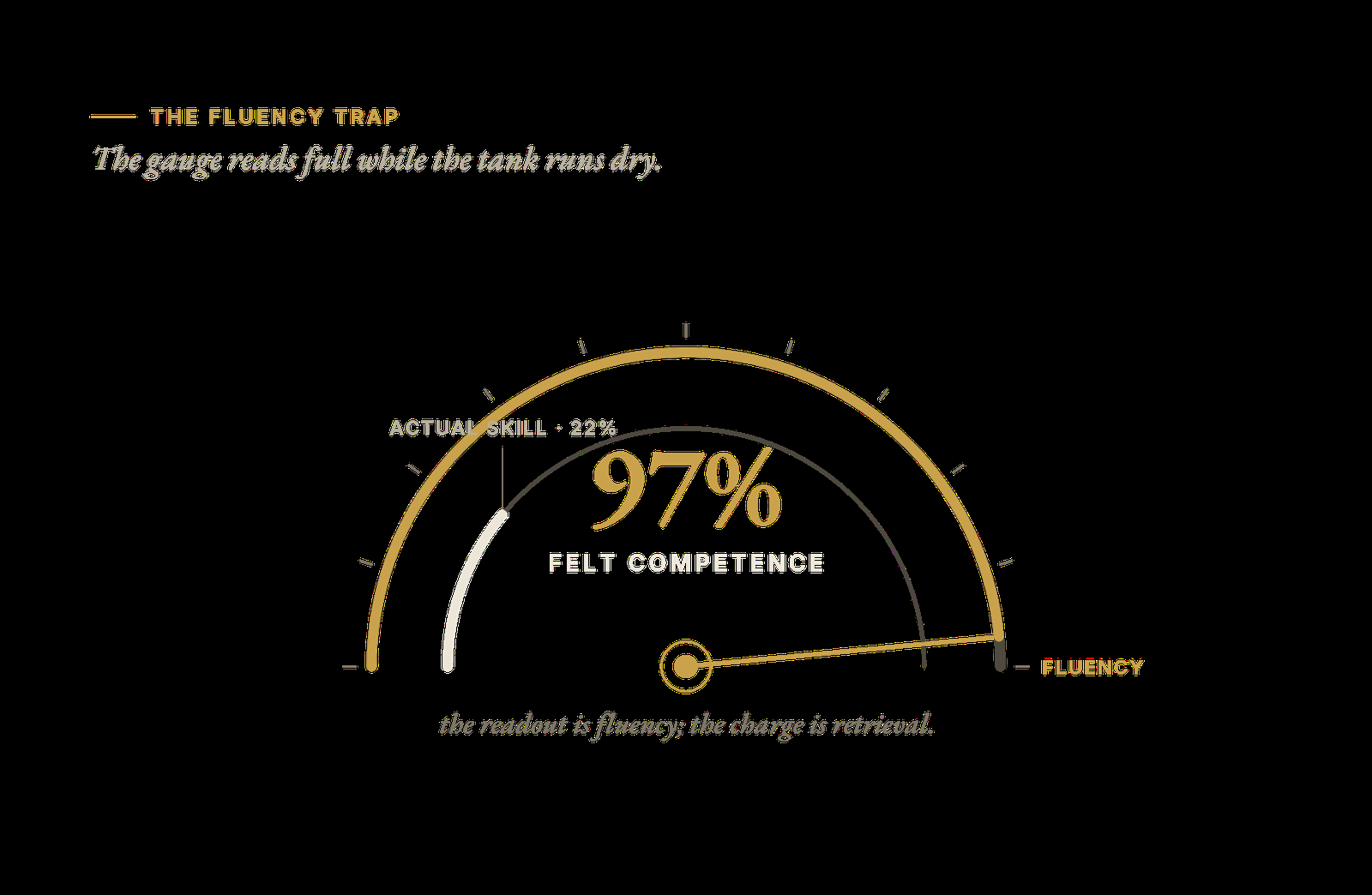
Let’s start with a confession about this very article. Right now, reading this, you feel something pleasant happening. The sentences are landing. The ideas connect. There’s a small, warm click of yes, exactly, I’ve felt that every few paragraphs. It feels like understanding. It feels like you’re getting somewhere. That feeling is the trap. And I say that fully aware I’m the one manufacturing it. Here is the uncomfortable thing cognitive scientists have known for decades and the entire content economy is financially motivated to hide from you: the ease with which you absorb an idea has almost nothing to do with whether you’ll retain it, and often runs in the opposite direction. Psychologists call the pleasant slippery feeling processing fluency — the sense of smooth, effortless comprehension. Your brain, being a lazy and overconfident narrator, reads that smoothness and draws a catastrophic conclusion: I process this easily, therefore I know this. You don’t know it. You’ve recognized it. Those are different things, and the distance between them is the distance between reading about swimming and swimming. Recognition is what happens when a well-designed sentence walks up to a concept you already half-hold and lights it up. It’s real, and it’s worthless as a predictor of skill, because the moment you have to produce the idea instead of merely nodding at it, the lights go out. The researchers Robert and Elizabeth Bjork spent a career mapping this, and their finding is almost offensive in its bluntness. Real learning requires what they named desirable difficulties — the effortful, slightly painful work of retrieving information from a cold memory, making mistakes, struggling against the material. The struggle isn’t a bug in learning. The struggle is the learning. Everything that removes the struggle (the perfect summary, the beautifully edited video, the tidy listicle) removes the mechanism by which knowledge gets built into you. Which brings us to the most damning finding of all, and the one that should terrify every charismatic person on YouTube. It’s called the fluent instructor illusion. In controlled studies, researchers had students learn material from two kinds of teachers. One was fluent: confident, polished, warm, moving through the content without a stumble, holding eye contact, radiating expertise. The other was halting, monotone, reading off a page. Afterward, students who watched the fluent instructor rated their own learning far higher. They felt they’d absorbed it. They felt smart. Then everyone took the actual test. The fluent instructor’s students performed no better than the students who suffered through the boring one — in both experiments, the difference in how much was learned was not significant. The charisma didn’t transfer knowledge. It transferred the feeling of knowledge, which is a very different product, and, not coincidentally, a far more sellable one.
The better the teacher makes you feel, the less you are probably learning. Comfort and comprehension are not the same signal. Your brain can’t tell them apart.
Sit with what that means for the world you live in. Every incentive in the modern attention economy pushes content toward maximum fluency. The creator who explains deep work with perfect lighting and a soothing voice and zero friction will always beat the one who makes you do the hard, ugly work of thinking. The market doesn’t reward teachers who change behavior. It rewards teachers who feel like they change behavior, because that feeling is what gets the like, the save, the subscribe, the sale. The education researcher Jason Lodge found a sharp modern version of this while studying students who use AI to write. Their short-term output improves (cleaner essays, faster results) while their actual capacity to learn degrades, because the tool does the effortful thinking they were supposed to do themselves. He called it a performance paradox, and it maps almost perfectly onto your relationship with self-help content. The polished summary does your struggling for you. You get the clean output (a head full of frameworks) and lose the very process that would have turned any of them into a skill. So this is the first drain on the account. Every time you consume a beautifully packaged idea about how to live, you feel yourself getting wiser. You are, in fact, getting the sensation of wisdom on credit — the feeling of competence, delivered instantly, with the actual competence permanently deferred. The content soothes the itch that would have sent you off to learn the thing for real. There’s a reason this particular avoidance is almost impossible to catch yourself committing. Old-fashioned procrastination (the game, the show, the scroll) came with a built-in alarm: guilt. You knew you were hiding. But hiding inside learning trips no alarm at all. No one has ever felt ashamed for reading a personal-development classic instead of doing the terrifying thing the book is about. Psychologists have a name for this upgraded, guilt-proof evasion — epistemic procrastivity: procrastination that wears the uniform of self-education. It is the perfect alibi. You cannot accuse yourself of avoidance while you are demonstrably working on yourself. So the one task that frightens you (the one with real stakes attached) sits untouched behind a tasteful wall of productive-looking study. What you found was a version of avoidance with a better résumé. That would be enough of a problem on its own, and absorbing the idea is only step one. Something even stranger happens the moment you decide to act on it — the moment you make a plan. Because your brain, watching you write “wake up at 6 and meditate” into a fresh new app, does something bizarre. It pays you. It hands you a wave of satisfaction, a real chemical reward, as if the meditating were already done. And nobody ever taught you to ask the obvious question: Where is that reward coming from — and what is it costing you?
Part II — Planning: Cognitive Embezzlement
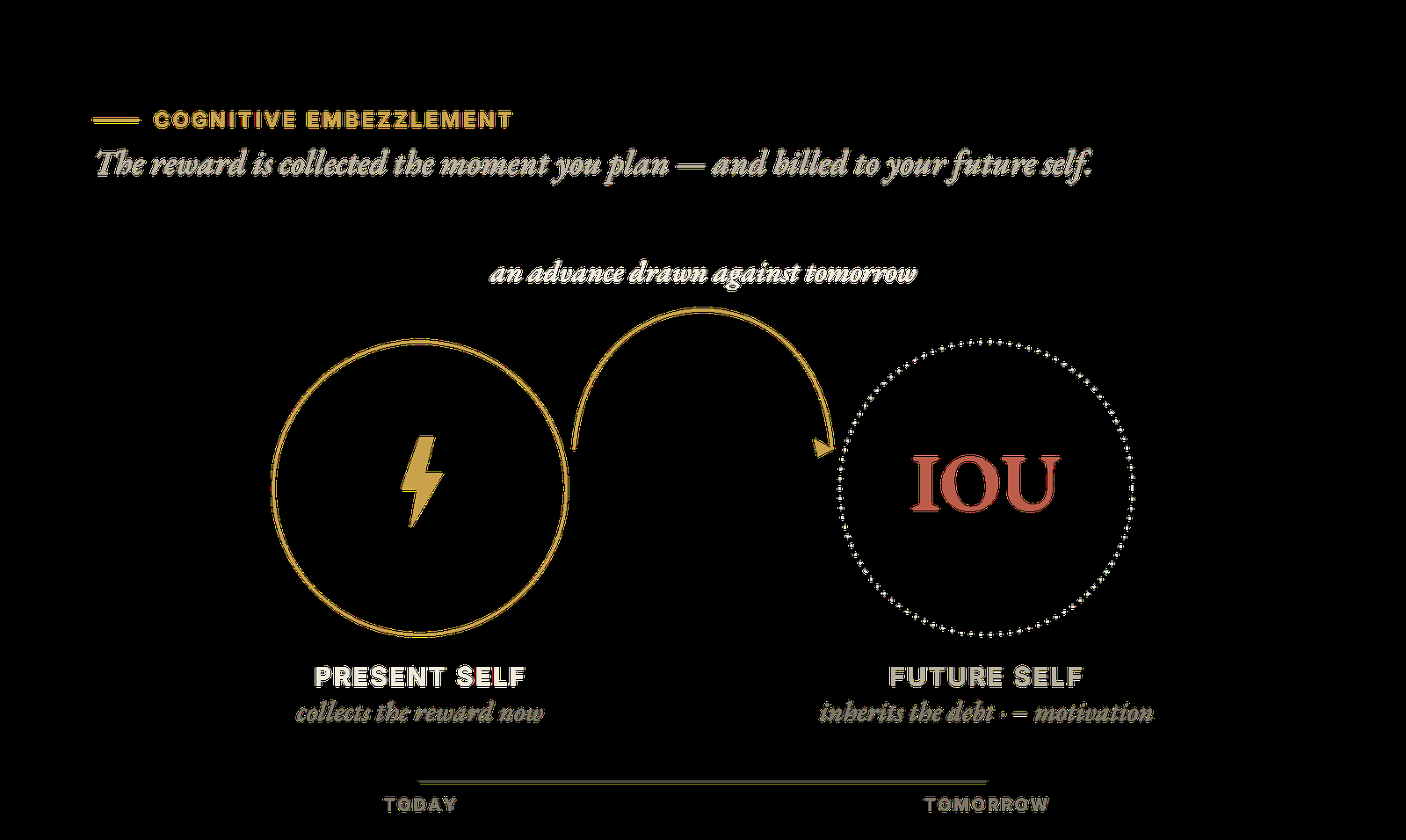
Everyone has felt it, so let’s name it precisely. You’ve had a heavy, formless week. Then one evening you sit down and plan. You build the schedule. You break the project into clean, satisfying subtasks. You lay out tomorrow like a general laying out a campaign. And you stand up from that desk feeling accomplished and lighter, as if you did something today. You wrote a list. The feeling was real, though, and the feeling is the problem, so we need to understand where it came from. To do that, we have to correct the single most widespread misconception about the chemical everyone loves to name-drop. Dopamine has more to do with prediction than with pleasure. For decades the popular story got this backwards. We pictured dopamine as the little reward pellet the brain drops when something good happens — the hit of joy at the finish line. Then neuroscientists watched the neurons themselves fire, and the timing was all wrong. Once a reward became predictable, the dopamine neurons fired before it — at the cue, the anticipation, the moment the brain first predicted that something good was coming. Researchers formalized this as reward prediction error: dopamine neurons fire hardest not when you get the thing, but when you first glimpse the path to it. Read that again with your to-do list in mind. Your brain runs its biggest surge of reward chemistry at the moment it predicts success — which is to say, at the moment you make the plan. Not when you finish the run. When you buy the shoes. Not when you write the book. When you name the document. The anticipation itself is the payday. Evolution built this for a good reason: it kept our ancestors moving toward the berry bush before they’d tasted a single berry. But it has a catastrophic side effect in a world where you can simulate the path to the berry bush endlessly, in high definition, without ever standing up. It gets worse, because the trigger is even cheaper than you think. The neuroscientists Ethan Bromberg-Martin and Okihide Hikosaka showed that the brain treats information itself as a primary reward — processed in the same deep circuitry, the ventral tegmental area and the substantia nigra, that handles food, water, and money. In their experiments, monkeys reliably chose the cue that told them the size of a coming reward over one that told them nothing — even though the choice changed nothing about how much water they got. Later work went further: offered a gamble, monkeys gave up real water just to see the outcome in advance. They paid, in juice, to know sooner. You do the same thing. Every time you find the perfect new productivity system, the ideal framework, the technique that will finally fix everything, your brain fires the reward for finding a solution — a solution you have not implemented and may never implement. The discovery is the hit. Now stack the two facts together and the mechanism snaps into focus. Planning triggers anticipatory reward. Information triggers primary reward. So the act of researching, listing, scheduling, and organizing your future delivers a genuine neurochemical payment for a change that hasn’t happened. And here is the poison in it: that payment satisfies the very hunger that was supposed to drive the action. The tension between where you are and where you want to be (the discomfort that was going to make you move) gets discharged. Quietly. Chemically. You feel like you’ve begun. So the engine idles. This deserves a name, because naming it is the only way to catch yourself doing it.
Call it cognitive embezzlement: the brain steals the emotion of victory from your future self and spends it now, on a plan. You draw down the reward for a finish line you never crossed — and your future self inherits the debt: a goal now stripped of its motivational charge.
If this were only about brain chemistry, it would be dangerous enough. But there’s a second machine running alongside it, this one social, and it’s the reason planning out loud is even more paralyzing than planning in private. In the early 1980s, the psychologists Robert Wicklund and Peter Gollwitzer described something they called symbolic self-completion. People who are reaching for an identity they don’t yet fully own (“entrepreneur,” “writer,” “athlete,” “the kind of person who has their life together”) feel the gap as tension, and they reach for symbols to close it. A credential. A piece of gear. A public announcement. A beautifully organized system. And the strange finding was this: once you accumulate enough symbols of an identity, especially in front of other people, your brain files the identity as partly achieved — and the drive to earn it drops. This is why telling everyone about your plan feels so good and works so badly. The like, the encouraging comment, the impressed nod — these are social confirmations of the identity, and they pay out the same currency as real progress, at a fraction of the cost. The louder you declare the intention, the more completely the tension is discharged, and the less likely you are to do the private, invisible, unglamorous work.
The more convincingly you perform the identity, the less you need to become it. Announcement is not preparation for action. Announcement is a substitute for it.
The Germans, who have a word for everything unbearable, have one for the whole sad economy of it: Ersatzbefriedigung — substitute satisfaction. The feeling of the thing, sourced from something that is not the thing. You wanted to be a person who wrote. You bought the notebook, told two friends, and read three articles about writing routines. Your nervous system, unable to distinguish the symbols of the goal from the goal, marked the box. Satisfied. Filed. So now the account has two withdrawals against it. Learning spent your competence. Planning spent your motivation. And in both cases you felt richer at the exact moment you were going broke. You might think the natural defense is discipline — to stop consuming, stop merely planning, and build a real system. Tighten the screws. Track everything. Optimize. This is the third habit, and it’s the most seductive of all, because it doesn’t feel like avoidance. It feels like rigor. It feels like the opposite of the problem. It is the problem wearing the problem’s uniform. And it doesn’t just drain the account. It turns your own will against you.
Part III — Optimizing: The Immune Rejection
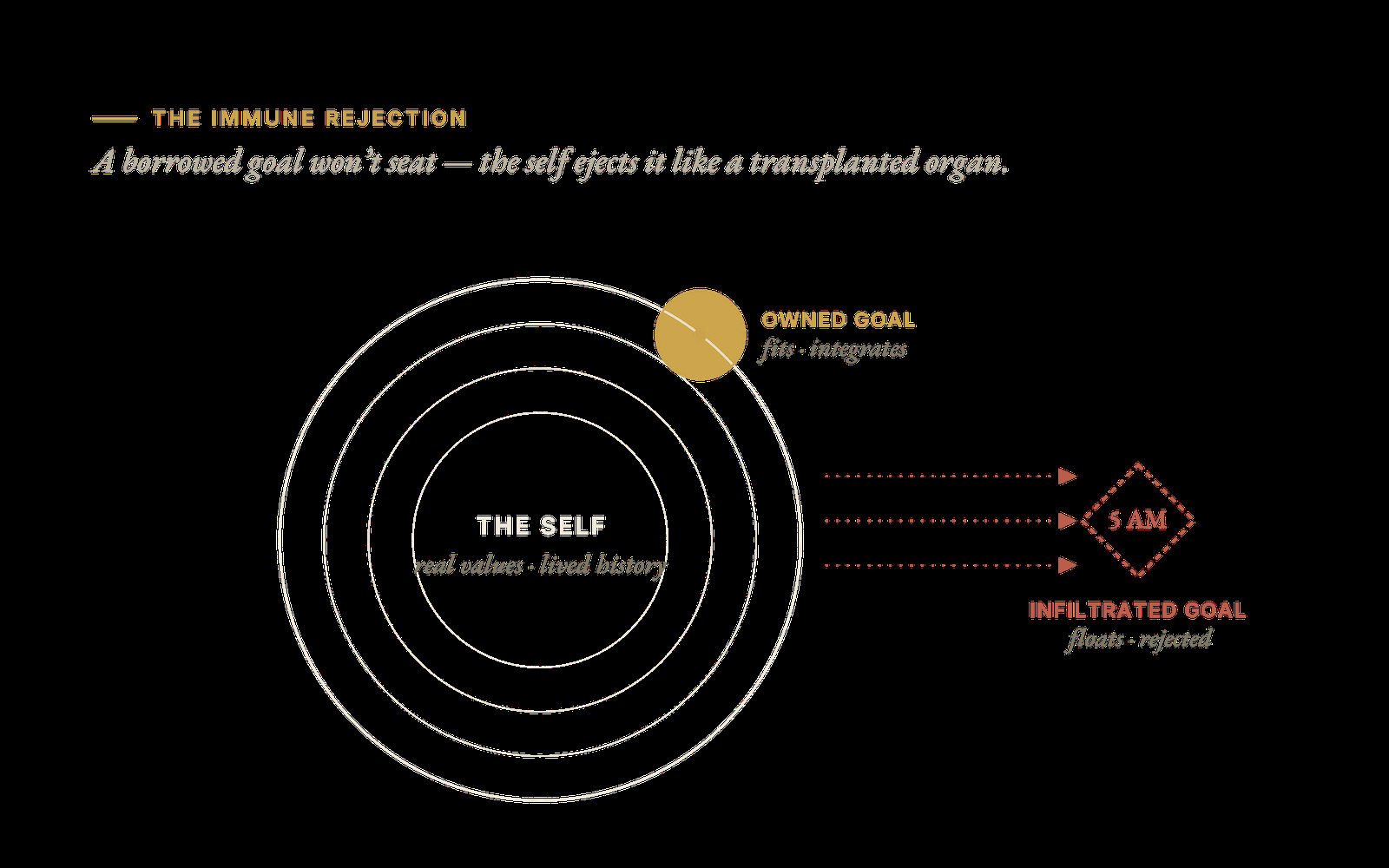
Here is where most people mount their defense. By now you’ve felt the sting of the last two sections. Fine (you say) I consume too much, I plan too much, I get high on the anticipation. So I’ll stop being sloppy about it. I’ll build a real system. I’ll track my habits, measure my inputs, install the framework, and hold myself accountable to the numbers. This feels like the cure. It is the disease’s most sophisticated form. Because unlike scrolling or fantasizing, optimizing doesn’t feel like avoidance. It feels like rigor. It has the texture of discipline — spreadsheets, streaks, dashboards, the satisfying click of a habit checked off. You cannot accuse yourself of laziness while you are meticulously engineering your own excellence. That’s exactly what makes it the perfect hiding place. The most dangerous procrastination is the kind that looks identical to hard work. But there’s a deeper problem, and it comes from a corner of psychology most self-help has never heard of. The German psychologist Julius Kuhl spent decades building something called PSI theory — a model of how intention converts into action inside a human being. And he identified a specific failure mode with a chilling name: self-infiltration (Selbstinfiltration). It works like this. Under pressure, or stress, or the ambient anxiety of the achievement society, a person absorbs an external goal (a should, an ideal, a borrowed picture of the good life) and mislabels it as their own. The 5 a.m. wakeup. The cold plunge. The reading list. The someone-else’s morning routine. The goal gets in. But it doesn’t integrate. Kuhl’s insight is that a owned goal is wired into what he called your extension memory — the vast, quiet network of your real values, history, and felt sense of who you are. An infiltrated goal floats on top of that network, disconnected, foreign. And your psyche (this is the part that should stop you cold) can tell. It knows the difference between a goal that grew out of you and a goal that was installed on you. It just can’t always tell you in words. So it tells you in paralysis. When you sit down to execute an infiltrated goal, Kuhl’s model predicts you’ll drop out of what he calls action orientation (Handlungsorientierung) (the mode of just moving) and into state orientation (Lageorientierung): the mode of endless internal churning. Rumination. Re-planning. Re-reading your notes. Reorganizing the system. Analyzing why you’re stuck instead of getting unstuck. You know this state intimately. It’s the fourth hour of “getting ready to start.” It’s the will, spinning in place, generating heat and no motion. And now the reframe that turns this entire genre on its head:
Your procrastination may not be a defect in your character. It may be an immune response. The psyche rejecting an infiltrated goal the way a body rejects a transplanted organ — not because the organ is bad, but because it isn’t yours.
Read that against every guru who has ever told you the problem is your discipline. If Kuhl is right, then a huge share of what you’ve been calling failure is a healthy system protecting itself. The paralysis may be closer to integrity than to weakness. You couldn’t stick to the perfect optimized routine not because you’re broken, but because, at a level below language, you never agreed to it. Someone with better lighting and a book deal agreed to it, and you downloaded their conclusion. Which is exactly why more optimization makes it worse. Every tracker you add, every metric you install, every borrowed system you adopt, tightens the grip of the foreign goal and deepens the rejection. And there’s a final twist in the machinery, discovered long before any of this, by Edward Deci in 1971 and by Mark Lepper, David Greene and Richard Nisbett two years later. They found that when you attach an external reward to an activity people already did for its own sake, the intrinsic motivation erodes. Not dramatically (the effect is small to moderate) but reliably, across more than a hundred experiments. They called it the overjustification effect. The moment the behavior is being tracked, scored, and rewarded, your brain reassigns the reason for doing it — from I do this because it’s mine to I do this because the system says so. The locus of control migrates outward, into the app, and the activity dies a little. So the tracker meant to enforce your discipline slowly eats the only thing that could have sustained it. This is the quiet tragedy of the Quantified Self: measure your sleep, your steps, your focus, your mood, and you don’t get mastery — you get a low-grade digital hypochondria and a widening gap between the numbers and any actual sense of how you’re doing. You optimize your way out of contact with your own needs. Learning spent your competence. Planning spent your motivation. Optimizing spent your agency — the raw sense that the goal was ever yours to pursue. Three habits. Three withdrawals. Three different reasons the account keeps draining. Except (and this is the moment the case cracks open) they were never three separate crimes. Step back far enough and the three mechanisms lock together into a single sequence, each one feeding the next, running on a loop, every single day. It has an order. It has a logic. It even, disturbingly, has a shape you can graph. And that graph ends at a specific point — a point where the whole system doesn’t just stall, but collapses into something that looks exactly like clinical burnout. Let’s draw it.
Part IV — The Reckoning: The Progress Credit Model
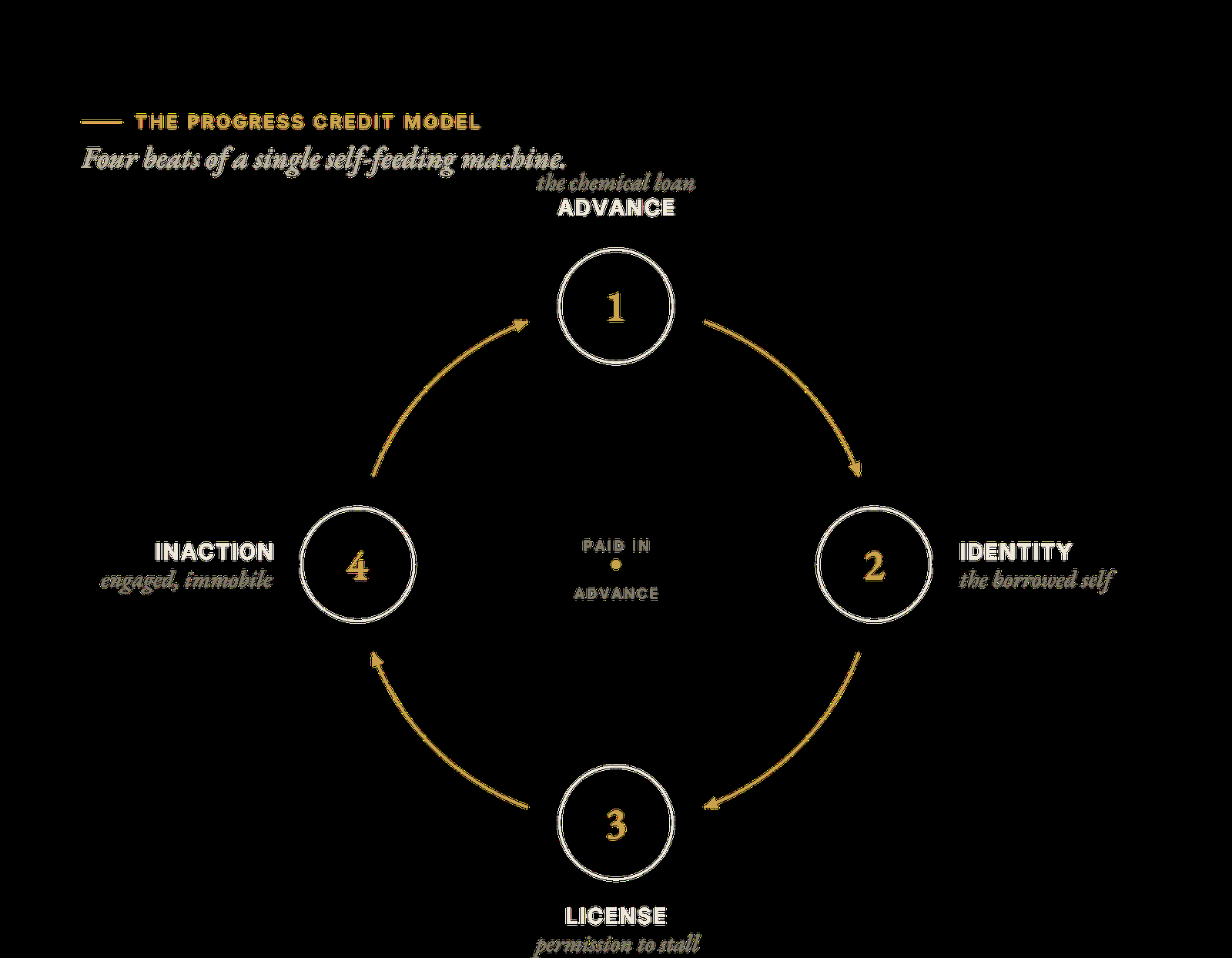
Line up the three habits and something clicks into place. They aren’t three separate failures. They’re four beats of a single, self-perpetuating machine — one the psychologist Peter Gollwitzer and the neuroscience of reward can be assembled into a model with an almost unfair explanatory neatness. Call it the Progress Credit Model, because that’s exactly what it runs on: credit, drawn against a self that hasn’t done the work yet. Here is the full sequence. Beat one: the advance. You engage with the goal — read, plan, research, set up the system. Your dopamine system, firing on prediction rather than achievement, pays out an anticipatory reward. You feel the lift of beginning before anything has begun. (This is Part II’s cognitive embezzlement, now revealed as merely the opening move.) Beat two: the identity. The symbols accumulate — the app, the announcement, the reading list, the aesthetic of the person you’re becoming. Symbolic self-completion files the identity as partly earned. The tension that was supposed to fuel you dissipates into the warm bath of feeling like the kind of person who does this. Beat three: the license. And now the piece I’ve held back until now, because it’s the hinge the whole trap swings on — moral licensing. The behavioral economists found it in a hundred small, humiliating studies. Give people a reason to feel they’ve been good, and they promptly grant themselves permission to be bad. The most quoted example is almost too perfect: people who took what they believed was a vitamin (a placebo, nothing in it) were afterward more likely to smoke, to skip exercise, to choose the junk food. Why? Because they’d already “taken care of” their health. The good deed, even an imaginary one, buys a license for the indulgence that undoes it. Now apply that to a two-hour podcast about focus.
You listen to an expert explain deep work, and your brain stamps the receipt: I have done something for my future today. That receipt is a license. And the thing it licenses is the exact behavior you were trying to escape — the scrolling, the delay, the not-doing. You didn’t just fail to start. You purchased the right not to.
This is why the productivity content makes the productivity worse, not better. It isn’t neutral. Every hour of consumption issues a fresh moral license for another hour of avoidance. The more virtuously you prepare, the more permission you accrue to never begin. Beat four: motivated inaction. Add up the three payments (the chemical advance, the borrowed identity, the moral license) and you arrive at a state psychology has a wonderfully paradoxical name for. Not laziness. Not apathy. Motivated inaction: a condition of intense engagement and total immobility running at the same time. You are working extremely hard at your goal. You are also not moving an inch toward it. The intention-behavior gap (the well-documented chasm between what people sincerely intend and what they do) isn’t a gap you fall into by accident. In this model, it’s a gap the system manufactures, on purpose, because the loop is more rewarding than the finish line and infinitely cheaper. So the machine runs. Advance, identity, license, inaction. Advance, identity, license, inaction. Every cycle feels like progress. Every cycle spends a little more of a fund you keep forgetting is finite. And this is where the model stops being a clever description and becomes a frightening prediction. Because there’s a fifth beat. It doesn’t happen daily. It happens once, quietly, somewhere down the line — and when it does, it doesn’t feel like a bad day. It feels like the lights going out. Picture two curves on the same graph.
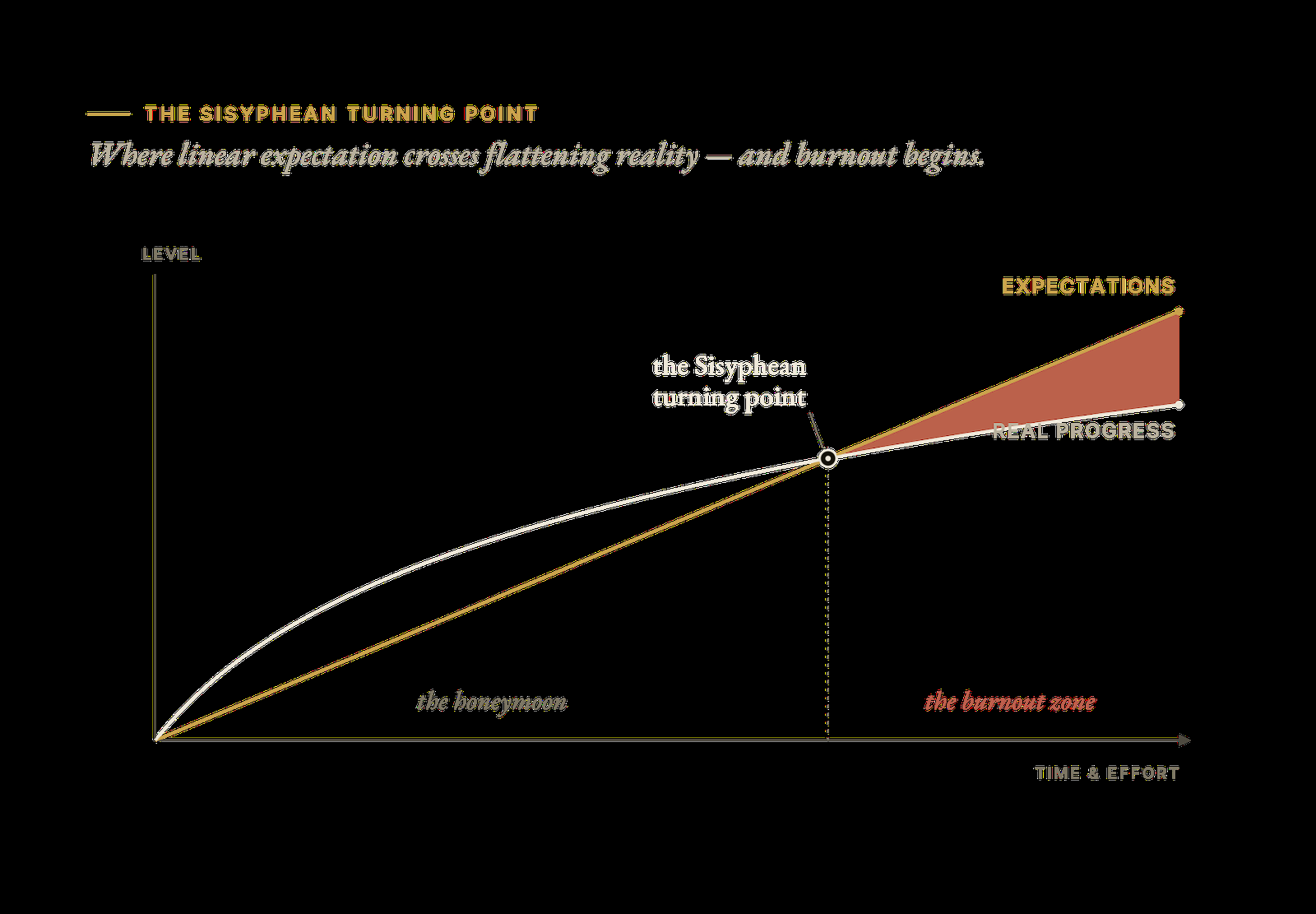
The first curve is your real progress — actual skill, actual change. And real skill, in almost any domain, grows with diminishing returns. Fast at the start, when everything is new and every week brings a visible leap. Then slower. Then agonizingly slow, each further gain demanding far more effort than the last. The curve rises steeply and then bends toward flat. This is not pessimism; it’s the shape practice curves take in study after study — a power law when you average across people, an exponential when you follow a single learner. The second curve is your expectations — your sense of where you should be by now. And expectations don’t obey diminishing returns. Fed a steady diet of cheap progress credit (every plan, every course, every symbol paying out that little advance) they grow in a straight line. Or worse. They climb and climb, undisciplined by the diminishing returns that constrain reality. For a while, at the start, real progress runs above expectations. This is the honeymoon. You’re improving faster than you thought you would; every dopamine hit is a pleasant surprise. Positive prediction error. It feels amazing. It’s why the first two weeks of any new system are euphoric. But the two curves are on a collision course, because one is bending flat and the other is going straight. And somewhere (the model calls it the Sisyphean Turning Point) they cross. After that point, everything inverts. Now expectations sit permanently above reality. Every day, your brain compares where you are to where the progress credit told you you’d be, and every day reality comes up short. In the language of the reward system, this is chronic negative prediction error — expected reward exceeding actual reward, over and over, indefinitely. In the laboratory, when an expected reward fails to arrive, dopamine neurons briefly fire below their baseline rate. Whether a long run of such shortfalls in everyday life adds up to burnout is a hypothesis, not a finding; this essay offers it as a model. Here is the uncomfortable part of that model:
You can reach the Sisyphean Turning Point while your real skills are still rising. The curve is still going up. You are, objectively, better than you were. But because expectations outran reality long ago, your nervous system reads the same climb as failure — and burns you out at the exact moment you were, in truth, succeeding.
This is why so many capable, improving, hardworking people hit a wall that makes no sense from the outside. They were being taxed, daily, on progress they had already spent in advance. The behavioral scientists have a drier way of describing the wreckage, and it’s worth having, because it turns the whole thing into a checklist you can use. There’s a model called COM-B, which says any real behavior requires three things at once: Capability (you can do it), Opportunity (conditions and time allow it), and Motivation (you want to). Watch what the loop does to all three. Capability: hollowed out by the fluency illusion. You feel competent; you never built the skill. Motivation: pre-spent by anticipatory reward and discharged by symbolic completion. The tank reads full and is empty. Opportunity: consumed by the hours of scrolling and the cyber-fatigue (the drained, over-stimulated depletion) that the consumption itself produces, leaving no time and no energy for the doing. The self-improvement loop doesn’t strengthen the three pillars of action. It demolishes all three while convincing you it’s reinforcing them. That’s the entire paradox, stated in a single line: the machine that promises to make you capable, motivated, and free to act is the same machine dismantling your capability, your motivation, and your opportunity — one satisfying, well-designed, beautifully fluent session at a time. Put together, the pattern looks less like laziness and more like a reward system doing what it evolved to do, in an environment engineered to exploit it, sold back to you as the solution. Which leaves the practical question. How do you break a loop — without turning the escape itself into just one more thing you learn about, plan for, and optimize? Because that trap is standing right here, waiting. And it’s the last one.
Reclaiming Action Friction
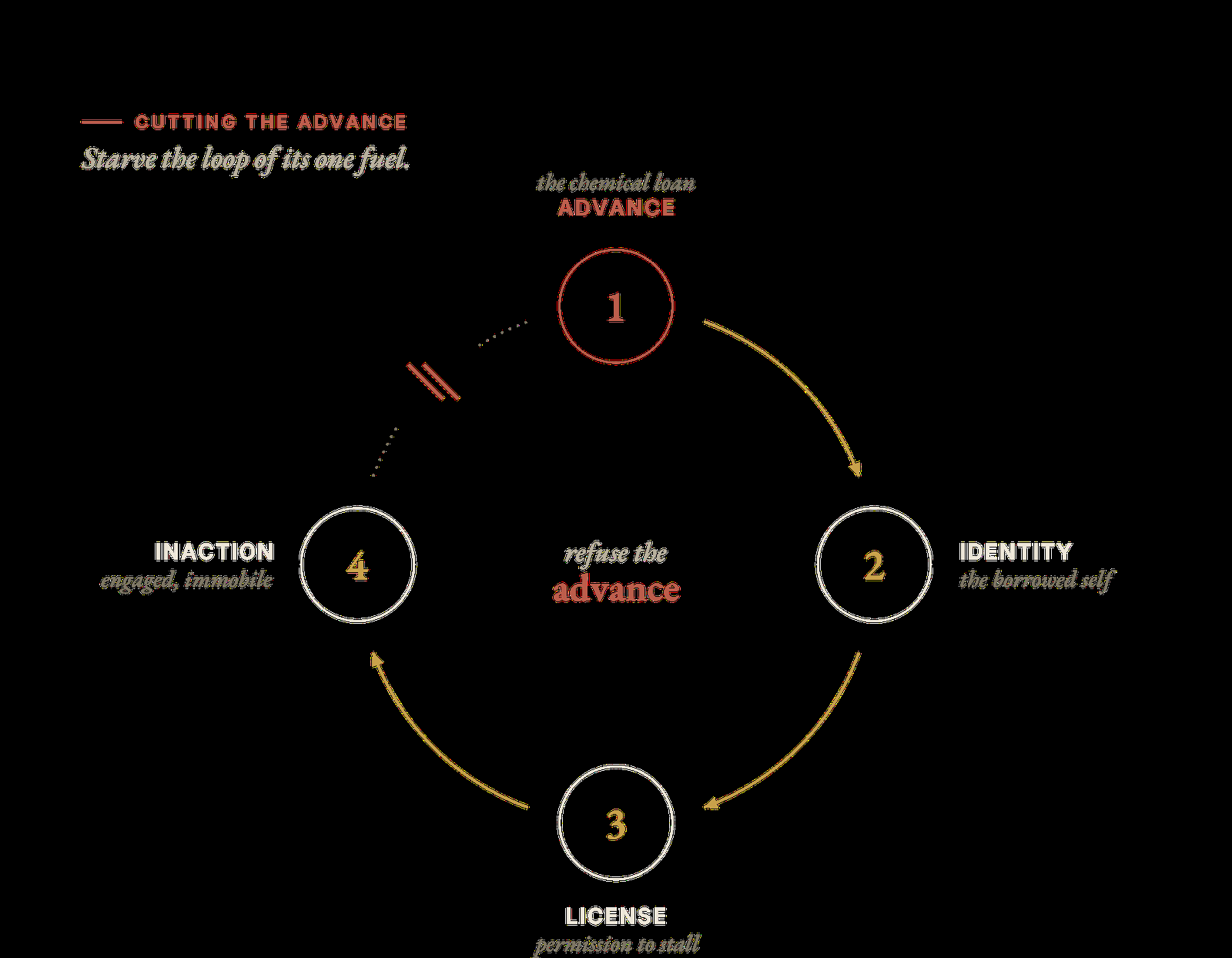
The trap in fixing this is that the fix is itself catnip for the machine. Tell someone their problem is too much consuming, planning, and optimizing, and their very next move (reliably, predictably) is to go consume an article about it, plan a new anti-consumption system, and optimize their content diet with a tracker. The disease metabolizes its own cure. So forget “consume less.” That framing is bait. The only fixes that work are the ones that attack the machine’s power source directly: its ability to pay you in advance. Take away the advance, and the loop has nothing to run on. Here are four ways to cut the wire — not habits to adopt, but withdrawals to refuse. One: never let preparation onto the ledger. The machine survives because reading, planning, and organizing all get logged, in your mind, as progress. So keep two separate books. In the only book that counts, the entry for “watched a course,” “made a plan,” “researched the tools” is exactly zero. Not a small amount. Zero. The only entries that post are shipped, external, irreversible outputs — the words written, the rep done, the call made, the thing that now exists in the world and can’t be un-existed.
Preparation is not a small down payment on the goal. On the ledger that matters, it is not a payment at all. If it didn’t leave your head and touch reality, it never happened.
This feels unfair the first week. It feels unfair because the machine has spent years training you to accept its counterfeit currency. You’re not being harsh. You’re refusing to be paid in a fake one.
In practice — end each day by writing down only what physically left you and touched the world: the sent email, the shipped page, the completed rep. If that line is blank, the day scores zero — no matter how many hours of reading or planning sit behind it.
Two: starve the announcement. Symbolic self-completion runs on the audience — the like, the “oh that’s a great idea,” the impressed nod that pays out the identity before you’ve earned it. So move the announcement to after. Do the work in silence, and let the world find out only once there’s a result to find. Not because privacy is virtuous, but for a colder reason: the tension of an unwitnessed, undeclared intention is the only fuel that reliably converts to action. Every person you tell is a small withdrawal from that fuel.
In practice — put a 21-day gag order on every new goal. Tell no one, post nothing, add it to no public tracker. Let the intention stay uncomfortably unwitnessed until there is a result that can announce itself.
Tell no one what you’re about to do. Show everyone what you’ve done. The gap between those two sentences is where all the real work lives.
Three: pay for every input with an output. The fluency illusion is defeated by exactly one thing — retrieval. So install a tax on consumption: you may not take in a new idea until you’ve produced something with the last one. Read a chapter, then close the book and write, from cold memory, the one thing that changes what you’ll do tomorrow — before you’re allowed the next chapter. It will be slower. It will be less pleasant. It will feel like going backward. Good. That specific discomfort is the sensation of an idea being wired in rather than skated over. If the learning feels smooth, you’re not learning. You’re being entertained by the shape of learning.
In practice — run the blank-sheet test. The moment a lecture ends, close the tab, take an empty page, and reconstruct the key steps from cold memory. The humiliating blanks you discover are the exact places where no learning had happened yet — and where it now can.
Four: freeze the system while the work is live. Optimizing is the machine’s most convincing disguise, so give it no room to operate during execution. Choose your tool once (any decent one, chosen in ten minutes, permanently) and then declare the system closed. No re-tooling, no reorganizing, no “let me just find a better app” while the actual task is open in the next window. And during the work itself, cut the lookup reflex: no mid-task research, no “quick” search that becomes forty minutes of frictionless drift. Let yourself be stuck. Let yourself do it slightly wrong. The friction of proceeding without perfect information is the work — the exact rep your capability was starving for.
In practice — choose your tool in ten minutes, once, and never again mid-task. Keep a scrap of paper beside you and park every urge to look something up on it; you may consult the list only after the work session is closed. Nine times out of ten, you never needed the search.
Notice what all four have in common. None of them add anything. None is a new practice to install, a new discipline to maintain, a new system to optimize. Every one is a subtraction — a refusal to accept the counterfeit reward. And that’s the only shape a real fix can take here, because anything you add becomes the next thing the machine feeds on. There’s a single principle underneath all four, and it’s the thing this entire article has been circling. Your brain has spent your whole life rewarding you for recognizing good ideas. The escape is to stop trading in recognition and start trading in generation — to value nothing that entered through your eyes and everything that left through your hands. Recognition is the currency of the trap. Generation, with all its friction and error and unglamorous slowness, is the only thing the trap can’t counterfeit. Which brings us, finally, back to the man from the beginning. Forty-three books. Nineteen tabs. Starting Monday. He was never lazy. He was solvent in the wrong currency — rich in recognition, bankrupt in generation, paying himself an advance every single day on a life he kept meaning to live. And the way out was never going to be a forty-fourth book. It was going to be the willingness to sit with an itch he’d spent years learning to scratch.
Coda — The Debt You Refuse to Take
And right now, having read all of this, your brain is doing the precise thing this essay just spent six thousand words describing. It wants to save this piece. Bookmark it. File it beside the other forty-two. It wants you to feel the warm, fluent click of understanding your own paralysis — one final advance, drawn against one more life you fully intend to start living. Don’t. Don’t save it. Don’t send it to yourself. Don’t add it to the list. Close this tab, leave the essay right here, and go do the one uncomfortable, unglamorous, terrifying thing you have been avoiding all week. That (and nothing you could ever read about it) is where the change begins.
The most extreme version of that promise, a spiritual teaching whose official site claims laboratory confirmation, is checked in The Secret, a spiritual book that borrows the language of science.
The Boring Bottom Line
You were never lazy, and no forty-fourth book will fix what isn’t broken. Learning, planning, and optimizing feel like progress because your brain pays the reward up front — competence you haven’t built, motivation you’ve already spent, a borrowed identity that cancels the very drive to earn it. Consume enough of it and expectations outrun reality until the dopamine drops below zero and calls itself burnout. The only exits are subtractions: don’t bank preparation, don’t announce the goal, pay for every input with an output, and let the friction back in. It’s slower, quieter, and far less shareable than a fresh-start Monday — which is exactly why it’s the part that works.
A worked example of this method on one subject: why you procrastinate, ranked by evidence. The same method turned on a far older self-improvement tradition: Christianity as a religion of slaves and neurotics. And the people the founding experiments were run on, study by study: who was in the room.
Sources
- Diagnosing the History of Depression in the Contemporary Age (1998 / 2010). The Weariness of the Self: Diagnosing the History of Depression in the Contemporary Age. Alain Ehrenberg — The Weariness of the Self doi:10.1515/9780773577152
- Byung-Chul Han — The Burnout Society (2010 / 2015). The Burnout Society. doi:10.1515/9780804797504
- Edgar Cabanas & Eva Illouz — Manufacturing Happy Citizens ( Happycratie , 2018 / 2019). Manufacturing Happy Citizens. openlibrary.org
- Julius Kuhl — Personality Systems Interaction (PSI) theory; self-infiltration and state- versus action-orientation ( Lageorientierung / Handlungsorientierung ). Lageorientierung. doi:10.1016/B978-012109890-2/50034-2
- Robert A. Wicklund & Peter M. Gollwitzer — Symbolic Self-Completion. Symbolic Self-Completion. doi:10.4324/9781315825663
- Ethan S. Bromberg-Martin & Okihide Hikosaka — "Midbrain dopamine neurons signal preference for advance information about upcoming rewards," Neuron. Neuron. doi:10.1016/j.neuron.2009.06.009
- Wolfram Schultz — reward prediction error; "A neural substrate of prediction and reward," Science. Science. doi:10.1126/science.275.5306.1593
- creating desirable difficulties to enhance learning". Robert A. Bjork & Elizabeth L. Bjork — "Making things hard on yourself, but in a good way bjorklab.psych.ucla.edu
- Jeffrey D. Karpicke & Henry L. Roediger III — "The critical importance of retrieval for learning," Science. Science. doi:10.1126/science.1152408
- Shana K. Carpenter et al. — instructor fluency and the illusion of learning (2013 onward) doi:10.3758/s13423-013-0442-z
- Edward L. Deci & Richard M. Ryan — Self-Determination Theory; the overjustification effect (Deci, 1971). doi:10.1037/h0030644
- Benoît Monin & Dale T. Miller (2001). Uzma Khan & Ravi Dhar (2006) — moral licensing. doi:10.1037/0022-3514.81.1.33
- Paschal Sheeran — the intention–behavior gap (2002). Sheeran & Webb (2016). doi:10.1111/spc3.12265
- Susan Michie, Maartje M. van Stralen & Robert West — the COM-B model and the Behaviour Change Wheel. doi:10.1186/1748-5908-6-42