TL;DR
- The decline Haidt describes is real: in US national surveys of more than half a million teenagers, depressive symptoms and suicide-related outcomes rose between 2010 and 2015, especially among girls.
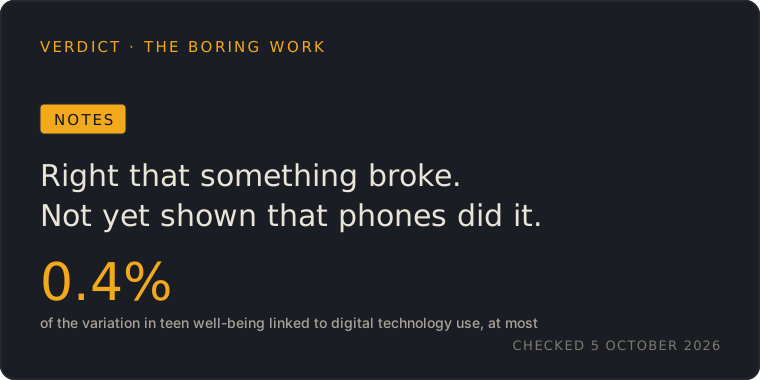
- The cause he names is where the evidence thins. Across three large datasets, digital technology use explained at most 0.4% of the variation in adolescent well-being, and in one long study social media did not predict later depression, while depression did predict more social media use among girls.
- The strongest support comes from economists: Facebook’s staggered arrival at US colleges was followed by worse student mental health, and four weeks without Facebook raised adults’ well-being in a randomised trial.
- The first English study of school phone bans found less phone use during school hours and no difference in well-being, anxiety, depression, sleep or grades.
- The fourth norm, more free play and independence, is the least contested and the least discussed.
This page discusses research on adolescent depression, self-harm and suicide. It is not medical advice. If you are worried about a young person’s mental health, talk to a doctor or a mental health professional.
Verdict
Read the notes, and read the critics alongside the book. Haidt is right that something went badly wrong for teenagers in the early 2010s, and several of his prescriptions are sensible whatever caused it. His central causal claim, that smartphones and social media rewired childhood and produced an epidemic of mental illness, is far stronger than the studies he relies on, and the researchers who measure this for a living are split on it.
The argument in one paragraph
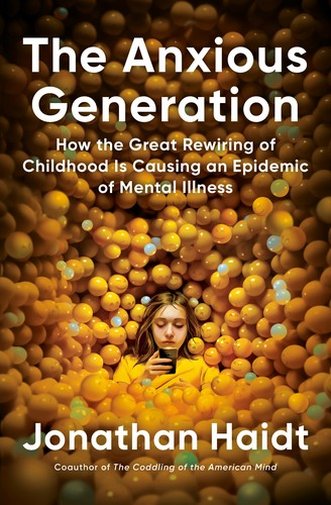
Jonathan Haidt, a social psychologist at New York University, published the book in 2024. Its own page states the claim plainly: after a decade of stability, adolescent mental health «plunged in the early 2010s», and rates of depression, anxiety, self-harm and suicide «rose sharply, more than doubling on most measures» (Haidt, 2024). The cause, in Haidt’s account, is the replacement of a «play-based childhood» with a «phone-based childhood», which he calls the great rewiring. His remedy is four norms: no smartphones before high school, no social media before 16, phone-free schools, and «more independence, free play, and responsibility in the real world» (Four New Norms).
That paragraph contains three separate claims, and they have very different evidence behind them. Teenagers got sicker: well documented. Phones and social media made them sick: contested. The four norms will make them better: mostly untested. This page takes them in that order.
| Claim | Status | Best evidence | |
|---|---|---|---|
| Teen distress rose sharply after about 2012 | Supported in US survey data | [[Twenge et al., 2017 | 10.1177/2167702617723376]] |
| Phones and social media caused the rise | Contested | Small associations in large datasets; a few natural and randomised experiments point the other way | |
| The four norms will reverse it | Mostly untested | One study of school phone bans found no difference in well-being |
The rise is real
Start with what is not in dispute. Using two nationally representative surveys of American students in grades 8 to 12, 506,820 teenagers in all, plus national suicide statistics, Jean Twenge and colleagues found that depressive symptoms, suicide-related outcomes and suicide rates «increased between 2010 and 2015, especially among females» (Twenge et al., 2017).
The same paper is where the screen hypothesis enters. Teenagers who spent more time on new media «were more likely to report mental health issues», those who spent more time on sports, homework and seeing friends were less likely, and the authors wrote that the shift toward screens «may account for the increases». Note the verb. A survey taken at one moment can show that heavy users are sadder; it cannot show which came first. A sad teenager may retreat into a phone as easily as a phone may make a teenager sad, and a single snapshot looks identical either way. That limitation applies to most of the graphs in the book.
How big is the link?
The obvious next step was to measure the size of that association carefully. Amy Orben and Andrew Przybylski, then at the Oxford Internet Institute, took three large datasets with 355,358 adolescents and ran every reasonable version of the analysis instead of picking one. Their result: the link between digital technology use and well-being was negative and small: technology use explained at most 0.4% of the variation in how teenagers were doing (Orben & Przybylski, 2019).
To picture 0.4%, imagine knowing exactly how much time each of a thousand teenagers spends on screens and trying to guess how happy each one is. That knowledge would improve your guesses by almost nothing; the other 99.6% of the differences between them lie elsewhere. Taking the wider data into account, the authors concluded the effects were «too small to warrant policy change».
Timing is the second question. A Canadian team followed 594 adolescents for two years and 1,132 university students for six, measuring both social media use and depressive symptoms every year. Social media use «did not predict depressive symptoms over time for males or females», while «greater depressive symptoms predicted more frequent social-media use only among adolescent girls» (Heffer et al., 2019). In that sample the arrow ran, if anywhere, from sadness to scrolling.
A global test points the same way. Two researchers matched the spread of Facebook across 72 countries against the well-being of 946,798 people from 2008 to 2019, and the countries where Facebook spread faster showed no sign of the widespread psychological harm the book describes; the small associations they did find ran slightly positive (Vuorre & Przybylski, 2023).
The critic who teaches causal inference
The sharpest response to the book came in Nature from Candice Odgers, a developmental psychologist at the University of California, Irvine, who has studied adolescent mental health for two decades. Her verdict: the book’s «repeated suggestion that digital technologies are rewiring our children’s brains and causing an epidemic of mental illness is not supported by science» (Odgers, 2024).
Her complaint is about method. Haidt’s book is full of graphs where phone adoption and teen distress rise together, and Odgers uses that kind of graph on the first day of her statistics course to show students how easily two rising lines turn into a causal story. «Hundreds of researchers, myself included, have searched for the kind of large effects suggested by Haidt», she writes, and found «a mix of no, small and mixed associations».
She also names what the book leaves out: guns, the opioid crisis, poverty after 2008, discrimination, and a shortage of services, with on average one school psychologist for every 1,119 American students. And she agrees with part of the programme. Stricter content moderation and designing platforms with users’ ages in mind are, in her words, «reasonable». Age limits and device bans, she argues, are unlikely to work and could backfire.
The best evidence on Haidt’s side
Fairness requires the studies that cut the other way, and the strongest come from economics, where researchers look for natural experiments.
Facebook did not arrive everywhere at once. It opened college by college between 2004 and 2006, which let three economists compare student mental health before and after its arrival at each campus. They found that «the rollout of Facebook at a college had a negative impact on student mental health», with more students reporting that poor mental health hurt their studies, and evidence pointing to «unfavorable social comparisons» as the mechanism (Braghieri et al., 2022). These were university students, not 12-year-olds, and Facebook in 2005 was not Instagram in 2015, but this is a causal design, and it points Haidt’s way.
Randomised trials add a little more. Paying American adults to deactivate Facebook for four weeks before the 2018 midterm elections «increased subjective well-being», and also left them knowing less about the news (Allcott et al., 2020). In a smaller trial, 143 University of Pennsylvania undergraduates limited to 10 minutes per platform per day for three weeks reported less loneliness and depression than those who carried on as usual (Hunt et al., 2018).
All three studies are on adults or college students, and the effects, where measured, are modest. They show that social media can lower mood for some people. They do not show that it produced a doubling of adolescent self-harm across several countries, which is the claim the book needs.
Do the four norms work?
Phone-free schools are the norm governments adopted fastest, so they are the first to have data. The SMART Schools study compared 1,227 pupils aged 12 to 15 in 20 English schools that banned recreational phone use and 10 that allowed it. Pupils in restrictive schools spent about 40 minutes less on their phones during school hours, but their total phone time over the day and the week was not different, and there was «no evidence of a difference» in mental well-being; anxiety, depression, sleep, physical activity and grades did not differ either (Goodyear et al., 2025).
The study was cross-sectional, only about one school in ten agreed to take part, and it cannot rule out benefits for attention or classroom climate. It did find that teenagers who spent more total time on phones and social media had worse well-being, anxiety and sleep, which fits Haidt’s concern and also fits the reverse direction found in the Canadian study. What it does not support is the specific promise that taking phones away for the school day improves mental health.
The age thresholds (14 for a smartphone, 16 for social media) have no trial behind them that I could find. They are round numbers chosen as a coordination device, which Haidt is open about: the aim is for parents to act together, so that no child ends up as the one kid in class without a phone.
The fourth norm is different. Haidt’s argument that children lost independent play long before smartphones draws on work by the developmental psychologist Peter Gray and colleagues, who summarised evidence that a «decline in independent activity» is a cause of declining child mental well-being (Gray et al., 2023). That too is mostly correlational. It has one advantage over the phone thesis: letting a ten-year-old walk to a shop has few plausible downsides, so it needs less proof.
What a parent can take from it
None of these studies says phones are harmless. Together they say the average effect across teenagers is small and that the direction is unclear in most data; an average can still hide a minority who are hurt more, and nobody has yet shown who they are. A parent who delays a smartphone, keeps phones out of bedrooms at night and pushes for more unsupervised time outdoors is not taking a risk on bad science; those choices cost little. A parent who believes that doing so will prevent depression has been promised more than any study delivers.
The same caution applies to policy. If social media explains a small share of teen distress, then a law that removes it will leave most of the distress in place, and the causes Odgers lists will still be waiting.
How claims about attention spread online without the data behind them is traced in the goldfish attention myth, and what has been measured about attention recovering away from screens is in how long attention takes to recover. The rest of the shelf, checked the same way, is in the book reviews.
The boring bottom line
Teenagers in the United States became markedly more distressed after 2010, and that is documented. The claim that phones and social media caused it rests mainly on rising lines on the same graph; in large datasets the association explains at most 0.4% of the differences in well-being, and in at least one long study depression came before heavy social media use, not after.
Natural experiments with Facebook at college and short deactivation trials in adults show social media can lower mood. The first study of school phone bans found less phone use at school and no difference in mental health. Read the book for the questions it raises, and read Odgers for the questions it skips.
Sources
- Haidt, J (2024). The Anxious Generation: About the book. anxiousgeneration.com. The publisher's description of the book's central claim, read on 5 October 2026. anxiousgeneration.com
- Haidt, J (2024). The Four New Norms. anxiousgeneration.com. The four norms in the author's own wording. anxiousgeneration.com
- Twenge, J.M., Joiner, T.E., Rogers, M.L., Martin, G.N (2017). Increases in Depressive Symptoms, Suicide-Related Outcomes, and Suicide Rates Among U.S. Adolescents After 2010 and Links to Increased New Media Screen Time. Clinical Psychological Science. 6(1), 3-17. Two national US surveys (N = 506,820) plus suicide statistics; increases 2010-2015, especially among girls. Cross-sectional associations with new media use. doi:10.1177/2167702617723376
- Orben, A., Przybylski, A.K (2019). The association between adolescent well-being and digital technology use. Nature Human Behaviour. 3(2), 173-182. Specification curve analysis across three datasets (n = 355,358): at most 0.4% of variation in well-being. doi:10.1038/s41562-018-0506-1
- Heffer, T., Good, M., Daly, O., MacDonell, E., Willoughby, T (2019). The Longitudinal Association Between Social-Media Use and Depressive Symptoms Among Adolescents and Young Adults: An Empirical Reply to Twenge et al. (2018). Clinical Psychological Science. 7(3), 462-470. 594 adolescents over 2 years and 1,132 undergraduates over 6 years: social media did not predict later depressive symptoms; depressive symptoms predicted more use among adolescent girls. doi:10.1177/2167702618812727
- Vuorre, M., Przybylski, A.K (2023). Estimating the association between Facebook adoption and well-being in 72 countries. Royal Society Open Science. 10(8), 221451. Facebook adoption in 72 countries and well-being of 946,798 people, 2008-2019: no evidence of widespread harm; small associations, mostly positive. doi:10.1098/rsos.221451
- Odgers, C.L (2024). The great rewiring: is social media really behind an epidemic of teenage mental illness?. Nature. 628(8006), 29-30. Book review in Nature by a developmental psychologist; cited for her assessment and the evidence she summarises. doi:10.1038/d41586-024-00902-2
- Braghieri, L., Levy, R., Makarin, A (2022). Social Media and Mental Health. American Economic Review. 112(11), 3660-3693. Natural experiment: staggered Facebook rollout across US colleges; negative effect on student mental health via social comparison. doi:10.1257/aer.20211218
- Allcott, H., Braghieri, L., Eichmeyer, S., Gentzkow, M (2020). The Welfare Effects of Social Media. American Economic Review. 110(3), 629-676. Randomised: four weeks of Facebook deactivation before the 2018 US midterms increased subjective well-being in adults. doi:10.1257/aer.20190658
- Hunt, M.G., Marx, R., Lipson, C., Young, J (2018). No More FOMO: Limiting Social Media Decreases Loneliness and Depression. Journal of Social and Clinical Psychology. 37(10), 751-768. Randomised, 143 undergraduates, three weeks of limited use: reduced loneliness and depression. doi:10.1521/jscp.2018.37.10.751
- Goodyear, V.A., Randhawa, A., Adab, P., Al-Janabi, H., Fenton, S., Jones, K., et al (2025). School phone policies and their association with mental wellbeing, phone use, and social media use (SMART Schools): a cross-sectional observational study. The Lancet Regional Health – Europe. 51, 101211. Cross-sectional, 1,227 pupils in 30 English schools: restrictive policies cut in-school phone time but not total time; no difference in well-being, anxiety, depression, sleep or attainment. doi:10.1016/j.lanepe.2025.101211
- Gray, P., Lancy, D.F., Bjorklund, D.F (2023). Decline in Independent Activity as a Cause of Decline in Children’s Mental Well-being: Summary of the Evidence. The Journal of Pediatrics. 260, 113352. Narrative summary arguing that declining independent activity causes declining child well-being; mostly correlational evidence. doi:10.1016/j.jpeds.2023.02.004