TL;DR
- Angela Duckworth, who made «grit» a household word, now argues that grit is «sometimes not sufficient», and that it is «far, far better to make your situation better first».
- The core idea has real support. In her own field experiments, students told to change their surroundings, for example studying away from the phone, met more of their goals than students told to resist temptation in the moment.
- People do behave differently from one situation to the next: in diary studies the typical person showed nearly the whole range of every personality trait within two or three weeks.
- Neighbourhoods and roommates matter too. Children whose families won a lottery to move to lower-poverty areas before age 13 earned more as adults, while randomly assigned college roommates nudged each other’s grades.
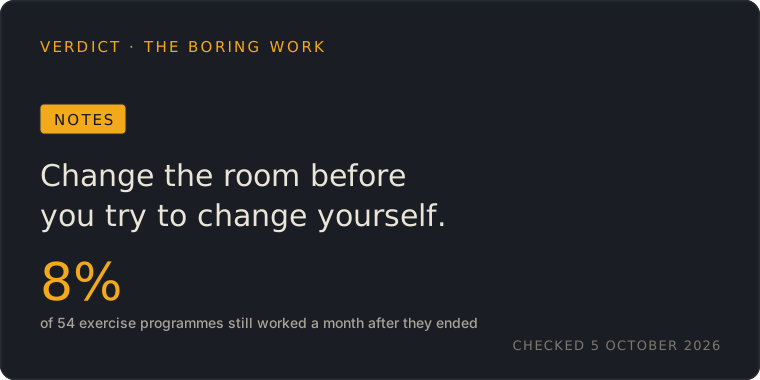
- The limits are in the effect sizes. In a megastudy Duckworth co-led with 61,293 gym members, 54 programmes were tested and only 8% still made a measurable difference after they ended.
Verdict
Read the notes, and expect smaller effects than the book’s tone suggests. Situated is a more careful book than Grit, built on a principle that has been tested and holds up: shaping your surroundings tends to beat fighting yourself. What the studies do not support is the hope that the right setup will transform results; most situational tweaks help a little, for a while.
From grit to situations
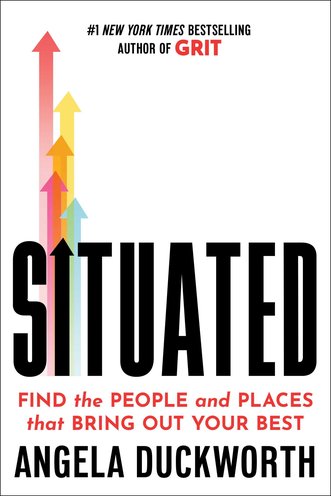
Angela Duckworth is a psychologist at the University of Pennsylvania and a MacArthur Fellow; her 2016 book Grit has sold, by her publisher’s count, more than five million copies. Situated, published on 1 September 2026, opens with a concession. In the publisher’s words, it «springs from her deepening realization that grit, while necessary, is sometimes not sufficient», and its central instruction is that «it is far, far better to make your situation better first». The book promises to explain why «your personality changes, sometimes dramatically, from one situation to another», how to beat temptation without leaning on willpower, and «how the company you keep shapes the person you become» (Scribner, 2026).
That is a notable turn. The idea of grit, as this site found in does grit predict success, shrank sharply once large datasets tested it. A book that moves the spotlight from the person to the setting is, in effect, the author following the evidence. The question is how far the evidence goes.
| Promise | Status | Best evidence | ||
|---|---|---|---|---|
| Personality changes across situations | Supported | [[Fleeson, 2001 | 10.1037/0022-3514.80.6.1011]] | |
| Beat temptation by changing the situation | Supported, modest effects | [[Duckworth et al., 2016 | 10.1037/edu0000062]] | |
| The company you keep shapes you | Supported, effects vary | [[Sacerdote, 2001 | 10.1162/00335530151144131]]; [[Chetty et al., 2016 | 10.1257/aer.20150572]] |
| Small changes to your setup reliably change results | Partly supported | [[Milkman et al., 2021 | 10.1038/s41586-021-04128-4]] |
You are not the same person all week
The claim that personality shifts with the situation sounds like a self-help slogan, and it is one of the better-established findings in personality research. In three studies, William Fleeson, a psychologist at Wake Forest University, had people report their behaviour several times a day for two to three weeks. Variability within each person was high: over a couple of weeks, the typical participant showed nearly every level of every Big Five trait, from very introverted moments to very extraverted ones (Fleeson, 2001).
The same paper found the other half of the picture, which a reader should keep: people’s averages were «almost perfectly stable». An introvert at a party behaves more like an extravert than she does at home, and over a fortnight she is still, on average, an introvert. Situations move the needle around a set point; they do not replace it. That is consistent with Duckworth’s claim and narrower than «dramatically».
Temptation without willpower
The best-tested chapter is the one about self-control, because Duckworth tested it herself. With the Yale philosopher Tamar Gendler and the Stanford psychologist James Gross, she argued in 2016 that self-control strategies can be arranged on a timeline, and that strategies used early, before a temptation has grown strong, may work best. Their examples are ordinary: «the partygoer who chooses a seat far from where drinks are being poured» and «the student who goes to the library without a cell phone» (Duckworth, Gendler & Gross, 2016).
They then ran field experiments. High school students randomly assigned to change something about their situation in advance were «more likely to meet their academic goals during the following week» than students told to resist in the moment or given no strategy, and college students showed the same pattern, partly because they felt less tempted during the week (Duckworth et al., 2016). The outcome was goals met over one week, reported by the students themselves, which is a modest test, and it is the right kind of test.
Independent evidence points in the same direction from a different angle. In a week-long study in which 205 adults were signalled at random moments and reported 7,827 desires, personality mattered most for how strong and conflicting desires were, while situational factors, such as other people around or alcohol, shaped what people did about them (Hofmann et al., 2012). Duckworth’s argument, in one sentence, is that people who seem disciplined may spend less time near what tempts them.
Why the easy path feels like cheating
The publisher promises to explain «why taking the less effortful path can feel like cheating but often solves a stubborn problem». The 2016 paper offers the most interesting answer in the book’s whole argument. Situational self-control works by stopping an impulse before it grows, so there is little inner struggle to notice. «Ironically, we may underappreciate situational self-control for the same reason it is so effective», the authors write: by arranging circumstances in advance, we «minimize the in-the-moment experience of intrapsychic struggle typically associated with exercising self-control» (Duckworth, Gendler & Gross, 2016).
That has a practical consequence. People judge their own discipline by how hard they had to fight, so the person who leaves the biscuits at the shop feels less virtuous than the one who resists them on the counter, while being more likely to succeed. The idea is a hypothesis drawn from the process model rather than a measured effect, and it matches what the students in the field experiments said: changing the situation worked partly because they felt less tempted during the week. If the book persuades readers to stop treating struggle as proof of effort, it will have done something useful.
Roommates and zip codes
The book’s claim that «the company you keep shapes the person you become» has some of the best natural experiments in social science behind it, because researchers have found places where people are assigned to company by chance.
Dartmouth College assigned first-year roommates at random. Comparing students whose roommates happened to differ, the economist Bruce Sacerdote found that «peers have an impact on grade point average and on decisions to join social groups such as fraternities», while effects were «markedly absent in other major life decisions such as choice of college major» (Sacerdote, 2001). The company you keep shaped some choices and left others alone.
The zip code claim rests on a larger experiment. In the 1990s, the Moving to Opportunity programme gave randomly selected families in high-poverty public housing vouchers to move to lower-poverty neighbourhoods. Decades later, tax records showed that moving «when young (before age 13) increases college attendance and earnings and reduces single parenthood rates», while moving as an adolescent had «slightly negative impacts» (Chetty et al., 2016). Situations shape lives, and when you change them matters as much as whether you do. An adult choosing a new office or gym is not a child spending a decade in a better neighbourhood, so these results support the principle more than any particular tip.
How big are the effects?
Here the book needs its fine print. Situational change is close cousin to «nudging», the redesign of choices that governments adopted in the 2010s. A 2021 meta-analysis of more than 200 studies and 2,149,683 people found that choice-architecture interventions changed behaviour «with a small to medium effect size of Cohen’s d = 0.45» (Mertens et al., 2021). A team of methodologists then reanalysed the same studies correcting for the tendency of small positive results to be published and null results to be shelved, and concluded that «when this publication bias is appropriately corrected for, no evidence for the effectiveness of nudges remains» (Maier et al., 2022). The truth is probably between those two numbers, and it varies a great deal by setting: food choices respond more than most.
The most honest data come from Duckworth’s own work. With Katherine Milkman, she led a megastudy in which 30 scientists designed 54 four-week programmes to get 61,293 members of an American gym chain to exercise more. «45% of these interventions significantly increased weekly gym visits by 9% to 27%», the best one paying small rewards for returning after a missed workout. But once the four weeks were over, only about one programme in twelve (8% of them) still produced a measurable difference, and independent judges could not predict which ideas would work (Milkman et al., 2021). For someone who goes once a week, a 9% rise is one extra visit every eleven weeks or so.
That result does not refute Situated; most of the programmes were reminders and rewards rather than changes to the physical setting. It does set expectations. A redesigned situation is a tool that tilts the odds, and the tilt is usually small and fades when the setup is removed, which is an argument for building situations you can keep.
Stars as evidence
The publisher promises that the book «shows how high performers like Taylor Swift, Michael Phelps, and Jerry Seinfeld create situations that make it easier to excel». Those stories are what make the book readable, and reviewers single them out. They are also the weakest kind of evidence: successful people’s routines are visible because they succeeded, and nobody interviews the thousands with similar routines who did not. Read them as illustrations of a principle that rests on the experiments above, not as proof of it. There is also a selection problem specific to this book’s argument. A star can afford to engineer every detail of her surroundings: the studio, the team, the schedule, the people allowed in the room. Most readers control a desk, a phone and perhaps a commute, and the research above is mostly about those humbler levers, which is where the book is most useful.
Who should read it
Read it if you have tried to fix a habit by gritting your teeth and failed. The book’s main instruction, move the temptation out of reach before you need willpower to resist it, is cheap, sensible and tested. It also suits managers and parents, since it shifts the question from «what is wrong with this person» to «what about this setting is making the wrong thing easy».
Do not expect transformation. The measured effects of situational changes are real and mostly modest, and the lasting ones are the changes that stay in place.
For the book this one revises, see does grit predict success; for the habit-building version of the same idea, the check on habit stacking. Every book we have put through this process is listed under book reviews.
The boring bottom line
Situated is grit’s author conceding that the setting often matters more than the striving, and the research backs the direction. Students who changed their surroundings met more of their goals; children who moved young to better neighbourhoods earned more as adults; roommates shifted each other’s grades.
The size is the catch. Nudge-style changes shrink to little after correcting for publication bias, and of 54 gym programmes in Duckworth’s own megastudy, only 8% still worked a month after they stopped. Change the room before you try to change yourself, and expect the room to help a little.
Sources
- Scribner / Simon & Schuster (2026). Situated: Find the People and Places That Bring Out Your Best (publisher's page). simonandschuster.com. Publisher's description of the book's argument and promises; read on 5 October 2026. simonandschuster.com
- Fleeson, W (2001). Toward a structure- and process-integrated view of personality: Traits as density distributions of states.. Journal of Personality and Social Psychology. 80(6), 1011-1027. Three experience-sampling studies over 2-3 weeks: high within-person variability in Big Five states, stable individual averages. doi:10.1037/0022-3514.80.6.1011
- Duckworth, A.L., Gendler, T.S., Gross, J.J (2016). Situational Strategies for Self-Control. Perspectives on Psychological Science. 11(1), 35-55. Process model of situational self-control; theoretical review by the book's author and colleagues. doi:10.1177/1745691615623247
- Duckworth, A.L., White, R.E., Matteucci, A.J., Shearer, A., Gross, J.J (2016). A stitch in time: Strategic self-control in high school and college students.. Journal of Educational Psychology. 108(3), 329-341. Field experiments with high school and college students: situation modification beat response modulation or no strategy for meeting a week's academic goals. doi:10.1037/edu0000062
- Hofmann, W., Baumeister, R.F., Förster, G., Vohs, K.D (2012). Everyday temptations: An experience sampling study of desire, conflict, and self-control.. Journal of Personality and Social Psychology. 102(6), 1318-1335. Experience sampling, 205 adults, 7,827 desire episodes over a week. doi:10.1037/a0026545
- Sacerdote, B (2001). Peer Effects with Random Assignment: Results for Dartmouth Roommates. The Quarterly Journal of Economics. 116(2), 681-704. Random roommate assignment at Dartmouth: peer effects on GPA and fraternity membership, none on choice of major. doi:10.1162/00335530151144131
- Chetty, R., Hendren, N., Katz, L.F (2016). The Effects of Exposure to Better Neighborhoods on Children: New Evidence from the Moving to Opportunity Experiment. American Economic Review. 106(4), 855-902. Moving to Opportunity: moving before age 13 raised college attendance and earnings; moving as an adolescent slightly negative. doi:10.1257/aer.20150572
- Mertens, S., Herberz, M., Hahnel, U.J.J., Brosch, T (2021). The effectiveness of nudging: A meta-analysis of choice architecture interventions across behavioral domains. Proceedings of the National Academy of Sciences. 119(1), e2107346118. Meta-analysis of choice-architecture interventions, more than 200 studies, n = 2,149,683; d = 0.45 before correction for publication bias. doi:10.1073/pnas.2107346118
- Maier, M., Bartoš, F., Stanley, T.D., Shanks, D.R., Harris, A.J.L., Wagenmakers, E.J (2022). No evidence for nudging after adjusting for publication bias. Proceedings of the National Academy of Sciences. 119(31), e2200300119. Reanalysis of the meta-analysis above with robust Bayesian correction for publication bias: no evidence of an effect remains. doi:10.1073/pnas.2200300119
- Milkman, K.L., Gromet, D., Ho, H., Kay, J.S., Lee, T.W., Pandiloski, P., et al (2021). Megastudies improve the impact of applied behavioural science. Nature. 600(7889), 478-483. Megastudy, 61,293 gym members, 54 four-week programmes; 45% raised visits during the programme, 8% after it. Duckworth is a co-author. doi:10.1038/s41586-021-04128-4