TL;DR
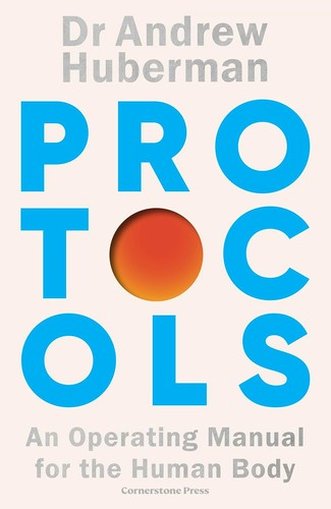
- Protocols, published in September 2026, collects the routines Andrew Huberman has taught on his podcast across seven areas, from sleep and light to focus and personal growth. Its publisher’s own examples are morning sunlight and a breathing pattern for stress.
- The basics hold up. Light in the morning shifts the body clock earlier, more daytime light goes with fewer psychiatric diagnoses in a study of 86,772 adults, and caffeine six hours before bed still disrupted sleep in a controlled trial.
- The precision does not. Huberman’s sleep toolkit prescribes 10, 20 or 30 to 60 minutes of outdoor light by cloud cover; no study I could find tested those durations.
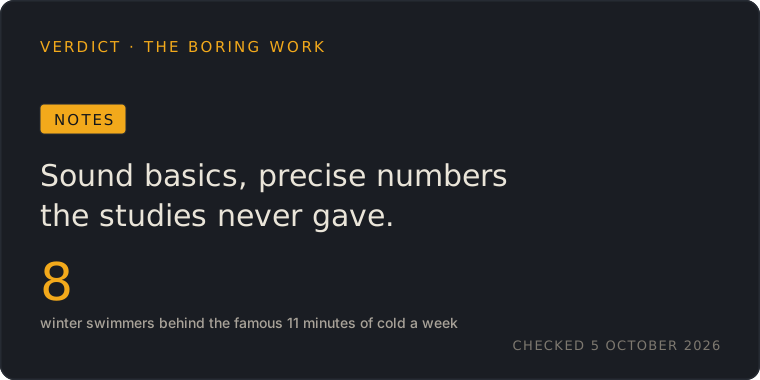
- The famous 11 minutes of cold water a week is the habit eight Danish winter swimmers reported in an observational study, not a dose anyone was assigned.
- The breathing protocol has a randomised trial behind it, and Huberman is a co-author of that trial. His sleep toolkit also recommends supplements with a discount code for a brand that sponsors him.
This page discusses sleep, cold exposure, caffeine and supplements because the book does. It is not medical advice and gives no doses. If you have a sleep disorder, a heart condition or take medication, talk to a doctor before changing any of these.
Verdict
Read the notes. The foundations of the book (bright light by day, darkness at night, caffeine kept away from bedtime) are older than the podcast and well supported. What Protocols adds is a layer of exact minutes and degrees that sounds like measurement and mostly is not, plus a few claims about cold water and dopamine that stretch small studies a long way.
What this review could check
Andrew Huberman is a neurobiologist and tenured professor at Stanford School of Medicine and the host of Huberman Lab, one of the most listened-to health podcasts in the world. Protocols is a 688-page book released on 15 September 2026, and his publisher describes it as «essential practices» across seven areas: sleep, exercise, stress control, nutrition, light, focus and learning, and personal growth. The publisher gives two examples: «a simple sleep protocol includes viewing sunlight as soon as possible after waking», and «another protocol uses a unique breathing pattern to reduce stress in the moment» (Simon & Schuster, 2026).
The book is three weeks old, so this page does something narrower than a chapter-by-chapter review. It checks the protocols as Huberman has published them himself, in the newsletters on his own website that the podcast and the book grew from, and it names the source every time. Where the book differs from those newsletters, the book wins; where they agree, the evidence below applies to both.
| Protocol | Status | Best evidence | |
|---|---|---|---|
| Morning sunlight shifts the body clock | Supported | [[Khalsa et al., 2003 | 10.1113/jphysiol.2003.040477]] |
| 10 / 20 / 30-60 minutes of light by cloud cover | Untested as stated | No study of those durations located | |
| Caffeine away from bedtime | Supported | [[Drake et al., 2013 | 10.5664/jcsm.3170]] |
| 11 minutes of cold water a week | Observational, 8 people | [[Søberg et al., 2021 | 10.1016/j.xcrm.2021.100408]] |
| Exhale-focused breathing for stress | One randomised trial, co-authored by Huberman | [[Balban et al., 2023 | 10.1016/j.xcrm.2022.100895]] |
Morning light: right direction, invented precision
Huberman’s sleep newsletter tells readers to «view sunlight by going outside within 30-60 minutes of waking», and specifies the dose: on «bright cloudless days: view morning and afternoon sun for 10 min; cloudy days: 20 min; very overcast days 30-60 min» (Huberman, 2021).
The direction rests on solid physiology. The body clock is reset by light reaching the eyes, and when that light arrives matters. In a laboratory study at Harvard, 21 healthy volunteers were kept in dim light and exposed to bright light at different points in their circadian cycle. Light before the low point of body temperature delayed the clock; light after it advanced the clock (Khalsa et al., 2003). For most people that low point falls in the early morning, so morning light pushes the clock earlier, which is what someone struggling to fall asleep at night wants. A review of the field adds that daytime light can improve sleep and mood «with little to no side effects», while light at night disrupts both (Blume et al., 2019).
Large observational data point the same way. Among 86,772 UK adults who wore light sensors, «greater daytime light exposure was associated with reduced risk for major depressive disorder, PTSD, psychosis, and self-harm behavior», and greater light at night with higher risk (Burns et al., 2023). The participants averaged 62 years old and the study was cross-sectional, so it cannot say which came first.
The evening half of the same advice is better supported than the morning half. The newsletter tells readers to avoid bright light, especially overhead light, between 10 pm and 4 am, and to use only as much as they need to move around safely. In the UK Biobank data, night-time light exposure was linked to higher risk of depression, anxiety, PTSD, psychosis, bipolar disorder and self-harm, independently of daytime light, and the review cited above lists nocturnal light among the clearest disruptors of circadian rhythm and sleep. A dim house after dark is the cheapest protocol in the book and the one with the broadest evidence behind it.
What none of these studies contains is a 10-minute dose for sunny days or 20 for cloudy ones. The Harvard volunteers sat under 6.7 hours of bright light; the UK Biobank study measured a week of ordinary life. The specific minutes may be reasonable guesses, and they are presented as if someone had measured them. I could not find the study that did.
Caffeine: the protocol with the cleanest trial
The same newsletter says to «avoid caffeine within 8-10 hours of bedtime». This is the least glamorous protocol in the set and the best tested. In a placebo-controlled study, adults took 400 mg of caffeine at bedtime, three hours before or six hours before; all three timings disturbed sleep compared with placebo, and the authors concluded that caffeine «taken 6 hours before bedtime has important disruptive effects on sleep» (Drake et al., 2013). 400 mg is roughly four ordinary cups of filter coffee at once, a large dose, so the trial shows the risk clearly without telling anyone exactly where their own cutoff lies.
Cold water: eleven minutes, eight men
Huberman’s cold-exposure newsletter recommends «11 minutes per week TOTAL», spread over two to four short sessions, and explains that the number «is based on a recent study» (Huberman, 2022).
The study that contains that number is a Danish paper on brown fat. Researchers compared eight young men who were experienced winter swimmers with eight matched men who were not. In a table describing the swimmers’ habits, their total time immersed in cold water came to 11 minutes a week, alongside 57 minutes in a sauna (Søberg et al., 2021). The swimmers showed differences in how they regulated body temperature. Nobody was assigned 11 minutes, nothing was compared against 5 or 20, and the men also used saunas. The figure describes what eight enthusiasts happened to do. That is a perfectly good starting point for a hypothesis, and a poor basis for a weekly target printed in a manual: an average of eight people says nothing about whether 11 minutes is better than 5, or worse than 20, or different at all.
The newsletter also says cold «causes the prolonged release of dopamine» and that «even short bouts of cold exposure can cause a lasting increase in dopamine». The study usually cited for this immersed young men up to the neck for an hour. At 14°C, plasma noradrenaline rose by 530% and dopamine by 250% during the immersion (Šrámek et al., 2000). That was a full hour at 14°C, measured in blood rather than in the brain, which says nothing about short bouts or lasting effects on mood. A fuller account of what cold water does and does not do is in every cold-plunge claim, ranked.
Breathing: a real trial, and a disclosure
The breathing protocol is the strongest of the newer ones, because it was tested directly. In a remote randomised trial lasting one month, participants did five minutes a day of one of three breathing exercises or of mindfulness meditation. «Breathwork, especially the exhale-focused cyclic sighing, produces greater improvement in mood» and a larger drop in breathing rate than meditation, the authors report (Balban et al., 2023).
Two details belong next to that result. Andrew Huberman is the senior author of the paper, alongside the Stanford psychiatrist David Spiegel. Co-authorship is not misconduct, and the trial was registered (NCT05304000); it does mean the main evidence for a protocol in the book comes from the book’s author, and it has not yet been independently replicated at scale. And the comparison was with meditation, not with doing nothing, so the trial shows that sighing beat meditation on mood over a month, a narrower result than «reduces stress in the moment».
Supplements and sponsors
The sleep newsletter recommends specific supplements before bed and adds that Huberman uses one brand «for all of the above», with a 20% discount link. This page does not repeat the doses. The point for a reader is structural: a protocol that names a sponsored product deserves a second source, and the newsletter offers none for the supplement claims beyond the podcast conversation it came from. Huberman does add sensible caveats («start with one supplement (or none!)»), which is more than many in the field do.
«Stronger and leaner at any age»
The publisher also promises protocols «for getting stronger and leaner at any age». The strength half of that is one of the best-established findings in exercise science, and it predates the podcast by decades. In 1990, ten frail nursing-home residents with an average age of 90 did eight weeks of high-intensity resistance training. In the nine who finished, strength rose by an average of 174%, thigh muscle area grew by 9%, and walking speed improved by 48% (Fiatarone et al., 1990). If muscle responds to lifting at 90, it responds at 40.
That study is small and old, and it measured strength rather than leanness or longevity, but the direction has been confirmed many times since. Here Protocols stands on firm ground, and the main risk for a reader is the opposite of over-belief: skipping the dull, well-proven chapter on lifting in favour of the novel chapters on cold and light.
What to take from the book
Huberman’s real contribution is that he made circadian biology popular, and most of what he says about light and sleep is closer to the textbooks than to the internet. The format is where it goes wrong. A protocol, by definition, specifies the dose, and the doses in this field mostly do not exist yet; the book fills the gap with confident numbers drawn from small studies, observational tables and the author’s own experience.
Keep the shape: light in the morning, dark at night, caffeine well before bed, and a slow exhale when stress rises. Treat every exact number as a starting guess rather than a finding, and treat the cold-water and supplement chapters as hypotheses with a commercial interest attached.
What whole-body cold chambers do and do not do is in the cryotherapy check, and how sleep, light and energy fit together is on the energy page. For more health and habit bestsellers held up against their sources, browse the book reviews.
The boring bottom line
Morning light advances the body clock, daytime light goes with better mental health in large data, and caffeine six hours before bed still costs sleep. Those foundations of Protocols are solid and older than the book.
The exact durations of sunlight are untested, the 11 minutes of cold is what eight Danish winter swimmers happened to do, the dopamine claim comes from an hour in 14°C water, and the best evidence for the breathing protocol is a trial the author co-wrote. Useful habits, sold with more precision than the science can supply.
Sources
- Simon & Schuster (2026). Protocols: An Operating Manual for the Human Body (publisher's page). simonandschuster.com. Publisher's description of the book's seven areas and its example protocols; read on 5 October 2026. simonandschuster.com
- Huberman, A (2021). Toolkit for Sleep. Huberman Lab newsletter. The author's sleep toolkit with the light durations, caffeine window and supplement list; read on 5 October 2026. hubermanlab.com
- Khalsa, S.B.S., Jewett, M.E., Cajochen, C., Czeisler, C.A (2003). A Phase Response Curve to Single Bright Light Pulses in Human Subjects. The Journal of Physiology. 549(3), 945-952. 21 volunteers; phase response curve to 6.7 h of bright light: delays before the temperature minimum, advances after it. doi:10.1113/jphysiol.2003.040477
- Blume, C., Garbazza, C., Spitschan, M (2019). Effects of light on human circadian rhythms, sleep and mood. Somnologie. 23(3), 147-156. Narrative review of light, circadian rhythms, sleep and mood. doi:10.1007/s11818-019-00215-x
- Burns, A.C., Windred, D.P., Rutter, M.K., Olivier, P., Vetter, C., Saxena, R., et al (2023). Day and night light exposure are associated with psychiatric disorders: an objective light study in >85,000 people. Nature Mental Health. 1(11), 853-862. Cross-sectional, 86,772 UK Biobank adults with light sensors; daytime light associated with lower, night light with higher psychiatric risk. doi:10.1038/s44220-023-00135-8
- Drake, C., Roehrs, T., Shambroom, J., Roth, T (2013). Caffeine Effects on Sleep Taken 0, 3, or 6 Hours before Going to Bed. Journal of Clinical Sleep Medicine. 9(11), 1195-1200. 400 mg caffeine at 0, 3 or 6 h before bed versus placebo; all three disturbed sleep. doi:10.5664/jcsm.3170
- Huberman, A (2022). The Science & Use of Cold Exposure for Health & Performance. Huberman Lab newsletter. The author's cold-exposure newsletter with the 11-minute recommendation and dopamine claims; read on 5 October 2026. hubermanlab.com
- Søberg, S., Löfgren, J., Philipsen, F.E., Jensen, M., Hansen, A.E., Ahrens, E., et al (2021). Altered brown fat thermoregulation and enhanced cold-induced thermogenesis in young, healthy, winter-swimming men. Cell Reports Medicine. 2(10), 100408. 8 winter swimmers versus 8 controls; the swimmers' habits table reports 11 min of cold water and 57 min of sauna per week. Observational. doi:10.1016/j.xcrm.2021.100408
- Šrámek, P., Šimečková, M., Janský, L., Šavlíková, J., Vybíral, S (2000). Human physiological responses to immersion into water of different temperatures. European Journal of Applied Physiology. 81(5), 436-442. 1-hour head-out immersion; at 14°C plasma noradrenaline +530% and dopamine +250% during immersion. doi:10.1007/s004210050065
- Balban, M.Y., Neri, E., Kogon, M.M., Weed, L., Nouriani, B., Jo, B., et al (2023). Brief structured respiration practices enhance mood and reduce physiological arousal. Cell Reports Medicine. 4(1), 100895. Remote randomised trial (NCT05304000), one month, 5 min a day; cyclic sighing improved mood more than mindfulness meditation. Huberman is the senior author. doi:10.1016/j.xcrm.2022.100895
- Fiatarone, M.A., Marks, E.C., Ryan, N.D., Meredith, C.N., Lipsitz, L.A., Evans, W.J (1990). High-Intensity Strength Training in Nonagenarians. JAMA. 263(22), 3029. 10 frail nursing-home residents aged about 90, 8 weeks of resistance training: strength +174%, gait speed +48%. doi:10.1001/jama.1990.03440220053029