TL;DR
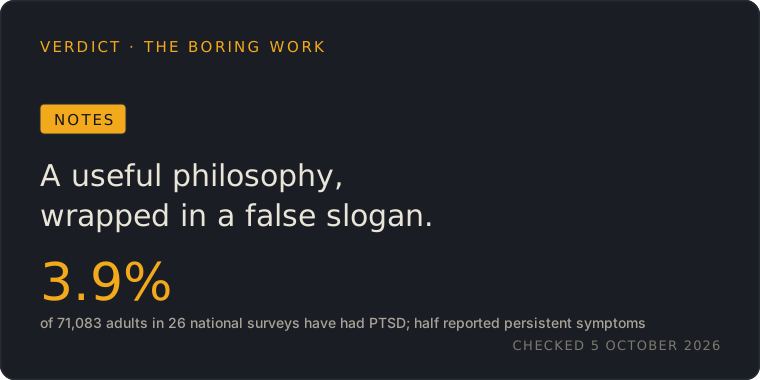
- The book’s most quoted chapter is titled «Trauma Does Not Exist». Large surveys say otherwise: across 26 national surveys with 71,083 adults, 3.9% had had post-traumatic stress disorder in their lifetime, and half of them reported persistent symptoms.
- Read closely, the book’s own position is milder than its slogan: past experiences have «strong» influences, but «nothing is actually determined by those influences». That milder version is close to the research on resilience, which finds that most people exposed to trauma do not develop lasting disorder.
- «Unhappiness is something you choose» goes too far: twin studies put about a third of the differences in well-being down to genes.
- The book is strongest where it points outward. Strong social ties go with 50% better odds of survival across 148 studies, and spending on others raised happiness in experiments on several continents.
- Its «separation of tasks» and its warning against living for recognition match research on the costs of staking self-worth on approval, though Adlerian therapy itself has a thin trial record.
This page discusses trauma and post-traumatic stress disorder. It is not medical advice. If past events are affecting your life now, a qualified therapist can help, and seeking that help is not a failure of courage.
Verdict
Read the notes, and skip the first night. The book is a philosophy of responsibility and community dressed as a psychology book, and much of its practical advice (stop living for approval, decide which problems are yours, contribute to others) has research behind it. Its headline claims about trauma and chosen unhappiness are false as stated, and a reader struggling with real trauma could be harmed by taking them literally.
A dialogue about Adler
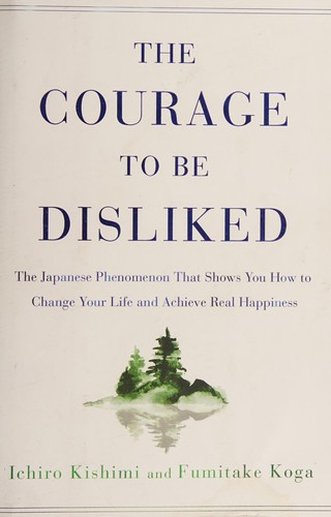
The Courage to Be Disliked was written by Ichiro Kishimi, a Japanese philosopher and translator of the Austrian psychiatrist Alfred Adler, with the writer Fumitake Koga. It appeared in Japan in 2013 and in English in 2018, and it is built as five nights of argument between a philosopher and a sceptical young man (Kishimi & Koga, 2018).
The format matters for a reviewer. The philosopher wins every exchange, so claims are asserted rather than tested, and the young man’s objections, which are often the reader’s objections, are dismissed rather than answered with evidence. Adler himself, who broke with Freud in 1911, built a theory of goals rather than causes, and the book presents it as a philosophy to live by. Fair enough; the trouble starts where it makes claims about how minds work, because those can be checked. The book’s own chapter titles make that easy: «Trauma Does Not Exist», «Unhappiness Is Something You Choose for Yourself», «All Problems Are Interpersonal Relationship Problems». Each is phrased as a fact about people, and each can be held up against what has been measured.
| Claim | Status | Best evidence | |
|---|---|---|---|
| «Trauma does not exist» | Refuted as stated | [[Koenen et al., 2017 | 10.1017/S0033291717000708]] |
| The past influences but does not determine you | Supported | [[Bonanno, 2004 | 10.1037/0003-066X.59.1.20]] |
| Unhappiness is something you choose | Overstated | [[Bartels, 2015 | 10.1007/s10519-015-9713-y]] |
| Living for recognition costs you | Supported | [[Crocker & Park, 2004 | 10.1037/0033-2909.130.3.392]] |
| A feeling of community and contribution brings happiness | Supported | [[Holt-Lunstad et al., 2010 | 10.1371/journal.pmed.1000316]] |
The first night: trauma
The chapter is titled «Trauma Does Not Exist», and the philosopher is unambiguous. Asked whether he denies the existence of trauma altogether, he answers: «Yes, I am. Adamantly.» He then quotes Adler: «We do not suffer from the shock of our experiences—the so-called trauma—but instead we make out of them whatever suits our purposes. We are not determined by our experiences, but the meaning we give them is self-determining.»
As a statement about the world, that does not survive the epidemiology. The World Health Organization’s World Mental Health Surveys interviewed 68,894 adults in 24 countries and found that 70.4% had lived through at least one traumatic event, with interpersonal violence carrying the highest risk of PTSD (Kessler et al., 2017). Across 26 surveys and 71,083 adults, the lifetime prevalence of post-traumatic stress disorder was 3.9%, rising to 5.6% among those exposed to trauma, and «half of respondents with PTSD reported persistent symptoms» (Koenen et al., 2017).
Childhood adversity leaves traces in the body too. In a study of 9,508 adults at a large American health organisation, the number of kinds of adverse childhood experience a person reported, such as abuse or living with a household member who was mentally ill or imprisoned, showed «a graded relationship» with adult health risks and diseases (Felitti et al., 1998). These are associations, and they do not prove that every person with a hard childhood is damaged. They do show that experiences shape outcomes on average, which is what «trauma does not exist» denies.
What the book means, and where it is right
Read past the slogan, and the philosopher says something more defensible. Adler, he explains, «is not saying that the experience of a horrible calamity or abuse during childhood or other such incidents have no influence on forming a personality; their influences are strong. But the important thing is that nothing is actually determined by those influences.»
That version fits the research better than the chapter title. The psychologist George Bonanno, reviewing studies of bereavement and violence, argued that resilience «is more common than is often believed», and that many people exposed to potentially traumatic events show «only minor and transient disruptions» (Bonanno, 2004). The survey numbers above say the same thing from the other side: most people who live through trauma never develop PTSD.
The book’s tool, changing the meaning you give to an experience, also has support. A meta-analysis of 306 experiments found that strategies of «cognitive change», reinterpreting a situation, had a small-to-medium effect on emotional outcomes, d = 0.36, larger than distraction or suppression (Webb et al., 2012). Reappraisal is one of the working parts of cognitive behavioural therapy. The research supports «the meaning you give events matters». It does not support «the events themselves do not».
The difference is not academic. A person with PTSD who reads that trauma does not exist, and that they «make out of» their experiences «whatever suits» their purposes, may conclude that their symptoms are a choice. They are not, and nothing in the research above suggests they are.
«Unhappiness is something you choose»
The first night also contains the line «Unhappiness Is Something You Choose for Yourself», and the philosopher tells the youth that at some stage he «chose “being unhappy”» because he judged it «good for you». This is the Adlerian idea of teleology: behaviour serves goals, even hidden ones.
Behaviour genetics sets a limit on it. A meta-analysis of twin and family studies estimated the heritability of overall well-being at 36% across 55,974 people, and of life satisfaction at 32% (Bartels, 2015). This is no claim that a third of anyone’s happiness is fixed, since heritability describes differences in a population, not limits on a person. It does mean that a good part of why some people are gloomier than others has nothing to do with what they chose. Choice matters; so do genes, circumstances and illness.
Living in the present
Between the claims about trauma and the advice about other people, the book sets out a view of time. «Life is a series of moments, and neither the past nor the future exists», the philosopher says, and «what happened in the past has nothing whatsoever to do with your here and now». The young man protests that the past is powerful; the philosopher answers that dwelling on it is a way of excusing oneself from acting.
As ethics, this is an old and respectable position, close to the Stoics and to parts of Buddhist teaching, and many readers find it freeing. As psychology, it repeats the error of the first night in a gentler form. The past plainly has something to do with the present: it built the habits, skills, relationships and memories a person brings into every moment. The useful core of the idea survives without the exaggeration. Whatever happened, the question that can be acted on is what to do next, and spending all one’s attention on causes can become a reason not to act. That is a sound piece of advice, and it does not require believing that the past does not exist.
The second and third nights: other people
The book’s next claim is that «all problems are interpersonal relationship problems», and its practical answer is the «separation of tasks»: for any problem, ask «Whose task is this?», by asking «who ultimately is going to receive the result» of the choice, and stop intruding on other people’s tasks or letting them intrude on yours. It also «denies the need to seek recognition from others», and gives the book its title: «Freedom is being disliked by other people.»
«All problems» is a philosopher’s exaggeration, but the advice about recognition matches a solid line of research. The psychologists Jennifer Crocker and Lora Park reviewed work on what happens when people stake their self-worth on approval or performance. In those areas, people adopt the goal of proving their worth, and when threatened they react in ways that «undermine learning; relatedness; autonomy and self-regulation; and over time, mental and physical health» (Crocker & Park, 2004). The short-term relief of being approved is outweighed by long-term costs, which is close to what the philosopher tells the youth.
The last nights: community and contribution
The book ends where Adler’s theory ends, with «a feeling of community»: seeing other people as comrades and finding happiness in contributing to them. This is the best-supported part of the book.
Social ties predict survival. A meta-analysis of 148 studies with 308,849 participants found «a 50% increased likelihood of survival for participants with stronger social relationships», an effect «comparable with well-established risk factors for mortality» (Holt-Lunstad et al., 2010). Contribution has experimental support too. People randomly assigned to spend money on others «experienced greater happiness than those assigned to spend money on themselves» (Dunn et al., 2008), and later studies found the same pattern in Canada, Uganda, India and South Africa, with survey data from 136 countries pointing the same way (Aknin et al., 2013).
Adlerian therapy, the clinical practice behind the book, has a thinner record. The controlled studies I could find are mostly small trials of Adlerian play therapy with children, which reviews describe as effective for behaviour problems (Sertkaya Fidan & Ulusoy Doğmuş, 2025); for adults, the trial evidence is sparse. The book’s value lies in its ideas, not in a tested therapy.
Who should read it
Read it if you live for other people’s approval, take on problems that are not yours, or need a push toward contributing instead of comparing. Those chapters are sound, and for some readers they will matter a great deal.
Read the first night as philosophy, not medicine. If something that happened to you still shapes your days, it says nothing about your courage, and a qualified clinician is a better guide than a dialogue that denies the problem exists.
The evidence on social ties and happiness is gathered in the happiness myths, and another bestseller about not caring what others think is checked in The Subtle Art of Not Giving a F*ck. More philosophy-flavoured self-help, read against the research, is collected in the book reviews.
The boring bottom line
The Courage to Be Disliked opens with a false claim and ends with a well-supported one. Trauma exists: in 26 national surveys, 3.9% of adults had had PTSD and half of them still had symptoms. The book’s milder version, that the past influences without determining, matches the research on resilience and reappraisal, and its claim that unhappiness is chosen ignores the third of well-being that twin studies trace to genes.
Its advice about approval, other people’s tasks and contribution is the reason to read it. Stronger social ties go with better survival, giving makes people happier, and staking your worth on recognition has measurable costs.
Sources
- Kishimi, I., & Koga, F (2018). The Courage to Be Disliked. Atria Books. Atria Books English edition, 2018 (Japanese original 2013). Quotations checked against the book's text. simonandschuster.com
- Kessler, R.C., Aguilar-Gaxiola, S., Alonso, J., Benjet, C., Bromet, E.J., Cardoso, G., et al (2017). Trauma and PTSD in the WHO World Mental Health Surveys. European Journal of Psychotraumatology. 8(sup5), 1353383. 24-country WHO surveys, 68,894 respondents: 70.4% experienced lifetime trauma; interpersonal violence carried the highest PTSD risk. doi:10.1080/20008198.2017.1353383
- Koenen, K.C., Ratanatharathorn, A., Ng, L., McLaughlin, K.A., Bromet, E.J., Stein, D.J., et al (2017). Posttraumatic stress disorder in the World Mental Health Surveys. Psychological Medicine. 47(13), 2260-2274. 26 WHO World Mental Health surveys, 71,083 adults: lifetime PTSD 3.9%, 5.6% among the trauma-exposed; half with persistent symptoms. doi:10.1017/S0033291717000708
- Felitti, V.J., Anda, R.F., Nordenberg, D., Williamson, D.F., Spitz, A.M., Edwards, V., et al (1998). Relationship of Childhood Abuse and Household Dysfunction to Many of the Leading Causes of Death in Adults. American Journal of Preventive Medicine. 14(4), 245-258. 9,508 HMO members: graded relationship between number of adverse childhood experiences and adult health risks. Observational. doi:10.1016/S0749-3797(98)00017-8
- Bonanno, G.A (2004). Loss, Trauma, and Human Resilience: Have We Underestimated the Human Capacity to Thrive After Extremely Aversive Events?. American Psychologist. 59(1), 20-28. Review arguing that resilience after loss or potential trauma is common and distinct from recovery. doi:10.1037/0003-066X.59.1.20
- Webb, T.L., Miles, E., Sheeran, P (2012). Dealing with feeling: A meta-analysis of the effectiveness of strategies derived from the process model of emotion regulation.. Psychological Bulletin. 138(4), 775-808. 306 experimental comparisons of emotion regulation strategies; cognitive change d = 0.36. doi:10.1037/a0027600
- Bartels, M (2015). Genetics of Wellbeing and Its Components Satisfaction with Life, Happiness, and Quality of Life: A Review and Meta-analysis of Heritability Studies. Behavior Genetics. 45(2), 137-156. Meta-analysis of twin-family studies: heritability of well-being 36% (n = 55,974), of life satisfaction 32%. doi:10.1007/s10519-015-9713-y
- Crocker, J., Park, L.E (2004). The Costly Pursuit of Self-Esteem.. Psychological Bulletin. 130(3), 392-414. Review of the costs of pursuing self-esteem through contingent self-worth. doi:10.1037/0033-2909.130.3.392
- Holt-Lunstad, J., Smith, T.B., Layton, J.B (2010). Social Relationships and Mortality Risk: A Meta-analytic Review. PLoS Medicine. 7(7), e1000316. 148 studies, 308,849 participants: OR 1.50 for survival with stronger social relationships. doi:10.1371/journal.pmed.1000316
- Dunn, E.W., Aknin, L.B., Norton, M.I (2008). Spending Money on Others Promotes Happiness. Science. 319(5870), 1687-1688. Survey, field and randomised evidence that spending on others raises happiness. doi:10.1126/science.1150952
- Aknin, L.B., Barrington-Leigh, C.P., Dunn, E.W., Helliwell, J.F., Burns, J., Biswas-Diener, R., et al (2013). Prosocial spending and well-being: Cross-cultural evidence for a psychological universal.. Journal of Personality and Social Psychology. 104(4), 635-652. Prosocial spending and happiness in 136 countries (survey) and experiments in Canada, Uganda, India and South Africa. doi:10.1037/a0031578
- Sertkaya Fidan, B., Ulusoy Doğmuş, Y (2025). The Effectiveness of Cognitive Behavioral and Adlerian Play Therapies in Children Aged 3–12 Years: A Systematic Literature Review. Research on Social Work Practice. 36(3), 248-267. Systematic review of cognitive behavioural and Adlerian play therapy in children aged 3-12. doi:10.1177/10497315251316182