TL;DR
- The book’s central claim is that «thinking is the root cause of all our psychological suffering», while single thoughts are harmless and come from «the Universe».
- Half of that is supported. Repetitive negative thinking predicts depression and anxiety, and a wandering mind goes with lower happiness in moment-by-moment sampling. Therapies that teach people to step back from thoughts, such as metacognitive therapy, beat waitlists by a wide margin in trials.
- The other half is not. A major review found that repetitive thinking can also be constructive, helping people recover from trauma, plan ahead and recover from depression. «Thoughts create. Thinking destroys» does not match the research.
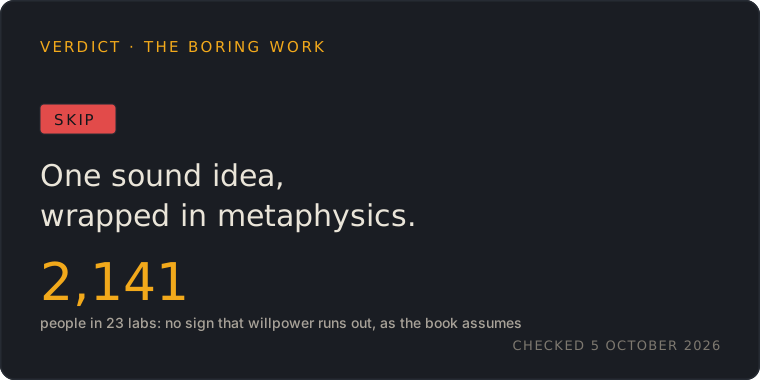
- The book takes for granted that willpower is «a finite resource». A 23-laboratory replication with 2,141 people found no sign of that effect.
- Its framework comes from Sydney Banks’s Three Principles, whose supporting studies are mostly small and run by its own practitioners.
This page discusses anxiety, depression and rumination. It is not medical advice. If thoughts you cannot step away from are affecting your life, a qualified clinician can help.
Verdict
Skip it, and take its one good idea from a better source. The advice to notice thoughts without wrestling with them is sound and well tested, but the same idea comes with evidence and limits in metacognitive and acceptance-based therapies. The book wraps it in spiritual claims stated as facts about the mind, some of which the research contradicts.
Thoughts versus thinking
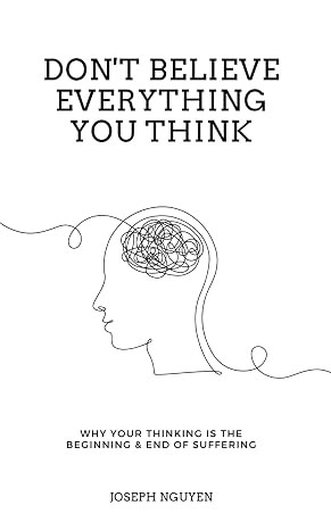
Joseph Nguyen, a former advertising entrepreneur, self-published Don’t Believe Everything You Think in 2022; an expanded edition followed, and his publisher describes it as a New York Times bestseller that promises to reveal «the root cause of all psychological and emotional suffering and how to end it» (Nguyen, expanded edition).
The book rests on one distinction, which Nguyen reads aloud in the full audiobook he published himself. Thoughts, in his account, are «something we have»: they arrive effortlessly, and «the source of thoughts comes from something that is beyond our minds — the Universe, if you will». Thinking is different: «the act of thinking about our thoughts», which «takes a significant amount of energy, effort, and willpower (which is a finite resource)». Then the thesis: «Thinking is the root cause of all our psychological suffering», compressed into a slogan, «Thoughts create. Thinking destroys.» Later he narrows it: «we can only ever feel negative emotions when we are thinking» (Nguyen, audiobook).
The framework is borrowed, and the book says so. Its chapter on the mind presents «three principles: Universal Mind, Consciousness, and Thought», which «were first discovered by Sydney Banks», a Scottish welder in British Columbia who described a spiritual insight in 1973 and founded what its followers call the Three Principles or Innate Health. That origin matters for a reviewer, because it tells us which parts of the book are claims about the world and which are articles of faith. Universal Mind as «the Intelligence behind all living things» is the second kind, and this page leaves it alone.
| Claim | Status | Best evidence | |
|---|---|---|---|
| Repetitive negative thinking drives suffering | Supported | [[Nolen-Hoeksema et al., 2008 | 10.1111/j.1745-6924.2008.00088.x]] |
| Thinking about thoughts is always destructive | Refuted | [[Watkins, 2008 | 10.1037/0033-2909.134.2.163]] |
| Stepping back from thoughts relieves distress | Supported | [[Normann & Morina, 2018 | 10.3389/fpsyg.2018.02211]] |
| Willpower is a finite resource | Not supported | [[Hagger et al., 2016 | 10.1177/1745691616652873]] |
| The Three Principles framework works as an intervention | Early, small studies | [[Dingle et al., 2023 | 10.1080/10509674.2023.2261915]] |
Where the book is right
Start with the part that holds. Rumination, the habit of turning a problem over and over without moving toward a solution, is one of the best-studied risk factors in clinical psychology. A review by Susan Nolen-Hoeksema and colleagues found strong support for the idea that rumination makes depression worse, deepens negative thinking, gets in the way of solving problems and acting on them, and wears away social support, and that it is linked to anxiety, binge drinking and self-harm as well (Nolen-Hoeksema et al., 2008).
The ordinary wandering mind tells a similar story. Using a phone app that asked people at random moments what they were doing, thinking and feeling, two Harvard psychologists found that people’s minds were on something other than what they were doing a large share of the time, and that mind-wandering typically went with feeling less happy (Killingsworth & Gilbert, 2010).
And the book’s remedy, not fighting thoughts, has a long experimental pedigree. In the famous white bear study, people asked not to think of a white bear for five minutes could not manage it, and afterwards thought about the bear more than people who had been allowed to think about it all along (Wegner et al., 1987). A meta-analysis of controlled studies later found that this rebound effect is real but «small to moderate» and varies with the kind of thought (Abramowitz et al., 2001). Trying to stop a thought by force tends to backfire, which is close to what Nguyen says.
Therapies built on stepping back from thoughts rather than arguing with them have done well in trials. Metacognitive therapy, which teaches what its developers call detached mindfulness, was compared with waitlist controls in a 2018 meta-analysis and produced a large effect, Hedges’ g = 2.06, and it also outperformed cognitive and behavioural interventions at the end of treatment, g = 0.69 (Normann & Morina, 2018). To translate g = 2.06: the average treated person ended up better off than about 98% of the people still waiting. Waitlist comparisons flatter any treatment, but this is the strongest support anywhere for the book’s practical advice.
The money exercise
The book’s best-known passage is a thought experiment. Nguyen asks the reader to name the income they dream of, then to multiply it by five and notice what happens. The first number, he says, «popped» up, «quickly and effortlessly»; what followed was a «wild rollercoaster» of doubt: «there’s no way you can make that much», «no one in your family is making that much money». His conclusion: «Having the initial thought of how much you wanted to make didn’t cause any suffering until you began thinking about the thought of how much you wanted to make.»
As a demonstration, it works on many readers, and it illustrates something real: an anxious commentary often follows a simple idea, and noticing that sequence can loosen its grip. As evidence, it is weaker than it feels. The exercise instructs the reader to spend 30 to 60 seconds dwelling on an inflated goal and then reports the anxiety that the instructions invited. A different instruction, such as listing three concrete steps toward the first number, would produce a different feeling, and Watkins’s review suggests it would often be a better one. The experiment shows that some thinking hurts. It cannot show that thinking as such does.
Where it goes wrong
The trouble is the word «all», and the slogan that turns a useful observation into a law. Edward Watkins, a clinical psychologist at the University of Exeter, reviewed the research on repetitive thought and concluded that it «can have constructive or unconstructive consequences» (Watkins, 2008). Its harms are the ones Nguyen describes: depression, anxiety and physical health problems. Its benefits are equally documented: «recovery from upsetting and traumatic events, adaptive preparation and anticipatory planning, recovery from depression, and uptake of health-promoting behaviors».
Which kind you get depends, in Watkins’s account, on the content of the thought, the context and how concretely you are thinking. Turning over «why does this always happen to me» tends to hurt; working through «what exactly do I do on Monday» tends to help. Both are «thinking about thoughts», and the book’s rule would discard both.
The claim that «we can only ever feel negative emotions when we are thinking» runs into the same wall. Nolen-Hoeksema’s review notes that experimental studies show positive distraction relieves depressed mood, which fits the book; it also documents rumination as one route to distress among several. Grief, physical pain and fear in an actual emergency do not wait for a train of thought, and Nguyen half-concedes this when he allows that fear in a dark alley can be useful. A law with an exception for every situation that matters is not a law.
«Willpower (which is a finite resource)»
In passing, the book treats willpower as a fuel that runs down with use. That idea, ego depletion, was one of the most cited findings in social psychology until it was put to a large test. Twenty-three laboratories ran the same preregistered protocol with 2,141 participants, and the depletion effect came out close to zero (Hagger et al., 2016). The full story is in does willpower run out like a muscle.
This matters for the book’s logic more than it seems. Nguyen’s case against thinking leans on the claim that it drains a limited resource; without that, the argument returns to whether a given kind of thinking helps or hurts, which is Watkins’s position rather than his.
The Three Principles behind it
Since the book presents itself as a «completely new paradigm», it is fair to ask how the paradigm it borrows has fared. Three Principles practitioners have published a number of studies, and the better ones are encouraging and small. A pilot randomised trial with 90 incarcerated women found that those given the programme improved on emotion regulation, psychological flexibility, global mental health and trauma symptoms compared with a waitlist, both after the course and six months later (Dingle et al., 2023).
That is a real result and a pilot: one prison, a waitlist control and self-report measures. Much of the earlier published work consists of correlational surveys of people already exposed to the principles. The approach may well help; the evidence that it explains «the root cause of all psychological and emotional suffering» does not exist.
«Instantly»
The publisher’s list of what readers will discover includes «how to instantly create a new experience of life if you don’t like the one you’re in right now» and how to let go of «anxiety, self-doubt, self-sabotage, and self-destructive habits». Those are promises about outcomes, and the treatments that do relieve anxiety and rumination in trials take weeks of practice, with a therapist, and still leave some people unimproved. The metacognitive therapy trials above ran over a course of sessions, not a single reading. An insight can feel instant; the change the research measures is not.
Who should read it
If you are caught in loops of overthinking and want a short, gentle book that tells you to stop fighting your mind, this one may help, and its central exercise, noticing a thought and declining to chase it, is harmless and often useful.
But it is not the best source for that exercise, and its absolute claims could mislead someone with depression or anxiety into treating their condition as a failure to stop thinking. Metacognitive therapy, acceptance-based therapies and plain cognitive behavioural therapy teach the same skill with evidence attached and with the limits stated.
What has been measured about a mind that keeps drifting is collected on the attention page, and another bestseller about not taking your thoughts so seriously is checked in The Subtle Art of Not Giving a F*ck. The full list of checked books lives on the book reviews page.
The boring bottom line
Rumination makes people worse, a wandering mind goes with lower mood, and trying to suppress a thought tends to bring it back. On those points Don’t Believe Everything You Think agrees with the research, and therapies that teach stepping back from thoughts have strong trial results.
Its law, that thinking is the root of all suffering and thoughts come from the Universe, goes far beyond them. Repetitive thought also helps people plan, recover from trauma and climb out of depression; willpower does not run out like fuel; and the Three Principles have pilot data, not proof. Keep the exercise, and leave the metaphysics.
Sources
- Nguyen, J (2024). Don't Believe Everything You Think (Expanded Edition), publisher's page. Simon & Schuster. Publisher's description of the expanded edition; read on 5 October 2026. simonandschuster.com
- Nguyen, J (2022). Don't Believe Everything You Think: full-length audiobook. YouTube. Full-length audiobook published on the author's channel; quotations checked against it and the book's text. youtube.com
- Nolen-Hoeksema, S., Wisco, B.E., Lyubomirsky, S (2008). Rethinking Rumination. Perspectives on Psychological Science. 3(5), 400-424. Review of response styles theory: rumination worsens depression, negative thinking and problem solving; linked to anxiety, binge drinking and self-harm. doi:10.1111/j.1745-6924.2008.00088.x
- Killingsworth, M.A., Gilbert, D.T (2010). A Wandering Mind Is an Unhappy Mind. Science. 330(6006), 932-932. Experience sampling by smartphone: mind-wandering is frequent and typically accompanied by lower happiness. doi:10.1126/science.1192439
- Wegner, D.M., Schneider, D.J., Carter, S.R., White, T.L (1987). Paradoxical effects of thought suppression.. Journal of Personality and Social Psychology. 53(1), 5-13. The white bear experiments: attempted suppression followed by a rebound in the suppressed thought. doi:10.1037/0022-3514.53.1.5
- Abramowitz, J.S., Tolin, D.F., Street, G.P (2001). Paradoxical effects of thought suppression: a meta-analysis of controlled studies. Clinical Psychology Review. 21(5), 683-703. Meta-analysis of controlled thought-suppression studies: small-to-moderate rebound effect. doi:10.1016/S0272-7358(00)00057-X
- Normann, N., Morina, N (2018). The Efficacy of Metacognitive Therapy: A Systematic Review and Meta-Analysis. Frontiers in Psychology. 9, 2211. Meta-analysis of metacognitive therapy, 25 studies (15 RCTs): g = 2.06 versus waitlist; g = 0.69 versus CBT at post-treatment. doi:10.3389/fpsyg.2018.02211
- Watkins, E.R (2008). Constructive and unconstructive repetitive thought.. Psychological Bulletin. 134(2), 163-206. Review: repetitive thought has both unconstructive (depression, anxiety) and constructive (recovery, planning) consequences. doi:10.1037/0033-2909.134.2.163
- Hagger, M.S., Chatzisarantis, N.L.D., Alberts, H., Anggono, C.O., Batailler, C., Birt, A.R., et al (2016). A Multilab Preregistered Replication of the Ego-Depletion Effect. Perspectives on Psychological Science. 11(4), 546-573. Registered replication, 23 laboratories, N = 2,141: ego-depletion effect close to zero. doi:10.1177/1745691616652873
- Dingle, T., Flowers, J., Bowen, S (2023). Insight to wellbeing: a pilot randomized trial of a 3 principles intervention to the alleviation of psychological suffering among incarcerated women. Journal of Offender Rehabilitation. 62(8), 518-533. Pilot randomised trial, 90 incarcerated women, waitlist control; improvements at post-course and 6 months. doi:10.1080/10509674.2023.2261915