TL;DR
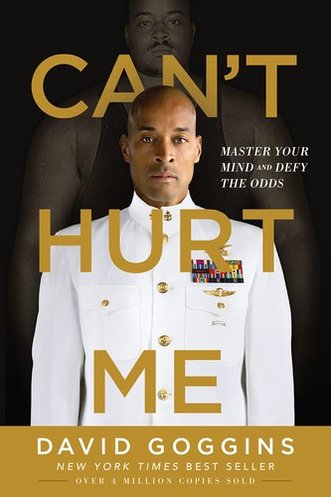
- Can’t Hurt Me is a memoir first, and a powerful one: a hard childhood, an overweight young man, then Navy SEAL training and ultra-endurance records. Its lessons are drawn from one extraordinary life.
- Its famous number is the «40% Rule»: most of us «only tap into 40% of our capabilities». No study measures that. The figure goes back to a motto passed around Navy SEAL training, not to a laboratory.
- The idea underneath it has partial support. Exercise scientists now see fatigue as partly regulated by the brain: mental fatigue cut cycling time to exhaustion by about 15%, and two weeks of motivational self-talk lengthened it by about 18%.
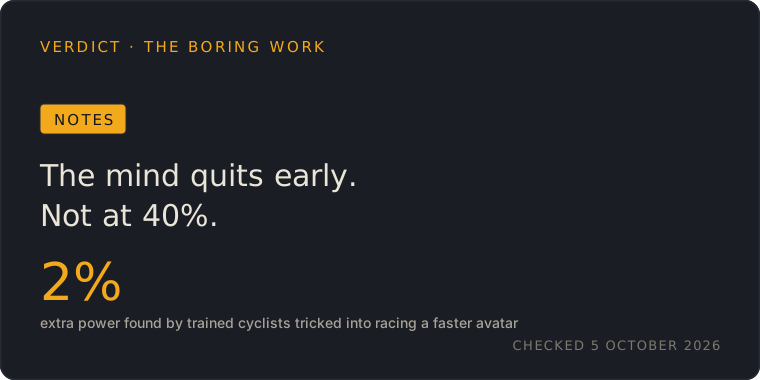
- But the measurable reserve is small. Trained cyclists tricked into racing an avatar 2% faster than their best did beat their usual time, by seconds. That is a hidden margin, not 150% more capacity.
- The book’s mental tools resemble techniques with evidence: self-talk improved sports performance in a meta-analysis of 32 studies, and recalling past successes is a recognised source of self-confidence.
This page discusses training through exhaustion. It is not medical or training advice. Pushing past the signals your body sends can cause serious injury; anyone planning extreme exercise should talk to a doctor first.
Verdict
Read it for the story, and read the notes for the method. Goggins’s life is remarkable, and his central intuition, that people usually stop before their bodies force them to, is partly right. His central number is invented, the real margin is a few per cent rather than more than double, and a philosophy built on ignoring pain carries risks the book treats as badges.
The life and the rule
David Goggins’s own site summarises the book’s arc: a childhood of «poverty, prejudice, and physical abuse», transformation from «a depressed, overweight young man with no future» into a U.S. Armed Forces icon, and the claim that he is «the only man in history to complete elite training as a Navy SEAL, Army Ranger, and Air Force Tactical Air Controller». The same page states the book’s lesson: Goggins «reveals that most of us only tap into 40% of our capabilities. Goggins calls this the 40% Rule» (Goggins, official site).
The memoir offers tools for getting past that 40%: the «accountability mirror», where he wrote his failings on sticky notes and confronted them daily; the «cookie jar», a mental store of past hardships survived, to draw on when the next one arrives; and the «callused mind», built by doing hard and unpleasant things on purpose until discomfort stops ruling decisions. Those tools are psychology, and they can be compared with what has been measured.
| Claim | Status | Best evidence | ||
|---|---|---|---|---|
| We use only 40% of our capacity | Unsupported number | No study of the figure located | ||
| The mind quits before the body | Partly supported | [[Noakes, 2012 | 10.3389/fphys.2012.00082]]; [[Marcora et al., 2009 | 10.1152/japplphysiol.91324.2008]] |
| Talking yourself through it extends endurance | Supported | [[Blanchfield et al., 2014 | 10.1249/MSS.0000000000000184]] | |
| Recalling past wins builds confidence | Supported in theory and practice | [[Bandura, 1977 | 10.1037/0033-295X.84.2.191]] |
Where the 40% comes from
The number has no laboratory behind it that I could find. It circulated as a motto in Navy SEAL training and reached a mass audience before Can’t Hurt Me through Jesse Itzler’s 2015 book Living with a SEAL, in which an unnamed SEAL, later revealed as Goggins, told Itzler that when your mind says you’re done, you’re only 40% done. In both books it is presented as hard-won experience rather than a measurement, and that is the right way to read it.
Take the number literally for a moment to see why it matters. If exhaustion arrives at 40% of capacity, the remaining 60% is one and a half times what you have already done. Anyone who has run until they could not continue knows that what follows is nowhere near another one and a half runs. The rule works as a slogan precisely because nobody tests it. Shout it at someone on the last mile of a race and it may help them finish; write it in a manual and it becomes a claim about human physiology, which is where it fails.
What the brain does to effort
The idea underneath the slogan, that the brain stops us before the muscles do, has a real scientific history. The South African physiologist Tim Noakes argued that fatigue is «predominantly an emotion, part of a complex regulation, the goal of which is to protect the body from harm», reviving an idea from the 19th-century Italian physiologist Angelo Mosso (Noakes, 2012). In this view, the feeling of exhaustion is a warning issued with a safety margin, not a reading of an empty tank.
Experiments support the general point. In a randomised crossover study, 16 people cycled to exhaustion after 90 minutes of either a demanding mental task or neutral documentaries. Mentally fatigued, they quit after 640 seconds on average instead of 754, about 15% sooner, even though heart, lungs and muscles responded the same; what changed was how hard the effort felt (Marcora et al., 2009). If perceived effort can shorten performance with the body unchanged, it can presumably also lengthen it.
That is what self-talk did. In a randomised study, 24 participants cycled to exhaustion before and after two weeks of training in motivational self-talk or a control phase. The self-talk group improved from 637 to 750 seconds, about 18%, and rated the effort as lower (Blanchfield et al., 2014). This is the closest laboratory relative of the callused mind: the same body, a different conversation in the head, a longer ride.
How big is the hidden reserve?
Then the number that the 40% Rule cannot survive. In a deception experiment, nine trained male cyclists raced a 4,000-metre time trial against an on-screen avatar they were told represented their own best effort. In one trial the avatar secretly rode at 102% of that best. The cyclists kept up and finished faster than their baseline, by a margin the researchers estimated at between about 2 and 10 seconds (Stone et al., 2012).
There was a reserve, and athletes reached it when the brain was fooled about the pace. It was a matter of a couple of per cent, not of two and a half times. The same pattern runs through this research: motivation, self-talk and belief move endurance by a few per cent to a few tens of per cent in time-to-exhaustion tests, which are themselves the measure most sensitive to motivation. None of it points to most of our capability sitting unused.
The mental tools
The accountability mirror is a form of self-talk with a written prompt, and self-talk has the strongest evidence of any tool in the book. A meta-analysis of 32 studies with 62 effect sizes found a «positive moderate effect» on sports performance, ES = 0.48, larger for new tasks and for fine motor skills than for gross ones, and larger when people were trained in self-talk (Hatzigeorgiadis et al., 2011).
The cookie jar has a solid theoretical ancestor. Albert Bandura’s theory of self-efficacy, the belief that you can carry out a task, names performance accomplishments, your own past successes, as one of its sources, alongside watching others succeed, being persuaded, and reading your own bodily state (Bandura, 1977). Recalling a past success before a hard task is a reasonable way to draw on that source, and costs nothing.
The callused mind, deliberate exposure to discomfort to make it less frightening, is the least directly tested. It resembles exposure-based approaches in therapy and the general finding that people adapt to stressors they face repeatedly, but I found no study testing Goggins’s version, in which the discomfort is chosen for its own sake and pushed to extremes.
The nearest evidence is encouraging and bounded. A multi-year study of a national US sample found that people with «some but nonzero lifetime adversity» had lower distress, fewer post-traumatic stress symptoms and higher life satisfaction over time than both people with a lot of adversity and people with none, and were the least shaken by new adverse events (Seery et al., 2010). The authors’ own summary was that, «in moderation, whatever does not kill us may indeed make us stronger». Note the two words that do the work: «in moderation». The curve was U-shaped. Those with the heaviest burden of adversity did worst of all, and Goggins’s childhood, as he tells it, sits at that end of the curve. His story is evidence that some people climb out from there, not that the climb is typical.
Mental toughness itself has become a research topic, with questionnaires that measure confidence, commitment and the sense of control under pressure. A systematic review found that higher scores go with better coping, better educational outcomes and better mental health, and that roughly half of the variation in mental toughness between people is accounted for by genes (Lin et al., 2017). That is a useful corrective to the book’s implied promise that anyone can forge Goggins’s mind by will alone. Some of what looks like a callused mind was there before the calluses.
What the book leaves out
The book’s limit is its sample of one. Goggins describes running through serious injuries and medical crises, and finishing anyway. Those stories show what one person was willing to endure; they do not show that enduring was wise, and the same signals of pain he trained himself to override exist to prevent damage. The brain’s safety margin is, on Noakes’s account, there for a reason.
There is also a survivorship problem. For every person who pushed through pain to a record, there are others who pushed through it to a stress fracture or worse, and they do not write memoirs. A rule of «go further than your mind wants» needs a companion rule about when the mind is right, and the book does not supply one.
Sports medicine has a name for what happens when that companion rule is missing. A joint consensus statement of the European College of Sport Science and the American College of Sports Medicine describes a spectrum from «functional overreaching», a short dip in performance that leads to improvement after recovery, to non-functional overreaching and overtraining syndrome, a «prolonged maladaptation» with fatigue, falling performance and mood disturbance. The key, in their words, is that successful training «must avoid the combination of excessive overload plus inadequate recovery» (Meeusen et al., 2013). The callused mind is a tool for overload. Recovery is the half of the equation the 40% Rule leaves out, and it is the half that decides whether hard work makes you stronger or breaks you.
Who should read it
Read it if you need a jolt. The life story is gripping, the voice is unmistakable, and the basic message (you can usually do more than you think, and the voice telling you to stop is not always the truth) is correct in a modest form. Self-talk and remembered wins are real, cheap tools.
Do not read it as physiology. Your reserve is real and small, your pain carries information, and «40%» works as a battle cry rather than a measurement.
What has been measured about pushing sets to the limit is in training to failure, and a runner’s account of a 102 km race is in stop racing ultras. Memoirs and manuals alike are graded in the book reviews.
The boring bottom line
Can’t Hurt Me is right that the brain calls time on effort before the body is spent. Mental fatigue shortened cycling to exhaustion by about 15%, motivational self-talk extended it by about 18%, and self-talk improved sports performance across 32 studies.
The 40% Rule is a motto with no measurement behind it. When researchers tricked trained cyclists into finding their hidden reserve, it came to about 2%. Take the voice, the self-talk and the cookie jar; leave the arithmetic, and listen when the pain is telling you something real.
Sources
- Goggins, D (2018). Can't Hurt Me: book page. davidgoggins.com. The author's site: book description and the 40% Rule in its own wording; read on 5 October 2026. davidgoggins.com
- Noakes, T.D (2012). Fatigue is a Brain-Derived Emotion that Regulates the Exercise Behavior to Ensure the Protection of Whole Body Homeostasis. Frontiers in Physiology. 3. Review arguing that fatigue is a brain-regulated emotion protecting the body (central governor view). doi:10.3389/fphys.2012.00082
- Marcora, S.M., Staiano, W., Manning, V (2009). Mental fatigue impairs physical performance in humans. Journal of Applied Physiology. 106(3), 857-864. Randomised crossover, 16 participants: mental fatigue reduced cycling time to exhaustion from 754 to 640 s; physiology unchanged, perceived effort higher. doi:10.1152/japplphysiol.91324.2008
- BLANCHFIELD, A.W., HARDY, J., DE MORREE, H.M., STAIANO, W., MARCORA, S.M (2014). Talking Yourself Out of Exhaustion. Medicine & Science in Sports & Exercise. 46(5), 998-1007. Randomised, 24 participants, 2 weeks of motivational self-talk: time to exhaustion 637 to 750 s; lower perceived exertion. doi:10.1249/MSS.0000000000000184
- STONE, M.R., THOMAS, K., WILKINSON, M., JONES, A.M., GIBSON, A.S.C., THOMPSON, K.G (2012). Effects of Deception on Exercise Performance. Medicine & Science in Sports & Exercise. 44(3), 534-541. Nine trained cyclists raced an avatar secretly set to 102% of their best; they finished faster than baseline by an estimated 2-10 s. doi:10.1249/MSS.0b013e318232cf77
- Hatzigeorgiadis, A., Zourbanos, N., Galanis, E., Theodorakis, Y (2011). Self-Talk and Sports Performance. Perspectives on Psychological Science. 6(4), 348-356. Meta-analysis of 32 studies, 62 effect sizes: self-talk interventions ES = 0.48 on sports performance. doi:10.1177/1745691611413136
- Bandura, A (1977). Self-efficacy: Toward a unifying theory of behavioral change.. Psychological Review. 84(2), 191-215. Self-efficacy theory; performance accomplishments as one of four sources of efficacy expectations. doi:10.1037/0033-295X.84.2.191
- Seery, M.D., Holman, E.A., Silver, R.C (2010). Whatever does not kill us: Cumulative lifetime adversity, vulnerability, and resilience.. Journal of Personality and Social Psychology. 99(6), 1025-1041. Longitudinal national US sample: some lifetime adversity predicted better outcomes than none or a lot (U-shaped). doi:10.1037/a0021344
- Lin, Y., Mutz, J., Clough, P.J., Papageorgiou, K.A (2017). Mental Toughness and Individual Differences in Learning, Educational and Work Performance, Psychological Well-being, and Personality: A Systematic Review. Frontiers in Psychology. 8, 1345. Systematic review of mental toughness: associations with coping, education and mental health; about 50% heritable. doi:10.3389/fpsyg.2017.01345
- Meeusen, R., Duclos, M., Foster, C., Fry, A., Gleeson, M., Nieman, D., et al (2013). Prevention, Diagnosis, and Treatment of the Overtraining Syndrome. Medicine & Science in Sports & Exercise. 45(1), 186-205. Joint ECSS/ACSM consensus statement on overreaching and overtraining syndrome. doi:10.1249/MSS.0b013e318279a10a