TL;DR
- Influence is a rare thing on the self-help shelf: a book by a working experimental psychologist whose central claims came out of controlled studies. Its seven principles are reciprocation, commitment and consistency, social proof, liking, authority, scarcity and, new in the 2021 edition, unity.
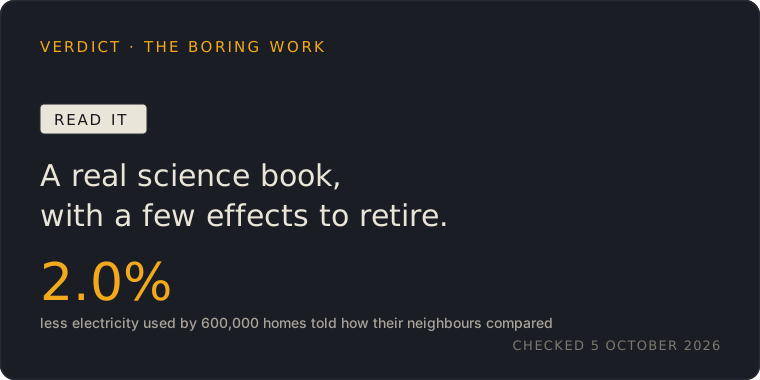
- Most of the principles still hold, with smaller effects than the stories suggest. Letters comparing 600,000 households’ electricity use with their neighbours’ cut consumption by 2.0%, an effect equal to a price rise of 11 to 20%.
- One of the book’s best-known social-proof demonstrations, hotel signs saying most guests reuse their towels, did not beat a standard environmental message when repeated in two German hotels.
- The door-in-the-face technique (a big request, then a smaller one) raised what people said they would do, r = .126 across 78 studies, but had no significant effect on what they did (r = .052).
- Authority is the principle that held best: a partial replication of Milgram’s obedience study in 2006 found obedience only slightly lower than 45 years earlier.
Verdict
Read it. Influence is built on real experiments and has aged better than almost anything else in popular psychology from its era. Read it knowing that several of its signature demonstrations have since produced smaller or no effects in other hands, and that the principles describe tendencies that shift behaviour by a few per cent, not levers that make people say yes.
The book and its author
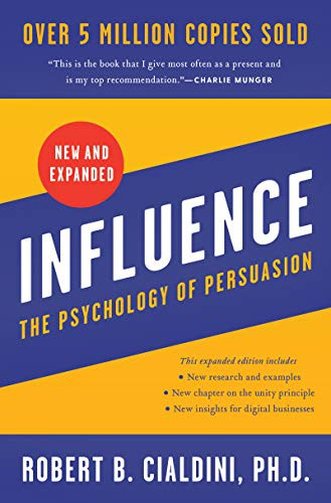
Robert Cialdini, an emeritus professor of psychology and marketing at Arizona State University, first published Influence in 1984 after years of experiments and of working undercover in sales and fundraising jobs to see persuasion from the inside. The 2021 edition, the one now on the bestseller lists, adds a seventh principle. Its publisher describes it as backed by «35 years of evidence-based, peer-reviewed scientific research» and lists the principles as reciprocation, commitment and consistency, social proof, liking, authority, scarcity and «Unity, the newest principle for this edition» (Harper Business, 2021).
That makes this review different from most on this site. The question is not whether the book has evidence, but how well that evidence has survived the replication crisis that hit social psychology after 2011. The answer varies principle by principle.
| Principle | Status | Key evidence | ||
|---|---|---|---|---|
| Reciprocation | Supported, small effects | [[Regan, 1971 | 10.1016/0022-1031(71)90025-4]] | |
| Commitment and consistency | Mixed | [[Burger, 1999 | 10.1207/s15327957pspr0304_2]] | |
| Door-in-the-face (rejection then retreat) | Words yes, behaviour barely | [[Feeley et al., 2012 | 10.1080/03637751.2012.697631]] | |
| Social proof | Supported at scale, one classic did not replicate | [[Allcott, 2011 | 10.1016/j.jpubeco.2011.03.003]]; [[Bohner & Schlüter, 2014 | 10.1371/journal.pone.0104086]] |
| Liking | Supported for similarity | [[Burger et al., 2004 | 10.1177/0146167203258838]] | |
| Authority | Supported | [[Burger, 2009 | 10.1037/a0010932]] | |
| Scarcity | Supported in a meta-analysis | [[Lynn, 1991 | 10.1002/mar.4220080105]] | |
| Unity | Too new to judge | No independent replication located |
Reciprocation and the bottle of Coke
The reciprocation chapter leans on a 1971 experiment by Dennis Regan at Cornell. A participant and a confederate rated paintings; in some sessions the confederate left the room and came back with a soft drink for the participant as an unasked favour, then later asked the participant to buy raffle tickets. Those given the drink bought more tickets, and in the original the favour mattered more than whether the participant liked the confederate (Regan, 1971).
The study was small and of its time, and it is better read as a demonstration than as a measurement. The broader principle, that people feel obliged to return favours, has a large literature behind it and fits everything from free samples to restaurant mints. What a reader should not take from the chapter is a sense of size: a free gift tilts behaviour, it does not compel it.
Commitment and the two doors
The commitment chapter introduces two classic techniques. In the foot-in-the-door, a small first request makes a larger second one more likely; in the door-in-the-face, which the book places under reciprocation, a large request that is refused makes a smaller follow-up more likely, because the requester appears to have made a concession.
Both have been reviewed at scale. Jerry Burger, surveying the foot-in-the-door literature, found it real but fragile, with several psychological processes pulling in different directions, enough to produce successful demonstrations alongside «studies in which the technique was ineffective or led to a decrease in compliance» (Burger, 1999).
The door-in-the-face fared worse. A meta-analysis of its first 35 years found «an overall significant effect of the DITF strategy on verbal compliance (k=78, r=.126), but an insignificant effect for behavioral compliance (k=39, r=.052)» (Feeley et al., 2012). People said yes more often, and then did not show up more often. An r of .126 means the technique accounts for under 2% of the differences in whether people agree; an r of .052 is close to nothing.
Social proof: towels and electricity
Social proof, the tendency to do what people like us are doing, is the principle Cialdini has done most to build in the field, and its fate is the most instructive.
The famous demonstration comes from hotels. In two field experiments, signs telling guests that «the majority of guests reuse their towels» outperformed the standard environmental appeal, and signs about guests «in this room» did best of all (Goldstein et al., 2008). When German psychologists repeated the experiments in two hotels with 724 and 204 guests, both kinds of sign raised towel reuse above no sign at all, but «descriptive norm messages were not more effective than the standard message», and the room-specific effect was inconsistent (Bohner & Schlüter, 2014). The authors pointed to cultural differences; either way, the specific trick did not travel.
The principle itself did travel, and at enormous scale. The company OPOWER mailed Home Energy Report letters comparing households’ electricity use with their neighbours’. Across randomised field experiments with 600,000 treatment and control households in the United States, the average programme cut consumption by 2.0%, «equivalent to that of a short-run electricity price increase of 11 to 20%», with the biggest users cutting by 6.3% and the smallest by only 0.3% (Allcott, 2011).
Two per cent sounds small, and it is: on a monthly bill of 100 units, two units less. Spread across hundreds of thousands of homes at almost no cost, it is also one of the most successful applications of psychology to public policy. That combination, a real effect that is small for each person and large in aggregate, is the right way to read the whole book.
Liking, and a shared birthday
The liking chapter argues that we say yes more readily to people we like, and that liking can be manufactured by small signals: compliments, cooperation, familiarity and, above all, similarity. Cialdini’s examples include salespeople who just happen to share a customer’s hometown or hobby.
The similarity claim has a tidy experimental test from Jerry Burger and colleagues. In four studies, undergraduates who believed they shared a birthday, a first name or a fingerprint pattern with the person making a request «were more likely to comply with a request than participants who did not perceive an incidental similarity with the requester». The effect vanished when the shared feature was described as common, or when the similarity was with someone other than the requester (Burger et al., 2004).
Those details are the useful part. A coincidence works only when it feels rare and personal, which is why the salesperson’s «me too» is so often oddly specific, and why it loses its force once you know the trick. The studies were run with students and small favours, so they say more about the direction of the effect than about its size in a car showroom. They also illustrate the book’s best habit: each principle comes with the conditions under which it stops working, which is exactly the information a reader needs to resist it.
Authority: Milgram, again
The authority chapter rests on Stanley Milgram’s obedience experiments of the early 1960s, in which most participants continued to give what they believed were dangerous electric shocks when an experimenter told them to. Such a study cannot be repeated in full today, but in 2006 Jerry Burger ran a partial replication that stopped at the 150-volt point, where in Milgram’s data 79% of those who continued went on to the end. «Obedience rates in the 2006 replication were only slightly lower than those Milgram found 45 years earlier», he reported, and contrary to expectation, seeing another person refuse did not reduce obedience (Burger, 2009).
Of all seven principles, this is the one where the replication record is strongest relative to the book’s claims. People defer to perceived authority more than they expect to, and that has not changed much in half a century.
Scarcity and unity
The scarcity principle, that things become more desirable when they seem rare or about to run out, is supported by a meta-analysis of commodity theory research, which «deals with the psychological effects of scarcity» and holds that scarcity «enhances the value (or desirability) of anything that can be possessed» (Lynn, 1991). The effects in that literature vary widely, and the review is old, but the direction has held up in marketing research since. The practical lesson for a buyer is simple and old: a countdown timer or a «only two left» label is information about the seller’s strategy, and only sometimes about the stock. Waiting a day before buying is the cheapest way to find out which of the two it is, and it costs the buyer nothing but a little patience.
Unity, the new seventh principle, holds that people are most influenced by those they see as part of a shared «we», such as family, place or identity. It is plausible and draws on research on group identity, but it is the newest part of the book, it was added by the author rather than established by independent replication, and I could not find a test of unity as a persuasion principle by researchers outside Cialdini’s circle. It should be read as a hypothesis with good company rather than an established law.
What the book does well
Influence has two virtues that most of its shelf lacks. It describes how its claims were tested, often in enough detail for a reader to judge them. And each chapter includes a section on defence: how to notice when a principle is being used on you, and how to say no. The 2021 edition keeps both.
Its weakness is the one shared by every book written before the replication crisis: it presents single studies as settled, and some of them were not. The principles are mostly sound; several of the dramatic numbers attached to them are not reliable guides to how much a technique will do for you.
Who should read it
Read it if you sell, negotiate, raise money, or just want to know why you bought the thing you did not need. It is the best popular introduction to persuasion research, and its defensive advice is worth the price on its own.
Read it with this page’s numbers in mind. Expect the techniques to nudge, by single-digit percentages, and to work less well when people are paying attention, which, after reading the book, they increasingly are.
A bestseller that borrowed from the same research tradition and fared worse is Thinking, Fast and Slow, checked, and the classic book on liking and persuasion is reviewed in How to Win Friends and Influence People. The whole shelf of reviewed titles is under book reviews.
The boring bottom line
Influence describes real forces. Neighbour comparisons cut household electricity use by 2.0% across 600,000 homes, obedience to authority barely changed between Milgram’s time and a 2006 replication, and scarcity raises perceived value across many studies.
Some famous demonstrations shrank. The hotel towel sign did not beat a plain environmental message in Germany, and the door-in-the-face moves what people promise more than what they do. Read it as the best book on persuasion written for a general audience, and as a guide to small, reliable nudges rather than magic words.
Sources
- Cialdini, R.B (2021). Influence, New and Expanded: The Psychology of Persuasion (publisher's page). Harper Business. Publisher's description of the 2021 edition and its seven principles; read on 5 October 2026. harpercollins.co.nz
- Regan, D.T (1971). Effects of a favor and liking on compliance. Journal of Experimental Social Psychology. 7(6), 627-639. The soft-drink favour experiment behind the reciprocation chapter; small laboratory study. doi:10.1016/0022-1031(71)90025-4
- Burger, J.M (1999). The Foot-in-the-Door Compliance Procedure: A Multiple-Process Analysis and Review. Personality and Social Psychology Review. 3(4), 303-325. Review of foot-in-the-door research: several processes; successful and failed demonstrations. doi:10.1207/s15327957pspr0304_2
- Feeley, T.H., Anker, A.E., Aloe, A.M (2012). The Door-in-the-Face Persuasive Message Strategy: A Meta-Analysis of the First 35 Years. Communication Monographs. 79(3), 316-343. Meta-analysis, 35 years of door-in-the-face studies: verbal compliance r = .126 (k = 78); behavioural compliance r = .052, not significant (k = 39). doi:10.1080/03637751.2012.697631
- Goldstein, N.J., Cialdini, R.B., Griskevicius, V (2008). A Room with a Viewpoint: Using Social Norms to Motivate Environmental Conservation in Hotels. Journal of Consumer Research. 35(3), 472-482. Two hotel field experiments: descriptive and provincial norms outperformed a standard environmental appeal. doi:10.1086/586910
- Bohner, G., Schlüter, L.E (2014). A Room with a Viewpoint Revisited: Descriptive Norms and Hotel Guests' Towel Reuse Behavior. PLoS ONE. 9(8), e104086. Replication in two German hotels (N = 724 and 204): descriptive-norm signs no better than a standard environmental message. doi:10.1371/journal.pone.0104086
- Allcott, H (2011). Social norms and energy conservation. Journal of Public Economics. 95(9-10), 1082-1095. Randomised natural field experiments, 600,000 households: Home Energy Reports cut consumption by 2.0% on average. doi:10.1016/j.jpubeco.2011.03.003
- Burger, J.M., Messian, N., Patel, S., del Prado, A., Anderson, C (2004). What a Coincidence! The Effects of Incidental Similarity on Compliance. Personality and Social Psychology Bulletin. 30(1), 35-43. Four studies: incidental similarity (birthday, name, fingerprints) increased compliance; no effect when the shared feature was common. doi:10.1177/0146167203258838
- Burger, J.M (2009). Replicating Milgram: Would people still obey today?. American Psychologist. 64(1), 1-11. Partial replication of Milgram to 150 volts, 70 adults in 2006: obedience only slightly lower than in the 1960s. doi:10.1037/a0010932
- Lynn, M (1991). Scarcity effects on value: A quantitative review of the commodity theory literature. Psychology & Marketing. 8(1), 43-57. Meta-analysis of commodity theory: scarcity enhances perceived value. doi:10.1002/mar.4220080105