This timeline sits inside a larger file on what attention research can and cannot measure.
TL;DR
- Nobody has established how long attention takes to recover from heavy phone use. The available trials are too short and too unlike one another to provide a recovery timeline.
- One small, one-week trial found greater objective sustained-attention improvement after a 50% than after a 10% social-media reduction. That is a group comparison, not a recovery curve.
- The trials that compared different durations, up to four weeks, measured loneliness and well-being. Not attention.
- Sleep science has real recovery curves, and they carry a warning: after a week of restriction, three nights of recovery sleep were not enough to restore attention.
- Expect to feel better before you measure better. That gap is the most reliable finding in this area, and the easiest way to fool yourself.
Why does nobody answer how long it takes?
You have cut back. Maybe you did a weekend without the phone, or two weeks with an app blocking everything. Now you want to know the thing every article skips: how long until this works, and how will you know it did.
We checked who answers it. On 27 July 2026 we read every article ranking on Google’s first page for four attention-span queries — thirteen pages in total. Two of them addressed how long recovery takes. Neither cited a source for its estimate. One said “a matter of weeks”. The other said “most people notice improvements in weeks”. Both were guessing in public.
That is the state of the internet on this question. Below is the state of the evidence, which is different and more useful, though not in the way you were hoping.
What does the evidence say about time?
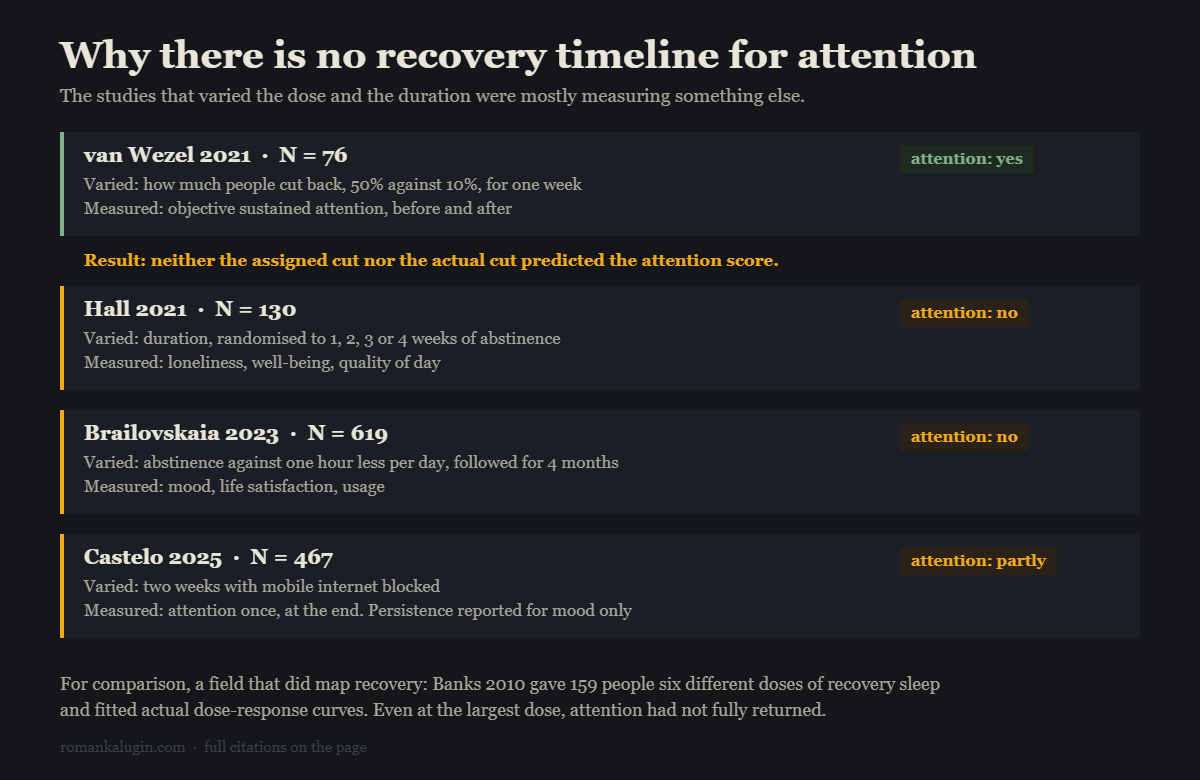
Three trials matter here, and each one answers a different part of the question badly.
Does a bigger cut produce a bigger gain?
Seventy-six people were randomly assigned to cut social media by a target of 50% or 10% for one week, enforced by screen-time timers, with objective sustained attention measured before and after. The 50% target produced greater improvement in the objective sustained-attention measure than the 10% target. This single, short comparison cannot tell us how long improvement takes or whether it persists.
Source: van Wezel et al., 2021. Small sample, one week, two dose levels, and the control group over-complied, which the authors say damaged the manipulation.
Does a longer break produce a bigger gain?
One hundred and thirty people were randomised to no change, or to one, two, three or four weeks of social media abstinence, with a daily diary throughout. This is exactly the design the question needs. The outcomes were loneliness, well-being and quality of day.
Source: Hall et al., 2021. No attention measure of any kind. Duration was not associated with change in what it did measure.
Does the gain last?
The best trial on phones blocked mobile internet for two weeks and measured attention with a five-minute lab task. It reports that well-being and mental health were still elevated two weeks after the block ended.
Source: Castelo et al., 2025. Sustained attention is absent from that persistence sentence. The one trial positioned to answer whether attention gains outlast the intervention does not report it.
There is one more thing worth knowing about that trial, because it is often presented as a dose finding. It compared people who kept the block on for at least ten of fourteen days against everyone else, and the attention effect was 0.26 in that group against 0.23 overall. That is a two-group comparison. The published report contains no analysis relating days of compliance to the size of the attention effect.
And the study people cite as the “24-hour detox” study, in which participants sealed their phones in evidence bags for a day, measured mood, anxiety and craving. It did not measure attention at all. Only craving moved (Wilcockson, Osborne & Ellis, 2019).
Has nobody looked?
It matters which claim we are making, because the weaker one is easy to knock down.
We are not saying the question has been ignored. Researchers have varied the dose. They have varied the duration up to four weeks. They have followed people for four months. Only one small dose study directly compared two social-media reduction targets with an objective attention measure; it found a one-week group difference, but not a recovery timeline or persistence result. The duration study and the four-month follow-up measured mood and usage instead.
The meta-analyses confirm the shape of the gap. Reviews of digital detox trials have tested duration as a moderator and found it non-significant — for well-being. None reports duration as a moderator of a cognitive outcome, because there are not enough trials with cognitive outcomes to pool.
So the defensible sentence is narrow: for attention specifically, one short trial found a difference between two reduction targets, but no dose-response curve or recovery timeline has been established.
One more warning, since this article will be checked. There is a “systematic review” circulating that reports precise attention effect sizes by detox duration, with an optimal window of fourteen to twenty-eight days and a ceiling beyond that. It appears in a journal that is not indexed in PubMed, Scopus or Web of Science, and several of the studies in its reference list cannot be located. If you meet those numbers, that is where they come from.
What does a real recovery curve look like?
To see what is missing, look at a field that did the work. Sleep researchers have mapped recovery of attention properly, and the results are sobering.
Sixty-six people spent a week on three, five, seven or nine hours in bed, then three recovery nights of eight hours. Attention lapses tracked the dose while they were restricted. In the five and seven hour groups, performance did not return to baseline after three recovery nights (Belenky et al., 2003).
A later study went further and varied the recovery itself. One hundred and fifty-nine people spent five nights on four hours, then were randomised to one of six recovery doses, from zero to ten hours in a single night. The authors fitted actual dose-response functions: exponential for attention lapses, linear for other measures. Recovery was incomplete even at the largest dose (Banks et al., 2010).
That is what an answer to “how long does it take” looks like: several doses, a measured curve, and a finding that the obvious recovery period is not enough. Nothing of that shape exists for phones. When someone tells you two weeks off your phone restores your attention, ask which curve they are reading.
Why do you feel better before you measure better?
This is the most consistent pattern across everything above, and it is the one that will mislead you personally.
The dose trial did find greater objective attention improvement in its higher-reduction group, but it did not establish when that improvement stabilises or persists. In the phone trial, the outcomes reported as persisting after the intervention were self-reported; persistence of the objective attention result was not reported. In sleep research, subjective ratings recover before objective attention does — people report feeling fine while their lapse rate is still elevated.
Read that sequence again, because it has a practical consequence. Feeling better is useful, but it is not by itself proof that sustained attention has recovered. Track a repeatable behavioural measure as well as your experience.
What should you do while the answer does not exist?
You still have to decide something. Here is what follows from the evidence rather than from confidence.
1. Use a defined test window, not a weekend. A one-week social-media reduction trial and a two-week mobile-internet blocking trial both measured attention improvement, but neither establishes a universal recovery deadline. The 24-hour version has not been shown to affect attention, and the study that ran it was not measuring attention in the first place. Today: choose a repeatable two-week test window and record a baseline before you start.
2. Reduce, do not abstain. A three-arm trial of 619 people compared a week of total smartphone abstinence, a week of one hour less per day, and no change. Both helped; the reduction group did better and its effects were more stable at follow-up (Brailovskaia et al., 2023). This also matches what happened when a trial demanded total blocking: only a quarter of participants managed it. Today: set one hour less, not zero.
3. Batch, do not silence. In a field experiment with 237 participants, receiving notifications in three scheduled batches a day improved attention and well-being. Hourly batching did not help, and switching them off entirely had mixed results (Fitz et al., 2019). Today: three fixed times, not silence.
4. Fix sleep first or you are testing nothing. Attention degrades with sleep restriction in a dose-dependent way and does not fully recover in three nights. Any attention experiment run on top of a sleep debt is measuring the debt. Today: if you are under seven hours, that is the intervention. If you sleep enough and are still depleted, the problem may not be attention at all — see why tired, sleepy and burned out need different fixes.
5. Take a baseline you did not invent. If you only track how you feel, you will conclude it worked, because that is what feelings do here. The task used in the research, the gradual-onset continuous performance task, is publicly available and free. It measures one narrow thing over five minutes and it is not a diagnosis. Today: record one score before you change anything, and the same task at the same time of day afterwards. What a good session feels like, and why chasing it is a separate question, is covered in how to reach flow state.
6. Plan for the rebound. In the two-week trial, daily screen time fell from 314 minutes to 161, then climbed back to 265 within a fortnight of the block coming off, without anyone asking participants to keep going. Whatever you build has to survive the block being removed. Today: decide now what stays permanently.
When will this not work?
Everything above assumes the problem is your relationship with a device. Often it is not.
The most common misdiagnosis is simpler than any clinical one. If you can concentrate when you decide to, but keep deciding not to, the mechanism is avoidance rather than attention, and no amount of blocking will move it. That is procrastination, and what predicts it is a different list.
Difficulty concentrating is one of the least specific symptoms there is. It appears in ADHD, depression, anxiety, sleep apnoea, iron deficiency, thyroid problems, long COVID and grief. A poor score on an attention task does not identify any of them: adults with ADHD do perform worse on these tasks, at medium effect sizes around 0.46 to 0.69, but a meta-analysis of 83 studies concluded the deficits are neither necessary nor sufficient to explain the condition (Willcutt et al., 2005). Those distributions overlap heavily. An online test cannot tell you which side you are on.
The useful distinction is not what you have, but what changed. Attention that has been poor since childhood, in every setting, is a different investigation from attention that fell off a cliff eight months ago. The second pattern is the one most likely to have a treatable cause, and the one most often wasted on productivity advice.
See a doctor rather than a system if the change is recent and worsening, or if it comes with low mood or loss of interest, heavy snoring or witnessed pauses in breathing, unexplained fatigue or weight change, or if it started after a head injury, a new medication or an illness. Nothing here is medical advice or a diagnosis.
Whether standing at your desk sharpens attention was tested in twelve experiments; the result is in do standing desks improve productivity. Whether phones caused the rise in teenage distress is a separate question, examined in The Anxious Generation, checked.
The boring bottom line
There is no recovery timeline, and the reason is not that the field forgot to ask. It asked with the wrong instrument: the studies that varied the dose and the duration were mostly measuring how people felt, and the one that measured attention properly found no relationship to dose at all.
What is left is a floor rather than a schedule. Two weeks of substantially less phone internet has produced a measurable improvement once, the effect was the smallest of the three that trial measured, and nobody has shown it survives the intervention ending. Reduce rather than abstain, batch rather than silence, fix sleep before you test anything, and take a baseline you cannot flatter. Then be suspicious of the moment you feel it working, because in every study where both were measured, that feeling arrived first and on its own.
Sources
- van Wezel MMC, Abrahamse EL, Vanden Abeele MMP (2021). Does a 7-day restriction on the use of social media improve cognitive functioning and emotional well-being? Addictive Behaviors Reports , 14, 100365. N = 76, 50% vs 10% reduction, null for objective sustained attention. Addictive Behaviors Reports. doi:10.1016/j.abrep.2021.100365
- Hall JA, Xing C, Ross EM, Johnson RM (2021). Experimentally manipulating social media abstinence: results of a four-week diary study. Media Psychology. 24(2), 259-275. N = 130, five durations, well-being outcomes only doi:10.1080/15213269.2019.1688171
- Castelo N, Kushlev K, Ward AF, Esterman M, Reiner PB (2025). Blocking mobile internet on smartphones improves sustained attention, mental health, and subjective well-being. PNAS Nexus. 4(2), pgaf017. N = 467 randomised, 25.5% compliant, attention dz = 0.23. PMID 39967678 doi:10.1093/pnasnexus/pgaf017
- Wilcockson TDW, Osborne AM, Ellis DA (2019). Digital detox: the effect of smartphone abstinence on mood, anxiety, and craving. Addictive Behaviors. 99, 106013. 24-hour abstinence; no attention measure doi:10.1016/j.addbeh.2019.06.002
- Brailovskaia J, Delveaux J, John J, Wicker V, Noveski A, Kim S, Schillack H, Margraf J (2023). Finding the sweet spot of smartphone use. Journal of Experimental Psychology: Applied. 29(1), 149-161. N = 619, abstinence vs one hour less vs control, four-month follow-up doi:10.1037/xap0000430
- Fitz N, Kushlev K, Jagannathan R, Lewis T, Paliwal D, Ariely D (2019). Batching smartphone notifications can improve well-being. Computers in Human Behavior. 101, 84-94. N = 237 doi:10.1016/j.chb.2019.07.016
- Belenky G, Wesensten NJ, Thorne DR, Thomas ML, Sing HC, Redmond DP, Russo MB, Balkin TJ (2003). Patterns of performance degradation and restoration during sleep restriction and subsequent recovery. Journal of Sleep Research. 12(1), 1-12. N = 66, four sleep doses, three recovery nights insufficient doi:10.1046/j.1365-2869.2003.00337.x
- Banks S, Van Dongen HPA, Maislin G, Dinges DF (2010). Neurobehavioral dynamics following chronic sleep restriction: dose-response effects of one night for recovery. Sleep. 33(8), 1013-1026. N = 159, six recovery doses, fitted dose-response functions doi:10.1093/sleep/33.8.1013
- Willcutt EG, Doyle AE, Nigg JT, Faraone SV, Pennington BF (2005). Validity of the executive function theory of attention-deficit/hyperactivity disorder: a meta-analytic review. Biological Psychiatry. 57(11), 1336-1346. 83 studies doi:10.1016/j.biopsych.2005.02.006