If the decline is not sudden but lifelong, start instead with what is known about attention spans.
TL;DR
- “Suddenly” is the most informative word in your question, and every article ranking for it ignores that word completely.
- A change you can date is a different problem from attention that has always been poor. It usually has a cause, and the cause is often treatable.
- Sudden onset argues against ADHD rather than for it. The diagnosis requires symptoms present in childhood.
- The short list worth ruling out first: sleep debt, sleep-disordered breathing, depression and anxiety, thyroid, iron, a new medication, and post-viral cognitive change.
- Do this in order, and give sleep a fair two weeks before you conclude anything, or you will be testing every other theory against a deficit.
Why is “suddenly” the word that matters?
We read what currently ranks for this question. The answers are screens, sleep hygiene, overstimulation, noisy environments, and dopamine. They are answers to a different question: why attention is worse in general, for everyone, gradually.
You did not ask that. You said suddenly. You have a before and an after, and probably a rough date. That detail is diagnostic, and it is being thrown away.
Gradual and universal points at how you live. Sudden and personal points at something that changed in you. Those need different first moves, and the second one is the one where general advice can cost you months.
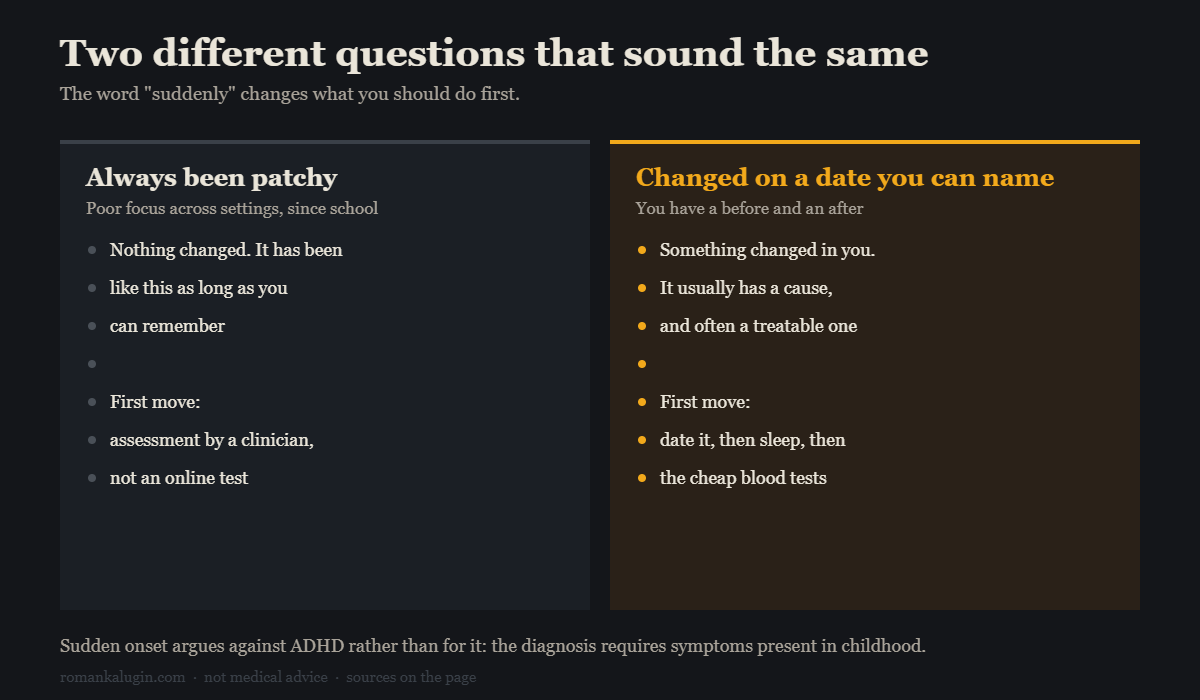
What does “suddenly” argue against?
The most common conclusion people reach on their own is ADHD. Sudden onset is evidence against it, not for it.
ADHD is a neurodevelopmental condition. The diagnostic criteria require symptoms to have been present in childhood, and the international consensus statement is explicit that it begins early and is not something that appears in an otherwise unremarkable adult in the space of a few months (Faraone et al., 2021).
That does not mean adult diagnosis is invalid. Plenty of adults are diagnosed late, because the childhood signs were missed, masked, or absorbed by a structured environment. But that is a story of recognition arriving late, not of onset arriving late. If you can name the month things changed and there was nothing before it, the honest reading is that something else changed.
The second thing sudden onset argues against is a test result. People take an online continuous performance test, score badly, and treat that as confirmation. A meta-analysis of 83 studies found that people with ADHD do perform worse on executive function tasks, at medium effect sizes of roughly 0.46 to 0.69 — but the deficits are neither necessary nor sufficient to explain the condition (Willcutt et al., 2005). Effects that size mean the distributions overlap heavily. A bad score tells you that you did badly on that task, on that day.
Two more things that prove nothing either way, because they get quoted at people constantly: being able to focus intensely on something you enjoy, and having a shorter attention span than a goldfish. The second is not even a real number — the figure was never measured.
What does it point to instead?
This is not a diagnosis and it is not ordered by how likely you are to have it. It is ordered by how cheap each one is to rule out, which is a different and more useful order.
Sleep debt, and not the amount you think
Attention degrades with sleep restriction in a dose-dependent way, and it does not bounce back quickly. In a controlled study, people on five or seven hours in bed for a week did not return to baseline after three recovery nights (Belenky et al., 2003).
Tell: a change that started around a new schedule, a baby, a night-shift rotation, or a habit of catching up only at weekends.
Sleep-disordered breathing
This is the one people miss because they are asleep for it. In a population cohort, moderate-to-severe sleep-disordered breathing was present in 17% of men and 9% of women aged 50 to 70 (Peppard et al., 2013).
Tell: snoring, waking unrefreshed after enough hours, morning headache, or a partner who has noticed you stop breathing.
Depression and anxiety
Concentration difficulty is a diagnostic feature, not a side issue. A meta-analysis found cognitive impairment in depression across attention, executive function and memory, present during episodes and often lingering into remission (Rock et al., 2014).
Tell: loss of interest or pleasure alongside the focus problem, or a mind that is busy rather than blank.
Thyroid
Cheap to test and common enough to be worth it. In a screening study of 25,862 people, 9.5% had an elevated TSH (Canaris et al., 2000).
Tell: cold intolerance, weight change, dry skin, or unusual fatigue arriving with the fog.
Iron, even without anaemia
In a randomised trial of 198 non-anaemic menstruating women with ferritin below 50, twelve weeks of iron reduced fatigue by about half from baseline, roughly 19 percentage points more than placebo (Vaucher et al., 2012). Note the boundary: this was fatigue, in that population, with low ferritin. It is not a general focus supplement.
Tell: heavy periods, a vegetarian or vegan diet, endurance training, or recent blood donation.
A medication that changed
Antihistamines, some blood pressure drugs, sleep aids, and several psychiatric medications affect concentration. So does stopping something.
Tell: onset within a few weeks of a new prescription, a dose change, or a discontinuation.
After an infection
A community study of around 113,000 people found measurable cognitive differences after Covid-19, small on average but larger and more persistent in those with prolonged symptoms (Hampshire et al., 2024).
Tell: the change dates from an illness, and word-finding or mental speed feels affected as much as focus.
Load, grief, and life events
Not everything with a date is pathology. Sustained stress, caregiving, bereavement and upheaval consume the same capacity you are trying to spend on work.
Tell: the timing matches an event, and the difficulty is worst on tasks that require holding several things in mind.
What should you do, in order?
1. Date it. Write down the month it changed and what else changed that month: job, medication, illness, sleep pattern, relationship, bereavement. Most people find the answer at this step and stop reading. Today: five minutes, on paper.
2. Give sleep a fair two weeks. Not a good night. Two weeks of adequate opportunity, because the recovery data says a few nights is not enough to restore attention after a period of restriction. Everything else you test while carrying a sleep debt is being tested unfairly. Today: set the bedtime, not the alarm.
3. Take the cheap tests. If the change is recent and has not resolved with sleep, a basic panel is a reasonable conversation with a doctor: thyroid function, full blood count and ferritin, and a question about sleep-disordered breathing if you snore or wake unrefreshed. Today: book it rather than researching it further.
4. Screen the mood question honestly. Ask whether interest and pleasure have gone, not just focus. Attention problems that travel with anhedonia are a different conversation and a more urgent one. Today: answer that one question truthfully.
5. Only then optimise. If nothing above fits and the change is real, the environmental work is worth doing: substantially less mobile internet for at least two weeks rather than a heroic weekend, notifications in three batches a day, and a measured baseline rather than a feeling. That is covered in how long it takes to get your attention back, including the uncomfortable part: nobody has established a recovery timeline.
When should you stop reading and see a doctor?
Nothing here is medical advice or a diagnosis, and a web page cannot examine you. Some patterns should go to a clinician rather than to a productivity system, and soon.
Concentration that is getting worse week by week rather than holding steady. Difficulty that arrived with, or after, a head injury. Word-finding trouble, getting lost in familiar places, or other people noticing before you did. Focus loss alongside low mood, loss of interest, or any thoughts of harming yourself. Unexplained weight loss, fever or night sweats. New neurological symptoms: weakness, numbness, vision changes, or a first seizure. Witnessed pauses in breathing during sleep.
None of those means something terrible is happening. All of them mean the next step is an examination, not an app.
Is it ever just the phone?
We are not going to overcorrect. A real change with a real date can still be behavioural: a new job with a chat tool that never stops, a phone habit that grew quietly, a role that switched from deep work to interruption management.
The test is whether the difficulty follows the environment. If focus returns on holiday, on a train with no signal, or in a different office, the mechanism is load and interruption rather than something inside you. If it follows you everywhere and did not exist a year ago, keep working down the list above.
Not every environment built to hold your attention is a phone. One recent case, argued rather than graded, is a film designed to withhold its own resolution. Whether heavy phone use counts as an addiction is the question behind our notes on «Dopamine Nation».
The boring bottom line
The word “suddenly” is the useful part of your question and the part every ranking article throws away. Attention that has always been patchy is one investigation. Attention that changed on a date you can name is another, and that one usually has a cause rather than a lifestyle.
Sudden onset argues against ADHD, because that diagnosis needs childhood symptoms. It argues for the cheap and boring list: sleep, breathing during sleep, mood, thyroid, iron, medication, recent illness, and load. Date the change, fix sleep properly for two weeks, take the simple tests, answer the mood question honestly. Optimise last, not first.
Sources
- Faraone SV, Banaschewski T, Coghill D, et al (2021). The World Federation of ADHD International Consensus Statement. Neuroscience & Biobehavioral Reviews. 128, 789-818 doi:10.1016/j.neubiorev.2021.01.022
- Willcutt EG, Doyle AE, Nigg JT, Faraone SV, Pennington BF (2005). Validity of the executive function theory of attention-deficit/hyperactivity disorder: a meta-analytic review. Biological Psychiatry. 57(11), 1336-1346. 83 studies doi:10.1016/j.biopsych.2005.02.006
- Belenky G, Wesensten NJ, Thorne DR, et al (2003). Patterns of performance degradation and restoration during sleep restriction and subsequent recovery. Journal of Sleep Research. 12(1), 1-12. N = 66 doi:10.1046/j.1365-2869.2003.00337.x
- Peppard PE, Young T, Barnet JH, Palta M, Hagen EW, Hla KM (2013). Increased prevalence of sleep-disordered breathing in adults. American Journal of Epidemiology. 177(9), 1006-1014 doi:10.1093/aje/kws342
- Rock, P. L.; Roiser, J. P.; Riedel, W. J.; Blackwell, A. D. (2014). Cognitive impairment in depression: a systematic review and meta-analysis. Psychological Medicine. Rock PL, Roiser JP, Riedel WJ, Blackwell AD (2014). Cognitive impairment in depression. 44(10), 2029-2040 doi:10.1017/S0033291713002535
- Canaris GJ, Manowitz NR, Mayor G, Ridgway EC (2000). The Colorado thyroid disease prevalence study. Archives of Internal Medicine. 160(4), 526-534. N = 25,862 doi:10.1001/archinte.160.4.526
- Vaucher P, Druais PL, Waldvogel S, Favrat B (2012). Effect of iron supplementation on fatigue in nonanemic menstruating women with low ferritin. CMAJ. 184(11), 1247-1254. N = 198 doi:10.1503/cmaj.110950
- Hampshire A, Azor A, Atchison C, et al (2024). Cognition and memory after Covid-19 in a large community sample. New England Journal of Medicine. 390(9), 806-818 doi:10.1056/NEJMoa2311330