Every claim on this site gets a grade, a date and a list of the papers behind it. This one sits in the registry of checked claims.
TL;DR
- The dictionary that made it word of the year built the doubt into the definition. Oxford’s entry calls brain rot “the supposed deterioration of a person’s mental or intellectual state”; the word supposed is theirs.
- Split into four separate claims, it gets four different answers. Attention: a large correlation and a failed replication, pointing opposite ways. Immediate memory: two small experiments, effects lasting minutes. Brain structure: one study of 75 people, measured once. Dementia: no study of short-form video exists.
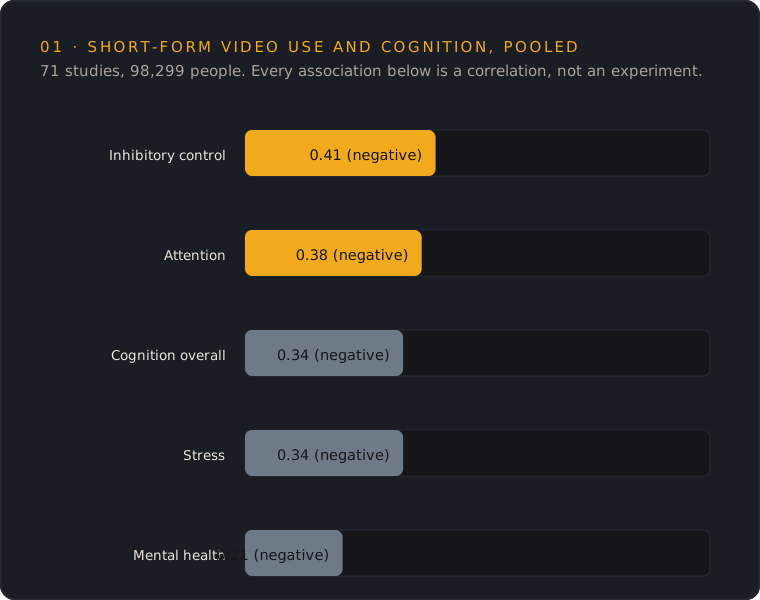
- The biggest synthesis pools 71 studies and 98,299 people and finds video use associated with poorer attention at r = −.38. Every study in it is correlational, so it cannot say which way the arrow runs.
- The one lab test of the founding claim went the other way: a meta-analysis of 39 effect sizes found the link between media multitasking and distractibility disappeared once small-study bias was corrected for.
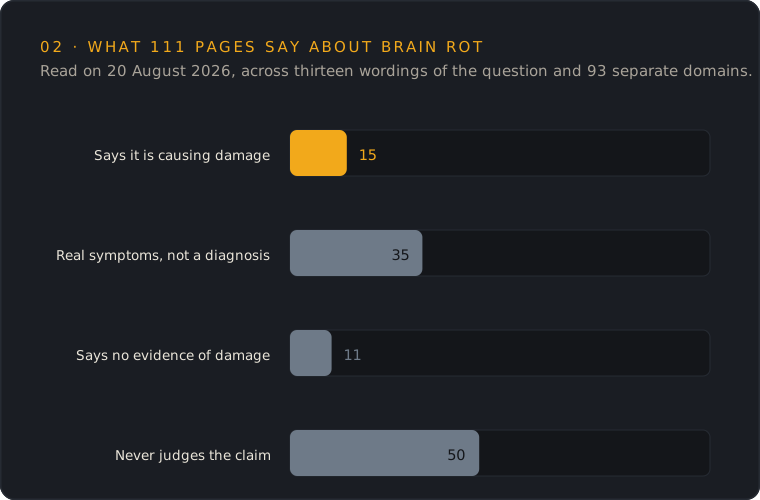
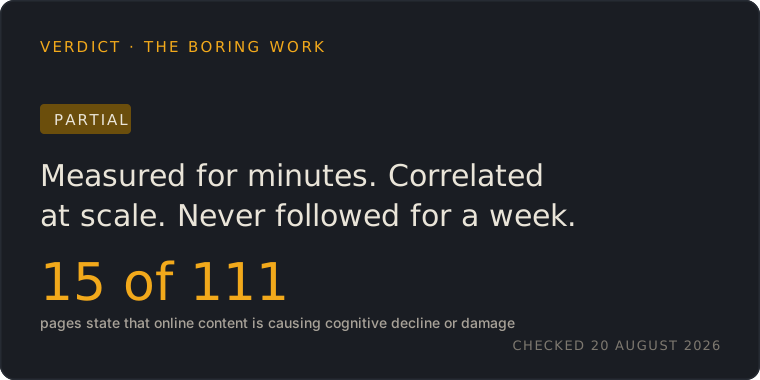
- Of the 111 pages we read on 20 August 2026, fifteen state that online content is causing cognitive decline or damage. Thirty-five say the symptoms are real and the term is not a diagnosis. Eleven say plainly that no evidence of damage exists.
In November 2024, after a public vote with more than 37,000 participants, Oxford University Press named brain rot its word of the year. The definition it published is worth reading slowly, because a lexicographer chose every word in it: brain rot is “the supposed deterioration of a person’s mental or intellectual state, especially viewed as the result of overconsumption of material (now particularly online content) considered to be trivial or unchallenging” (Oxford University Press, 2024). Supposed. Viewed as. Considered to be. The dictionary crowned the term and hedged every clause of it.
Here is the best joke in the whole story: the first recorded use of «brain rot» is from 1854. Henry David Thoreau, sitting alone by Walden Pond with no wifi, complained that England was busy curing potato rot while nobody moved to cure «brain-rot», the shallow chatter of his day. People have worried about trash content dissolving minds for 170 years; only the trash changes. What is new is that there are now actual studies. Not many, and not the ones people cite, but enough to answer what turn out to be four separate questions hiding inside one meme.
Four claims, four verdicts
| Claim | Verdict | What has been measured | Where the limit is |
|---|---|---|---|
| It wrecks your attention | Partial, and contested | 71 studies, 98,299 people: video use with attention r = −.38, inhibitory control r = −.41 (Nguyen et al., 2025) | All correlational. In lab tests of distractor filtering the association vanished after correcting for small-study bias |
| It hurts your memory | Partial, for minutes | 45 people, video context-switching worsened prospective memory afterwards (Barton & Smyth, 2025); 140 students, forward digit span 6.63 against 7.61 (Mittal et al., 2026) | Both measure the half hour after watching. Neither followed anyone for a week |
| It changes your brain’s structure | Partial, from one study | 75 adults: higher media multitasking scores tracked smaller grey matter density in the anterior cingulate cortex (Loh & Kanai, 2014) | Cross-sectional. The authors state they cannot specify the direction of causality |
| It leads to dementia | Untested | No prospective study of short-form video and dementia exists. The nearest evidence is 407,792 people followed 12.6 years, where five hours of daily television carried a dementia hazard ratio of 1.44 and computer use carried none (Xu et al., 2024) | That study is about television in middle-aged and older adults, not about scrolling |
Attention: a big correlation and a failed replication
The strongest evidence for the claim is also the evidence that cannot prove it. An Australian team pooled 71 studies covering 98,299 people, the biggest sweep ever done. Heavy short-video users scored worse on cognition overall, and worst of all on attention and self-control, correlations of −.38 and −.41, which in psychology is serious money (Nguyen et al., 2025). Curiously, there was no link at all with body image or self-esteem.
But every one of those numbers is a correlation, and a correlation is a photograph of two things standing next to each other, not a video of one pushing the other. Three worlds produce the same picture: scrolling rots attention; people with restless attention scroll more; or something third, boredom, stress, insomnia, drives both. The 71 studies cannot pick between them, because not one randomised anybody to scroll.
Now put that next to the one place where the question was tested rather than surveyed. Wisnu Wiradhany and Mark Nieuwenstein at the University of Groningen ran two replications of the founding study on media multitasking and distractibility, with an average replication power of 0.81, and then meta-analysed everything published. Of 14 tests, five reached significance and two survived a Bayesian analysis. Their meta-analysis of 39 effect sizes “yielded a weak but significant association between media multitasking and distractibility that turned nonsignificant after correction for small-study effects” (Wiradhany & Nieuwenstein, 2017).
The contradiction dissolves once you see what each side measured. The big scary correlations mostly come from people rating their own attention on questionnaires. The null comes from sitting the same kind of people at an actual test and timing them. Heavy scrollers say their attention is wrecked; when measured, they perform fine. Which is the truth, the confession or the stopwatch? That depends on what you think attention is, a subject the timeline of how attention recovers takes further.
What the first page of Google says about it
On 20 August 2026 we ran thirteen wordings of the question (is brain rot real, does short form video damage your brain science, can scrolling cause permanent brain damage evidence and ten more) and read every page they returned: 111 pages across 93 domains.
Fifteen of the 111 state that online content is causing cognitive decline or damage. Thirty-five take the middle position: the symptoms are real, the term is not a diagnosis, the association is an association. Eleven say plainly that no evidence of damage exists, and fifty never judge the claim. This is a topic where the careful answer has largely won: the hospital blogs and the health desks land on “not a medical condition, and the feeling is real”, which is close to what the evidence supports.
The five that go further are worth naming by kind rather than by name: two are addiction-treatment clinics, one is a supplement seller, one is a neurology practice, and one is a newsletter reporting a single study as proof. Three of the five slide between the folk term and clinical brain damage inside the same article, listing meningitis, traumatic brain injury and neurodegenerative disease among the causes of “brain rot”, which is a category error with a phone number attached.
Memory: real, and measured in minutes
On memory, two real experiments exist, both small, and both about the half hour after you put the phone down. In Bristol, 45 people either binge-switched between short videos, watched with limited switching, or watched nothing, then took a memory test. The binge-switchers got worse. The limited-switchers improved (Barton & Smyth, 2025). Same videos, same screen; the poison was the pace of switching, not the medium.
The second is a comparison of 140 medical students in Rajasthan, half of whom scrolled for thirty minutes and half of whom did something offline, tested immediately afterwards on digit span. The scrolling group did worse on forward span, 6.63 against 7.61, and the paper reports both of its measures honestly: “The social media group scored lower than the control group on both forward (6.63 1.30 vs. 7.61 1.77) and backward (5.46 1.51 vs. 5.90 1.79) digit span tests (p < 0.001 and p = 0.118, respectively)” (Mittal et al., 2026). The second of those two p-values is not significant, and the paper’s conclusion nonetheless says working memory was impaired.
These two studies do the one thing the 98,299-person pile cannot: they assign who scrolls, so the arrow of cause is clean. But both stop the clock within the hour. They prove the post-scroll fog is real, the way a hangover is real. They say nothing about whether a year of scrolling leaves a scar, because nobody has run that study.
Structure: one paper, 75 people, measured once
Every claim that screens are physically changing your brain traces back to a small number of imaging papers, and the one that gets cited most is from 2014. Kep Kee Loh and Ryota Kanai, then at Duke-NUS in Singapore and University College London, scanned 75 healthy adults and correlated their media multitasking scores with grey matter density. Higher scores went with smaller density in the anterior cingulate cortex, and with weaker connectivity between that region and the precuneus (Loh & Kanai, 2014).
And the authors themselves wrote the caveat into the abstract: «the cross-sectional nature of our study does not allow us to specify the direction of causality». Translation: we photographed 75 brains once, and we cannot tell whether heavy multitasking shrank that region or people born with a smaller one drift into heavy multitasking. For ten years that sentence has been quoted with the caveat filed off, as «scrolling shrinks your brain».
Dementia: the study does not exist
Nobody has followed short-form video users to see whether they develop dementia. The claim circulates anyway, usually under the label “digital dementia”, and the label is worth pausing on: search that phrase in the medical literature and what comes back is research on digital tools for assessing dementia risk. The folk claim and the technical term are two different things sharing a name.
What does exist is a large prospective cohort on screens of a different kind. Chenjie Xu and colleagues at Hangzhou Normal University followed 407,792 UK Biobank participants who were free of dementia, stroke and Parkinson’s at enrolment, for a median of 12.6 years. Watching five or more hours of television a day, against nought to one hour, carried a dementia hazard ratio of 1.44 (95% CI 1.28 to 1.62), with smaller elevations for stroke and Parkinson’s, and inverse associations with grey matter and hippocampal volume. And then the sentence that never travels: “we did not observe the significant associations between discretional computer use and brain-related disorders or neuroimaging features” (Xu et al., 2024).
Sit with that: two kinds of screen, one giant cohort, opposite results. Five hours of daily TV tracked with 44% higher dementia risk; recreational computer use tracked with none. Whatever drives the television number, and hours of motionless sitting is the prime suspect, it is not the lit rectangle itself. Stretching that finding to cover phones means leaping across a gap the very same study measured and found.
Where the limits are
The meta-analysis is large and entirely correlational. The two experiments are 45 and 140 people and stop within the hour. The imaging paper is 75 people at one time point. The dementia cohort is about middle-aged and older adults watching television between 2006 and 2010, which is a different behaviour on different hardware in a different decade. And the term itself is roughly two years old in its current sense, which is less time than a prospective study takes to run.
One more limit, and it is the one this site keeps running into: the popular version of the claim borrows numbers from elsewhere. The eight-second attention span attributed to a Microsoft report, which turns up on several of the pages we read, is a statistic with no study behind it. A claim can be worth investigating and still be argued for with invented evidence.
What to do with this instead
The shift: stop asking whether your brain is damaged and start asking what the scrolling replaced.
First move: separate the feeling from the mechanism. The fog after an hour of short video is measurable (two experiments found it), and it is measured in minutes, not months. Treating it as recoverable fatigue matches the evidence better than treating it as accumulating damage.
Second move: watch the pace, not the medium. The one experiment that varied switching speed found that limited switching improved prospective memory while unlimited switching worsened it. Same videos, same screen, opposite result.
Third move: when a page cites brain scans, check the sample and the design before the conclusion. The imaging finding behind most of these claims is 75 people measured once, and its own authors say it cannot establish direction.
Nothing here is a claim about children specifically. The evidence discussed above was collected on adults and university students, apart from the meta-analysis, which pooled youth and adult samples and reports the pattern as consistent across both. Questions about what any of this means for a particular child belong with a clinician rather than with a table of correlations.
The boring bottom line
Brain rot names something people feel, and the honest word for that something is fatigue, not rot. Attention correlates with video use at −.38 across nearly a hundred thousand people, and the one lab test of the same idea came out empty. Memory takes a hit that has been measured for half an hour. Brain structure has been photographed once, in 75 people, by authors who said aloud that they cannot tell which way the arrow points. Dementia has not been studied at all.
Oxford got it right in the definition and nobody read that far. Supposed deterioration. Two years on, it is still supposed.
Sources
- Oxford University Press (2024). Brain rot named Oxford Word of the Year 2024. Oxford University Press press office. The definition the dictionary settled on contains the word supposed, which is the whole question this page answers. corp.oup.com
- Nguyen, L., Walters, J., Paul, S., Monreal Ijurco, S., Rainey, G. E. (2025). Feeds, feelings, and focus: A systematic review and meta-analysis examining the cognitive and mental health correlates of short-form video use. Psychological Bulletin. The largest synthesis on the question. Every association in it is a correlation, and the review notes that domains beyond attention and inhibitory control are barely studied. doi:10.1037/bul0000498
- Wiradhany, W., & Nieuwenstein, M. R (2017). Cognitive control in media multitaskers: Two replication studies and a meta-analysis. Attention, Perception & Psychophysics. 80(2), 351-368. The direct test of the founding claim that heavy media multitaskers filter distraction worse, and it does not hold up. doi:10.3758/s13414-017-1408-4
- Loh, K. K., & Kanai, R (2014). Higher media multi-tasking activity is associated with smaller gray-matter density in the anterior cingulate cortex. PLoS ONE. 9(9), e106698. The one brain-imaging finding behind every claim that screens are changing the brain's structure. Seventy-five people, measured once. doi:10.1371/journal.pone.0106698
- Xu, C., Cao, Z., Lu, Z., Hou, Y., & Wang, Y (2024). Associations between recreational screen time and brain health in middle-aged and older adults: A large prospective cohort study. Journal of the American Medical Directors Association. 25(6), 104910. The largest prospective evidence on screens and later brain disorders, and the two kinds of screen come out differently. doi:10.1016/j.jamda.2024.03.010
- Barton, N., & Smyth, M (2025). Context-switching in short-form videos: What is the impact on prospective memory?. Memory. 33(7), 1-14. The closest thing to an experiment on the thing people mean by the phrase, and it measures the half-hour after watching, not anything lasting. doi:10.1080/09658211.2025.2521076
- Mittal, A., Sohu, A., Agarwal, V., Manna, S., & Grover, S (2026). The effect of social media scrolling on working memory among Indian medical students: A prospective comparative observational study. Cureus. The paper concludes that scrolling impairs working memory. One of its two measures returned a null result, and the abstract prints both. doi:10.7759/cureus.105147