Every claim on this site gets a grade, a date and a list of the papers behind it. This one sits in the registry of checked claims.
TL;DR
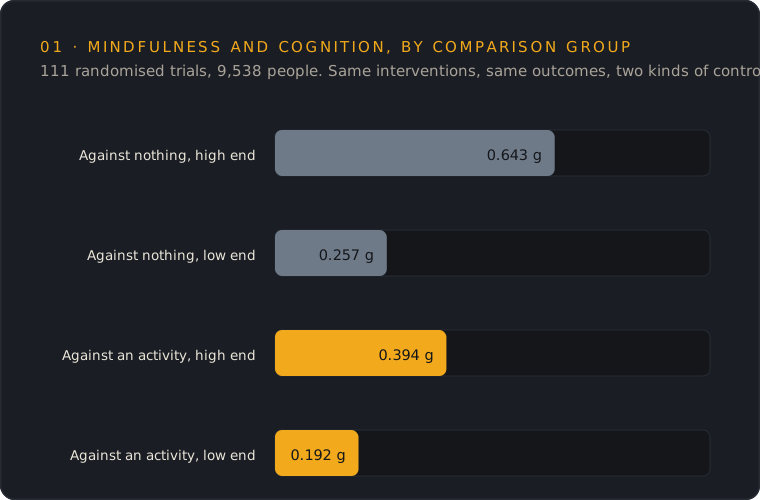
- Yes, and by about a third of what the headlines imply. Across 111 randomised trials and 9,538 people, the effect on cognition runs at g = 0.257 to 0.643 against doing nothing, and g = 0.192 to 0.394 once the comparison group is given something else to do.
- The gap between those two numbers is the whole story, and it is missing from every popular account we read. In one review the same contrast is described as medium-to-large against inactive controls and low-to-negligible against active ones.
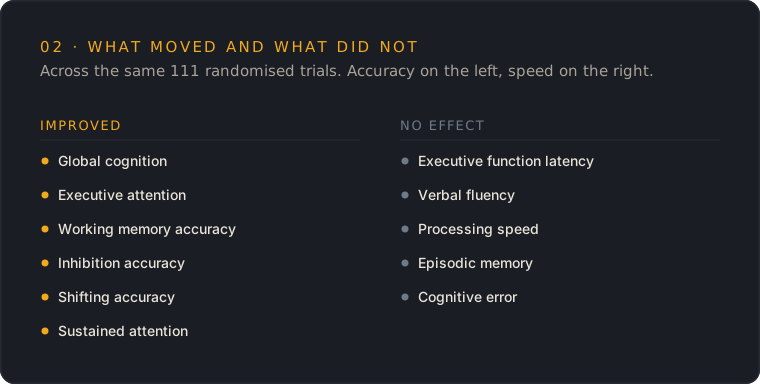
- Not every kind of attention moves. Accuracy-based measures improve; latency measures, verbal fluency, processing speed and episodic memory do not.
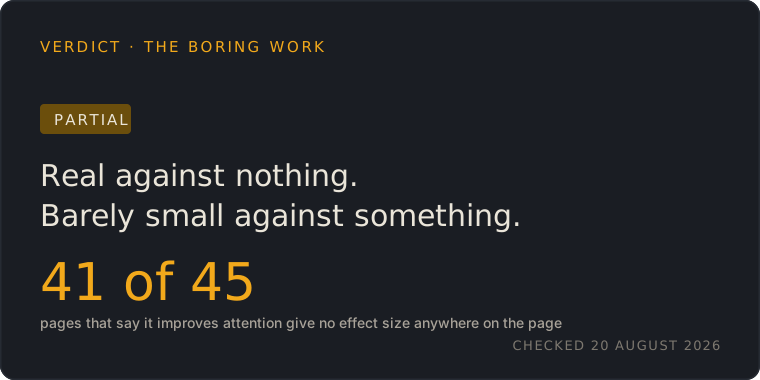
- Of the 116 pages we read on 20 August 2026, forty-five state that mindfulness improves attention. Forty-one of those forty-five give no effect size anywhere on the page. The four that do are research papers and one evidence-led guide.
- Adverse effects are documented and rarely mentioned. In a study that interviewed 96 programme participants properly, 83% reported at least one meditation-related side effect and 37% one that affected functioning, rates the authors put on a par with other psychological treatments.
Imagine testing a headache pill by comparing people who took it against people who got nothing: no pill, no attention, just a waiting list. The pill would look miraculous, because half the «effect» would be attention, hope and time off. That is precisely how most mindfulness trials were run, and it is why this page opens with a number almost nobody publishes. Not because it is hidden, it sits in the abstract of the largest meta-analysis on the subject, but because it is unflattering in a specific way: the benefit of mindfulness for attention shrinks by roughly half the moment the comparison group is given literally anything else to do.
This page gives the effect size twice, once for each comparison, then separates the kinds of attention that move from the kinds that do not, says how much practice the people in the trials did, and ends with the part that gets left out of every article about benefits.
Three words before the numbers
Effect size: how big a difference is, expressed in standard deviations rather than in units of whatever was measured. Hedges’ g of 0.2 is conventionally small, 0.5 moderate, 0.8 large.
Waitlist control: the comparison group is told to wait and given nothing. Any difference includes the effect of attention, expectation, structure and time away from ordinary life.
Active control: the comparison group is given something else to do (relaxation, education, exercise). Only this comparison isolates the practice itself.
The effect size nobody quotes
Against nothing: 0.257 to 0.643. Against something: 0.192 to 0.394. Nur Hani Zainal at Harvard Medical School and Michelle Newman at Penn State pooled 111 randomised controlled trials covering 9,538 meditation-naive participants, and reported the two comparisons separately. Mindfulness-based interventions had “small-to-moderate significant effects on global cognition, executive attention, working memory accuracy, inhibition accuracy, shifting accuracy, sustained attention, and subjective cognitive functioning (vs. waitlist/no-treatment, g = 0.257-0.643; vs. active controls, g = 0.192-0.394)” (Zainal & Newman, 2024).
Look hard at that second range. Its lower end, 0.192, dips below the official threshold for even a «small» effect. Not zero, and nothing like «meditation rewires your attention». One more twist from the same paper: effects were stronger in people with real psychiatric symptoms than in healthy adults. The person these trials help most is not the productivity enthusiast with an app subscription; it is the person who was struggling to begin with.
A second review states the contrast in words rather than numbers, and more bluntly. Francesco Oliva and colleagues at the University of Turin looked at mindfulness for attention deficit disorder across 31 papers and described “the gap detected by our systematic review between the medium/large effect size of inactive-controlled studies and the low/negligible one of active-controlled studies” (Oliva et al., 2021). They also note that in children, no active-controlled study has been run at all, and that publication bias was detected in some of the adult analyses.
Which attention moves, and which does not
«Attention» is not one skill, and the data split it beautifully. Mindfulness improved the careful kinds: sustained attention, working memory accuracy, catching errors, resisting impulses. It did nothing for the fast kinds: reaction times, processing speed, verbal fluency, and nothing for episodic memory.
The pattern has a one-line summary: meditation makes you more careful, not quicker. Which makes sense, the practice is literally rehearsing «notice when you drift, come back, don’t judge», and that is an accuracy skill. If what you want from focus is raw throughput, these trials point elsewhere: toward the timeline of how attention recovers after an interruption.
What the first page of Google says about it
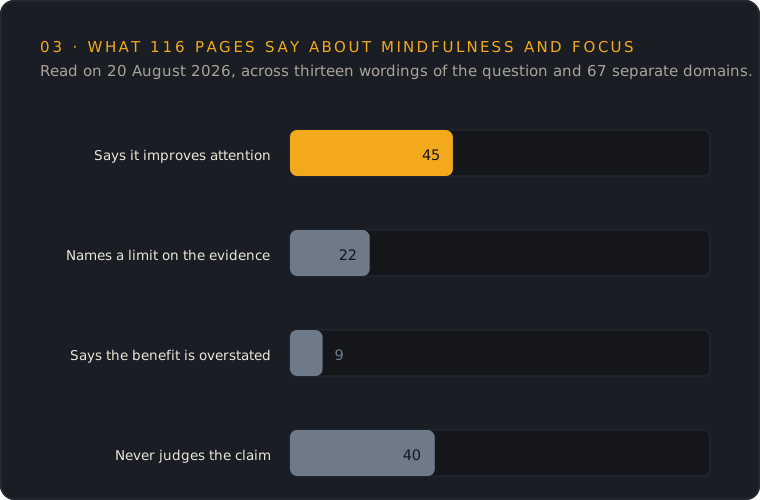
On 20 August 2026 we ran thirteen wordings of the question (does mindfulness improve focus attention, meditation attention span research evidence effect size, mindfulness benefits overhyped criticism evidence weak and ten more) and read every page they returned: 116 pages across 67 domains.
Forty-five of the 116 state that mindfulness improves attention. Twenty-two name a real limit on the evidence, nine argue the benefit is unproven or overstated, and forty never judge the claim. Then we went back through the forty-five and searched each page for any effect size at all: the strings effect size, Cohen’s d, Hedges’ g, d = and g =. Forty-one of the forty-five contain none of them anywhere on the page. The four that do are three research papers and one evidence-led practitioner guide.
The pages that do handle it well are worth reading. A university science office states the crux in one line — “the kicker is that mindfulness is rarely shown to be better than an active control” — and a site run by mindfulness practitioners, of all places, lays out exactly why a waitlist comparison cannot settle anything: the benefit “could come from meditation — but also from receiving attention, taking time away from work, relaxing, expecting improvement, or participating in a structured wellness activity”.
Three things wearing one word
One more trap before any of this applies to your mornings: «mindfulness» is three different things wearing one coat, and the popular articles swap between them mid-sentence.
A state. Being absorbed in what you are doing right now. Measured with questionnaires, correlated with lots of things, and almost never the subject of a randomised trial, because you cannot randomise people into a state.
A practice. Sitting for some minutes and returning attention to a chosen object when it drifts. This is what most people mean by meditating, and it varies enormously in length, technique and guidance.
A programme. An eight-week standardised course, usually mindfulness-based stress reduction or mindfulness-based cognitive therapy, with weekly group sessions, a teacher, homework and a manual. This is the thing that gets randomised, and every effect size on this page comes from it.
The slippage matters because every effect size on this page comes from the third thing, the full eight-week programme with a live teacher, a group, homework and a manual. When a phone app boasts «backed by over a hundred randomised trials», the trials studied the classroom course, not the app. It is like a home juice powder citing trials of hospital nutrition wards.
How much practice the trials involved
And how much did trial participants practise? Researchers at Aarhus pooled 43 studies and found people completed about 64% of their assigned homework, roughly 30 minutes a day, six days a week (Parsons et al., 2017). Every benefit number above was bought at that price, not at the price of ten app-minutes on the tram.
Across 28 studies with 898 participants, the association between how much people practised and how much they improved came out at r = 0.26, interval 0.19 to 0.34. Small, positive, and based on self-reported practice. So the honest version of “how much do I need to do” is: the people in these trials averaged around half an hour a day, six days a week, and doing more of it tracked with doing slightly better.
The part the benefit articles leave out
Adverse effects are documented, common enough to matter, and depend heavily on whether anyone asks. Miguel Farias and colleagues at Coventry University screened 6,742 citations and reviewed 83 studies covering 6,703 people who had practised meditation. Overall prevalence of adverse events was 8.3% (95% CI 0.05 to 0.12), but 3.7% in experimental studies and 33.2% in observational ones. The most common were anxiety at 33%, depression at 27% and cognitive anomalies at 25%. Their conclusion: “the occurrence of AEs during or after meditation practices is not uncommon, and may occur in individuals with no previous history of mental health problems” (Farias et al., 2020).
That tenfold gap between study designs is the tell: side effects appear when somebody bothers to ask. One Brown University team asked properly, sending an independent interviewer with a 44-item checklist to 96 programme graduates. The answers: 83% reported at least one meditation-related side effect, 58% something unpleasant, 37% something that interfered with daily functioning, and lasting negative effects in 6 to 14%, linked to hyperarousal and dissociation (Britton et al., 2021).
The authors file the finding fairly: meditation’s side-effect rate is «similar to other psychological treatments». Sitting alone with your own mind for half an hour a day is a psychological intervention, and psychological interventions have side effects. The difference is that therapy is sold with that warning printed on it, and mindfulness is sold as a candle-scented harmlessness.
Where the limits are
The 111-trial synthesis covers meditation-naive participants, which is the right population for the question and not the population of long-term practitioners. Effects were larger in people with elevated psychiatric symptoms and in medical samples than in healthy controls, so the average conceals two different groups. Home practice figures come from what participants reported doing, not from anything measured. The adverse-events prevalence swings by a factor of nine depending on study design, which means any single number for it is a claim about methods as much as about meditation.
And the word covers three different things (a state, a practice, and a standardised eight-week clinical programme) that share almost no evidence base with each other. Nearly all the numbers on this page come from the third. Whether ten minutes with an app inherits them is not something these trials tested.
What to do with this instead
The shift: when a page says mindfulness improves attention, ask what the other group was doing.
First move: treat “improves attention” and “improves attention more than an equivalent activity” as two different claims, because these trials treat them that way. The first is well supported. The second is supported at around 0.2 to 0.4 standard deviations, which is real and modest.
Second move: if you are after accuracy (fewer careless errors, better catching yourself drifting), these findings point your way. If you are after speed, it does not: latency measures and processing speed did not move across 111 trials.
Third move: notice that a page claiming a benefit and giving no number is not reporting research, whatever it links to. Forty-one of the forty-five pages we read that assert the benefit contain no effect size at all.
Nothing here is a practice protocol or a recommendation about whether to meditate. The practice amounts quoted above describe what participants in published trials did, which is the only form in which such a number means anything. If meditation is being considered alongside a mental health condition, that is a conversation with a clinician; the adverse-effects literature above is precisely why.
Two neighbouring pages in the attention cluster: the attention hub, which starts from what focus research can and cannot measure, and the eight-second goldfish figure, an attention statistic that travelled for a decade with no study behind it.
The boring bottom line
Mindfulness improves some kinds of attention, by a small amount, in trials where the comparison group was given something to do, and by roughly twice as much in trials where the comparison group was given nothing. Both numbers are printed in the same abstract. Only the larger one travels.
Forty-five pages told us it works. Four of them contained a number. That ratio is the reason this site exists.
Sources
- Zainal, N. H., & Newman, M. G (2024). Mindfulness enhances cognitive functioning: A meta-analysis of 111 randomized controlled trials. Health Psychology Review. 18(2), 369-395. The only synthesis that reports the two control conditions separately, which is the number this question turns on. Effects were stronger in people with elevated psychiatric symptoms than in healthy controls. doi:10.1080/17437199.2023.2248222
- Oliva, F., Malandrone, F., di Girolamo, G., Mirabella, S., Colombi, N., et al (2021). The efficacy of mindfulness-based interventions in attention-deficit/hyperactivity disorder beyond core symptoms: A systematic review, meta-analysis, and meta-regression. Journal of Affective Disorders. 292, 475-486. The clearest statement anywhere of what happens to the effect when the comparison group is given something to do instead of nothing. doi:10.1016/j.jad.2021.05.068
- Parsons, C. E., Crane, C., Parsons, L. J., Fjorback, L. O., & Kuyken, W (2017). Home practice in mindfulness-based cognitive therapy and mindfulness-based stress reduction: A systematic review and meta-analysis of participants' mindfulness practice and its association with outcomes. Behaviour Research and Therapy. 95, 29-41. What people in the trials actually did, rather than what the programme asked of them, and how weakly the amount tracks the result. doi:10.1016/j.brat.2017.05.004
- Farias, M., Maraldi, E., Wallenkampf, K. C., & Lucchetti, G (2020). Adverse events in meditation practices and meditation-based therapies: A systematic review. Acta Psychiatrica Scandinavica. 143(5), 374-393. The prevalence depends heavily on whether the study went looking, which is the pattern in every literature where nobody asks about harms. doi:10.1111/acps.13225
- Britton, W. B., Lindahl, J. R., Cooper, D. J., Canby, N. K., & Palitsky, R (2021). Defining and measuring meditation-related adverse effects in mindfulness-based programs. Clinical Psychological Science. 10(6), 1185-1204. The study that asked properly, and put the rate in context: comparable to other psychological treatments rather than uniquely dangerous. doi:10.1177/2167702621996340