TL;DR
- The idea was not overturned. It shrank: across 273 studies and 365,915 people, the link between mindset and school achievement came out weak.
- The best-designed test, a preregistered national trial with US secondary students, found a short online session raised grades for lower-achieving students, and mainly in schools where classmates’ norms backed the message.
- Two meta-analyses of the same literature appeared in the same journal in 2023 and disagreed about method. Both are cited here, with the objection raised against one of them.
- Carol Dweck began correcting the popular version herself in 2015: «Maybe we originally put too much emphasis on sheer effort.»
- Nearly all of the evidence comes from children and teenagers. In 5,653 university applicants, the association with aptitude scores was slightly negative.

Verdict
Read the notes, not the whole programme. The core idea survived two decades of testing at a fraction of its advertised size, and its author has spent the last ten years saying so in public.
This page is about the book. The question of how big the mindset effect is, and for whom, has its own check on growth mindset; numbers appear below only where they bear on a promise the book makes.
The napkin version
Carol Dweck, a psychologist at Stanford when the book appeared in 2006, built it around a distinction that fits on a napkin. Some people believe ability is fixed: you are good at maths or you are not. Others believe ability grows with work. Those beliefs shape what you do when a task gets hard, and because reactions to difficulty compound over years, the belief ends up writing a good part of your biography. Change the belief, the book says, and you change the trajectory. Schools took that sentence seriously, and mindset posters went up in classrooms on several continents.
Two studies carry most of the weight. In six experiments, children praised for being clever chose easier tasks afterwards and did worse after a setback than children praised for effort (Mueller & Dweck, 1998). And a study that followed 373 seventh graders through two years of junior high linked the belief that intelligence can grow to rising maths grades, with a small taught intervention (48 pupils against 43 controls) attached (Blackwell et al., 2007).

Both founding studies are small, both were run on children, and both come from before psychology tightened its methods around 2015. None of that makes them wrong. It does mean that what was published after them measures the idea better than the book can, and that a reader of the 2006 text holds the hypothesis in its most confident form rather than its best-tested one.
The book also presents mindset as a trait you have, one type or the other, and builds portraits of people around it: the fixed-mindset athlete, the growth-mindset manager. The author later rejected that framing herself and described people as mixtures. Read with that in mind, several chapters change status. They illustrate a distinction rather than demonstrate it.
273 studies later
In 2018 a team pooled 273 studies with 365,915 participants to ask how strongly mindset tracks achievement, and a further 43 studies to ask whether interventions move it. Their summary: «Overall effects were weak for both meta-analyses», with some support for the idea that students from poorer families or at academic risk might benefit (Sisk et al., 2018).
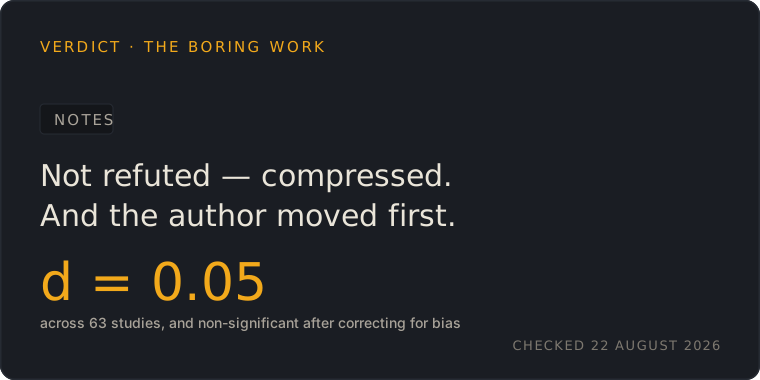
Five years later the intervention literature was meta-analysed twice in the same journal, by teams reading it in different ways. One graded every study against best practice for causal inference and found, across 63 studies and 97,672 participants, an average effect of d = 0.05, 95% CI [0.02, 0.09], which did not survive a correction for publication bias; it fell to 0.04 where the intervention demonstrably changed students’ mindsets and to 0.02 in the highest-quality studies (Macnamara & Burgoyne, 2023).
The other team modelled the variation inside studies and reported that in targeted groups with faithful delivery, effects on achievement reached d = 0.14, 95% CI [0.06, 0.22], and effects on mental health d = 0.32, while stressing «the extensive variation in effects to be expected from future interventions» (Burnette et al., 2023).
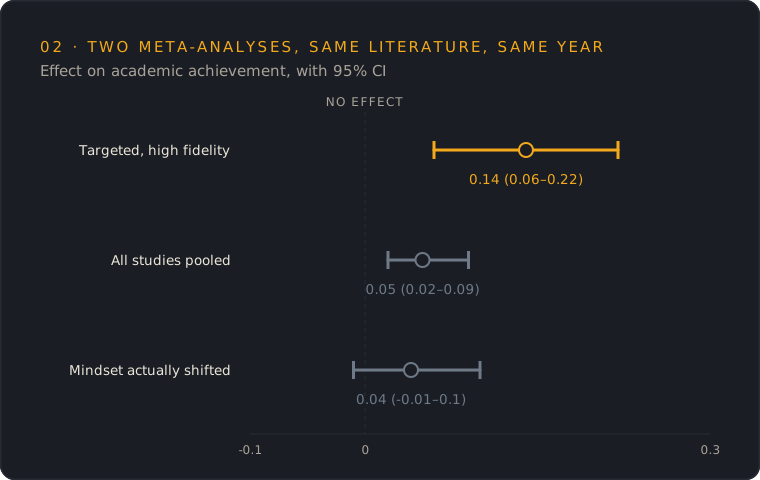
A commentary in the same journal argued that averaging results within each study and testing moderators one at a time, as the sceptical team did, is weaker practice for a large and varied literature than modelling that variation directly (Tipton et al., 2023). Several of its authors work on growth mindset themselves, which a reader should know when weighing it. One finding from the sceptical paper should not get lost in the methods argument: «Authors with a financial incentive to report positive findings published significantly larger effects than authors without this incentive.»
A d of 0.05 needs translating. Picture two classrooms of thirty, one that got the intervention and one that did not, and line both up by grades. The two lines would overlap almost completely; you could not tell which classroom was which by looking at the marks. Across a whole country, a shift that small can still be worth buying, since the intervention costs almost nothing. For one student, it is compatible with no change at all. The population claim survives at a whisper. The personal transformation on the cover does not.
The two 2023 teams are easier to reconcile than their headlines suggest, because both published their criteria. One asked how much of the literature meets the bar for a causal conclusion and found very little. The other asked where effects concentrate and found them in particular groups given a carefully delivered version. Those are different questions, and a reader can hold both answers at once.
Under an hour, and who it moved
The most informative single study is a randomised trial in a nationally representative sample of US secondary-school students, preregistered, with data collected and processed independently and the results corroborated by a blinded Bayesian analysis, which is a level of rigour rare anywhere in psychology.
An online intervention lasting under an hour «improved grades among lower-achieving students and increased overall enrolment to advanced mathematics courses», and the effect on grades held in schools whose peer norms supported the message (Yeager et al., 2019).
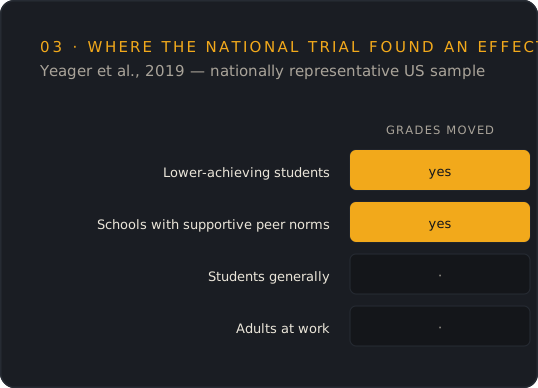
That is a real result, and look at its shape. A free hour of online exercises helps students who are struggling, in schools where classmates do not sneer at the idea. Worth having, and a long way from «change your belief, change what you can become», which is how the book reads on a beach.
What the author wrote in 2015
The part of this story that does Dweck the most credit is also the part the mindset industry quotes least. In 2015, after watching what schools had done with her idea, she published an essay correcting the popular version by name and point by point.
On effort: «A growth mindset isn’t just about effort … Students need to try new strategies and seek input from others when they’re stuck.» On what schools were doing: «the path to a growth mindset is a journey, not a proclamation». And she named what she saw spreading, «false growth mindset»: teachers adopting the language and the posters while their teaching stayed the same. «The growth mindset was intended to help close achievement gaps, not hide them.»
Then the passage that matters most for anyone deciding whether to read the book: «Maybe we originally put too much emphasis on sheer effort. Maybe we made the development of a growth mindset sound too easy. Maybe we talked too much about people having one mindset or the other, rather than portraying people as mixtures» (Dweck, 2015).
She was not withdrawing the idea or conceding that the effect is zero; her collaborators were running the national trial in the same period. She was narrowing what the message was supposed to carry, and warning that a version of it had escaped into schools, where it worked as praise instead of as teaching.
Children, almost all of them
One limit runs under everything above and is rarely said aloud. The original experiments were on schoolchildren. The national trial was on secondary-school students. Both 2023 meta-analyses are dominated by school samples.
The studies I found that test the idea away from the original setting are not encouraging. In 5,653 university applicants sitting a scholastic aptitude test, growth mindset showed no positive association with scores; the correlation was slightly negative, r = −0.03 (Bahník & Vranka, 2017). And in a series of studies with 624 Chinese children aged 9 to 13, starting with a close replication of the 1998 praise experiment, the classic mindset manipulation had no effect on resilience after failure once an active control was added, and mindset did not predict grades across a semester (Li & Bates, 2019).
The book’s later chapters carry the idea into sport, business and marriage. I found no study testing that extension, which makes it untested rather than supported, and it is the part of the book most quoted in management writing.
What a 2006 book could not have known
Part of the distance between the book and what came after it is nobody’s fault. In 2006 the field had no habit of preregistration, rarely corrected for unpublished null results and had run almost no large coordinated replications. Every area of psychology that went through that change came out with smaller effects, and mindset research is neither the worst case nor an outlier.
Nor could the book have known how its idea would be used. The national trial’s most interesting finding is how much the effect depended on context: the same hour of intervention did different things in different schools, according to whether the surrounding culture supported it. A book cannot carry a condition like that, and the version that spread through classrooms was the version without it.
The mental-health thread was not in the 2006 argument at all. One of the 2023 analyses found effects on mental health larger than those on grades, which points somewhere the book was not looking and where follow-up work has not yet caught up.
Who should read it
Read it if you want to understand how a psychological idea swept through education, and what a shrinking effect looks like from the inside. Read the 2015 essay next to it; together they make a short course in a research programme correcting itself in public.
Do not read it as a programme for your life or your team. «Change the belief and the outcome follows» is stronger than the evidence at every step: the correlation, the intervention and the jump from school to adulthood. If you work with struggling students, the national trial says something specific and useful, and it is a better guide than the book.
And if the book helped you, nothing here says that experience was imaginary. Small average effects hide large differences between individuals in both directions, and a book that changed how you read your own failures did something a meta-analysis is not built to detect. What the numbers limit is the promise made on other people’s behalf: that teaching this belief will reliably change outcomes at scale.
The book’s neighbour on the persistence shelf went through the same compression: does grit predict success. Another classroom idea that outran its data is learning styles, and every book checked so far is in the book reviews.
The boring bottom line
Across 273 studies and 365,915 people, the link between mindset and achievement is weak. Across 63 intervention studies the pooled effect is d = 0.05 and does not survive a correction for publication bias; a parallel analysis of the same studies reaches 0.14 in targeted groups with faithful delivery, and the two teams still disagree about method.
The best trial found a real, small effect for lower-achieving students in schools whose culture backed it. Almost every study was run on children; in 5,653 university applicants there was nothing. And the author started correcting the emphasis in 2015, in her own words, which is more than most authors on this shelf have ever done.
Sources
- Mueller, C. M., & Dweck, C. S (1998). Praise for intelligence can undermine children's motivation and performance. Journal of Personality and Social Psychology. 75(1), 33-52. The source of the book's praise chapter, included as the object of examination rather than as confirmation. doi:10.1037/0022-3514.75.1.33
- Blackwell, L. S., Trzesniewski, K. H., & Dweck, C. S (2007). Implicit theories of intelligence predict achievement across an adolescent transition: A longitudinal study and an intervention. Child Development. 78(1), 246-263. The origin of the «short intervention raises grades» claim, on a sample small enough that the later national trial matters far more. doi:10.1111/j.1467-8624.2007.00995.x
- Sisk, V. F., Burgoyne, A. P., Sun, J., Butler, J. L., & Macnamara, B. N (2018). To what extent and under which circumstances are growth mind-sets important to academic achievement? Two meta-analyses. Psychological Science. 29(4), 549-571. The number itself, and the wider evidence around it, is set out on this site's page on growth mindset; here it is cited rather than retold. doi:10.1177/0956797617739704
- Macnamara, B. N., & Burgoyne, A. P (2023). Do growth mindset interventions impact students' academic achievement? A systematic review and meta-analysis with recommendations for best practices. Psychological Bulletin. 149(3-4), 133-173. One of two meta-analyses of the same literature published in the same issue, reaching the more sceptical conclusion. doi:10.1037/bul0000352
- Burnette, J. L., Billingsley, J., Banks, G. C., Knouse, L. E., Hoyt, C. L., et al (2023). A systematic review and meta-analysis of growth mindset interventions: For whom, how, and why might such interventions work?. Psychological Bulletin. 149(3-4), 174-205. The parallel meta-analysis of the same literature, reaching a more positive conclusion for specific subgroups. doi:10.1037/bul0000368
- Tipton, E., Bryan, C. J., Murray, J., McDaniel, M. A., Schneider, B., & Yeager, D. S (2023). Why meta-analyses of growth mindset and other interventions should follow best practices for examining heterogeneity. Psychological Bulletin. Included so the disagreement is visible as an open methodological dispute rather than a settled score. Several of its authors are researchers in the field being reviewed. doi:10.1037/bul0000384
- Yeager, D. S., Hanselman, P., Walton, G. M., Murray, J. S., Crosnoe, R., et al (2019). A national experiment reveals where a growth mindset improves achievement. Nature. 573, 364-369. The best-designed test in the literature, and it locates the effect in a subgroup and a context rather than in students generally. doi:10.1038/s41586-019-1466-y
- Dweck, C. S (2015). Carol Dweck revisits the «growth mindset». Education Week, 22 September 2015. Read on 22 August 2026. The distance between the 2006 book and this essay is the main thing a reader should know. edweek.org
- Bahník, Š., & Vranka, M. A (2017). Growth mindset is not associated with scholastic aptitude in a large sample of university applicants. Personality and Individual Differences. 117, 139-143. Included because nearly all of this literature is on children, and this is one of the few large adult samples. doi:10.1016/j.paid.2017.05.046
- Li, Y., & Bates, T. C (2019). You can't change your basic ability, but you work at things, and that's how we get hard things done: Testing the role of growth mindset on response to setbacks, educational attainment, and cognitive ability. Journal of Experimental Psychology: General. 148(9), 1640-1655. An independent test in a different country, and a null one. doi:10.1037/xge0000669