TL;DR
- Verdict: overstated, not fake. Growth mindset works a little, not a lot. Picture a class of 100 kids ranked from lowest to highest score. Give the kid sitting exactly in the middle a growth-mindset pep talk — just the belief, no extra tutoring — and on average, across every study ever run, that kid moves up to about 53rd place. Three spots out of a hundred.
- The two studies that started this whole idea, from 1998 and 2007, did not hold up when other scientists tried to repeat them. Three separate teams tried, in three different countries, and none of them found much.
- In March 2023, two teams of scientists looked at almost the same pile of studies and came to opposite conclusions, in the same issue of the same journal. Neither team lied. They just asked different questions.
- We read every source cited on 61 pages that come up when you search this topic on Google right now. Only two of those pages cite both sides of the 2023 disagreement above, and neither explains what it was about. Not one mentions the newest big study, published in November 2025.
- What to do instead, in one sentence: telling someone “you can improve” only works if you also show them exactly how — a slogan by itself does nothing.
Where did “growth mindset” come from?
“You must be really smart at this.” Or: “You must have worked really hard.” In 1998, two researchers at Columbia University in New York — a graduate student named Claudia Mueller and her professor, Carol Dweck — handed roughly 400 fifth-graders an easy puzzle, let every one of them succeed, then praised half with the first line and half with the second. Next came a much harder puzzle, built to fail. The split that followed was stark. Kids praised for being smart gave up sooner, lied more often about their scores afterward, and chose an easier puzzle the next time — protecting an identity instead of building a skill. Kids praised for trying picked the hard puzzle again, said they enjoyed it more, and treated the failure as information rather than a verdict on who they were.
That single result, published in a leading psychology journal, became one of the most cited studies in the field. Nine years later, three more researchers — Lisa Blackwell, Kali Trzesniewski, and Dweck, who by then had moved to Stanford — followed several hundred seventh-graders through two brutal years, the transition into a harder middle school, and found the pattern held over time: students who believed intelligence could grow posted steeper, steadier gains in math than students who believed it was fixed.
By the mid-2010s, growth mindset had stopped being one finding among many. It had become doctrine. Surveys found 88% of American teachers called it critical to student success, and 97% agreed every student could and should have one. Mindset Works — a for-profit company Dweck co-founded, which had already spent a decade selling its Brainology curriculum to schools — landed a $3.5 million federal grant, not to spread the idea but to test whether its own product worked. And then other scientists, in different countries, sat down to check whether the original result would survive being tested again.
What happened when other labs tried to replicate it?
It did not go well for the theory. Three separate teams, in three different countries, each tried to reproduce the original finding on their own students — and none of them found what the founding studies had promised.
The first attempt came from Scotland. Timothy Bates, a psychology professor at the University of Edinburgh, working with a researcher named Yue Li, ran three studies on more than 600 Chinese schoolchildren aged 9 to 13, trying to rebuild the 1998 effect as faithfully as they could. On the one test closest to the original design, the praise manipulation worked. But all eight measures of motivation and attribution the researchers tracked — the same eight Mueller and Dweck had used — came back null, with an average p of .48. Two follow-up studies, this time with a proper comparison group and a harder test, found no effect at all.
The second attempt was the biggest classroom trial ever run on this idea. In the UK, the government-funded Education Endowment Foundation paid for a program called “Changing Mindsets,” built with researchers at the University of Portsmouth. Here’s what it actually looked like in practice: nearly 5,000 ten- and eleven-year-olds across a hundred schools sat through eight weekly sessions where teachers, trained in a short course beforehand, explained that intelligence isn’t fixed and can grow with effort — the same message from the 1998 study, stretched into a school-year program. At the end of the year, the researchers checked math and reading scores. Nothing had moved.
The third attempt was the largest of all, and it didn’t come from a classroom experiment — it came from real academic records. In the Czech Republic, researchers Štěpán Bahník and Marek Vranka checked whether mindset predicted actual performance in 5,653 university applicants sitting a national aptitude test. The correlation was −0.03 — statistically indistinguishable from zero, and pointing the wrong way if anything.
Three attempts. Three countries — Scotland, the UK more broadly, and the Czech Republic. Three completely different methods: a lab replication, a full school-year program, and a check against real exam scores. All three came back nearly empty.
So what does the actual math say?
In 2018, Victoria Sisk, a researcher at Case Western Reserve University in Ohio, led a team that did what no single study could: they gathered up every relevant study anyone had ever published and pooled the results into one number. Two hundred seventy-three separate results, roughly 365,000 students, testing the plain question: does believing your ability can grow line up with actually doing better in school? The answer: a correlation of about 0.10, on a scale where 0 means no relationship and 1 means a perfect one. In plain terms, mindset accounts for roughly one percent of the difference in how well students do — a link so faint it barely counts as detectable, let alone important.
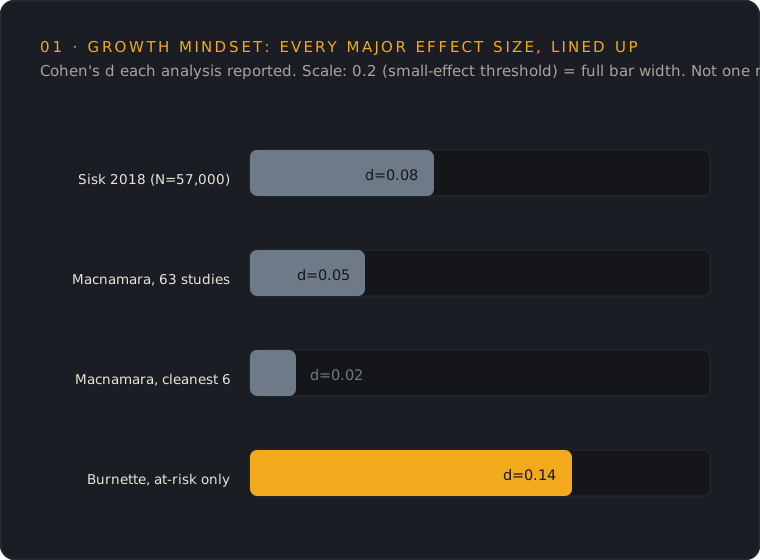
Then Sisk’s team asked a harder, more useful question: forget just watching who happens to believe what — what happens when someone actively teaches a student to believe it? Pooling 43 separate programs and roughly 57,000 students, they found an average effect of 0.08 on a standard scale researchers use to measure how much a program actually moves the needle.
Here’s what that number means in plain English, the class-of-100 example from the top of this article, worked through properly. Line up 100 students by test score, worst to best. The middle student sits at spot 50. Teach that student growth mindset — belief only, no extra help with the actual subject — and on average they move up to about spot 53. Three places out of a hundred. That’s the whole effect, for a typical student. And the picture gets a little darker once you account for something researchers call publication bias: journals like publishing studies that found something exciting, and tend to quietly skip the ones that found nothing. Correct for that pattern, Sisk’s team wrote, and the honest effect is probably even closer to zero.
One genuine bright spot survived the wreckage. The effect ran larger — still modest, but real — for two overlapping groups: students who were already struggling academically, and students from lower-income families.
Is there real evidence growth mindset works for anyone?
Yes, and it deserves a fair hearing rather than a reflexive dismissal. In 2019, David Yeager, a psychology professor at the University of Texas at Austin — and, before that, a middle school teacher himself — led the largest and most careful test of this idea ever attempted. Called the National Study of Learning Mindsets, it ran through 65 U.S. high schools and 12,490 ninth-graders, and the plan for how it would be analyzed was published before the results came in, so nobody could quietly adjust the method after seeing the data. Students sat through two 25-minute online sessions about three weeks apart — under an hour of exercises in total. The bump in GPA among the lower-achieving students the trial was pre-registered to target: 0.10 points on a 4-point scale — small, but real and statistically solid. For students overall, the study reports no significant effect at all.
The interesting part was in the fine print. Almost the entire effect came from one group — students who were already earning the lowest grades — whose GPA rose 0.10 to 0.15 points, while students who were already doing fine gained nothing measurable at all. And even for the students it did help, the effect disappeared in schools where teachers and classmates treated struggle as proof that a kid wasn’t smart, rather than a normal part of learning. A student’s own belief, on its own, wasn’t enough. It needed a classroom willing to act like the belief was true.
The 2023 fight nobody outside academia noticed
By 2023, scientists had gathered enough data to settle this once and for all — or so it seemed. That March, one of psychology’s most respected journals published three papers about nearly the same pile of studies, back to back, in the same issue. Two of them landed on opposite headline numbers. The third was a referee, and one of its authors turns out to be someone you’ve already met.
Team one, led by Brooke Macnamara at Case Western Reserve University, took the strict approach: gather 63 studies covering 97,672 students, hold every one of them to a tough quality bar, and calculate one single overall number. What they found wasn’t flattering. Ninety-four percent of the studies they reviewed had a basic design problem — the growth-mindset message arrived bundled together with something else, like time-management coaching or study tips, so there was no way to tell whether the belief itself did anything, or whether the extra coaching did all the work. Researchers who had a financial stake in the outcome — people who sell growth-mindset training programs — were two and a half times as likely to report a statistically significant benefit as researchers with no such stake: 56% of their papers versus 21%. Narrowed down to just the six cleanest studies available, covering 13,571 students, the effect came out essentially at zero.
Team two, led by Jeni Burnette, a psychologist at North Carolina State University, looked at almost the same evidence and asked a different question entirely. Instead of one average number for everybody, they asked: where does the effect actually show up? Averaging together a mixed group of students — some already doing great, some genuinely stuck — will always wash out a program that was only ever supposed to help one of those groups. Using statistical tools built specifically to catch that kind of pattern, they found a real, meaningful effect specifically among at-risk students, in the studies where the program had actually been run the way it was designed to be run.
Then came the referee. Elizabeth Tipton, a statistician at Northwestern University, led a third paper — a methodological commentary examining how both of the other teams had done their math — and one of her five co-authors was David Yeager, the same researcher behind the national high-school study earlier in this article. Their verdict: Macnamara’s team-one approach, averaging everyone into one number, is the wrong tool for a program that was only ever supposed to help a specific slice of students. Burnette’s team-two approach, built to detect exactly that kind of hidden pattern, was closer to getting the statistics right.
Team one — Macnamara: “let’s hold everyone to a strict bar”
63 studies, 97,672 students. Question: what’s the one overall number, if we throw out anything sloppy?
Answer: basically zero once you correct for the studies most likely to be flawed or biased. Most programs mixed the belief-message with other coaching, so nobody could tell what actually worked.
Team two — Burnette: “let’s ask who it actually helps”
A separate search of the same literature — 53 independent samples. Question: instead of one average, where does the real effect live?
Answer: a real, meaningful effect — but only among students who were already struggling, and only when the program was actually delivered properly. The referee paper (Tipton, with Yeager) later sided with this approach.
Same journal, same month, nearly the same pile of evidence, opposite headline numbers from the first two teams — because they weren’t really disagreeing about the facts. They were asking different questions of the same facts, and the third paper points toward Burnette’s question being the better one to ask. That’s a less satisfying story than “science finally settled it,” but it’s the honest one.
What holds up, once the marketing is stripped away?
Two things survive all this back-and-forth. First, the effect is real for one specific, narrow group: students who are already struggling, inside a school that treats effort as useful information instead of an excuse. Second — and this is the part almost nobody selling growth-mindset training ever mentions — belief on its own was never the actual mechanism. Every large program that genuinely moved a number bundled the belief together with something concrete: a study strategy, feedback aimed at the work instead of the person, a teacher who modeled struggling honestly instead of hiding it.
This is the part worth slowing down for — it’s the whole reason this article exists. We didn’t just read the science. We read what’s actually sitting at the top of Google right now, the pages a curious parent or teacher would land on: 61 currently-accessible pages ranking for growth-mindset searches, every one checked for what it actually cites. Why does that matter more than summarizing the studies? Because the science and the search results are, right now, telling two different stories — and almost nobody searching this topic ever sees the second one.
Here’s the newest piece of that gap. In November 2025, Pimmada Charoensilp, a researcher at Chulalongkorn University in Thailand, published an analysis with two co-authors covering over half a million 15-year-olds across 74 countries, drawn from the OECD’s PISA 2022 international testing data. Growth mindset was linked to better math scores beyond what family income alone would predict, in most of those countries — but exactly how income and mindset interacted varied so much from country to country that the researchers found no single global pattern. In some places, growth mindset helped lower-income students the most, matching Yeager’s American finding. In others, it was wealthier students who gained more.
Not one of the 61 pages we read cites this study. It came out in November 2025, eight months before this article went up. It complicates a tidy story that most of the internet stopped updating years ago — and that, right there, is the actual apex of what this audit found: the newest, most careful science and the everyday search results have quietly drifted apart, and almost nobody looking this up would ever know it.
Where growth-mindset training goes wrong
Remember Carol Dweck, the Stanford psychologist from the very beginning of this article, the one whose 1998 study started all of this? She flagged this exact failure mode herself, years before any of the meta-analyses caught up with her. In a 2015 piece for Education Week, she gave it a name: “false growth mindset” — praising effort that led nowhere, treating any struggle as automatically virtuous, hanging inspirational posters instead of teaching an actual strategy. That’s precisely the flaw baked into 94% of the studies Macnamara’s team reviewed: growth-mindset language layered on top of real skill-building, with no way to untangle which part did the work.
What should you do instead?
Three simple moves, if you want this to actually help someone:
- Don’t just say “you can improve” — show how. Yeager’s own intervention was belief-only by design — the paper states that students were deliberately not told to work hard or to use any particular study strategy — and it moved grades only in schools that already backed the belief up with real support. A belief with no plan attached is just a nice thought.
- Praise the move that worked, not “trying” in general. “You switched to a different approach when the first one didn’t work” teaches something a kid can do again next time. “You worked really hard” just teaches a kid to look busy.
- If someone’s already doing fine, don’t bother. The entire measurable benefit shows up in students who are struggling, inside classrooms that back the belief up with real support. Outside that narrow situation the academic evidence is close to nothing — though the same 2023 meta-analysis found a larger effect on mental health (d = 0.32) than on grades, and the PISA data show that which students gain most flips from country to country.
The other famous classroom claim about how minds differ is the learning-styles myth, and the identity-change version of the same promise is taken apart in our review of «Atomic Habits».
The boring bottom line
Growth mindset isn’t a myth the way ego depletion or the eight-second attention span are myths — the effect is real and it does replicate, somewhere between 0.08 and 0.14 depending who’s counting and which students you’re counting. It’s a myth in the way that actually matters if you’re deciding whether to spend money or classroom time on it: the real effect is roughly a tenth the size the bestsellers implied, it only shows up in students who are already struggling, and belief without an actual strategy attached has never once moved a number on its own. Skip the poster. Teach the strategy. Save the belief for the students it was actually built to help.
Sources
- Mueller, C. M., & Dweck, C. S (1998). Praise for intelligence can undermine children's motivation and performance. Journal of Personality and Social Psychology. 75(1), 33-52 doi:10.1037/0022-3514.75.1.33
- Blackwell, L. S., Trzesniewski, K. H., & Dweck, C. S (2007). Implicit theories of intelligence predict achievement across an adolescent transition. Child Development. 78(1), 246-263 doi:10.1111/j.1467-8624.2007.00995.x
- Li, Y., & Bates, T. C (2019). You can't change your basic ability, but you work at things, and that's how we get hard things done. Journal of Experimental Psychology: General. 148(9), 1640-1655 doi:10.1037/xge0000669
- Bahník, Š., & Vranka, M. A (2017). Growth mindset is not associated with scholastic aptitude in a large sample of university applicants. Personality and Individual Differences. 117, 139-143 doi:10.1016/j.paid.2017.05.046
- Sisk, V. F., Burgoyne, A. P., Sun, J., Butler, J. L., & Macnamara, B. N (2018). To what extent and under which circumstances are growth mind-sets important to academic achievement? Two meta-analyses. Psychological Science. 29(4), 549-571 doi:10.1177/0956797617739704
- Yeager, D. S., Hanselman, P., Walton, G. M., et al (2019). A national experiment reveals where a growth mindset improves achievement. Nature. 573, 364-369 doi:10.1038/s41586-019-1466-y
- Macnamara, B. N., & Burgoyne, A. P (2023). Do growth mindset interventions impact students' academic achievement? A systematic review and meta-analysis with recommendations for best practices. Psychological Bulletin. 149(3-4), 133-173 doi:10.1037/bul0000352
- Tipton, E., Bryan, C., Murray, J., McDaniel, M. A., Schneider, B., & Yeager, D. S (2023). Why meta-analyses of growth mindset and other interventions should follow best practices for examining heterogeneity: Commentary on Macnamara and Burgoyne (2023) and Burnette et al. Psychological Bulletin. (2023). , 149(3-4), 229-241 doi:10.1037/bul0000384
- Burnette, J. L., Billingsley, J., Banks, G. C., Knouse, L. E., Hoyt, C. L., Pollack, J. M., & Simon, S (2023). A systematic review and meta-analysis of growth mindset interventions. Psychological Bulletin. 149(3-4), 174-205 doi:10.1037/bul0000368
- Charoensilp, P., Kim, H., & Sriutaisuk, S (2025). Relationships between growth mindsets and math achievement across socioeconomic status in 74 countries: Evidence from PISA 2022. PLOS ONE. PLOS ONE. doi:10.1371/journal.pone.0337039