TL;DR
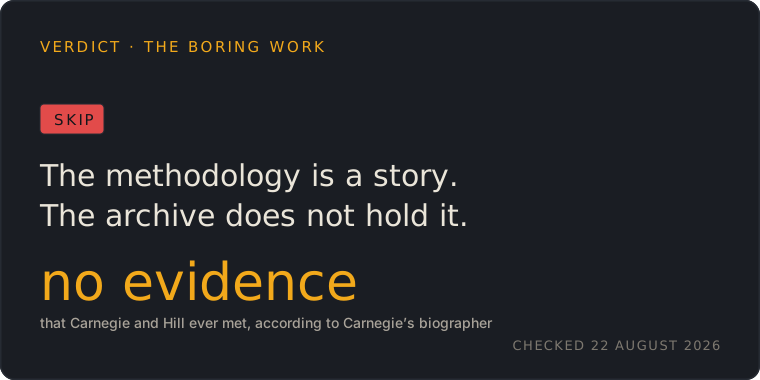
- The book’s authority rests on one story: Andrew Carnegie commissioned the young Napoleon Hill in 1908 to distil the formula of success. Carnegie’s biographer, the historian David Nasaw, told a journalist he «found no evidence of any sort that Carnegie and Hill ever met».
- Hill’s own official biographers, in 1995, conceded that his later book of conversations with Carnegie used «a somewhat contrived conversational format», while insisting the meeting happened.
- The «Master Mind» has a measured cousin: groups do have a collective intelligence factor. What predicts it is equal turn-taking and members reading each other well, not assembling impressive people.
- Writing down a definite goal anticipates goal-setting research, with a limit the book never mentions: a sum of money is an outcome, not an action.
- Repeating a positive statement to yourself, the book’s autosuggestion, made people with low self-esteem feel worse in a controlled experiment.
Verdict
Skip it, or read it as a historical document. The book presents its principles as findings from a twenty-year commission by the richest man in America, and that commission is the one part of the book that archives can check. The historian who searched found nothing, and the principles that do have research behind them turn out to say something different.
A methods section disguised as a legend
The legend goes like this. In 1908 the steel magnate Andrew Carnegie summons a young magazine writer named Napoleon Hill and gives him a mission: spend twenty years interviewing the most successful men in the country and work out the formula they share. Think and Grow Rich, published in 1937, presents itself as the result, and Gizmodo’s history of the book notes it has reportedly sold over 15 million copies.
Look at what the story does for the book. Without it, Think and Grow Rich is a list of assertions from a man few people had heard of. With it, the same assertions become findings, commissioned by Carnegie and drawn from hundreds of titans of industry. The origin story is the book’s methods section, which makes it the first thing a reviewer should check, and conveniently it is the one part of the book that can be checked against records.

What Carnegie’s biographer found
Carnegie is one of the most documented men of his century, and his papers fill archives. David Nasaw, a historian at the City University of New York, spent years inside them for his 2006 biography of Carnegie, which was a Pulitzer finalist. Matt Novak, a journalist at Gizmodo who researched Hill’s life, put the direct question to him.
Nasaw told him he «found no evidence of any sort that Carnegie and Hill ever met». Pressed on whether the book might rest on real events all the same, he answered: «Let me put it this way. I found no evidence that the book was authentic» (Novak, 2016). Novak also reports that Hill began telling the Carnegie story only after Carnegie died in 1919, when nobody could contradict it.
Two warnings in the book’s favour. Absence from an archive does not prove that nothing happened, and an interview quote is not a peer-reviewed paper. But weigh what this is: the considered answer of the person who knows the records best, asked specifically about this meeting.
The other side of the ledger is more striking. Hill later published a whole book of supposed conversations with Carnegie, and his official biography, released in 1995 by people sympathetic to him, concedes that it used «a somewhat contrived conversational format featuring Hill and Andrew Carnegie», while maintaining that the meeting itself was real. When the author’s own approved biographers call the printed dialogue contrived, a reader is entitled to treat the dialogue as the author’s voice, which is where the book’s authority was supposed to come from.
One note on what this page leaves out. Published accounts list a string of legal and financial episodes in Hill’s career, with dates and newspaper archives. I could not reach and read those documents, so none of them appear here. The statements quoted above are verified word for word in the article that reports them, and they are enough.
The Master Mind, measured
Now set the biography aside and give the ideas a hearing. The most interesting is the Master Mind: Hill’s claim that two or more minds working in harmony produce a third, greater intelligence. It sounds like mysticism, and something like it was measured in 2010.
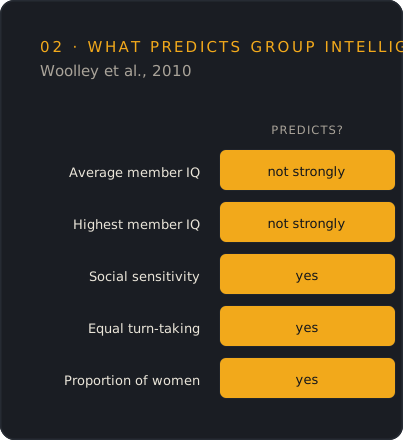
Across two studies with 699 people working in groups of two to five on a wide range of tasks, researchers found «converging evidence of a general collective intelligence factor that explains a group’s performance on a wide variety of tasks» (Woolley et al., 2010). Groups that did well at one kind of task tended to do well at others, much as individuals who score well on one kind of test tend to score well on others.
Here is where the recipe comes out backwards. This collective intelligence was «not strongly correlated with the average or maximum individual intelligence of group members». What did predict it was how well members read each other’s feelings, how evenly they took turns to speak, and the proportion of women in the group.
A later pooled analysis of 22 studies with 5,279 people in 1,356 groups confirmed the factor and sharpened the conclusion: «group collaboration process is more important in predicting CI than the skill of individual members» (Riedl et al., 2021). That work was funded by DARPA and the US Army Research Office, defence agencies with an obvious interest in teams that perform.
So Hill was right that a group can be more than the sum of its members, and wrong about what makes it so. His advice is to recruit the most accomplished allies you can find. The measurements say accomplishment barely matters and turn-taking decides, which suggests that a mastermind group dominated by one confident voice may do worse than its members would alone.
A sum of money with a date on it
The book’s most imitated instruction is to write down a definite objective: an exact sum, by an exact date, in writing. Whatever else Hill was doing, that form anticipates where goal-setting research landed after decades of work by Edwin Locke and Gary Latham, in which specific, difficult goals reliably beat the vague instruction to «do your best» (Locke & Latham, 2002).
The limit is one the book never mentions. That research works best for goals made of things you control: calls made, pages written, kilometres run. A sum of money is not an action. It is an outcome that depends on employers, markets and luck. «I will possess fifty thousand dollars by the first of January» names the prize and leaves the behaviour blank, which is the half the science covers. How much writing a goal down helps on its own is a separate story with its own famous fake number, told in the 42 per cent goal study.
The book does not stop at writing, either. The instruction goes on to reading the statement aloud twice a day and feeling yourself already in possession of the money, and at that point it has left goal setting behind.
Autosuggestion, tested
Hill calls that daily recitation autosuggestion, and it has a direct modern test. In a set of experiments at the University of Waterloo, repeating «I’m a lovable person» left participants with low self-esteem in a worse mood than not repeating it, while people with high self-esteem felt only slightly better (Wood et al., 2009). The statement backfired for the people most likely to reach for it.
Psychology also has a respected technique called self-affirmation, and it is a different act altogether. «Self-affirmation interventions typically have people write about core personal values», which produces «a more expansive view of the self and its resources» when a person faces a threat (Cohen & Sherman, 2014).

Writing briefly about what you value, in order to get through a stressful test, has little in common with telling yourself every morning that you already have the money. A good part of the motivational market runs on the assumption that evidence for the first supports the second.
The first has its own complicated record, and it is worth following because it shows what a real intervention looks like after fifteen years. A district-wide randomised scale-up found effects «consistent with but smaller than those from prior smaller scale studies» (Borman et al., 2016). A well-powered replication by the same team in the same district «found no evidence of effects», with estimates precise enough «to reject benefits larger than an effect size of 0.10», and the explanations they tested for the discrepancy «could not explain the difference» (Hanselman et al., 2017). An independent team using the same materials in two new schools reported: «Despite employing the same materials, we found no effect of the affirmation on academic performance» (Protzko & Aronson, 2016).
The sequence ends on a more careful claim. Longitudinal follow-up found the intervention «reduces the growth of the racial achievement gap by 50% across the high school transition», with the largest effects in schools where students faced stronger threats to their identity, and benefits that depended on whether students engaged with the writing at all (Borman et al., 2018). These are studies of schoolchildren, and none of it is advice to an adult reader. The early small studies produced the big numbers, the large careful ones produced small numbers or none, and the final account is full of conditions. The book’s version never went through that process at all.
Thoughts are things
The book’s opening premise, that a thought held with enough intensity becomes a material result, is the same idea a 2006 bestseller later built an industry on. There it is offered as spiritual teaching, and its official site goes a step further by claiming that laboratories have confirmed it; that claim, and why no laboratory has, is checked on the page about that book.
The line worth keeping clear is this one. That thinking shapes behaviour, and behaviour shapes outcomes, is uncontroversial and dull. That a thought reaches out and arranges the material world is the claim the book makes, and no measurement supports it.
What a skip verdict means here should be stated precisely. Nothing above shows that the principles are harmful, and the Master Mind points at something real. What fails is the transaction the book offers: it asks a reader to accept its assertions on the strength of a research programme, and the research programme is the part nobody can find. The same claims offered as one man’s opinions would make a smaller book, and an honest one.
Who this book is for
Read it as a historical document. It is the template from which most of the modern success shelf descends: interviews with great men, numbered principles, borrowed authority. Reading the original explains a great deal about the genre’s habits.
Do not read it as research. Its method is a story that Carnegie’s biographer could not find in the archive, and the conversations behind it are described as contrived by the author’s own authorised biographers.
The 2006 book that took over the «thoughts are things» premise is checked in The Secret, a spiritual book that borrows the language of science. For how this genre builds authority, see the new psychology of self-improvement; the rest of the shelf is under book reviews.
The boring bottom line
A book that presents itself as the distilled findings of a twenty-year commission has no visible commission behind it, by the account of the historian who searched, and a printed dialogue with its patron that its own supporters call contrived. Of the principles, the Master Mind has a real descendant that depends on equal turn-taking rather than on gathering talent, and the daily affirmation backfired for the people most likely to try it.
What remains is a template: assemble impressive names, state principles with numbers, and let the frame supply the authority the evidence never had to.
Sources
- Novak, M (2016). The Untold Story of Napoleon Hill, the Greatest Self-Help Scammer of All Time. Gizmodo / Paleofuture, 6 December 2016. Cited for two things only: the biographer's own words, and the authorised biography's own wording. The article also lists archival records of legal and financial episodes; none of those could be checked against a primary document from here, so none of them appear on this page. gizmodo.com
- Woolley, A W; Chabris, C F; Pentland, A; Hashmi, N; Malone, T W (2010). Evidence for a Collective Intelligence Factor in the Performance of Human Groups. Science 330(6004):686-688. The measurable version of the book's «third mind». What predicts it is not the brilliance of the members but whether the talking is shared out evenly. doi:10.1126/science.1193147
- Riedl, C; Kim, Y J; Gupta, P; Malone, T W; Woolley, A W (2021). Quantifying collective intelligence in human groups. PNAS 118(21):e2005737118. Confirms the factor at scale. The last clause is the part that matters for a book which recommends assembling talented people and calls the result a third mind. doi:10.1073/pnas.2005737118
- Locke, E A; Latham, G P (2002). Building a practically useful theory of goal setting and task motivation: A 35-year odyssey. American Psychologist 57(9):705-717. Identifier verified in Crossref and PubMed. Relevant because the book's demand for a written, dated, quantified goal anticipates the form this research settled on — for tasks with controllable execution, which a sum of money is not. doi:10.1037/0003-066X.57.9.705
- Wood, J V; Perunovic, W Q E; Lee, J W (2009). Positive Self-Statements: Power for Some, Peril for Others. Psychological Science 20(7):860-866. 20(7), 860-866. The closest direct test of the practice the book calls autosuggestion; cited for the direction of the effect, not as a survey of the affirmation literature. doi:10.1111/j.1467-9280.2009.02370.x
- Cohen, G L; Sherman, D K (2014). The Psychology of Change: Self-Affirmation and Social Psychological Intervention. Annual Review of Psychology 65:333-371. The crucial distinction on this page: the scientific term names a brief piece of writing about one's values, not the repetition of statements about future wealth. Two practices, one name, different mechanisms. doi:10.1146/annurev-psych-010213-115137
- Borman, G D; Grigg, J; Hanselman, P (2016). An Effort to Close Achievement Gaps at Scale Through Self-Affirmation. Educational Evaluation and Policy Analysis 38(1):21-42. First step in a sequence worth following: scaling up shrank the effect relative to the small studies that produced it. doi:10.3102/0162373715581709
- Hanselman, P; Rozek, C S; Grigg, J; Borman, G D (2017). New evidence on self-affirmation effects and theorized sources of heterogeneity from large-scale replications. Journal of Educational Psychology 109(3):405-424. The same team, the same procedures, the same district — and nothing. Note also that the proposed explanations for the discrepancy did not survive testing. doi:10.1037/edu0000141
- Protzko, J; Aronson, J (2016). Context Moderates Affirmation Effects on the Ethnic Achievement Gap. Social Psychological and Personality Science 7(6):500-507. An independent team reaching the same conclusion about context dependence. doi:10.1177/1948550616646426
- Borman, G D; Grigg, J; Rozek, C S; Hanselman, P; Dewey, N A (2018). Self-Affirmation Effects Are Produced by School Context, Student Engagement With the Intervention, and Time. Psychological Science 29(11):1773-1784. The end of the sequence: effects exist where the threat the intervention addresses is actually present, and where the student did the exercise. doi:10.1177/0956797618784016