TL;DR
- The demographer who certified the first blue zone has never accepted Loma Linda as one. Buettner has said he included it because National Geographic wanted a US site.
- The researcher who helped declare Nicoya a blue zone in 2007 published a paper in 2023 showing the advantage disappears for anyone born after 1930.
- Okinawa’s own certifier found the longevity is concentrated in cohorts born before the war, and notes that family registries destroyed in 1945 may have inflated ages when they were rebuilt.
- Buettner’s own summary in 2026: «all blue zones are waning right now.»
- The central critique, that pension fraud and bad records explain the clusters, won an Ig Nobel and after nine rounds of review still has no peer-reviewed home.
In the early 2000s a Belgian demographer and an Italian physician were marking a map of Sardinia. Every village with an unusual number of very old people got a dot in blue ink. The dots converged on a mountainous strip of Ogliastra, and the working name for that cluster came from the pen: the blue zone.
Michel Poulain and Giovanni Pes published the underlying work in 2004 (Poulain et al., 2004). It is a careful demographic paper about one province in Sardinia, built on the tedious business of validating birth dates against parish and civil records.
A journalist named Dan Buettner had joined the project. In 2005 he put it on the cover of National Geographic, and by the time the idea reached the wider world it had grown from one Sardinian province to a global set of longevity hotspots with a shared list of habits. He then trademarked the term.
Twenty years on, the most interesting criticisms of the blue zones are not coming from outside. They are coming from the people who certified them.
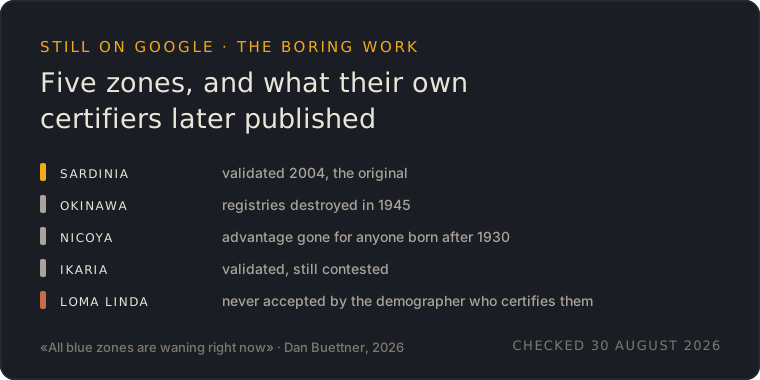
Loma Linda was added because a magazine wanted an American one
Start with the least defensible member of the set, because its own history is on the record.
Loma Linda, California, is a Seventh-day Adventist community. It has appeared on blue zone lists since the beginning. Poulain, who did the validation work that produced the concept, has never accepted it as a blue zone. And Buettner has said he included it to satisfy National Geographic’s request that an American site be on the list (Wood & Topol, STAT, 2026).
A category defined by demographic validation acquired one of its five members for editorial reasons. That does not make Adventists short-lived, and there is real research on Adventist longevity. It means the list was never assembled by a single consistent method, which matters because the whole rhetorical force of blue zones comes from the implication that it was.
Nicoya: the man who declared it published its retraction
In 2007 Buettner named the Nicoya Peninsula in Costa Rica. The demographer who helped was Luis Rosero-Bixby of the University of Costa Rica, and the supporting analysis appeared in 2014 (Rosero-Bixby et al., 2014).
In 2023 Rosero-Bixby published a follow-up. Its title is the finding: «The vanishing advantage of longevity in Nicoya, Costa Rica: A cohort shift» (Rosero-Bixby, 2023). People born on the peninsula after 1930 do not show the longevity advantage of the cohorts before them.
This is what it looks like when the science works. The same researcher, same region, better data, opposite conclusion, published without drama. It is also the sort of paper that never reaches the audience the original claim reached.
Okinawa: the records were rebuilt after the island burned
Okinawa is the most-cited blue zone and the one where the record problem is most concrete.
Poulain, again, is a co-author on the paper that complicates it (Poulain & Herm, 2024). Analysing demographic trends since 1975, he and Anne Herm found a sharp divide between Okinawans born before and after the Second World War. Nutrition and lifestyle changed enormously in that period, which is one explanation.
The other explanation is in the paper too, and it is uncomfortable. Okinawa’s family registries were destroyed in 1945. When records are reconstructed from memory and testimony rather than documents, ages drift upward. The authors concede this may have inflated the recorded ages of the pre-war cohorts, which are precisely the cohorts that made Okinawa famous.
| Blue zone | Who certified it | What the certifier’s own later work shows |
|---|---|---|
| Sardinia (Ogliastra) | Poulain & Pes, 2004 | The original, most carefully validated case |
| Okinawa | Poulain | Advantage concentrated in pre-war cohorts; registries destroyed in 1945 |
| Nicoya | Rosero-Bixby | Advantage vanishes for those born after 1930 |
| Loma Linda | nobody | Poulain has never accepted it; added at a magazine’s request |
| Ikaria | Buettner expedition | Included after the concept was already a brand |
The critique that cannot get published
The loudest challenge comes from Saul Newman, and its status is as interesting as its content.
Newman’s argument is that clerical error, missing documents, natural disasters and pension fraud explain centenarian clusters better than diet or community does (Newman, 2019/2024). The supporting examples are hard to wave away. In 2010 Japan announced that a large share of its registered over-100s had in fact died. In 2012 Greece found thousands of centenarian pensions being drawn for people who were dead. Poverty and weak record-keeping predict recorded extreme longevity in a way that, as Newman puts it, runs opposite to rational expectation.
He won an Ig Nobel Prize for it in 2024. The prize is awarded for research that makes you laugh and then think, and it is not a joke award in the dismissive sense.
And the paper still has no peer-reviewed home. It has existed as a preprint since 2019, updated in 2020 and 2024. Newman says it has been through nine rounds of review at one journal, where most papers see one to three.
That cuts both ways, and this site is not going to pretend otherwise. A preprint that cannot clear review after nine rounds may be facing a hostile field, which is Newman’s account. It may also have problems reviewers keep finding. Both are live possibilities, and anyone citing the Ig Nobel as though it settles the matter is overreaching.
Verdict on «blue zone longevity is explained by pension fraud and bad records»: P — Partial. The documented registry failures in Japan and Greece are real and large. The general claim remains unpublished after seven years.
What the founders now say
Here is the part that makes the rest of the argument almost redundant.
Asked in 2026 about the state of the concept, Buettner said: «I would say, all blue zones are waning right now, although we found a couple that are waxing or ascending.» He and Poulain and Pes are among the authors of a paper tracking the decline of the original zones.
The disagreements about new ones are equally telling. Buettner’s organisation named Singapore a sixth blue zone. Poulain calls that laughable and notes that Singapore’s own health minister disagrees. Poulain has added Martinique to his list; Buettner says they do not agree with it. Twenty years in, the two people most responsible for the concept cannot agree on which places qualify.
A category whose members are disputed by its own founders, whose original examples are fading, and one of which was added for editorial convenience, is not a stable scientific object.
Follow the money, because it is large
The commercial layer is unusual in size for a wellness idea and it explains why the concept is defended so vigorously.
| Item | Figure |
|---|---|
| Buettner’s blue zone books | Nine titles, over $1.2 million in sales |
| Blue Zones LLC sold to Adventist Health, 2020 | Reported $78 million |
| Annual cost to a city for official certification | About $100,000 per year |
| Five-year contract, 10 Iowa cities | Estimated $25 million |
| Blue Zones frozen meals | 4,000 stores, 2 million meals, $7 to $14 each |
Poulain’s account of when his relationship with Buettner soured is specific: he visited a Blue Zones project in Naples, Florida, and observed that the neighbourhoods that most needed help could not afford the initial consultation, let alone the annual fee.
None of this makes the health advice wrong. It does mean that the people best placed to defend the foundational claims have roughly seventy-eight million reasons not to concede them.
What survives
Quite a lot, and it is worth saying clearly because the demolition above is easy to overread.
The lifestyle recommendations are ordinary and well supported by evidence that has nothing to do with blue zones. Mostly plant-based eating, daily unstructured physical activity, strong social ties, a sense of purpose, moderate alcohol at most, not overeating. Each of these has its own literature. None of them needs a Sardinian village to be true.
The original Sardinian work also stands as a piece of demography. Poulain and Pes did the validation, published it, and have spent twenty years arguing with people who used it loosely, including the man who made it famous.
What does not survive is the inferential step everyone buys: that because these five places had unusual numbers of very old people, copying their habits will make you one. The places are disputed, the numbers are partly artefacts of record-keeping, the advantage is disappearing in at least two of them, and no one has run the experiment that would connect the habits to the outcome.
Why a fading effect looks like a confirmed one
There is a structural reason the blue zones could look real for twenty years and then dissolve, and it has nothing to do with anyone lying.
Every one of these regions was identified by looking for the extreme. Scan enough places for unusual longevity and some will show it, partly because they have it and partly because errors and noise pile up in the tails of a distribution. Then the search stops, because the cluster has been found. Nobody goes back to check whether the next hundred villages have the same rate, and nobody counts the places that were examined and rejected.
Add one more thing: the search is easiest where documentation is worst. Poor, rural, isolated communities with patchy civil registration are exactly where extreme ages are hardest to verify and easiest to overstate, and they are also exactly where the traditional-diet, close-community story is most appealing to write about. The conditions that make a place look like a blue zone overlap heavily with the conditions that make its ages unverifiable.
Which is why the cohort papers matter more than the arguments. As registration improved and the pre-war generations died, the advantage in Nicoya and Okinawa did not shrink gradually in the way a real biological effect erodes. It shifted with the cohort, which is what a record-keeping artefact does.
Verdicts
«There are five validated blue zones»: R — Refuted. One was added at a magazine’s request and has never been accepted by the demographer who created the category.
«Blue zone populations live exceptionally long»: P — Partial, and shrinking. The advantage vanishes for Nicoyans born after 1930 and is concentrated in Okinawan cohorts whose records were rebuilt after 1945.
«The blue zone habits will extend your life»: H — Untested. The habits are individually reasonable; the inference from these populations to your lifespan has never been tested.
«The whole thing is pension fraud»: P — Partial. Documented at scale in Japan and Greece; the general claim is a preprint that has not cleared review in seven years.
The shift: treat the blue zones as a hypothesis that generated good advice, not as evidence that the advice works.
First move: when a category has five members, ask how each one got in. Here the answer differs by member, and one of them is «a magazine asked».
Second move: notice who is publishing the corrections. Nicoya’s and Okinawa’s own certifiers wrote the papers walking them back, which is the strongest signal in this whole story.
Third move: keep the habits, drop the geography. Plant-heavy eating, daily movement, close relationships and purpose are each supported on their own, without any reference to Sardinia.
Longevity is not the only field where a headline number outlived its data. The same tracing method, applied across self-improvement, is collected in the register of checked claims, and the tiredness that sends people looking for such answers is sorted on tired, sleepy and burned out.
The boring bottom line
The man who invented the category has never accepted one of its five members. The researcher who certified Nicoya published the paper showing its advantage disappears after 1930. The researcher who certified Okinawa published the paper showing the advantage sits in cohorts whose birth records burned in 1945. And the man whose name is on the books says all of them are waning.
Underneath is advice almost nobody disputes: eat plants, move all day, know your neighbours, have a reason to get up. That advice was never load-bearing on whether Ogliastra had more centenarians than it could document.
The habits were always the useful part. The map was the product.
Sources
- Poulain, M., Pes, G. M., Grasland, C., Carru, C., Ferrucci, L., Baggio, G., Franceschi, C., & Deiana, L (2004). Identification of a geographic area characterized by extreme longevity in the Sardinia island: The AKEA study. Experimental Gerontology. 39(9), 1423-1429. The original paper. One Sardinian province, built on validating birth dates against parish and civil records. The blue ink on the map is where the name comes from. doi:10.1016/j.exger.2004.06.016
- Rosero-Bixby, L (2023). The vanishing advantage of longevity in Nicoya, Costa Rica: A cohort shift. Demographic Research. 49(27). By the demographer who helped declare Nicoya a blue zone in 2007: the advantage does not hold for those born after 1930. doi:10.4054/demres.2023.49.27
- Rosero-Bixby, L., Dow, W. H., & Rehkopf, D. H (2014). The Nicoya region of Costa Rica: A high longevity island for elderly males. Vienna Yearbook of Population Research. The supporting analysis for the Nicoya designation, later revised by the same author. doi:10.1553/populationyearbook2013s109
- Poulain, M., & Herm, A (2024). Exceptional longevity in Okinawa: Demographic trends since 1975. Journal of Internal Medicine. Sharp divide between pre- and post-war cohorts. The authors note that family registries destroyed in 1945 may have led to age inflation when records were reconstructed. doi:10.1111/joim.13764
- Newman, S. J (2019). Supercentenarian and remarkable age records exhibit patterns indicative of clerical errors and pension fraud. bioRxiv preprint (updated 2020, 2024). Won the 2024 Ig Nobel Prize in Demography. Still not published in a peer-reviewed journal after nine rounds of review at one title. Cite with that status attached. doi:10.1101/704080
- Wood, S., & Topol, E. J (2026). Are blue zones real? Answering that question is harder than ever. STAT (First Opinion). Source for the founders' own current positions: Buettner on Loma Linda and on all zones waning, Poulain on Singapore and Martinique, the trademark, and the commercial figures including the $78m sale to Adventist Health. statnews.com