TL;DR
- The claim that six minutes of reading cuts stress by 68 per cent traces to a single document: Lewis, D. (2009), Galaxy Stress Research, Mindlab International. It is named after a chocolate bar.
- It has never appeared in a journal. Searching Crossref and PubMed for it returns nothing, and the phrase «Galaxy Stress Research» has zero hits in PubMed titles and abstracts.
- The reported design used 16 volunteers, all of them already keen readers, measured with heart-rate and skin-conductance sensors after being deliberately stressed.
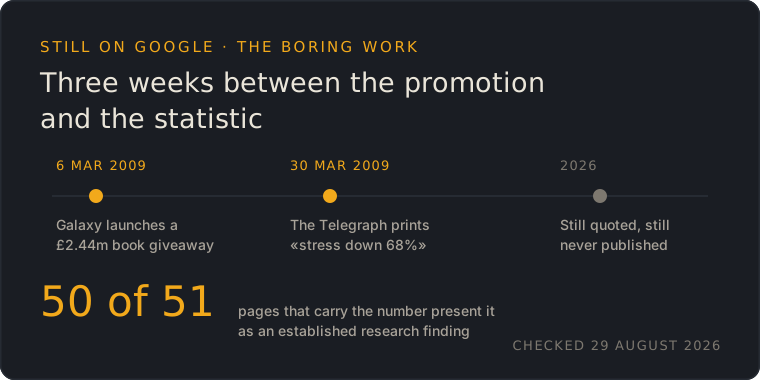
- The Telegraph ran it on 30 March 2009. Three weeks earlier, Galaxy had launched a £2.44m book-giveaway promotion.
- Reading has real measured benefits and none of them look like a percentage. In 3,635 people followed for 12 years, book readers had a 20 per cent lower mortality risk. That is a claim reading can carry.
Somebody, right now, is putting the number in a slide. Six minutes of reading, stress down 68 per cent. It has been in library posters, corporate wellness decks, bedtime-routine articles and university blogs for seventeen years. It is usually attributed to «a study at the University of Sussex», which sounds like exactly the sort of thing a study at the University of Sussex would find.
Follow it back and the trail ends somewhere unusual. Not at a bad study. Not at a misread abstract. At a document with a chocolate bar in the title.
Lewis, D. (2009). Galaxy Stress Research.
That is the citation, in the rare cases where anyone gives one. The full form, as it appears in the handful of academic papers that have cited it, is: Lewis, D. (2009), Galaxy Stress Research, Mindlab International, Sussex University, UK.
Three things in that line deserve attention.
Mindlab International is a commercial consultancy, not a university department. It was based on the Sussex campus, which is where «University of Sussex» entered the retelling and never left. Companies hire it to measure consumer responses. That is the business, and there is nothing improper about it, but it is a different activity from academic research and it produces a different kind of document.
Galaxy is a Mars-owned chocolate brand. On 6 March 2009, Galaxy launched «Irresistible Reads», described at the time as the UK’s biggest-ever book giveaway, supported by a £2.44m marketing campaign across television, press and PR. Twenty-four days later, on 30 March 2009, the Telegraph published «Reading ‘can help reduce stress’», and the 68 per cent entered the world.
The title itself is the tell. Peer-reviewed papers are not named after the client. This one is.
The search that returns nothing
A claim this widely repeated should be easy to look up. It is not there.
Crossref, which indexes essentially every article with a DOI, has no record of it. PubMed returns nothing for the exact phrase in any title or abstract. There is no volume, no issue, no page range, no DOI, no preprint, and no dataset. Nobody has replicated it, because there is no method section to replicate from.
This is the part worth stating carefully, because the honest verdict is narrower than the satisfying one. The study probably happened. Sixteen people probably sat in a room with sensors on them. Nobody is alleging invention. But an unpublished internal report for a confectionery promotion is not evidence in the sense the number is used, and «reduced stress by 68%» is being quoted with the confidence of a replicated finding.
Verdict: H — Untested. Not refuted, because there is nothing on the table to refute. The document that would let anyone check it has never been made available.
Sixteen readers, and no way to tell reading from waiting
The design, as described in the press coverage, went like this. Sixteen volunteers, all keen readers, were stressed on purpose using a set of tasks that included a game delivering a mild electric shock. Then they did one of several relaxing things while heart rate and skin conductance were recorded. Reading came out on top at 68 per cent, ahead of listening to music at 61, drinking tea at 54, walking at 42 and playing a video game at 21.
Start with the sample. Sixteen people is small enough that moving one person changes the ranking. All of them were recruited as keen readers, which means the activity being tested was the one they already enjoyed most, measured against activities they had not selected themselves. That compares someone’s hobby with someone else’s, not reading with music.
The deeper problem is the missing arm of the study. Heart rate and skin conductance rise when you are startled and then fall on their own. That is what those measurements do. A person who has just been given an electric shock and is then asked to sit still for six minutes will show a decline in both, whether they are reading, humming, or staring at a wall. Without a group that waits, there is no way to separate the effect of reading from the effect of the six minutes passing.
Then there is the unit. «Stress reduced by 68 per cent» is not a quantity anyone measures. Heart rate has beats per minute. Skin conductance has microsiemens. Neither converts into a percentage of a person’s stress, because stress has no zero point and no ceiling to take a percentage of. The number is a presentation choice, and its precision is decorative.
There is one more circularity in the recruitment. If you want to know whether reading calms people in general, the last group you would choose is people who already love reading, because for them a book is the thing they do to feel better, hardly a neutral activity. Handing a keen reader a favourite book and calling the result a measurement of reading is closer to measuring how well a preferred activity works on the person who prefers it.
The ranking carries the same problem, amplified. The gap between tea at 54 and walking at 42 is being reported to the whole percentage point from a sample of sixteen. Sample sizes that small produce confidence intervals wide enough to swallow the entire league table.
Why it travelled so well
The number has three qualities that make a claim durable, and none of them are truth.
It is oddly specific. Sixty-eight is not a round number, so it reads as measured rather than estimated. It comes with a ranking, which gives it narrative shape and makes it repeatable: reading beat music, which beat tea, which beat walking. And it flatters the person repeating it. Librarians, publishers, teachers and readers all had a reason to want this to be true, and nobody in that chain had a reason to check.
Add a university name that entered by geography rather than by authorship, and the claim acquires an institution it never had. Seventeen years later it is quoted by hospital wellness pages, tea companies, insurance blogs and reading charities, most of which cite each other.
There is a structural reason claims like this keep appearing, and it has nothing to do with anyone lying. A consultancy runs a short study for a brand. The brand issues a press release. A newspaper covers the release, because a tidy number about a familiar activity is a good story on a slow day. From that moment the finding exists as journalism rather than as research, and journalism does not carry method sections. Every subsequent retelling cites the newspaper, or cites something that cited the newspaper.
You can watch the claim gain authority as it moves. The earliest coverage says Mindlab International, a company. Later versions say researchers at the University of Sussex, which is where the company had its address. Later still it becomes a University of Sussex study, then a study, then science. Nothing was fabricated at any single step. The precision was lost gradually, and what remained looked more official than what started.
What reading has behind it
The irony is that the invented number is doing a job the real evidence could do better, if slower.
Start with the biggest claim anyone has made for reading, which is that it is associated with living longer. Researchers took 3,635 people from the Health and Retirement Study, recorded their reading habits, and followed them for up to twelve years (Bavishi et al., 2016). Book readers had a 20 per cent lower risk of dying over that period than non-book readers, after adjusting for age, sex, race, education, existing illness, self-rated health, wealth, marital status and depression. The effect was dose-responsive: more reading, more advantage. At the point where 80 per cent of the sample was still alive, book readers reached that milestone 23 months later than non-readers. Reading newspapers and magazines did not produce the same advantage.
Two honest caveats belong with that number. It is observational, so people who read books may differ from people who do not in ways no adjustment captures. And the authors found that cognition mediated the effect, which suggests the mechanism runs through what reading does to thinking rather than through relaxation.
In childhood, the picture is similar in shape. A study of more than 10,000 US adolescents found that early, sustained reading for pleasure was correlated with better cognitive test performance, lower mental-health problem scores, and measurably larger cortical areas and volumes in several brain regions (Sun et al., 2023). About twelve hours a week was where the cognitive association peaked. The design is largely cross-sectional and the authors are careful about causal language.
A British cohort of 11,180 children offers the most useful correction, because it includes a result nobody wanted. Reading most days at age eleven predicted lower odds of trying cigarettes and alcohol by fourteen, and higher odds of eating fruit (Mak & Fancourt, 2020). It also predicted less time spent on moderate to vigorous physical activity. Reading is a sitting-down activity, and the data noticed.
For reading as an actual treatment, there are randomised trials. Pooling eight of them across 979 children and adolescents, bibliotherapy beat control conditions for depression and anxiety symptoms with a standardised mean difference of −0.52 (Yuan et al., 2018). That is a moderate effect, from randomised comparisons, on a defined outcome. It is also not what anybody means when they say reading reduces stress by 68 per cent: these were structured self-help programmes, not novels.
A 2024 review of the whole reading-for-pleasure literature reaches the conclusion this material keeps reaching (Cremin & Scholes, 2024). The associations are consistent and mostly correlational, and the field’s own advocates are the ones saying so.
The cost of the better story
A public library choosing what to put on a poster has a genuine choice here. One option is a single number that fits in six words and is unverifiable. The other is a twelve-year cohort study with a 20 per cent mortality difference, a dose-response curve, and a footnote about confounding.
Almost everyone picks the first, and the reason is not stupidity. The 68 per cent is easier, shorter, and feels more useful, because it promises something you can act on this evening. The mortality finding cannot promise that. It describes a pattern across decades in a population, which is a true and much less motivating shape of claim.
What gets lost is that the honest evidence for reading is good. It just does not arrive as a percentage, and it never claimed to beat a cup of tea by fourteen points.
The shift: when a wellness statistic is oddly precise and comes with a league table, treat the precision as the warning sign rather than the evidence.
First move: look for the journal, not the institution. «A study at the University of Sussex» tells you a postcode. A volume and page number tells you somebody checked.
Second move: ask what the percentage is a percentage of. Stress has no zero and no maximum, so a 68 per cent reduction in it is a sentence with no referent.
Third move: when you want to argue for reading, use the twelve-year cohort. It is slower, it is hedged, and it is real.
What reading does have evidence for, and what a serious method for it looks like, is in our notes on «How to Read a Book». Every claim we have chased to its first appearance is listed in the ledger of checked claims.
The boring bottom line
The most-quoted statistic about reading comes from an unpublished commercial report named after a chocolate bar, produced three weeks into a £2.44m confectionery promotion, based on sixteen self-selected readers, measured in a unit that does not exist, with no group that sat and waited.
It is not a lie. It is a marketing document that got promoted to a fact by seventeen years of people quoting each other, and it has outcompeted a twelve-year study of 3,635 people because it is shorter.
Reading is good for you. The evidence for that is real, boring, and does not fit on a poster.
Sources
- Bavishi, A., Slade, M. D., & Levy, B. R (2016). A chapter a day: Association of book reading with longevity. Social Science & Medicine. 164, 44-48. 3,635 people, up to 12 years. HR 0.80 after full adjustment: a 20% lower mortality risk, with a 23-month survival advantage at the 80% survival point. Observational, and cognition mediated the effect. doi:10.1016/j.socscimed.2016.07.014
- Sun, Y.-J., Sahakian, B. J., Langley, C., et al. (2023). Early-initiated childhood reading for pleasure: Associations with better cognitive performance, mental well-being and brain structure in young adolescence. Psychological Medicine. 10,000+ US adolescents. Largely cross-sectional; roughly 12 h/week was where the cognitive association peaked. doi:10.1017/s0033291723001381
- Mak, H. W., & Fancourt, D (2020). Reading for pleasure in childhood and adolescent healthy behaviours: Longitudinal associations using the Millennium Cohort Study. Preventive Medicine. 11,180 children. Reading most days at 11 predicted less smoking and drinking at 14, and also less moderate-to-vigorous physical activity. The inconvenient result is in the abstract. doi:10.1016/j.ypmed.2019.105889
- Yuan, S., Zhou, X., Zhang, Y., Zhang, H., Pu, J., et al. (2018). Comparative efficacy and acceptability of bibliotherapy for depression and anxiety disorders in children and adolescents: A meta-analysis of randomized clinical trials. Neuropsychiatric Disease and Treatment. 8 RCTs, 979 participants, SMD -0.52. Structured self-help programmes, not novels: the distinction matters. doi:10.2147/NDT.S152747
- Cremin, T., & Scholes, L (2024). Reading for pleasure: Scrutinising the evidence base – benefits, tensions and recommendations. Language and Education. A review by advocates of reading that is candid about how much of the base is correlational. doi:10.1080/09500782.2024.2324948
- Lewis, D (2009). Galaxy Stress Research. Mindlab International, Sussex University, UK. The source of the 68% claim. Unpublished commercial report. Not indexed in Crossref; the exact phrase returns zero results in PubMed titles and abstracts. No DOI, no method section, no data. Checked August 2026.