TL;DR
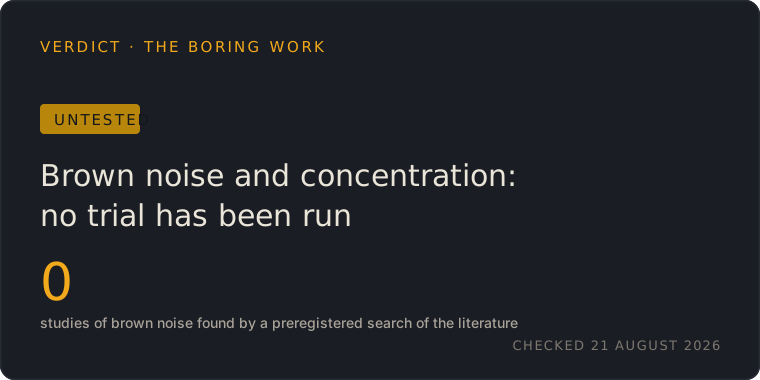
- In 2024 scientists went looking for every proper trial of «focus noise» ever run. They found thirteen. For brown noise (the internet’s favourite) they found exactly zero. Their words: «No studies of brown noise were identified.»
- White and pink noise have been tested, and here is the twist: they slightly help people with ADHD, and slightly hurt everyone else. Same sound, opposite effect.
- Most people who google «brown noise for focus» do not have ADHD — which puts them in the group the noise made slightly worse.
- The «it boosts your dopamine» story on the apps comes from a 2007 theory paper with zero participants. When researchers finally tested it, a boring 100 Hz hum worked just as well as the fancy noise — which the theory says should be impossible.
- And if you listen while reading: across 65 studies, any background sound made reading comprehension a bit worse. Speech and lyrics were the worst offenders.
Somewhere around 2022, TikTok discovered brown noise. Millions of people pressed play on a deep, waterfall-like rumble and reported the same thing: «my brain finally went quiet». Videos got tens of millions of views. Apps appeared. Spotify playlists exploded. And all of it rests on a question almost nobody thought to ask: has anyone tested this?
In 2024, a team of researchers did the checking for us. They combed the scientific literature for every randomised trial of coloured noise and attention — the kind of study where you compare people doing tasks with noise against people doing the same tasks in quiet. They found thirteen trials in total, covering 335 people. And for brown noise specifically, their report needs just one line: «No studies of brown noise were identified» (Nigg et al., 2024).
Zero. Not «mixed results», not «small studies» — zero studies. So on the four verdicts this site uses (defined on the method page), «brown noise helps you focus» comes out Untested: repeated everywhere, plausible-sounding, and never once put in front of a control group. The neighbouring claim about white and pink noise is Partial — measured, small, and cutting both ways, as you are about to see.
Three colours, two of them measured
First, what the colours mean — because it is simpler than it sounds. White noise spreads its energy evenly across all frequencies; it sounds like TV static. Pink noise shifts the balance toward the low end; it sounds like steady rain. Brown noise goes further still — most of its energy sits in the bass, so it sounds like a waterfall or a motorway heard from far away.
Notice what those are: descriptions of a sound. Not descriptions of what the sound does to a person. The entire brown-noise phenomenon lives in the gap between those two things.
The 2024 review was done properly — the plan was registered publicly before the results were seen, so nobody could move the goalposts. To count, a study had to randomly assign people with ADHD (or heavy ADHD symptoms) to noise or quiet, and measure how they did on attention tasks. Thirteen studies qualified. Eleven also included comparison groups of people without ADHD.
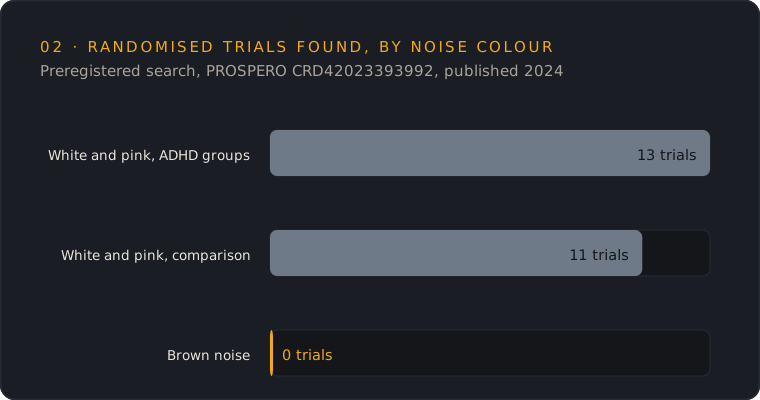
Brown noise did not show up once. The researchers even mention in their opening paragraph that public interest had swung toward brown — and then had nothing to include. So when a website tells you brown noise beats white or pink for concentration, understand what it is doing: comparing a measured thing with an unmeasured one and calling the difference a result.
One honest footnote: the search covered everything published up to early 2023. If someone runs a brown-noise trial tomorrow, the picture changes. Eighteen months on, no such trial has surfaced. «Untested» describes the shelf, not a law of nature.
The same noise, two opposite signs
Now for the colours that were tested — because this is where the story gets interesting.
For people with ADHD or strong ADHD symptoms, white and pink noise helped. The improvement was real but modest — think «a slightly better score on a twenty-minute lab task», not «a transformed afternoon». But for people without ADHD, the very same noise nudged performance downward, by about the same modest amount. Both findings were statistically solid. Same sound, opposite direction, depending entirely on whose ears it enters.
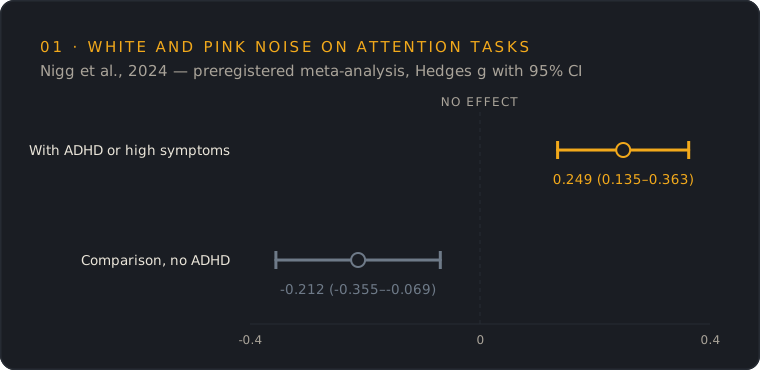
Think about who googles «noise for focus». Mostly it is ordinary tired people in open offices — exactly the group the data says the noise slightly hurts. The group it helps, people with ADHD, is real but much smaller. The internet sells the same playlist to both.
The numbers themselves held up well under scrutiny: the thirteen studies agreed with each other, no signs of cherry-picking were found, and the result did not depend on age or task type. But the boundaries matter. Every single outcome was a short laboratory task (recalling words, pressing buttons) done while the noise played. Nobody followed anyone through a real working day, a week of studying, or an actual piece of finished work. A focus app makes a promise about your afternoon; this evidence is about a twenty-minute test.
Who was measured, and on what
Where did this whole idea come from? One experiment in Stockholm, 2007. Researchers had children with ADHD and typical children do memory tasks in white noise and in silence. The children with ADHD did better with the noise on; the typical children did worse (Söderlund et al., 2007). That split (helps one group, hinders the other) showed up in the very first study and has echoed through the literature ever since.
Almost everything that followed also studied children. A 2016 follow-up tested forty children — the authors themselves called it a pilot (Söderlund et al., 2016). A 2021 study extended the pattern to children with reading difficulties, who gained under noise while skilled readers gained nothing or got worse (Söderlund et al., 2021). Pause on that for a second: a global market of focus apps for adults is built largely on experiments with schoolchildren doing memory drills.
So one boundary needs saying plainly: most of this evidence comes from children, nothing on this page is addressed to anyone under eighteen, and a result from a nine-year-old doing a span task does not automatically transfer to an adult trying to finish a report.
The explanation on vendor pages is a model, not a result
Open any focus-noise app and you will meet the same confident explanation: some brains run low on dopamine, background noise «tops up» their arousal, and the magic works through something called stochastic resonance — a real phenomenon in physics where adding a little random noise makes a weak signal easier to detect. It sounds wonderfully scientific.
Here is what the apps do not mention. That explanation comes from a single 2007 paper (Sikström and Söderlund, 2007) — a theory paper. No participants. No experiment. A mathematical model proposing how it might work. Quoting it as the reason your playlist works is quoting a guess as a fact.
And when researchers finally tested the guess, it failed — twice. The logic of the test is beautiful in its simplicity: stochastic resonance needs randomness. A pure, steady hum has none. So if a boring 100 Hz tone works as well as noise, the theory collapses.
In the first experiment, sixty adults did attention tasks in pink noise, in a plain 100 Hz tone, and in silence. People with more ADHD-like traits improved under sound — both sounds, equally (Rijmen & Wiersema, 2024). In the second, EEG recordings showed pink noise shifting brain activity in the opposite direction from what the dopamine model predicts — and the boring tone did exactly the same thing (Rijmen et al., 2025).
This does not erase the small benefit for people with ADHD — that stands. It erases the reason everyone gives for it. And with the reason goes brown noise’s whole claim to superiority: if randomness-in-the-bass were the working ingredient, brown should be king. If a steady hum does the same job, then the honest position is the one the literature already holds — nobody has checked.
Reading and focusing are two different questions
One more trap. «Helps you focus» and «good for studying» sound like the same claim. Measured, they come apart.
Across 65 studies of people reading with something in the background, noise, speech and music each made comprehension slightly worse — with intelligible speech and songs with lyrics the worst of all (Vasilev et al., 2018). No ADHD exception rescued the result. If you wear a waterfall in your ears to get through a chapter, you are running the reading experiment, and the reading experiment says: quiet wins.
The number nobody has established
The 2024 review ends by asking for more research — including on what volume is even safe. The trials used whatever loudness suited the lab, and none chose it with hearing safety in mind. So this page names no volume, no duration and no listening schedule. Hours of daily headphone rumble have no established safe dose, and inventing one to sound helpful would be exactly that: inventing.
What to do with the fact that it helps you
Now, the obvious objection: «But it works for me.» Nothing above says you are imagining it. Two different claims are being confused here, and separating them costs nothing.
«This helps me» is a report about you, on your days, at your desk — and it can be perfectly true. «Brown noise improves concentration» is a claim about people in general, and that one needs a control group and someone counting. You never needed the second claim to keep enjoying the first. The trouble only starts when someone sells you the first dressed up in the costume of the second — dopamine, stochastic resonance, neuroscience-sounding words that no brown-noise study has ever produced.
And there is a humbler explanation nobody advertises, because you cannot package it: a continuous sound covers interruptions. Doors slam, colleagues chat, phones ping — a steady waterfall drowns them out. That story predicts everything the data shows: no difference between colours, no difference between noise and a hum, no dopamine required. Sometimes the boring explanation is just the true one.
Where this stops
Three neighbouring questions land in the same search box and are not answered here. Noise for sleep is a separate literature with its own trials. Tinnitus is a matter for a clinician. And since most of the underlying research was done on children while this page is written for adults: nothing here is advice for anyone under eighteen.
The verdict, once more, because retellings love to flatten it: brown noise — Untested, the decisive study has never been run. White and pink — Partial: measured, small, minutes-long lab tasks, a plus for one group and a minus for the other. When a page claims «science supports brown noise», ask which study. The answer is empty, and the emptiness is the finding.
The shift: stop asking which colour is best and start asking whether anyone has compared your colour with silence.
First move: figure out which side of the split you are on. The measured benefit belongs to people with ADHD or heavy symptoms; the measured cost belongs to everyone else. Same thirteen studies, both numbers.
Second move: separate deep reading from everything else. Reading with sound has been measured on its own, and quiet won. A track that carries you through email may be taxing you on the chapter.
Third move: treat «backed by science» on a noise app as a citation request. The dopamine story is a 2007 theory with no participants, and its key prediction has now failed twice against a plain hum. More on attention claims outrunning their evidence: what the attention research measured, the piece on sudden attention decline, and the flow-state piece for what has been measured about working environments.
Music, the other thing people put in their ears to work, gets its own count, from the Mozart effect to lo-fi playlists, in does music help you focus.
The boring bottom line
The internet’s favourite focus sound has never been tested. The two sounds that have been tested help one group of people a little and cost everyone else a little, in lab tasks lasting minutes, mostly measured on schoolchildren. The dopamine story on the sales pages is a seventeen-year-old guess that just failed its first two real exams — beaten by a hum.
None of that makes your waterfall track a bad idea. It makes «brown noise improves focus» a sentence with nothing under it — offered, as it happens, by the people selling the recording.
Sources
- Nigg, J. T., Bruton, A., Kozlowski, M. B., Johnstone, J. M., & Karalunas, S. L (2024). Systematic review and meta-analysis: Do white noise or pink noise help with task performance in youth with attention-deficit/hyperactivity disorder or with elevated attention problems?. Journal of the American Academy of Child and Adolescent Psychiatry. 63(8), 778-788. Preregistered meta-analysis of white and pink noise on laboratory attention tasks. It searched for brown noise and found no trials of it. The sign of the effect reverses in participants without ADHD. The authors ask for studies establishing safe decibel levels. doi:10.1016/j.jaac.2023.12.014
- Soderlund, G., Sikstrom, S., & Smart, A (2007). Listen to the noise: Noise is beneficial for cognitive performance in ADHD. Journal of Child Psychology and Psychiatry. 48(8), 840-847. The experiment the whole colour-noise idea grew out of. The opposite sign in the control group was in the first paper and has been in every summary since. doi:10.1111/j.1469-7610.2007.01749.x
- Sikstrom, S., & Soderlund, G (2007). Stimulus-dependent dopamine release in attention-deficit/hyperactivity disorder. Psychological Review. 114(4), 1047-1075. The paper cited as the scientific explanation on vendor pages. It is a model and a simulation, and it says so. doi:10.1037/0033-295X.114.4.1047
- Rijmen, J., & Wiersema, J. R (2024). Stochastic resonance is not required for pink noise to have beneficial effects on ADHD-related performance? The moderate brain arousal model challenged. Neuropsychologia. 202, 108961. A direct test of the mechanism vendors cite. Randomness turned out not to be the working ingredient, because a pure tone did the same thing. doi:10.1016/j.neuropsychologia.2024.108961
- Rijmen, J., Senoussi, M., & Wiersema, J. R (2025). Pink noise and a pure tone both reduce 1/f neural noise in adults with elevated ADHD traits: A critical appraisal of the moderate brain arousal model. Journal of Attention Disorders. The closest thing to an adult measurement in this literature, and it went against the mechanism it was testing in both direction and specificity. doi:10.1177/10870547251357074
- Vasilev, M. R., Kirkby, J. A., & Angele, B (2018). Auditory distraction during reading: A Bayesian meta-analysis of a continuing controversy. Perspectives on Psychological Science. 13(5), 567-597. The half of the question the search results skip: reading with something in your ears is a different measurement from attention-task performance, and it comes out the other way. doi:10.1177/1745691617747398
- Soderlund, G. B. W., Bjork, C., & Gustafsson, P (2016). Comparing auditory noise treatment with stimulant medication on cognitive task performance in children with attention deficit hyperactivity disorder: Results from a pilot study. Frontiers in Psychology. 7, 1331. Cited here only for what it says about the size of this evidence base: forty children, a pilot label the authors put on it themselves. Nothing in it is a statement about treatment choice. doi:10.3389/fpsyg.2016.01331
- Soderlund, G. B. W., Asberg Johnels, J., Rothen, B., Torstensson-Hultberg, E., Magnusson, A., & Falth, L (2021). Sensory white noise improves reading skills and memory recall in children with reading disability. Brain and Behavior. 11(7), e02114. The same split appears again in a different clinical group: help for one group, a cost for the readers who did not have the difficulty. doi:10.1002/brb3.2114