TL;DR
- It doesn’t. Twenty-three labs tried to catch willpower running dry the way the original study claimed. Across 2,141 people, they found nothing — d=0.04, a number so close to zero it might as well be zero.
- The “muscle” idea comes from one lab study about radishes and cookies. It was never grounded in biology — the brain doesn’t run low on fuel the way a bicep does.
- A 2025 study did find an effect (d=0.35) — but only with a much harder, 40-minute task, published in a lower-tier journal, and the authors themselves admit they can’t rule out that it’s measuring eye strain, not willpower.
- We collected 76 pages currently ranking on Google for this question and were able to read 70 of them in full; six were behind paywalls or failed to render. The founding 1998 study still gets cited on half of them. The 2016 study that found nothing barely gets mentioned. The 2025 study has reached almost nobody yet.
- What to do instead: stop budgeting willpower like a battery. Redesign situations so you need less of it, and treat “I don’t feel like it” as a clue to investigate, not a tank you’ve run dry.
Where does the “willpower is a muscle” myth come from?
Picture a small room on a university campus sometime in the mid-1990s. On the table: a plate of cookies, still warm enough to smell, and a bowl of radishes. The students who walk in are hungry — they’ve been told to skip a meal beforehand — and a third of them are given a rule that feels almost cruel in retrospect: eat only the radishes. Leave the cookies alone, in plain sight, for several long minutes. Then, with no break and no explanation, everyone is handed a geometry puzzle. What nobody tells them is that the puzzle can’t be solved. The researchers aren’t measuring geometry. They’re timing how long people keep trying before they quit — and the students who’d just spent five minutes resisting cookies gave up first.
That single afternoon, run by the social psychologist Roy Baumeister and published in 1998, became one of the most cited results in the history of the field. From it, Baumeister and his co-authors built something bigger than an experiment: a theory. They called it the “strength model of self-control” — willpower, they proposed, draws from one shared pool, resisting temptation drains that pool, and the pool needs rest to refill, the same way a muscle does after a hard set. Two years later, the metaphor got its own headline. A follow-up paper asked, right there in the title, “Does self-control resemble a muscle?” That question mark did not survive contact with the outside world. By the time the idea reached blogs, books, and a thousand pieces of productivity advice, it wasn’t a question anymore. It was a fact — the same trajectory a lot of popular psychology claims follow: one small study, a metaphor sticky enough to survive translation, and decades of confident retelling with the doubt quietly filed off.
What does the actual search-result evidence show?
Type this question into Google and you’ll get dozens of answers before you finish scrolling. We collected 76 pages across a range of related searches and read 70 of them in full — on five of those seventy the text was cut off before the end, so those five may be undercounted — and tracked four things across every one of them: does it name the founding 1998 study, does it mention the 2016 study that found nothing, does it mention the far newer 2025 study, and does it present the muscle model as flat, unqualified fact. (These four counts describe four separate, non-exclusive questions asked of the same 70 pages, not four slices of one pie — a page can satisfy more than one of them, or none at all, so there’s no reason the numbers below should add up to 70 in either direction. In fact 15 of the 70 — about 1 in 5 — landed in none of the four categories at all: about half of them skeptical pieces that debunk the muscle model by citing other researchers entirely — Dweck, Inzlicht, Job, Randles — and the rest neutral overviews or practical advice.)
- 35 of 70 pages name Baumeister’s 1998 or 2000 paper directly. It is still the single citation half of everything written about this topic rests on, more than 25 years later.
- Only 10 of 70 pages mention the 2016 study that found the effect was statistically indistinguishable from zero — and just 7 of those name it outright; the other 3 describe it by its numbers (23 labs, roughly 2,000 participants) without ever saying “Hagger.”
- Just 1 of 70 pages mentions the 2025 study that reported a positive result — a single Psychology Today article from March 2026, published months after that study came out.
- 34 of 70 pages present the muscle model as settled fact with no caveat anywhere in the text — including the American Psychological Association’s own consumer-facing page on willpower, which cites both the 1998 and 2000 papers and never mentions that the theory has since been tested and come up empty.
Put plainly: the study that started the myth reaches half the pages people actually read on this. The study that quietly dismantled it reaches roughly 1 in 7. And the newest evidence — however you want to read it — has made it to exactly one page, out of seventy. The internet, in other words, is still running on a 1998 press release.
Is there any real evidence that willpower does work like a muscle?
Yes — and it deserves a fair hearing, not a reflexive dismissal. In October 2025, a research team led by Junhua Dang published a large multi-lab study, 14 samples and 2,078 participants in total, in the Journal of Pacific Rim Psychology. People in the “depleted” group made more errors on a self-control task afterward than people in the control group: d=0.35 against one control condition, d=0.31 against another, both statistically solid (p<.001). That’s not a rounding error. It’s a real, meaningful effect size — right about typical for social psychology, where the average finding lands near r=.21 (Richard et al., 2003), rather than unusually large.
Here’s the catch. To get that result, the researchers had to abandon the very tool every earlier large study had relied on. Gone was the short exercise — a seven-and-a-half-minute letter-“e” task at a computer screen — that had defined this line of research for two decades. In its place: an antisaccade task, which sounds clinical and turns out to be relentless in practice. Participants had to deliberately look away from a flashing light, 720 times in a row, for thirty to forty minutes straight, before they ever touched the self-control test that actually mattered. The researchers’ argument is straightforward — maybe every earlier study used a manipulation too mild to actually deplete anyone.
It’s the researchers themselves who puncture that argument. Forty minutes of a punishing visual task doesn’t just tax self-control — it tires your eyes, your visual attention, your patience. The study authors admit as much in their own words: their design “cannot completely disentangle whether the observed depletion effects are driven by inhibition per se or by the visual demands.” Translated out of academic hedging: the study can’t tell “ran out of willpower” apart from “eyes got tired,” and either one would produce the exact same numbers. The journal that published it is respectable, but a rung below the one that published the 2016 null result, and part of the study’s data collection wasn’t pre-registered — meaning some analysis choices were made after the researchers had already seen how the data looked, which tends to nudge findings toward the result everyone was hoping for.
And it isn’t even the only attempt since 2016. A second replication, also led by Dang, with 12 labs and 1,775 participants, published in 2021, used a task much closer to the original design — and found an effect, but a small one: d=0.10, creeping up to 0.16 only after excluding people who seemed to be answering at random. Line the two studies up side by side and an honest pattern falls out. Use a mild task, the kind closest to what Baumeister actually ran, and the effect sits at almost nothing. Use a grueling forty-minute task instead, and something finally shows up — bundled with a confound the researchers themselves can’t rule out. That isn’t a comeback story. It’s one open question balanced on top of a 23-lab null result.
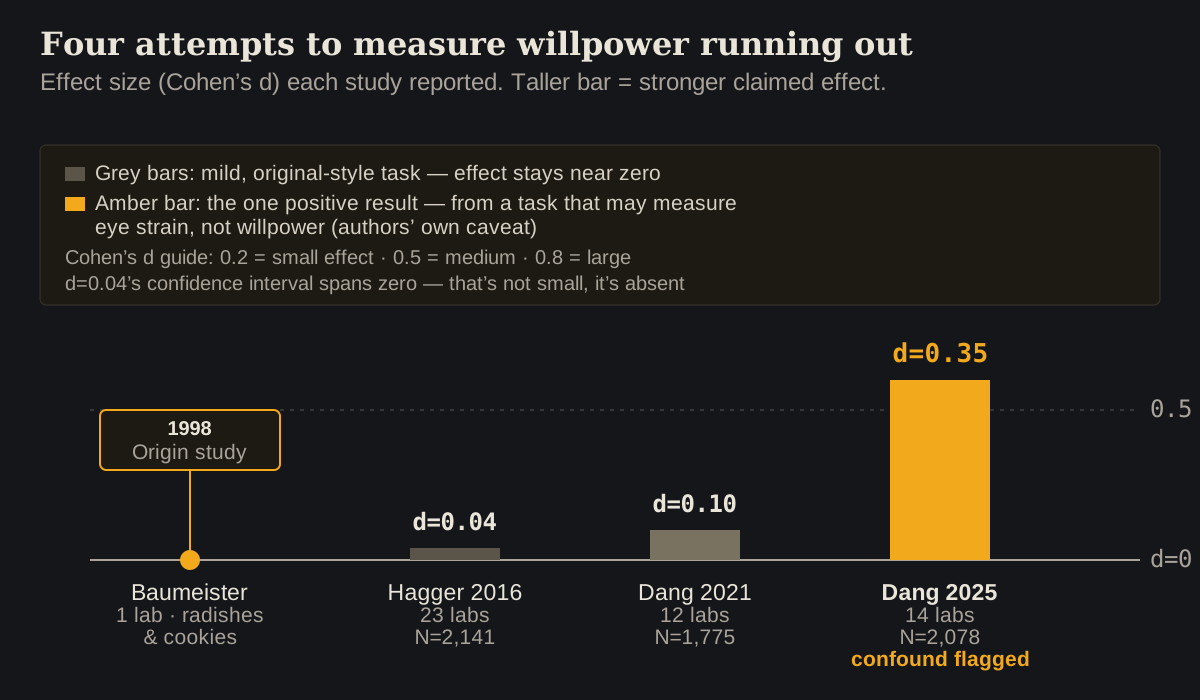
To put the chart in words: three independent large-scale attempts to catch willpower running dry with a mild task — the kind closest to Baumeister’s original design — landed at d=0.04 and d=0.10, both close enough to zero to call negligible. The fourth attempt, the only one to find a real effect, needed 30 to 40 minutes of a demanding visual task to get there, and comes with the authors’ own admission that it might be measuring eye strain instead.
What did the 2016 study that found nothing actually test?
This deserves a precise answer, because “a big study found nothing” travels a lot faster than what the study actually did. The 2016 project didn’t restage the radish-and-cookie scene. Twenty-three independent labs, working from the same pre-registered plan, ran 2,141 people through a cleaner, more tedious task: Baumeister’s own letter-“e” exercise from 1998, computerized in 2014 by the psychologist Chandra Sripada. Press a key for every word containing an “e”, but hold the response when the “e” sits next to a vowel — 150 trials, seven and a half minutes of busywork with a trap in it. Then, and only then, came a second test of self-control.
Here’s the detail that makes this result hard to explain away. Before a single lab collected a single data point, Baumeister — the theory’s own author, the man whose career this idea helped build — reviewed the protocol and signed off on it. This wasn’t a test rigged by skeptics to make the theory fail on a technicality. It was the theory’s original defender approving the method himself. And the result, pooled across all 23 labs, was d=0.04, with a confidence interval of [-0.07, 0.15] — a range so wide it straddles zero comfortably on both sides, like a net that catches nothing because there was nothing to catch.
The timing wasn’t a coincidence, either. The year before, a separate and far larger project turned the same question on psychology itself: how many of its published results actually hold up? Two hundred and seventy researchers tried to reproduce 100 studies and could only confirm 35 of the 97 that had originally reported something significant. Ego depletion wasn’t singled out as uniquely broken. It was one casualty in a field-wide reckoning — which is exactly why psychologists took the 2016 result seriously instead of shrugging it off as one unlucky afternoon in a lab.
What does hold up, if not the muscle?
Strip away the resource metaphor and the obvious replacement is belief: Job, Dweck and Walton proposed in 2010 that depletion hits only people who already assume willpower is a limited tank. It is a tidy story, and it has held up no better than the one it was meant to replace. A preregistered replication with 187 people found neither a depletion effect nor any moderation by willpower beliefs; the 36-lab, 3,531-person study found no moderation by willpower beliefs either; and a 2023 review of the evidence for it concluded that it is “weak at best.” Which leaves the “muscle” with no physical basis — and its belief-shaped successor still unproven.
Motivation and simple boredom do hold up, and they make for a far less dramatic explanation of the original cookie experiment than a depleted resource ever could. Someone who has just spent five minutes resisting fresh-baked cookies for a stranger’s research project has, understandably, very little left to give a pointless puzzle that can’t be solved. No fuel tank required — just a person who has run out of patience for busywork, which is a completely different thing. It’s the same trap that swallowed the 25-minute-timer myth: a real, felt experience gets handed a scientific-sounding explanation, and the explanation turns out to be the wrong one.
Does believing willpower is limited actually make things worse?
This is the idea that moved in after the muscle, and it deserves exactly the same treatment. Job, Dweck and Walton proposed in 2010 that depletion was never physiology but expectation: you flag after a hard task only if you already believe effort draws down a finite supply. It is a better story than the tank, and for a decade it was the sophisticated answer. It has not held up either. A preregistered replication with 187 participants found neither the depletion effect nor any moderation by willpower beliefs. The 36-laboratory study measured those beliefs directly and reported that depletion “was not moderated by trait self-control, willpower beliefs, or action orientation.” A 2023 review of the whole line put its verdict in the title: the existing evidence is weak at best.
What survives is quieter, and it is correlational. In two daily diary studies, people who describe willpower as a limited supply put off going to bed more than other people do — but only after a stressful day. A 2025 survey of 270 adults with type 2 diabetes found those beliefs predicted general emotional well-being, while noting the path may run through personality and self-efficacy rather than through the belief itself. That is the shape of this literature outside the lab: people who say their willpower drains easily also report worse days. Which way the arrow runs, nobody has shown. Someone whose days genuinely do go badly has every reason to describe their willpower as easily drained.
So the honest version of this advice is narrower than the one you usually hear, and it needs no mechanism at all. Someone skips a planned workout at 9pm and tells themselves, “I used up all my willpower today at work.” It’s a satisfying line, precisely because it isn’t anyone’s fault. But it does something sneaky: it takes a fixable problem and files it as unfixable. The fixable version has an obvious next move — change what happens in the hour after a hard day, or get honest about why the workout matters tonight and not some other night. The empty-tank version has no next move at all. It just sits there, waiting for a refill. That is reason enough to drop the sentence, whatever the psychology eventually turns out to be.
What should you do instead of relying on willpower?
Stop treating willpower like a battery that drains over the course of a day. Three moves that don’t depend on a theory that hasn’t survived its own replication attempts:
- Change the situation instead of rationing your effort. If avoiding something takes repeated willpower — walking past the snack drawer at 3pm, ignoring your phone during work — that’s a sign to physically remove the temptation, not a sign to save up strength for the next round. Put the snacks somewhere inconvenient. Leave the phone in another room. The goal is to need less willpower, not to have more of it.
- Treat “I don’t want to” as a clue, not a diagnosis. Before assuming you’re depleted, ask what specifically is making the task unpleasant right now: is it boring, is the payoff unclear, have you made zero visible progress on it today? Each of those has a concrete fix. “My tank is empty” doesn’t.
- Build the behavior into a routine instead of relying on resolve. Repetition, not self-control, is what makes an action automatic. Once something is a genuine habit, it barely calls on willpower at all, limited or not. The same principle applies to studying: people who think they need to match a technique to their personal “learning style” run into a similar dead end — the fix isn’t finding the right method for your type, it’s repeating the plain method enough times that it stops requiring effort.
Ego depletion was not the only casualty of that decade. Kahneman withdrew the priming chapter of «Thinking, Fast and Slow» for the same reason. And if the question underneath yours is why the day feels expensive rather than why you gave in, that is a different measurement problem.
The boring bottom line
The muscle metaphor for willpower rests on one afternoon in 1998, and a 23-lab, 2,141-person attempt to reproduce it came back empty. A 2025 study did find something, but only after forty minutes of a task punishing enough that it might be measuring eye strain rather than self-control, published in a journal a rung below the one that ran the null result, and not yet confirmed by anyone else. What’s actually holding up isn’t a resource that runs low — and it isn’t a belief about one either: the willpower-mindset version has failed its own replications. Stop rationing your willpower like it’s a scarce commodity. Start asking why the task in front of you feels hard right now, today, specifically — that question has an answer waiting for it. “My tank is empty” never does.
Sources
- Baumeister, R. F., Bratslavsky, E., Muraven, M., & Tice, D. M (1998). Ego depletion: Is the active self a limited resource? Journal of Personality and Social Psychology , 74(5), 1252-1265. Journal of Personality and Social Psychology. doi:10.1037/0022-3514.74.5.1252
- Muraven, M., & Baumeister, R. F (2000). Self-regulation and depletion of limited resources: Does self-control resemble a muscle? Psychological Bulletin , 126(2), 247-259. Psychological Bulletin. doi:10.1037/0033-2909.126.2.247
- Hagger, M. S., Chatzisarantis, N. L. D., et al (2016). A multilab preregistered replication of the ego-depletion effect. Perspectives on Psychological Science. 11(4), 546-573 doi:10.1177/1745691616652873
- Dang, J., Xiao, S., Mao, L., et al (2025). Revisiting ego depletion: Evidence from multi-lab collaborations. Journal of Pacific Rim Psychology. 19 doi:10.1177/18344909251386084
- Dang, J., Barker, P., Baumert, A., et al (2021). A multilab replication of the ego depletion effect. Social Psychological and Personality Science. 12(1), 14-24 doi:10.1177/1948550619887702
- Open Science Collaboration (2015). Estimating the reproducibility of psychological science. Science. 349(6251), aac4716 doi:10.1126/science.aac4716
- Job, V., Dweck, C. S., & Walton, G. M (2010). Ego depletion—is it all in your head? Implicit theories about willpower affect self-regulation. Psychological Science. 21(11), 1686-1693 doi:10.1177/0956797610384745
- Carruth, N. P., Ramos, J. A., & Miyake, A (2023). Does willpower mindset really moderate the ego-depletion effect? A preregistered replication of Job, Dweck, and Walton (2010). PLOS ONE. 18(6), e0287911 doi:10.1371/journal.pone.0287911
- Miyake, A., & Carruth, N. P (2023). On the robustness and replicability of the moderating influence of willpower mindset on the ego-depletion effect: existing evidence is weak at best. Frontiers in Psychology. 14, 1208299 doi:10.3389/fpsyg.2023.1208299
- Vohs, K. D., Schmeichel, B. J., Lohmann, S., et al (2021). A multisite preregistered paradigmatic test of the ego-depletion effect. Psychological Science. 32(10), 1566-1581 doi:10.1177/0956797621989733
- Bernecker, K., & Job, V (2020). Too exhausted to go to bed: Implicit theories about willpower and stress predict bedtime procrastination. British Journal of Psychology. 111(1), 126-147 doi:10.1111/bjop.12382
- Geerling, R., Holmes-Truscott, E., Speight, J., & Skinner, T (2025). The role of willpower beliefs in diabetes distress and general emotional well-being in adults with type 2 diabetes. Diabetic Medicine. 42(6), e70035 doi:10.1111/dme.70035