TL;DR
- Verdict: the mechanism is wrong, the experience is real. In February 2026, 39 scientists from eleven countries signed one paper agreeing that Polyvagal Theory’s specific explanation for why your body sometimes shuts down doesn’t hold up. That doesn’t mean the shutdown itself is imaginary — it means the wiring diagram used to explain it was wrong.
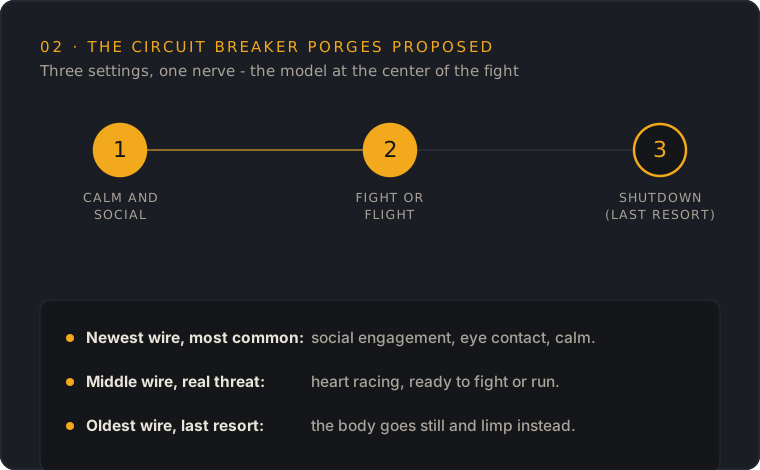
- The theory says your body runs on three settings, not two, like a circuit breaker with an extra fuse: calm and social, fight-or-flight, and — as a last resort — a full shutdown. The 2026 review says the biology behind that third setting doesn’t check out.
- The theory’s own creator wrote a rebuttal in the same journal issue. His argument isn’t new data — it’s that the critics are grading the wrong exam. Independent readers call that move a warning sign, not a comeback.
- We didn’t just read the papers — we analyzed Google’s actual search results for this topic, reading every one of the 57 pages currently ranking. More than half present the theory as settled fact. Barely more than one in four even mentions that scientists are fighting about it.
Where did Polyvagal Theory come from?
Let’s start with the word itself, because most people repeat it for years without ever being told what it means. “Poly” just means many. “Vagal” refers to the vagus nerve — a long cable that runs from your brainstem down through your chest and gut, and does most of the work of calming your body back down after stress. So “polyvagal,” literally, just means “many vagus”: the claim that this one nerve doesn’t act like a single on-off switch, but splits into separate, independently controllable pathways. Simple enough as an idea. The interesting part is who came up with it, and whether it actually holds up.
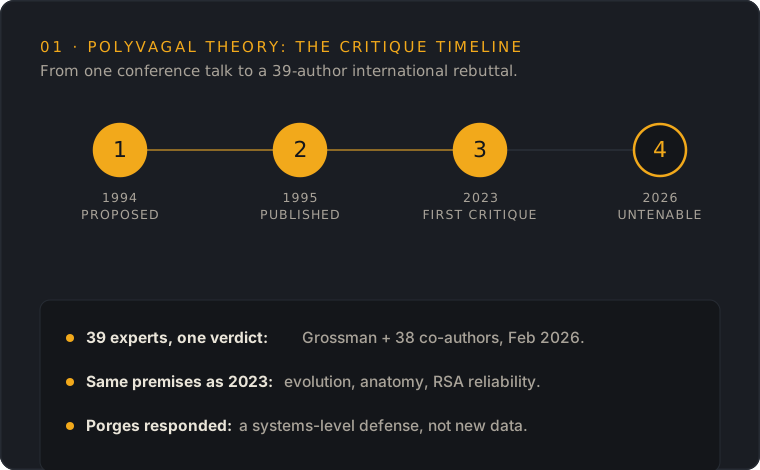
The person was Stephen Porges. The story began on October 8, 1994, in a conference hotel in Atlanta, where this University of Maryland professor walked to the podium to deliver the presidential address at a meeting of the Society for Psychophysiological Research. He had a puzzle to solve. Therapists working with trauma survivors kept describing something the standard science of the day couldn’t explain: people who didn’t fight and didn’t run, who instead went limp, silent, and far away — frozen, long after the danger had passed. Fight-or-flight had no room for that.
So Porges proposed adding a third setting, and the picture he painted is easy to hold in your head even now, three decades later. Your body’s automatic wiring, he said, works like a circuit breaker with a hidden third fuse nobody had mapped before. Most of the time you’re humming along on the newest wire — calm, social, able to make eye contact and read a room without a second thought. Real threat trips the next fuse, and you get the familiar jolt: heart pounding, ready to fight or run. But push past that — past the point where fighting or fleeing could actually save you — and Porges argued a third, far older wire kicks in on its own: a full-body shutdown, inherited from ancestors who survived predators not by outrunning them but by going limp and playing dead. He traced all three settings to two separate branches of a single nerve, the vagus: one ancient pathway, shared with reptiles, wired for that last-resort shutdown; one newer pathway, found only in mammals, wired for calm connection. He published the full idea the following year in the journal Psychophysiology, and along with it came a second new word: neuroception, the idea that your body has a kind of radar constantly scanning for danger, running underneath your conscious thoughts.
It caught on fast, because it filled a real gap. Within two decades, an entire self-help vocabulary had grown up around it — slow exhales, humming, cold water on the face, all marketed as ways to “activate your ventral vagal state,” usually by people who had never read the original 1995 paper. Porges himself moved on from Maryland; today he directs a trauma-research center at Indiana University’s Kinsey Institute and holds a professorship in psychiatry at the University of North Carolina. Which brings us to the part almost nobody selling those breathing exercises mentions.
Is there a real scientific fight, or just one skeptic?
Not one skeptic — dozens, and it’s been building for years. Paul Grossman, a physiologist who spent 15 years directing psychosomatic-medicine research at University Hospital Basel in Switzerland, studying the very nerve Porges built his theory around, published a detailed challenge in 2023 in the journal Biological Psychology. His target was the theory’s own foundation: the heart-rate measurement Porges uses to prove which “wire” is active, called respiratory sinus arrhythmia, or RSA for short — essentially, how much your heart rate speeds up and slows down as you breathe. Grossman’s read of decades of published studies and participant groups: RSA doesn’t behave consistently enough, across different people and situations, to prove which vagal pathway is in charge at any given moment. He also argued the evolutionary story doesn’t match what’s actually known about vertebrate anatomy, and that the clean split between the two nerve branches isn’t as tidy in a real body as the theory needs it to be.
Grossman didn’t let it drop there. Three years later, in February 2026, he returned to the fight — this time with 38 co-authors standing behind him: physiologists, evolutionary biologists, and neuroscientists spanning eleven countries — Switzerland, the United Kingdom, the United States, Australia, New Zealand, the Netherlands, Brazil, France, Germany, Italy, and Denmark. Their paper’s title doesn’t hedge: “Why the Polyvagal Theory Is Untenable.” They worked through five specific, checkable claims the theory depends on. Their verdict on every single one: doesn’t hold up. Not “needs updating.” Doesn’t hold up. Thirty-nine credentialed scientists, on four continents, tested the foundation and got the same answer.
How did Porges respond?
He didn’t stay quiet. In the same journal issue, Porges published his own rebuttal, titled “When a Critique Becomes Untenable.” Here’s the catch, though: he doesn’t answer the specific objections with new data. Instead, he argues Grossman’s whole team is grading the wrong exam. He describes his own work as a “systems-level, pathway-specific framework.” Plain translation: a big-picture model of how systems interact, not a set of small claims you can test one at a time. He accuses the critics of “category errors” — in his telling, they’re judging anatomy when they should be judging how the whole system behaves together, at the wrong “level of analysis.” A real disagreement, he writes, needs “representational fidelity” between what the critics attack and what the theory actually says. He doesn’t think Grossman’s paper clears that bar.
That’s a legitimate thing to argue in a journal. It’s also worth naming plainly what kind of argument it is. It isn’t new evidence that answers the anatomy or the heart-rate data on their own terms — it’s a claim that the objections are aimed at the wrong target. And here’s the question worth pausing on: what evidence, in principle, would ever count against a theory that can dodge any specific challenge by saying “you’re testing the wrong level”? The harder that question is to answer, the less the theory looks like ordinary science.
What holds up, and what doesn’t?
Start with what nobody in this fight disputes. The vagus nerve is real. It runs from your brainstem down through your chest and gut, and it’s central to how your body calms itself down. Chronic stress and trauma really do change how your body works. None of that is in question, on either side, and none of it depends on Porges being right.
What’s contested is the specific wiring diagram built on top of those basics: that the vagus splits into two evolutionarily distinct cables with separate jobs, stacked in a strict three-level hierarchy, and that a heart-rate measurement can reliably tell you which one is currently running the show. That’s the part 39 scientists just said doesn’t check out.
Here’s why that distinction actually matters if you use these techniques yourself: the calming exercises sold under the polyvagal name — slow exhales, humming, splashing cold water on your face — mostly work through much older, better-established plumbing. Stimulating the vagus nerve generally slows your heart rate and nudges your body toward calm, whether or not Porges’s specific two-cable story about why is correct. You don’t need the theory to be true for the breathing exercise to help you. More than half of what’s currently online never makes that distinction.
Do vagus nerve stimulators actually work?
Which raises an obvious next question, since it’s the product this whole theory is now selling: do those little devices that clip onto your ear or neck and buzz — marketed as vagus nerve stimulators — actually do anything, without the marketing? We looked, deliberately staying away from brand names and product reviews, and went straight to the clinical research instead.
The honest answer depends entirely on what you’re using it for, and it’s more interesting than a flat yes or no. Start with the exact claim the devices are sold on: that a short session raises your “vagal tone,” measured by heart-rate variability. A team of researchers ran what’s called a Bayesian meta-analysis on this specific question — a method built to test whether an effect is real or just noise, rather than merely failing to find one — pooling 16 controlled studies of healthy adults wearing these devices. Their finding: no measurable change in heart-rate variability at all. The statistical evidence favored “no effect” over “real effect” by roughly 25 to 1. A separate, broader review of 78 clinical trials confirmed the pattern from another angle: a small, real drop in heart rate — 1.23 beats per minute on average, 95% CI 0.72 to 1.74, so barely more than a single beat — but no meaningful change in blood pressure or oxygen levels, and most of the underlying studies were rated only moderate-to-low quality.
Now flip to a different question — not “does it move a heart-rate number in a healthy person,” but “does it help someone who’s actually struggling” — and the picture gets more interesting. A 2023 review pooling 12 trials and 838 people with depression found the stimulation meaningfully reduced depression-scale scores, performing about as well as standard antidepressant medication, though the researchers themselves rated the evidence quality low to very low. A 2025 review of insomnia, pooling six trials and 336 patients, found a similar-sized real improvement in sleep-quality scores — again rated low to very low quality evidence, meaning promising, not proven.
Put the two halves together and you get something oddly specific: the flagship number the devices are marketed on — “boost your vagal tone,” shown on an app as a rising heart-rate-variability chart — is the one piece of the story with the least support. The quieter, harder-to-market claims — modest help for people who are already depressed or sleeping badly — have thin but real evidence behind them. If a session with one of these devices relaxes you, that’s a perfectly good reason to keep using it. Just don’t expect the device to be doing something a slow exhale through pursed lips can’t also do for free, and don’t buy one hoping to watch a number on a screen prove it’s working.
What do the top-ranking pages actually cite?
Here’s the question worth pausing on, and it’s the whole reason this article exists: if the theory’s own foundation is this contested, does the average person searching for it online have any way of knowing? We didn’t just read the studies. We read what’s actually sitting at the top of Google right now for this topic: 57 currently-accessible pages, clinic sites, trauma-therapy blogs, wellness guides, and academic papers, every one checked for what it actually cites and admits.
The good news first: this isn’t a case of people getting the idea wrong. Four out of every five pages we read describe the actual mechanism accurately — the two branches, neuroception, the vagal brake. Writers understand the theory. What most of them don’t know is that it’s under fire. More than half the pages present Polyvagal Theory as settled neuroscience with zero hedge, no caveat, nothing. Barely more than one in four even mentions that a scientific fight over its basic architecture is happening at all — and most of those are the academic sources themselves, not the therapy blogs and wellness sites where the average reader actually lands.
Sit with that for a second, because it’s a genuinely strange situation. An idea that reshaped how an entire generation of therapists talk to trauma survivors about their own bodies has just been formally disputed by 39 of the exact scientists whose decades of anatomy and evolution research were originally cited to support it — and if you search this topic today, the odds are roughly three in four that you’ll never find out any of that happened. That gap, between what the science currently says and what the search results currently show, is the actual apex of what this audit found. It’s not that the internet is lying. It’s that it hasn’t caught up yet, and most of it won’t, until enough writers read past the first page of results.
Where does this cost you something?
The cost isn’t the breathing exercises — those are mostly harmless and often genuinely useful. The cost is the confidence therapists and clients place in the explanation bolted onto them. Building an entire treatment framework, and a trauma survivor’s understanding of their own body, on a wiring diagram that a growing body of expert opinion says doesn’t hold up is a real risk. Telling someone their freeze response has a precise, scientifically confirmed neural explanation — when physiologists are actively disputing that explanation — is a different thing than telling them it’s a useful, still-debated working idea. One version is honest. The other borrows more certainty than the evidence currently supports.
What should you do instead?
Three moves that don’t require the theoretical fight to be settled first:
- Keep what works, drop the certainty about why. If slow breathing or humming genuinely calms you, keep doing it. Just hold the explanation loosely — “this seems to help my body settle down” instead of “this activates my ventral vagal complex,” which claims far more precision than the evidence currently backs.
- If a therapist presents this as settled fact, ask about the debate. A good clinician can say the theory is clinically useful and still be honest that its neuroanatomical claims are disputed by working physiologists as of 2026. That’s not a red flag. Refusing to mention the debate at all is the red flag.
- Separate the metaphor from the mechanism. “My body shut down” is a genuinely useful way to describe what happened to you. It doesn’t require a specific, contested theory about two evolutionarily distinct nerve cables to be literally true.
The same shape shows up elsewhere: a tidy set of categories carrying more weight than the measurements underneath it. Two nearby cases are the four attachment styles and the «backed by science» label audited in our notes on «The Let Them Theory».
The boring bottom line
Polyvagal Theory gave trauma therapy a name for the freeze response that older fight-or-flight models missed — that’s a real, useful contribution, and it’s why the idea spread so fast. But the specific wiring diagram underneath it — two evolutionarily distinct nerve branches, stacked in a strict hierarchy, tracked reliably by a heart-rate measurement — is now disputed by 39 independent scientists across eleven countries, and the theory’s own defense leans on an argument that critics call unfalsifiable. The vagus nerve is real. The freeze response is real. The precise two-cable story explaining exactly how they connect is, as of 2026, a live scientific fight that most of what you’ll read online doesn’t mention at all.
This article discusses trauma-related nervous system responses for informational purposes. It is not a substitute for care from a licensed mental health professional, especially if you’re managing PTSD or complex trauma.
Sources
- Porges, S. W (1995). Orienting in a defensive world: Mammalian modifications of our evolutionary heritage. Psychophysiology. A polyvagal theory. , 32(4), 301-318 doi:10.1111/j.1469-8986.1995.tb01213.x
- Grossman, P (2023). Fundamental challenges and likely refutations of the five basic premises of the polyvagal theory. Biological Psychology. 180, 108589 doi:10.1016/j.biopsycho.2023.108589
- An international expert evaluation of the polyvagal theory and commentary upon Porges, S. W (2025). Polyvagal theory: Current status, clinical applications, and future directions. Clinical Neuropsychiatry. Grossman, P., et al. (2026). Why the polyvagal theory is untenable. 23(1), 100-112 doi:10.36131/cnfioritieditore20260110
- Porges, S. W (2026). When a critique becomes untenable: A scholarly response to Grossman et al.'s evaluation of polyvagal theory. Clinical Neuropsychiatry. 23(1), 113-128. PMID 41768026 doi:10.36131/cnfioritieditore20260111
- Wolf, V., Kühnel, A., Teckentrup, V., Koenig, J., & Kroemer, N. B (2021). Does transcutaneous auricular vagus nerve stimulation affect vagally mediated heart rate variability? A living and interactive Bayesian meta-analysis. Psychophysiology. 58(11), e13933 doi:10.1111/psyp.13933
- Hua, K., Cummings, M., Bernatik, M., Brinkhaus, B., Usichenko, T., & Dietzel, J (2023). Cardiovascular effects of auricular stimulation — a systematic review and meta-analysis of randomized controlled clinical trials. Frontiers in Neuroscience. 17, 1227858 doi:10.3389/fnins.2023.1227858
- Tan, C., Qiao, M., Ma, Y., Luo, Y., Fang, J., & Yang, Y (2023). The efficacy and safety of transcutaneous auricular vagus nerve stimulation in the treatment of depressive disorder: A systematic review and meta-analysis of randomized controlled trials. Journal of Affective Disorders. 337, 37-49 doi:10.1016/j.jad.2023.05.048
- de Oliveira, H. M., Gallo Ruelas, M., Viana Diaz, C. A., de Paula, G. O., Fruett da Costa, P. R., & Pilitsis, J. G (2025). Transcutaneous auricular vagus nerve stimulation in insomnia: A systematic review and meta-analysis. Neuromodulation. 28(8), 1332-1340 doi:10.1016/j.neurom.2025.04.001