TL;DR
- The four boxes are a legacy of a 1987 questionnaire that asked people to pick one paragraph out of three. Attachment researchers stopped using categories decades ago.
- When the types-versus-dimensions question was put to formal taxometric testing, the answer came back dimensional. There is no natural boundary between «anxious» and «secure»; there are two sliders.
- Stability is real but limited. Across 127 papers and 21,072 measured attachments, the correlation across time was .39, and beyond fifteen years it was not significant at all.
- «Disorganised» is not an adult dating style. It is an infant classification from a laboratory procedure, and the researchers who study it have publicly objected to how it is being used.
- The dimensions predict real things. What they do not support is the sentence «I am an anxious attachment», said the way people say their blood type.
In 1987 two social psychologists named Cindy Hazan and Phillip Shaver had an idea and no budget. They wanted to know whether the way infants bond with caregivers had any adult equivalent in romantic love. So they wrote three paragraphs, each describing a way of being in a relationship, and printed them in a Colorado newspaper with an invitation: read these, pick the one that sounds like you, mail it in (Hazan & Shaver, 1987).
It worked. Hundreds of people wrote back, the paragraphs sorted them into three groups, and the groups differed in ways that made sense. The paper became one of the most cited in the history of relationship psychology, and it did something its authors did not intend. It put attachment into boxes, and the boxes escaped.
It is worth sitting with how that study was built, because the design explains the shape of everything that followed. The three paragraphs were written first and the people were sorted into them afterwards. Readers of one newspaper who felt like replying to a survey about love are not a random sample of humanity. And a person choosing between three descriptions of themselves is doing something closer to picking a horoscope than to being measured: the format offers three answers, so it receives one of three answers, and the resulting three-way split looks like a discovery rather than a menu.
Four decades later those boxes are a genre. There are quizzes, an entire coaching industry, dating-app fields, and a vocabulary that has become as casual as star signs but sounds clinical. «He’s avoidant.» «I’m anxious-preoccupied.» «We’re a classic anxious-avoidant trap.»
The researchers who built the field abandoned the boxes a long time ago, for a reason that is easy to state and easy to check.
What replaced the boxes
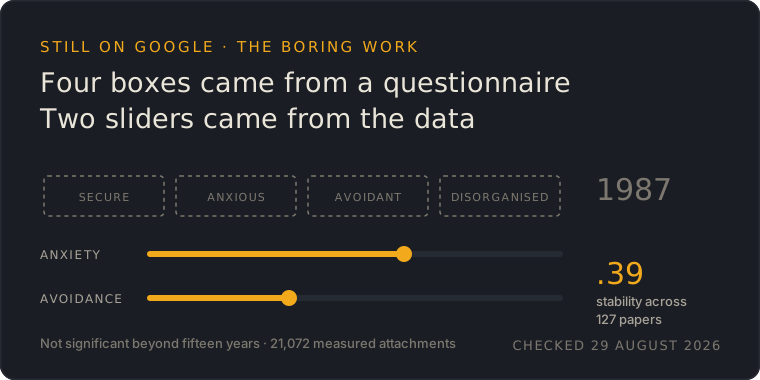
Modern attachment research does not describe you with a category. It gives you two numbers.
The first is anxiety: how much you worry about a partner’s availability, how much reassurance you need, how strongly you react to signs of distance. The second is avoidance: how uncomfortable you are with closeness and dependence, how much you handle things alone.
Two sliders, each running continuously from low to high. Everything the four types describe is a corner of that square. High anxiety with low avoidance is what people call anxious-preoccupied. Low anxiety with high avoidance is dismissive-avoidant. Both low is secure. Both high is the one people call fearful-avoidant, and it is the corner where most of the confusion lives.
The four names still exist because a 1991 paper laid them out that way (Bartholomew & Horowitz, 1991), and because names are easier to remember than coordinates. But in the research literature the names are a shorthand for regions of a space, not a claim that four kinds of person exist.
The test that settled it
«Categories or dimensions» sounds like an argument about words. It is not. It is a factual question with a right answer, and statisticians built tools specifically to answer it.
The tools are called taxometric methods, and the logic is simple enough to explain. If a real boundary exists between two kinds of thing, the data leave a signature at the boundary. Height does not do this: people are not tall-kind and short-kind, they are spread along a line. Biological sex mostly does. The methods ask whether the signature is there.
Applied to adult attachment across two large samples, the signature was absent. The finding is that individual differences «appear more consistent with a dimensional rather than a categorical model», and it held both for attachment in general and for attachment in specific relationships, with parents and with peers (Fraley et al., 2015).
This is worth translating out of statistics. When a quiz tells you that you are anxiously attached, it has drawn a line across a continuum and put you on one side of it. Somebody scoring one point lower gets a different label and a different explanation of their life. The line is a decision made by whoever wrote the quiz. It is not a seam in the world.
The measurement work points the same way. When researchers ran the major attachment questionnaires through item response theory, they found the items were doing a decent job of discriminating people at the insecure end and a poor job in the middle (Fraley, Waller & Brennan, 2000). Scales built to sort people had their sharpest resolution exactly where sorting is least meaningful.
Verdict on «there are four attachment types»: R — Refuted. Two continuous dimensions, tested directly, with no boundary between them.
How much of it stays with you
The second half of the popular claim is the one that does the emotional work: that your style was set in childhood and follows you around.
This has been measured properly. A meta-analysis pooled 127 papers covering 21,072 measured attachments and 225 time intervals, running from half a month to 29 years (Pinquart et al., 2013). The overall stability came out at r = .39.
A correlation of .39 means there is a real thread and it is not a rope. If you sorted a hundred people by their attachment security at twenty and again at thirty-five, the two lists would resemble each other in the way two shuffled versions of the same deck resemble each other. You would recognise the pattern. You could not predict any individual’s place.
There is a second way to read the same number that people rarely hear. A stability of .39 means most of what determines your attachment security today is not your attachment security a decade ago. The majority of the variation is coming from somewhere else, and «somewhere else» is largely the relationships you have been in since.
The interval detail is sharper still. Stability was decent under two years, weaker past five, and across intervals longer than fifteen years there was no significant stability at all. Whatever a childhood assessment captured, it does not reliably reach into middle age.
The review found something else worth keeping. Among children in at-risk circumstances, insecurity was the more durable state: secure children under stress were less likely to stay secure, and insecure children were more likely to stay insecure. Stability belongs less to attachment than to circumstances that do not change.
Verdict on «your attachment style is set in childhood and stays with you»: P — Partial. A medium-sized thread that fades with time and depends heavily on whether life stays the same.
The word that should not be on a dating profile
«Disorganised attachment» has become the prestige diagnosis of the genre, usually presented as a fourth adult style caused by childhood trauma. This is the clearest error in the popular version, and it is not a matter of interpretation.
Disorganised attachment is an infant classification. Mary Main and Judith Solomon introduced it in the 1980s to describe specific behaviour in a laboratory procedure: a one-year-old whose caregiver returns to the room and who then does something incoherent, approaching and backing away at once, freezing mid-movement, going still with a blank expression. It is a coding decision about a few seconds of videotape.
In 2017 a large group of the field’s senior researchers published a review with an explicit warning attached, because they were watching the term escape into clinical and policy settings where it was being treated as a diagnosis and a marker of maltreatment (Granqvist et al., 2017). Their concern was reification: turning a behavioural code into a thing a person is.
The adult-relationship pattern that gets called disorganised is a different construct entirely. In adult attachment measures it is the corner of the square where both sliders are high: you want closeness and you distrust it. That is a real, recognisable and often painful pattern. It is not the infant classification, it was not measured with the infant procedure, and the causal story attached to it in popular content is an inference nobody has demonstrated.
Verdict on «disorganised attachment is an adult style caused by childhood trauma»: H — Untested. Two different constructs from two different literatures, joined by a shared adjective.
What the dimensions buy you
None of this makes attachment research worthless. The opposite: it is one of the more productive programmes in personality and relationship science, and the reason is precisely that it dropped the categories.
The two dimensions predict things. Higher attachment anxiety is associated with more distress during conflict and more sensitivity to signals of rejection. Higher avoidance is associated with less support-seeking and more withdrawal under pressure. These are ordinary correlational findings of ordinary size, and they hold up.
The more useful discovery is that attachment security moves. A 2023 review of the change literature makes the case that security is better thought of as a state that relationships and circumstances push around than as a trait you were issued (Chopik, Weidmann & Oh, 2023). People become more secure in stable relationships with responsive partners. They become less secure after loss, betrayal or long stretches of instability. The field’s own leading review describes the question of what makes people secure or insecure as an open and actively debated one (Fraley, 2019).
Which is the opposite of the message the quiz delivers. A label explains your past and predicts your future. A pair of sliders describes where you are standing right now.
One practical consequence deserves saying plainly. If security responds to circumstances, then the most reliable route to becoming more secure is less insight into your childhood than time spent in a relationship where the other person is consistently responsive, which is a slow, unglamorous intervention that no quiz can sell you.
Why the boxes won anyway
The four-type model has the same advantages every popular taxonomy has. It is memorable, it is portable, it gives you a word for a feeling you did not have a word for, and it turns a diffuse difficulty into an identifiable thing.
It also has a specific and underrated appeal: it explains other people. «He’s avoidant» converts a painful and ambiguous situation into a solved one. The cost is that a solved situation stops generating curiosity, and the person you have labelled stops being someone you have to keep learning about.
The honest version is less satisfying and more useful. You are somewhere on two continuums. So is the other person. Both of you move.
The shift: replace «I am an anxious attachment» with «I score high on attachment anxiety right now», and notice how much of the fatalism drains out of the sentence.
First move: ask any quiz where it drew its line. Categories in this field are cut points chosen by the quiz author, and taxometric testing found no natural boundary to cut at.
Second move: treat scores older than a few years as history rather than description. Measured stability was .39 overall and nothing significant past fifteen years.
Third move: be careful with «disorganised». It is an infant coding category whose own researchers published a warning about its misuse, not a description of how you date.
Pop psychology’s other favourite nervous-system model gets the same audit in is polyvagal theory evidence-based. Every claim we have traced back to its first source sits in our register of checked self-improvement claims.
The boring bottom line
The four types come from a newspaper questionnaire in 1987 that asked people to pick a paragraph. Formal testing of whether real categories exist returned dimensions instead. Stability across the lifespan sits at .39 and disappears past fifteen years. The most dramatic label in the vocabulary was borrowed from an infant laboratory procedure whose own researchers have asked people to stop doing this.
Two sliders, both of which move, describing where you are rather than what you are. It fits on a dating profile far worse, which is most of why it lost.
Sources
- Fraley, R. C., Hudson, N. W., Heffernan, M. E., & Segal, N (2015). Are adult attachment styles categorical or dimensional? A taxometric analysis of general and relationship-specific attachment orientations. Journal of Personality and Social Psychology. Two large samples. Individual differences 'appear more consistent with a dimensional rather than a categorical model', for general attachment and for specific relationships alike. doi:10.1037/pspp0000027
- Pinquart, M., Feussner, C., & Ahnert, L (2013). Meta-analytic evidence for stability in attachments from infancy to early adulthood. Attachment & Human Development. 127 papers, 21,072 attachments, 225 intervals from half a month to 29 years. Overall r = .39; no significant stability beyond 15 years; insecurity more durable than security in at-risk samples. doi:10.1080/14616734.2013.746257
- Hazan, C., & Shaver, P (1987). Romantic love conceptualized as an attachment process. Journal of Personality and Social Psychology. 52(3), 511-524. The newspaper questionnaire that created the three-category habit. doi:10.1037/0022-3514.52.3.511
- Bartholomew, K., & Horowitz, L. M (1991). Attachment styles among young adults: A test of a four-category model. Journal of Personality and Social Psychology. 61(2), 226-244. Where the familiar four names come from. doi:10.1037/0022-3514.61.2.226
- Fraley, R. C., Waller, N. G., & Brennan, K. A (2000). An item response theory analysis of self-report measures of adult attachment. Journal of Personality and Social Psychology. 78(2), 350-365. The measurement side: existing scales discriminate best at the insecure end and worst in the middle. doi:10.1037/0022-3514.78.2.350
- Granqvist, P., Sroufe, L. A., Dozier, M., Hesse, E., Steele, M., van IJzendoorn, M., et al. (2017). Disorganized attachment in infancy: A review of the phenomenon and its implications for clinicians and policy-makers. Attachment & Human Development. The field's own warning against reifying an infant behavioural code into a diagnosis or a trait. doi:10.1080/14616734.2017.1354040
- Chopik, W. J., Weidmann, R., & Oh, J (2023). Attachment security and how to get it. Social and Personality Psychology Compass. Review of how and when attachment security changes. Security behaves more like a state that relationships move than a fixed trait. doi:10.1111/spc3.12808
- Fraley, R. C (2019). Attachment in adulthood: Recent developments, emerging debates, and future directions. Annual Review of Psychology. 70, 401-422. The field's summary of what is still unresolved, including what makes people secure or insecure in the first place. doi:10.1146/annurev-psych-010418-102813