Every claim on this site gets a grade, a date and a list of the papers behind it. This one sits in the registry of checked claims.
TL;DR
- The figure comes from one chart in one 2010 meta-analysis, where a comparison row is labelled “Smoking < 15 cigarettes daily”. Fifteen was the definition of moderate smoking in the paper the effect size was borrowed from, not a dose anyone measured against loneliness.
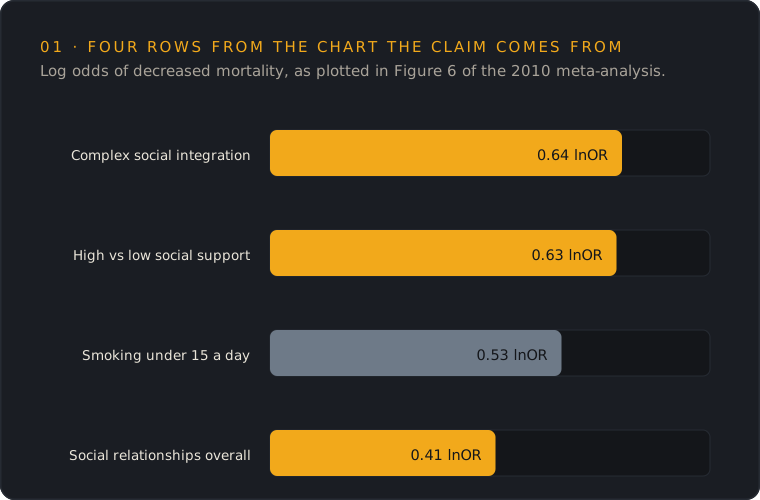
- On that same chart, the overall social-relationships bar is shorter than the smoking bar. Only the two strongest sub-measures reach past it, and neither of them is loneliness.
- The researcher whose paper produced the number has published a page correcting how it should be worded: “Lacking social connection is comparable to smoking up to 15 cigarettes per day.” Lacking social connection, not loneliness. Up to, not equal to.
- The underlying association is real and modest. Across 148 studies and 308,849 people, stronger social relationships carried an odds ratio of 1.50 for survival. In a later meta-analysis loneliness specifically came out at 1.26.
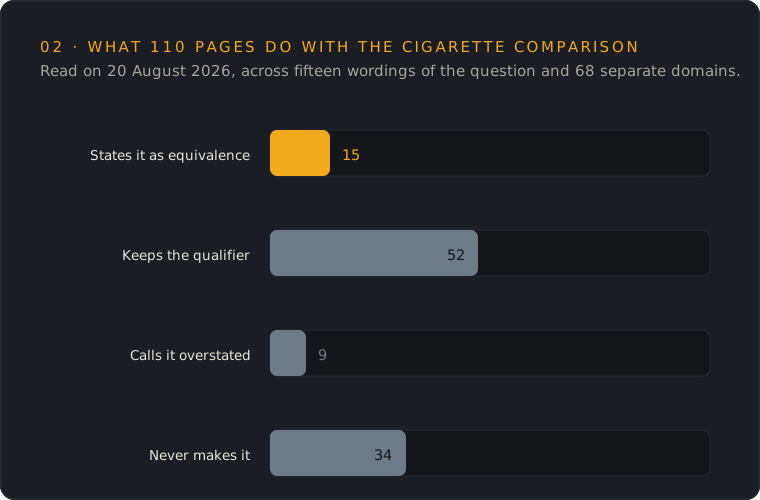
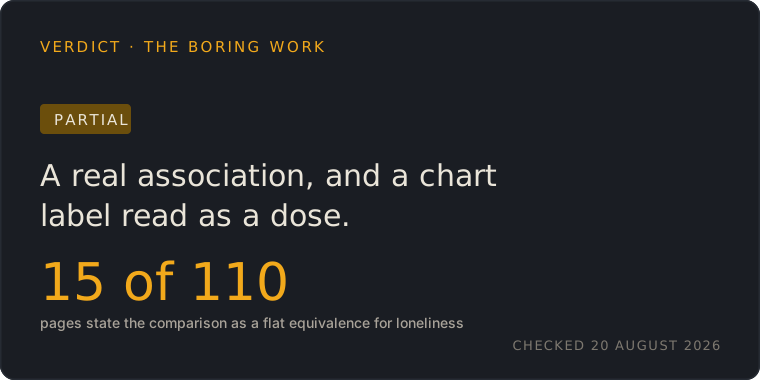
- Of the 110 pages we read on 20 August 2026, fifteen state the comparison as a flat equivalence for loneliness. Nine say the analogy is overstated or that the association weakens under adjustment.
A US surgeon general said it. The World Health Organization printed it. Councils pinned it to their health pages: loneliness is as bad for you as smoking fifteen cigarettes a day. It might be the most successful health slogan of the decade. And it was born not in a lab full of lonely smokers, but on a single bar chart, from which someone read a number the way you might read a price tag on the wrong shelf.
Nobody ever ran a study handing one group cigarettes and another group solitude. The slogan comes from Figure 6 of a 2010 meta-analysis in PLoS Medicine: twelve horizontal bars stacked on one axis, one of them labelled «Smoking < 15 cigarettes daily». This page is the story of how a label on that chart escaped, dropped a couple of crucial words on the way out, and became a fact.
Where the number comes from
A benchmark chart, read as a dose. Julianne Holt-Lunstad and colleagues pooled 148 studies of 308,849 people and found that people with stronger social ties were about 50% more likely to still be alive at follow-up (Holt-Lunstad, Smith & Layton, 2010). To help readers feel how big «50%» is, they drew a comparison chart, borrowing effect sizes from other studies: smoking, drinking, flu shots, obesity, blood-pressure pills. It was a visual aid, the scientific equivalent of «about the height of three double-decker buses». The buses were never meant to be boarded.
Three things about that figure are worth stating precisely, because none of them survive the retelling.
First, the label reads «Smoking < 15 cigarettes daily». Less than fifteen. Fifteen was where the borrowed study drew the line for «moderate smoker», the way a menu defines a «medium» pizza. Holt-Lunstad explains this on a page she keeps specifically to correct the slogan: «The effect size for smoking was based on moderate levels of daily smoking which was defined as up to 15 cigarettes» (Holt-Lunstad). Nobody measured where a two-pack-a-day habit would land, because the source had no such number.
Second, and this is the awkward part: on that chart, the social-relationships bar is shorter than the smoking bar. The overall finding sits at about 0.41 on the chart’s scale; smoking at about 0.53. Only two sub-measures poke above the smoking line, «high social support» and «complex social integration», and neither of them is loneliness. The slogan grabs the tallest bars on the chart and glues them onto a word that was never attached to them.
Third, the chart runs in the opposite direction from the slogan. Its axis measures the odds of living longer. It says «having friends helps about as much as not smoking much», which is a sunnier and much less quotable sentence than «loneliness kills like cigarettes».
The correction from the author is not buried. It is on her own site, under the heading “15 Cigarettes”, with the accurate wording spelled out: “Lacking social connection is comparable to smoking up to 15 cigarettes per day.” Two changes from the popular version, both load-bearing. Lacking social connection is an aggregate across network size, social support, integration and isolation; loneliness is one input among several. And up to is not equal to.
What the first page of Google says about it
On 20 August 2026 we ran fifteen wordings of the question (loneliness 15 cigarettes a day, loneliness as bad as smoking health risk, does loneliness kill health effects mortality and twelve more) and read every page they returned: 110 pages across 68 domains.
Fifteen of the 110 state the comparison as a flat equivalence for loneliness, or give a mortality figure as an established consequence of it: among them a county health department, a university extension service, national broadcasters, a hospital system’s health blog and a workplace mental-health body. Fifty-two keep the qualifier, writing “up to 15”, attributing the comparison to social disconnection rather than to the feeling, or reporting the odds ratio itself. Thirty-four never make the comparison at all. Nine pages in 110 say the analogy is overstated, or report that the association falls away once other risks are adjusted for.
Three things, one word
There is another wrinkle: «loneliness» in everyday speech is three different things wearing one coat. Science measures them separately: being objectively isolated (few contacts), feeling lonely (the ache, regardless of headcount), and living alone (a census fact). A follow-up meta-analysis by the same author priced each one: isolation raised the odds of dying during follow-up by 29%, feeling lonely by 26%, living alone by 32% (Holt-Lunstad et al., 2015).
Two surprises hide in those numbers. One: feeling alone and being alone carried almost identical risk; the body does not seem to care much which kind it is. Two: the risk was stronger in people under 65 than over, the exact opposite of the assumption that loneliness is a pensioner’s problem.
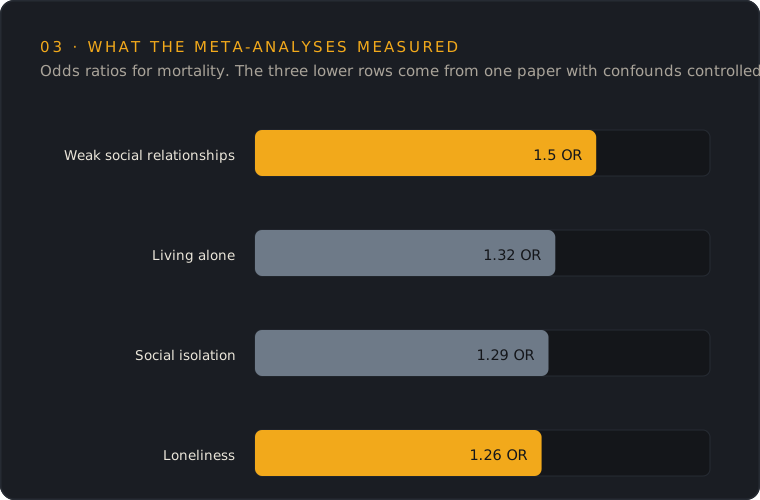
The 2010 paper adds a fourth number that never gets quoted, and it is the one that undercuts the tidiest version of the story. Its weakest measure was the simplest one: living alone versus living with others gave an odds ratio of 1.19, with a confidence interval of 0.99 to 1.44, an interval that includes no effect at all. The strongest was complex, multi-item social integration at 1.91. Whatever is being measured here, a headcount of the people in your house is not it.
Dementia, and why the direction is unsettled
A meta-analysis by Carlo Lazzari and Marco Rabottini pooled ten cohort studies of people aged 50 and over who were free of dementia at enrolment, and found a hazard ratio of 1.49 (95% CI 1.37 to 1.61) for developing dementia among those lonely or socially isolated (Lazzari & Rabottini, 2022). The cohorts averaged 8,239 people and the mean follow-up was 6.41 years.
But hold on before concluding that loneliness causes dementia. The disease smoulders silently for years before diagnosis, and one of the first things it steals is sociability: conversation gets tiring, threads get lost, gatherings get skipped. With a follow-up of six years, the studies sit inside that silent window. So the data cannot tell which way the arrow points: does isolation invite dementia, or does invisible early dementia isolate you? Both would produce exactly the same number.
None of that dismisses the finding. It does mean that “loneliness causes dementia” and “loneliness predicts dementia” are different sentences, and only the second one has been shown.
What the association might be made of
Observational findings this size usually have several things inside them, and this one is no exception. The 2010 paper’s own moderator analysis points at the answer: the strongest associations came from complex, multi-item measures of social integration, and the weakest from a single binary question about who else lives in the house. That gradient is what you would expect if the thing doing the work is not proximity but the number of channels through which somebody notices you.
Why would connection keep you alive at all? Partly for gloriously unmagical reasons. Someone who sees you weekly notices the cough you have stopped hearing, remembers the pills you abandoned, drives you to the clinic on a Tuesday. Housemates drag your sleep and dinner toward normal hours. And some of the arrow runs backwards: illness itself dismantles a social life. None of this is chemistry; much of it is logistics.
The meta-analyses control for what the original studies measured, which typically includes age, sex and baseline health, and cannot include what nobody recorded. This is the ordinary condition of observational epidemiology rather than a special weakness of this literature. It is worth stating because the cigarette comparison implies a causal dose, and a causal dose is exactly what an odds ratio from pooled cohort studies cannot supply.
One paragraph on the word epidemic
One paragraph on the word «epidemic», which usually rides along with the cigarettes. An epidemic is a claim that something is rising, and that is checkable. In Norway, where the same question was asked of 27,032 older adults across four decades, loneliness went down in every survey: from 11.4% in the mid-90s to 5.8% by 2019 (Aunsmo et al., 2023). One country, one age band, and the oldest people living alone did get lonelier. But «common and serious» is not the same word as «spreading».
Where the limits are
All of the mortality evidence here is observational. People who are lonely differ from people who are not in many ways that also affect how long they live, and the meta-analyses control for what the original studies happened to measure. The comparison chart at the centre of this page pools effect sizes from separate meta-analyses run on different populations with different designs, which is what makes it a benchmark rather than a measurement, and exactly why reading a dose off it does not work.
The trend data is one country and one age band. The dementia pooling is ten studies. And the three social variables, though they came out at similar magnitudes, are measured with instruments that share a lot of variance, so “no difference between objective and subjective” is a statement about these measures rather than about the human condition.
What to do with this instead
The shift: the comparison is a benchmark someone drew to make a number legible, and it was never a measurement of you.
First move: when a health claim arrives as an equivalence (this is like that many cigarettes, this is like that many drinks), look for the chart. Benchmarks of this kind are made by placing effect sizes from unrelated studies on one axis. That is a legitimate way to communicate a magnitude and an illegitimate way to derive a dose.
Second move: notice which of the three variables a given claim is about. The measured associations differ: complex social integration at 1.91 is the strongest thing on that chart, and living alone at 1.19 has a confidence interval that touches no effect. The thing with the biggest number is the richest measure, not the loneliest feeling.
Third move: treat the trend claim and the risk claim separately. Loneliness carrying real mortality risk and loneliness not increasing over time are both supported, and neither one refutes the other. Most of the argument online consists of people using one to dismiss the other.
Nothing here is advice about anyone’s health or social life, and none of it says loneliness is harmless; the associations are real, replicated and comparable in size to risk factors taken seriously by every health system. If persistent loneliness is affecting your health or mood, that is a conversation with a clinician rather than with a chart. A related piece on reading concrete signals rather than summary labels takes the same approach to a different question.
The same move, a modest association promoted to a rule about lifespan, runs through the Blue Zones story, where strong social ties sit on the list of habits credited to the longest-lived regions.
The boring bottom line
A researcher put twelve bars on one axis to show that social relationships matter about as much as things everybody already takes seriously. One of the bars was labelled “smoking under fifteen cigarettes daily”. Sixteen years later that label is a public-health slogan, the word “under” has been dropped, the aggregate has been narrowed to one of its inputs, and the bar it is compared against was never the tallest one on the chart.
The underlying finding survives all of that. Social connection is associated with living longer, at odds ratios between about 1.2 and 1.9 depending on what is measured. That is a real result, and it does not need a cigarette to be worth knowing.
Sources
- Holt-Lunstad, J., Smith, T. B., & Layton, J. B (2010). Social relationships and mortality risk: A meta-analytic review. PLoS Medicine. 7(7), e1000316. The paper the cigarette comparison comes from. Its Figure 6 plots the log odds of decreased mortality for social relationships alongside other risk factors, and one of those rows is labelled 'Smoking < 15 cigarettes daily'. doi:10.1371/journal.pmed.1000316
- Holt-Lunstad, J (2026). 15 cigarettes: what the comparison says and how to state it accurately. julianneholtlunstad.com, the author's own clarification page. The person whose paper produced the number has a page correcting how it is used. The correction has not travelled. julianneholtlunstad.com
- Holt-Lunstad, J., Smith, T. B., Baker, M., Harris, T., & Stephenson, D (2015). Loneliness and social isolation as risk factors for mortality: A meta-analytic review. Perspectives on Psychological Science. 10(2), 227-237. The paper that separates the three things popular accounts merge: being isolated, feeling lonely, and living by yourself. doi:10.1177/1745691614568352
- Lazzari, C., & Rabottini, M (2022). COVID-19, loneliness, social isolation and risk of dementia in older people: A systematic review and meta-analysis of the relevant literature. International Journal of Psychiatry in Clinical Practice. 26(2), 196-207. A mean follow-up of 6.41 years sits inside the period during which dementia is developing undetected, which is why the direction of this association cannot be read off the number. doi:10.1080/13651501.2021.1959616
- Aunsmo, R. H., Langballe, E. M., Hansen, T., Selbaek, G., & Strand, B. H (2023). Time trends in loneliness from 1984 to 2019 among 27,032 older adults in Norway: A HUNT study. Preventive Medicine. 175, 107659. One country, one age band, thirty-five years of the same question. The direction of travel is downwards. doi:10.1016/j.ypmed.2023.107659