TL;DR
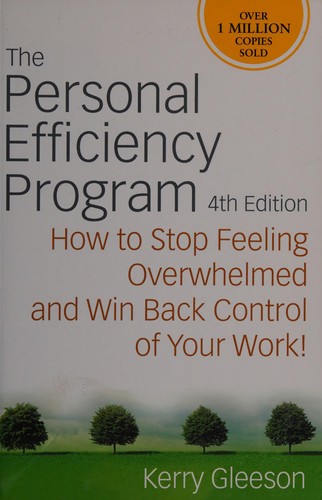
- Kerry Gleeson’s «The Personal Efficiency Program» (1994, revised through 2008) sells one rule: handle each incoming item once, immediately, instead of re-reading and re-shuffling it. The book is the printed form of a corporate training course sold by his firm, the Institute for Business Technology.
- The interruption research behind the advice is real and unusually clean. Interruptions averaging 4.4 seconds tripled sequence errors in a 300-person experiment, and 2.8 seconds doubled them.
- Batching email helps, modestly. A 124-person crossover trial found lower stress at three checks a day (d = 0.37). A Dutch workplace intervention found the benefit gone after two weeks.
- The rule’s own failure mode is documented: across five experiments, people repeatedly chose a smaller payoff because it expired sooner. «Do it now» is a machine for producing exactly that error.
- The programme itself has never been independently evaluated. Crossref and Europe PMC return nothing but the publisher’s own chapters, checked 11 August 2026.
Verdict
Read the notes. Confidence: moderate.
This is one of the least oversold books in the genre. Gleeson does not promise transformation, does not cite neuroscience he has not read, and does not pad the argument with parables. He describes a workflow, tells you to practise it daily, and stops. Two of his three main mechanisms (reducing self-inflicted interruption, and batching inbox processing) have held up in controlled work since he wrote. One has not: the instruction to act immediately on whatever arrives, which hands your day to whoever emails you last. And the programme sold under the book’s name has never been tested by anyone outside the company that sells it.
The result is a book whose good parts compress into about fifteen pages. That is what «read the notes» means here, and it is not an insult: fifteen defensible pages is more than most of the shelf manages. Compare the rest of our book reviews and this one sits near the honest end.
The claim on trial
The claim is «Do It Now»: that the largest recoverable loss in white-collar work is re-handling (picking up the same memo, opening the same message, deferring the same decision) and that resolving each item on first contact, inside an organised workspace with interruptions batched rather than continuous, measurably raises output.
The 2008 fourth edition (Gleeson, The Personal Efficiency Program, Wiley, 2008) is structured exactly as the claim implies: «Do It Now!», «Organize It Now!», «Do It Routinely», «Plan It Now!», a chapter on email, one on follow-through, one on meetings, and closing back matter about the Institute for Business Technology. The 1994 original is the same skeleton without the email chapter.
Two claims are stacked here. One is mechanistic: single-handling and interruption control raise output. The other is commercial: this programme, delivered as corporate training, produces the improvement. The evidence for them is very different.
What the interruption research shows
This is where the book is strongest, and the effects are larger than most people expect.
Erik Altmann, J. Gregory Trafton and David Hambrick ran the cleanest test. Across two experiments with 100 undergraduates each, participants worked through a seven-step sequential procedure while being briefly interrupted. Interruptions averaging 4.4 seconds tripled the rate of sequence errors, from 1.8% at baseline to 5.8%. Interruptions averaging 2.8 seconds (roughly the time it takes to perform one step) doubled them, 2.0% to 4.3% (Altmann, Trafton & Hambrick, Journal of Experimental Psychology: General, 2014). Errors that did not involve losing your place in the sequence were unaffected. The interruption does not make you generally stupider. It makes you lose the thread.
Under three seconds is a glance at a notification. Gleeson’s instinct that interruptions are structural rather than a character flaw is correct, and the threshold is far lower than his writing assumes.
In the field, Gloria Mark, Victor Gonzalez and Justin Harris shadowed 24 information workers for more than 700 hours over thirteen months. Workers stayed in one working sphere for an average of 11 minutes 4 seconds before switching. When work was interrupted, the average time to return to it was 25 minutes 26 seconds — but only because people visited an average of 2.26 other working spheres in between (Mark, Gonzalez & Harris, CHI, 2005). Fifty-seven per cent of work segments were interrupted; 77% were resumed the same day. The popular version of this statistic — «it takes 23 minutes to refocus» — misstates a real finding by dropping the detour.
The most useful result is also the most awkward for productivity writing. Mark, Daniela Gudith and Ulrich Klocke gave 48 participants an email-handling task under three interruption conditions. Interrupted participants finished faster: 20.3 and 20.6 minutes against 22.8 minutes uninterrupted. They also reported significantly higher stress (9.5 and 9.1 against 6.9 on a 20-point scale), more frustration, more effort and more time pressure, all at p < .01 (Mark, Gudith & Klocke, CHI, 2008). Interruption did not cost throughput on a short task. It was paid for in strain.
So the honest statement of Gleeson’s best mechanism is not «interruptions make you slower». It is: interruptions make you err on anything sequential, and they make the same output cost more of you.
Batching email: real, small, and it fades
Kostadin Kushlev and Elizabeth Dunn ran the study everyone cites. 124 adults, two weeks, within-subjects: one week checking email as often as possible with the inbox open, one week limited to three checks a day. The manipulation worked — checks fell from a baseline of 15.5 a day to 4.7. Daily stress was significantly lower in the limited week, F(1, 121) = 4.18, p = .04, Cohen’s d = 0.37 (Kushlev & Dunn, Computers in Human Behavior, 2015). A d of 0.37 is a small-to-moderate effect on a self-reported outcome, from a mostly student sample, and the paper says so. It is not the demolition of email that the summaries imply.
Two follow-ups complicate it further. Mark and colleagues instrumented 40 information workers for 12 workdays with computer logging, biosensors and daily surveys. Batching was associated with higher rated productivity when email time was long — and there was no evidence that batching lowered stress (Mark et al., CHI, 2016). The measured outcome moved in the opposite direction from the laboratory-adjacent result.
Then Indy Wijngaards, Florie Pronk and Martijn Burger studied a top-down batching intervention inside a Dutch financial services firm. The intervention group did encounter fewer email interruptions. Emotional exhaustion fell immediately after the intervention, most for workers handling high email volume and workers who believed instant replies were not expected of them. The effects had worn off two weeks later, and work engagement did not move at all (Wijngaards, Pronk & Burger, Internet Interventions, 2022). Their own conclusion is that batching is not a general remedy and should be encouraged only where it fits the job and the organisation’s response-time norms.
The dose matters too. In a three-week randomised trial with 237 completers, batching phone notifications to three times a day improved attention, concentration, mood, stress and perceived productivity against a control group. Hourly batching did almost nothing. Switching notifications off entirely backfired: less interruption, but significantly more anxiety and fear of missing out, with no attentional gain (Fitz et al., Computers in Human Behavior, 2019).
Gleeson’s version (process the inbox at set times, not continuously) survives all of this. The genre’s version, that batching is a large and durable win, does not.
Where «do it now» goes wrong
The rule has a specific, documented failure mode, and it is not procrastination.
Meng Zhu, Yang Yang and Christopher Hsee tested what happens when urgency and value point in different directions. Across five experiments (124 students, then samples of 203, 204, 402 and 402) participants chose between a task with a tight deadline and a smaller reward, and a task with a loose deadline and a larger one. In two of them, 35.3% and 48.1% took the smaller payoff because it expired sooner. Making the payoff sizes salient shrank the effect (33.7% down to 20.6%). Feeling busy made it worse (Zhu, Yang & Hsee, Journal of Consumer Research, 2018). Time pressure pulls attention onto the deadline and off the value.
«Do it now» is a rule that converts arrival time into priority. Applied literally, it is the mere urgency effect installed as a policy. Gleeson does hedge (he allows deferral, delegation and disposal as legitimate outcomes on first contact) but the book’s rhetorical weight is entirely on immediacy, and the training programme is named after it. A reader who follows the emphasis rather than the fine print will spend the day clearing other people’s requests.
The task-switching literature is often invoked here, usually badly. Joshua Rubinstein, David Meyer and Jeffrey Evans ran four experiments on alternating between classification rules and arithmetic operations. Switching costs rose with rule complexity and fell when visual cues signalled which task was coming, and the two effects were additive (Rubinstein, Meyer & Evans, Journal of Experimental Psychology: Human Perception and Performance, 2001). The widely quoted «switching costs 40% of your productive time» is not a finding in that paper. What the paper supports is narrower and still useful: switching hurts more when the rules are complex and less when you can see the switch coming.
Has the programme itself ever been tested
No. Checked 11 August 2026.
A Crossref search for «Personal Efficiency Program» returns the Wiley book’s own front matter, chapters and index, and nothing else; an author-plus-title search for Gleeson returns unrelated work. Europe PMC returns zero hits for the exact phrase. Web search returns booksellers, summary services and publisher marketing. There is no trial, no quasi-experiment, no independent audit, and no published before-and-after with a control group.
Untested is not refuted. It does mean that any figure you see for hours recovered per person per day originates with the vendor and has no external check behind it.
The closest thing to relevant evidence is the general literature. Brad Aeon, Aïda Faber and Alexandra Panaccio meta-analysed 158 studies, 53,957 participants and 490 effect sizes. Time management correlated with job performance at roughly r = .25, and negatively with psychological distress at r = −.36. The link to life satisfaction was about 72% stronger than the link to job satisfaction (Aeon, Faber & Panaccio, PLOS ONE, 2021). Time management does more for how you feel than for what you produce. The authors also note that studies rarely report what is taught in the training, which is precisely the problem with evaluating a proprietary programme.
What survives the move off paper
The 1994 book runs on physical objects: an in-tray, a desk, hanging files, a tickler system, a daily pass through the stack. Three things survive that translation intact.
One, the diagnosis. Re-handling is real, and it is the same act whether the object is a memo or an unread flag. Two, single-pass processing with a bounded set of outcomes. Three, working in a state where inputs arrive in known places at known times rather than continuously — which, given the Altmann finding at 2.8 seconds, matters more now than it did on paper.
Two things do not survive. Physical inboxes had a ceiling on arrival rate, set by how fast a person could walk to your desk. Digital inboxes have none, so «handle everything on arrival» stopped being a finite instruction. And paper had no notification layer: the book’s interruption chapter is about people and telephones, while the dominant modern interruption is a two-second glance it has no category for. Later editions bolt on an email chapter, but the underlying model (a finite pile, worked to zero, daily) is a paper model wearing digital clothes.
Who should read it
Worth the notes if your problem is re-handling: you open things, look at them, and put them back unresolved several times a day. Gleeson diagnoses that specific pathology better than most, and the daily-practice framing is more honest than the one-weekend-purge framing elsewhere in the genre.
Skip it if your problem is choosing between important things. The book has almost nothing on that, and its central rule actively works against it. Skip it if you have already read a modern workflow book; the overlap is high.
Managers considering the corporate programme should know they are buying an unevaluated intervention. That is not a reason to refuse it. It is a reason to run your own before-and-after with a comparison group, because nobody else has.
The better-known descendant of this method is «Getting Things Done», and «The Now Habit» explains why an organising system alone does not fix avoidance.
One thing to try
Pick the three times a day you will process your inbox and write them down. Three, not hourly — hourly batching did nothing measurable in the Fitz trial, and switching notifications off entirely raised anxiety without improving attention. Between those times, the inbox is closed and notifications are off.
Add one rule Gleeson does not give you: before each session, name the one thing you would still want finished if the rest of the day collapsed, and do that first. That single addition is what stops «do it now» from becoming «do whatever expired soonest».
Get the book
Find «The Personal Efficiency Program» on Amazon — as an Amazon Associate, The Boring Work earns from qualifying purchases (disclosure).
When to see a professional
This is general information about work organisation, not medical or psychological advice. Persistent exhaustion, dread about work, sleep disruption or an inability to disengage after hours are not workflow problems and will not respond to an in-tray system. If that describes you, speak to a doctor, an occupational health service or a licensed mental health professional. Emotional exhaustion is a measured clinical construct in the burnout literature, and the batching studies above moved it briefly at best.
The boring bottom line
Gleeson got the enemy right and the weapon half right. Re-handling and interruption are genuine, measurable costs — larger, at the level of brief interruptions, than he knew. Batching inbox processing to a few fixed times a day has real support, with a small effect size that fades without reinforcement. The instruction to act immediately on whatever arrives has a documented failure mode with numbers attached, and the programme sold under this book’s name has never been checked by anyone who was not selling it. Take the plumbing, leave the slogan.
Sources
- Gleeson, K. The Personal Efficiency Program, 4th edition, Wiley, 2008 — https://doi.org/10.1002/9781118256237
- Altmann, E. M., Trafton, J. G. & Hambrick, D. Z. Momentary interruptions can derail the train of thought. Journal of Experimental Psychology: General, 2014 — https://doi.org/10.1037/a0030986
- Mark, G., Gonzalez, V. M. & Harris, J. No task left behind? Proceedings of CHI, 2005 — https://doi.org/10.1145/1054972.1055017
- Mark, G., Gudith, D. & Klocke, U. The cost of interrupted work. Proceedings of CHI, 2008 — https://doi.org/10.1145/1357054.1357072
- Kushlev, K. & Dunn, E. W. Checking email less frequently reduces stress. Computers in Human Behavior, 2015 — https://doi.org/10.1016/j.chb.2014.11.005
- Mark, G., Iqbal, S. T., Czerwinski, M., Johns, P., Sano, A. & Lutchyn, Y. Email duration, batching and self-interruption. Proceedings of CHI, 2016 — https://doi.org/10.1145/2858036.2858262
- Wijngaards, I., Pronk, F. R. & Burger, M. J. For whom and under what circumstances does email message batching work? Internet Interventions, 2022 — https://doi.org/10.1016/j.invent.2022.100494
- Fitz, N., Kushlev, K., Jagannathan, R., Lewis, T., Paliwal, D. & Ariely, D. Batching smartphone notifications can improve well-being. Computers in Human Behavior, 2019 — https://doi.org/10.1016/j.chb.2019.07.016
- Zhu, M., Yang, Y. & Hsee, C. K. The mere urgency effect. Journal of Consumer Research, 2018 — https://doi.org/10.1093/jcr/ucy008
- Rubinstein, J. S., Meyer, D. E. & Evans, J. E. Executive control of cognitive processes in task switching. Journal of Experimental Psychology: Human Perception and Performance, 2001 — https://doi.org/10.1037/0096-1523.27.4.763
- Aeon, B., Faber, A. & Panaccio, A. Does time management work? A meta-analysis. PLOS ONE, 2021 — https://doi.org/10.1371/journal.pone.0245066