TL;DR
- The patterns Goulston names (procrastination, perfectionism, fear of confrontation, people-pleasing, grudge-holding) are real and measurable. His specific counter-moves have never been trialled.
- Self-handicapping, the researched version of self-sabotage, correlates with achievement at r = −.23 across 36 studies and 25,550 people. Consistent, real, modest.
- «Perfectionism» is two traits, not one. In 95 samples, failure-avoiding perfectionism correlates .47 with stress and .34 with burnout; perfectionism overall correlates .02 with job performance.
- On feeling like a fraud, a review of 62 studies covering 14,161 people found no published study evaluating any treatment at all.
- Self-help books produce real effects when they are structured cognitive-behavioural programmes with a person checking in. This book is neither.
Verdict
Read the notes. Confidence: moderate.
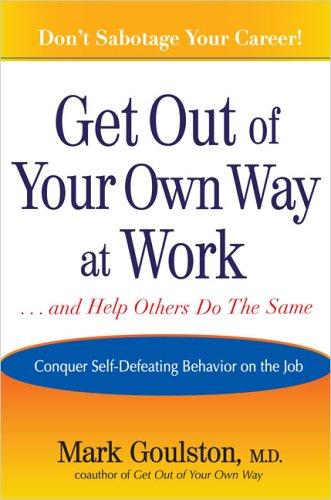
Mark Goulston’s «Get Out of Your Own Way at Work» (2005) is a psychiatrist’s catalogue of roughly forty ways employees defeat themselves, each with a short diagnosis and a short prescription. The diagnoses are good. Several of them anticipated findings that organisational psychology only nailed down a decade later. The prescriptions are clinical intuition written in the imperative mood, and not one of them has been through a controlled trial.
That gap is the whole review. The book is worth twenty minutes of skimming for the taxonomy. It is not worth treating as a treatment manual, because nobody has checked whether its treatments work.
The claim on trial
Stated plainly: most workplace underperformance is self-sabotage driven by identifiable internal patterns, and each pattern has a specific counter-move that resolves it.
That is two claims stacked. The first (that identifiable internal patterns drag down performance) is testable and has been tested. The second (that naming your pattern and doing the opposite fixes it) is the one that carries the book’s commercial promise, and it is the one with no evidence behind it.
Self-sabotage is real, and smaller than it sounds
The construct Goulston is describing has a name in the literature: self-handicapping. Steven Berglas and Edward Jones coined it in Berglas & Jones, Journal of Personality and Social Psychology, 1978, in an experiment where participants who had succeeded on an unsolvable test (success they could not explain) chose a performance-inhibiting drug over a performance-enhancing one before the next round. The point was that people manufacture excuses in advance so that failure will not implicate their ability. That is the mechanism Goulston keeps pointing at without the vocabulary.
It replicates, and it costs something. Schwinger et al., Journal of Educational Psychology, 2014 pooled 36 field studies with 49 independent effect sizes and 25,550 participants, and found a mean correlation between self-handicapping and academic achievement of r = −.23, with individual studies ranging from −.46 to +.02. The direction is stable. The magnitude explains about five per cent of the variance in outcomes.
So Goulston is right that a measurable self-defeating tendency exists and predicts worse results. He is wrong to imply it is the dominant explanation for underperformance. An r of −.23 leaves an enormous amount of room for skill, workload, management, and luck. A book that reads every bad quarter as an internal pattern is over-fitting.
Perfectionism is two things, and the book treats it as one
Goulston handles perfectionism as a single defect: you demand flawlessness, it slows you down, stop it. The best evidence says the construct splits, and the two halves behave almost oppositely.
Harari, Swider, Steed & Breidenthal, Journal of Applied Psychology, 2018 meta-analysed 95 samples of working adults and separated excellence-seeking perfectionism (self-imposed high standards) from failure-avoiding perfectionism (dread of falling short of what others expect). The results diverge sharply. Excellence-seeking correlated .38 with motivation (k = 11, N = 2,800) and .35 with engagement (k = 8, N = 1,117), while its correlations with anxiety (.11), depression (.09) and stress (.11) were small. Failure-avoiding correlated .47 with stress (k = 17, N = 4,001), .42 with anxiety, .42 with depression, and .34 with burnout (k = 24, N = 5,857) — and −.19 with engagement.
The finding that should have ended the folk wisdom: perfectionism’s correlation with job performance was ρ = .02 (k = 10, N = 3,231), with an 80% credibility interval from −.13 to .17. Excellence-seeking managed ρ = .07; failure-avoiding, ρ = −.04. Neither generalises. The trait that everybody names in interviews as a productive weakness does not predict performance in either direction.
A newer meta-analysis complicates this slightly rather than overturning it. Bellam & Curran, Journal of Occupational and Organizational Psychology, 2025 pooled 28 samples, 77 effect sizes and 9,560 participants, and found that both perfectionistic strivings and perfectionistic concerns predicted more hours worked, but only strivings predicted better performance. The consistent result across both syntheses is that the anxious, other-referenced half of perfectionism buys you longer hours and worse mental health with nothing to show for it.
This is the single place where the book’s structure fails hardest. «Stop being a perfectionist» is the wrong instruction for someone high in excellence-seeking and low in failure-avoiding — they are getting the motivation without the burnout. The counter-move needs to be aimed at the concerns, not the standards. Goulston has no way to tell the two apart.
Procrastination and the fear of being found out
On delay, Goulston’s instinct is sound. He treats procrastination as an emotional problem rather than a scheduling one, and tells readers to shrink the first step until it stops feeling threatening. Steel, Psychological Bulletin, 2007 pooled 691 correlations and found the strong, consistent predictors of procrastination were task aversiveness, delay to reward, self-efficacy and impulsiveness, plus conscientiousness and its facets — while neuroticism, rebelliousness and sensation-seeking barely registered. Delay is a motivational and affective failure, not a calendar failure. Goulston had that in 2005.
He is in company here. Our rewritten review of «The Now Habit» reached the same split verdict about a book from 1989: the diagnosis aged well, the method was never tested. Two authors, sixteen years apart, both reading procrastination correctly and both prescribing on intuition.
The impostor chapters are where the book’s promise breaks most cleanly. Goulston devotes real space to the fear of being exposed as a fraud, and the phenomenon is well documented. Bravata et al., Journal of General Internal Medicine, 2020 systematically reviewed 62 studies covering 14,161 participants across Medline, Embase and PsycINFO. Prevalence estimates ranged from 9% to 82% depending entirely on which screening instrument and cutoff was used — a spread wide enough to tell you the construct is not measured consistently. Impostor feelings were common in men and women, across ages, and were associated with impaired job performance, lower job satisfaction and burnout, and were frequently comorbid with depression and anxiety.
Then the sentence that should be on the cover of every book in this genre: no published studies evaluated treatments for this condition. Not one, as of the May 2018 search cutoff. The problem is real, prevalent and costly, and nobody has run a trial of anything that claims to fix it.
Does recognising the pattern change anything
This is the structural question. The book’s engine is insight: see your pattern, then do the opposite. That format has been studied, just not with this book in it.
Self-help in book form does work, within limits. Den Boer, Wiersma & Van den Bosch, Psychological Medicine, 2004 meta-analysed randomised trials in clinically significant anxiety and depression and found a mean effect of 0.84 against waiting-list or no-treatment controls, holding at 0.76 at follow-up, with effects of −0.03 against actual treatment — bibliotherapy roughly matched short-course psychiatric treatment. Gregory, Canning, Lee & Wise, Professional Psychology: Research and Practice, 2004 pooled 29 outcome studies of cognitive bibliotherapy for depression and reported 0.77 from the 17 studies with stronger designs.
Note what those numbers are attached to. Both syntheses studied cognitive bibliotherapy: structured programmes with exercises, worksheets, thought records and a sequence you complete. And the moderator analysis matters more than the headline. Gellatly et al., Psychological Medicine, 2007 ran a meta-regression on 34 studies with 39 comparisons and found that greater effectiveness was associated with CBT techniques and with therapist contact — but in the multivariate model, only guided self-help survived as a significant predictor (regression coefficient 0.36, 95% CI 0.05–0.68, p = 0.03). Cuijpers et al., Psychological Medicine, 2010 then pooled 21 randomised trials with 810 participants and found guided self-help matched face-to-face psychotherapy at post-test, d = −0.02.
The pattern is consistent across four independent syntheses: the thing that carries the effect is a structured behavioural programme plus a human being who checks whether you did it. «Get Out of Your Own Way at Work» has neither. It is forty short essays of recognition with a paragraph of advice each. The evidence base for that specific format (insight-only, unguided, unstructured) is thin, and the evidence base that exists points away from it.
Where Goulston does prescribe something with a tested analogue, it holds up. Two examples. His advice to stop nursing grudges maps onto forgiveness interventions, and Wade, Hoyt, Kidwell & Worthington, Journal of Consulting and Clinical Psychology, 2014 pooled 53 post-treatment effect sizes (N = 2,323) and found explicit forgiveness treatments beat no treatment at Δ+ = 0.56 [0.43, 0.68] and beat alternative treatments at Δ+ = 0.45, with longer interventions and individual delivery working best. His insistence that action comes before motivation rather than after it matches behavioural activation, where Ekers et al., PLoS ONE, 2014 pooled 26 randomised trials with 1,524 participants and found it superior to controls. Neither of these is Goulston’s finding. But he pointed at both before the trials were pooled, and that deserves saying.
What has never been tested
On 10 August 2026 we searched ClinicalTrials.gov for «Goulston» and for «get out of your own way»: zero registered studies for either. Europe PMC returned zero hits for «Goulston» combined with «self-sabotage», and zero for a title search on «self-sabotage» combined with trial or randomised. PubMed returned zero records with «get out of your own way» in title or abstract. Both searches are linked so you can re-run them.
No counter-move in this book has been through a controlled evaluation. That is a checked negative, not a refutation — untested is not the same as disproven, and several of the moves are close cousins of things that do work. But a reader should know that the specific package is unevaluated, and that its most heavily promoted target, impostor feelings, has no evaluated treatment of any kind.
Who should read it
Managers and coaches who need vocabulary. The book’s real product is a shared language for naming behaviour that is otherwise awkward to discuss — the person who never finishes, the person who cannot be told anything, the person who agrees to everything and delivers nothing. Forty labelled patterns is a useful index even when the fixes are guesses.
People who suspect one specific pattern is costing them. Read that chapter, skip the rest, and treat the prescription as a hypothesis to run rather than an instruction to follow.
Skip it if you want a programme. There isn’t one here. If you want structured self-help with trial evidence behind it, the syntheses above point at cognitive-behavioural workbooks with exercises, not essay collections. Our other self-help books, reviewed honestly apply the same test.
The companion Goulston book is «Just Listen», which has the opposite problem: good scripts on invented neuroscience. For procrastination specifically, «The Now Habit».
One thing to try
Split your perfectionism before you try to fix it. For one week, log every task you slowed down or refused to release. Next to each, write which of two sentences is truer: «I wanted it better» or «I was afraid of how it would look». The first is excellence-seeking, which correlated .38 with motivation and .07 with performance in Harari et al. — mildly wasteful, not dangerous. The second is failure-avoiding, which correlated .47 with stress and .34 with burnout while contributing nothing to performance. If most of your entries are the second sentence, the target is the audience in your head, not your standards. Goulston’s blanket instruction to lower the bar treats both the same, and for half the readers it is aimed at the wrong thing.
Get the book
Find «Get Out of Your Own Way at Work» on Amazon — as an Amazon Associate, The Boring Work earns from qualifying purchases (disclosure).
The boring bottom line
Goulston was a good diagnostician. He read procrastination as emotional rather than administrative years before the meta-analyses settled it, he pointed at grudges and inaction before the trials were pooled, and he described self-handicapping accurately without using the word. The taxonomy earns its shelf space.
The claim on trial holds partly. The patterns are real and they do predict worse outcomes, at correlations around −.23 for self-handicapping and around .3 to .5 between anxious perfectionism and burnout, stress and depression. What does not hold is the second half — that each pattern has a specific counter-move that resolves it. Those counter-moves are unevaluated, the format they arrive in is the format that self-help meta-analyses find weakest, and the book’s flagship problem has no tested treatment in the literature at all. Take the names. Leave the cures.
When to see a professional
This page is general information about published research, not medical advice, and nothing here is a diagnosis or a treatment plan. «Impostor syndrome» is not a recognised psychiatric diagnosis (it appears in neither the DSM nor ICD-10) but Bravata et al. found it frequently comorbid with depression and anxiety, which are diagnosable and treatable.
If self-criticism, dread of exposure, or inability to start work has lasted more than a couple of weeks and is affecting your sleep, appetite, relationships or ability to do your job, that is a reason to talk to your GP or family doctor, a clinical psychologist, or a psychiatrist — not a reason to buy another book. Guided programmes delivered by a trained person are exactly the condition under which self-help material performs best in the trials cited here. If you are having thoughts of harming yourself, contact your local emergency number or a crisis line immediately.
Sources
- Berglas, S., & Jones, E. E. Drug choice as a self-handicapping strategy in response to noncontingent success. Journal of Personality and Social Psychology, 36, 405–417, 1978.
- Schwinger, M., Wirthwein, L., Lemmer, G., & Steinmayr, R. Academic self-handicapping and achievement: A meta-analysis. Journal of Educational Psychology, 106(3), 744–761, 2014.
- Harari, D., Swider, B. W., Steed, L. B., & Breidenthal, A. P. Is perfect good? A meta-analysis of perfectionism in the workplace. Journal of Applied Psychology, 103(10), 1121–1144, 2018.
- Bellam, A., & Curran, T. Perfectionism and work performance: A meta-analysis. Journal of Occupational and Organizational Psychology, 98, e70050, 2025.
- Steel, P. The nature of procrastination: A meta-analytic and theoretical review of quintessential self-regulatory failure. Psychological Bulletin, 133(1), 65–94, 2007.
- Bravata, D. M., et al. Prevalence, predictors, and treatment of impostor syndrome: A systematic review. Journal of General Internal Medicine, 35, 1252–1275, 2020.
- Den Boer, P. C. A. M., Wiersma, D., & Van den Bosch, R. J. Why is self-help neglected in the treatment of emotional disorders? A meta-analysis. Psychological Medicine, 34, 959–971, 2004.
- Gregory, R. J., Canning, S. S., Lee, T. W., & Wise, J. C. Cognitive bibliotherapy for depression: A meta-analysis. Professional Psychology: Research and Practice, 35(3), 275–280, 2004.
- Gellatly, J., Bower, P., Hennessy, S., Richards, D., Gilbody, S., & Lovell, K. What makes self-help interventions effective in the management of depressive symptoms? Meta-analysis and meta-regression. Psychological Medicine, 37, 1217–1228, 2007.
- Cuijpers, P., Donker, T., van Straten, A., Li, J., & Andersson, G. Is guided self-help as effective as face-to-face psychotherapy for depression and anxiety disorders? Psychological Medicine, 40, 1943–1957, 2010.
- Wade, N. G., Hoyt, W. T., Kidwell, J. E. M., & Worthington, E. L. Efficacy of psychotherapeutic interventions to promote forgiveness: A meta-analysis. Journal of Consulting and Clinical Psychology, 82(1), 154–170, 2014.
- Ekers, D., Webster, L., Van Straten, A., Cuijpers, P., Richards, D., & Gilbody, S. Behavioural activation for depression: An update of meta-analysis of effectiveness and sub group analysis. PLoS ONE, 9(6), e100100, 2014.
- ClinicalTrials.gov search for «Goulston», run 10 August 2026 — zero registered studies.
- Europe PMC title search for «self-sabotage» combined with trial or randomised, run 10 August 2026 — zero results.