Every claim on this site gets a grade, a date and a list of the papers behind it. This one sits in the registry of checked claims.
TL;DR
- Eleven claims, eleven separate verdicts. Two hold, four fail in the direction people expect, three hold in a much narrower form than advertised, and two have no controlled trial behind them at all.
- The inflammation claim runs backwards. Pooled across trials, inflammation markers rose after cold-water immersion: a standardised effect of 1.03 immediately and 1.26 an hour later.
- The one large trial, 3,018 adults, found 29% less self-reported sickness absence and no difference in illness days. Those two results are usually reported as one.
- Ice baths after lifting cost you muscle. Over 12 weeks, strength and mass rose more with active recovery than with 10 minutes of cold water, and testosterone after a squat session went up 9.2% without the ice and down 0.5% with it.
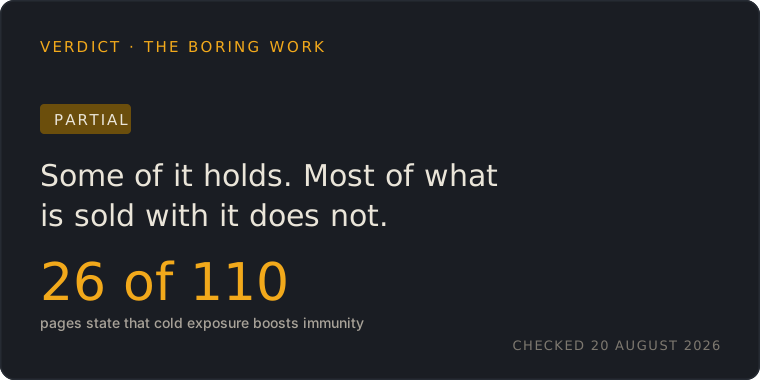
- Of the 110 pages we could read on 20 August 2026, 26 state that cold exposure boosts immunity as established. Twenty-three of the 107 sit on sites that sell plunge tubs, barrels or chillers.
Somewhere in your feed right now, someone is lowering themselves into a barrel of ice water and telling you it will fix your immune system, your hormones, your skin and your mood. The strange thing is that cold water is one of the better-studied habits in the whole wellness world — scientists have been dunking volunteers for decades. The problem is different: eleven separate claims, backed by wildly different amounts of evidence (from a trial with 3,018 people down to literally nothing), all get sold as one package deal.
So let’s unpack the package. One row per claim: what was measured, and where the evidence stops.
Every claim, ranked
| Claim | Verdict | What was measured | Where the limit is |
|---|---|---|---|
| Cold showers mean fewer sick days | Partial | 3,018 adults randomised to 30, 60 or 90 seconds of cold shower or control for 30 days: 29% lower sickness absence, incidence rate ratio 0.71 (Buijze et al., 2016) | Absence was self-reported, and illness days showed no group effect. People went to work; they were not less ill |
| Cold exposure boosts your immune system | Partial | 60 adults, 90 days of daily cold or hot showers: immunoglobulins, interleukin-2 and interleukin-4 rose in the cold group (El-Ansary et al., 2024) | Blood markers, not illness. The pooled analysis of 11 trials found no significant effect on immune function at any measured time point |
| Cold plunges reduce inflammation | Refuted as stated | Meta-analysis of 11 trials, 3,177 participants: inflammation rose, SMD 1.03 immediately and 1.26 at one hour (Cain et al., 2025) | This is the acute response. Local swelling after an injury is a different question with different evidence |
| It lowers your stress | Partial | Same meta-analysis: stress fell at 12 hours, SMD −1.00 (−1.40 to −0.61) | Null at every other time point measured: immediately, one hour, 24 hours and 48 hours |
| It improves your mood | Refuted as stated | No significant effect on mood in the pooled analysis. In a single-bout study of 16 adults, negative affect and cortisol were lower three hours later (Reed et al., 2024) | In that study positive affect did not change and beta-endorphins did not change at any point. The rush people describe was not in the blood |
| It raises testosterone | Refuted | 11 trained men, squats then either 15 minutes at 15 °C or passive rest: testosterone +9.2% without the cold, −0.5% with it at 30 minutes (Earp et al., 2019) | Eleven men, one session each, measured over an hour. Small, but it is the only direct test, and it points down |
| Ice baths after lifting help you build muscle | Refuted | 21 men, 12 weeks of strength training: isokinetic work +19%, type II fibre area +17%, myonuclei per fibre +26% with active recovery and none of it with cold water (Roberts et al., 2015) | Applies to immersion straight after resistance training. A cold shower hours later was not tested |
| Cold activates brown fat, so it burns fat | Partial | 24 men scanned at 22 °C and 16 °C: brown adipose tissue active in 23 of 24 during cold and none at thermoneutral (van Marken Lichtenbelt et al., 2009) | Activation is not weight loss. That study did not measure body weight change, and activity was lower in the heavier men |
| Cold water is good for your skin, pores and hair | Untested | Nothing. Five fixed PubMed queries restricted to humans returned no controlled trial testing any cosmetic outcome | The 68 records the skin query returns are about thermoregulation, blood flow, exercise recovery, cold urticaria and Raynaud’s |
| Cold water helps sunburn | Untested | Nothing. One record, from 1992, about thermoregulation after artificially induced fever | Not a gap in our reading. The literature does not contain the trial |
| Jumping into cold water is safe if you are healthy | Refuted | Cold submersion produces a high incidence of arrhythmias in healthy volunteers, from simultaneous sympathetic and parasympathetic activation (Shattock & Tipton, 2012) | The gasp reflex habituates after about four immersions, heart rate by 14 beats per minute (Barwood et al., 2024). The first ones are the dangerous ones |
The row that surprises people
Ask anyone why they plunge, and «it reduces inflammation» comes up first. Here is the uncomfortable news: the evidence points the other way. In 2025, researchers at the University of South Australia rounded up every proper trial of cold-water immersion in healthy adults (11 studies, 3,177 people) and pooled the results.
Inflammation markers went up — clearly and substantially, right after the plunge and even more an hour later. Which, once you think about it, makes sense: cold water is a shock to the body, and shock is exactly what inflammation responds to. Your immune system treats an ice bath roughly the way it treats a minor emergency.
Two things keep the popular claim from being completely dead. An ice pack on a sprained ankle does reduce local swelling — but that is a different mechanism at a different scale. And in theory, repeated small shocks could lower your background inflammation over months (the «what doesn’t kill you» principle, which scientists call hormesis) — but the human trials that would prove that have never been run.
Twenty-nine per cent of what
«Cold showers cut sick days by 29%» — this number is everywhere, and it comes from one Dutch trial. Credit where due: it was a serious study. Researchers in Amsterdam got 3,018 adults to finish their daily shower with a blast of cold for a month, with a control group who showered normally.
The headline is real: people in the cold-shower groups called in sick 29% less. But read the very next line of the same study, the one nobody quotes: they were ill just as often. They felt sick the same number of days — they just dragged themselves to work anyway.
So the famous trial may not show that cold showers protect you from germs. It may show that people who volunteer to shower cold for science are the kind of people who go to work with a runny nose. That is a finding about toughness, not immunity — and it is not the version printed on the plunge-tub box.
The one with the clearest verdict
If you remember one row from the table, make it this one — especially if you lift. Australian researchers ran the definitive experiment: 21 men strength trained for 12 weeks, and after every session half of them sat in cold water for 10 minutes while the other half did light cool-down exercise.
The cool-down group won across the board: 19% more strength, 17% thicker fast-twitch muscle fibres. The ice-bath group? Their gains were so small they did not reach statistical significance on any measure. The ice was not helping their recovery. It was eating their results.
A follow-up study explained why: muscle samples showed that cold water literally dampens the biological signals that tell muscle to grow. The soreness you are icing away is part of the growth process. The authors’ own conclusion: athletes should reconsider routine ice baths.
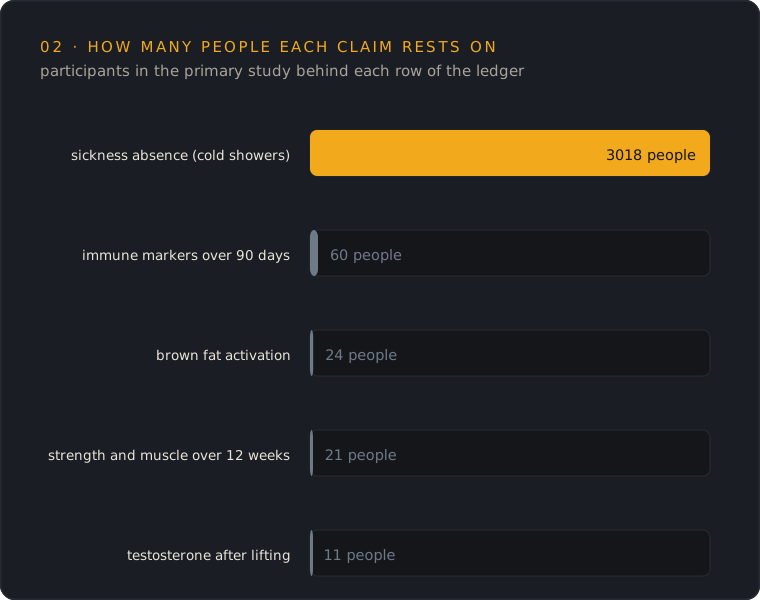
The testosterone claim got its own test, and it is almost comic. Eleven trained men did heavy squats, then either rested or sat in cold water. After normal rest, testosterone rose 9.2% — the ordinary response to lifting. After the cold water it fell, ending the hour 10.4% below where it started. Small study, only eleven men — but it is the only direct test that exists, and it points exactly the wrong way for the influencers.
The rows with nothing in them
Cold water is also sold hard for beauty: tighter pores, glowing skin, shinier hair. So we went looking for the studies — five careful searches of PubMed, the database that indexes essentially all of the world’s medical research. The searches are printed in our working notes, so anyone can rerun them.
The skin query returns 68 records. We read all 68 titles. They are about thermoregulation, cutaneous blood flow, cold-induced vasodilation, recovery after exercise in the heat, cold urticaria and Raynaud’s phenomenon. Not one tests whether cold water improves how skin looks or behaves. The facial swelling query returns five records, including a case of cold-induced anaphylaxis. The pores query returns two, one of them about silica nanoparticles. The hair query returns four, the most relevant being a 1984 paper on hairdressers’ eczema. The sunburn query returns one, from 1992, about thermoregulation after artificially induced fever.
To be sure the counting worked, the same script runs a control query about cold-water immersion and muscle recovery. That one returns 312 records. The zeroes above are zeroes in the literature, not in the method.
Understand what that means. Not «the studies are mixed». Not «more research is needed». Nobody, anywhere, has ever run a controlled trial of cold water on skin, pores, hair or sunburn. The beauty claims are not losing the scientific argument — they have never entered it.
The part that predates the industry
Long before anyone sold a plunge tub, physiologists studied sudden cold-water entry for a grim reason: it is how people drown. Their finding deserves more airtime than any benefit on this page. The moment you plunge, your body slams two opposing panic buttons at once — one system screams «speed up» (the gasp-and-race cold shock response) while another orders «slow down» (the diving reflex). That tug-of-war produces irregular heartbeats at a startling rate — in young, healthy volunteers.
The good news (and it is the biggest, most reliable effect in this entire article) is that the body learns fast. Pool all the repeated-immersion studies together and every part of the shock response fades dramatically, usually after about four immersions.
Which pinpoints the danger with unusual precision: it is concentrated in the very first plunges — in beginners. In other words, in exactly the person a viral video has just talked into jumping in a cold lake.
Still on Google
On 20 August 2026 we ran fourteen searches, among them do cold showers boost your immune system, ice bath immune system research does cold water immersion improve immunity and cold water therapy claims debunked which benefits are real, and read 110 pages across 86 sites. Twenty-six state that cold exposure strengthens immunity with no limit attached, and another 24 state it and name one. Twelve take the position that this is unsupported. Forty-eight never raise it.
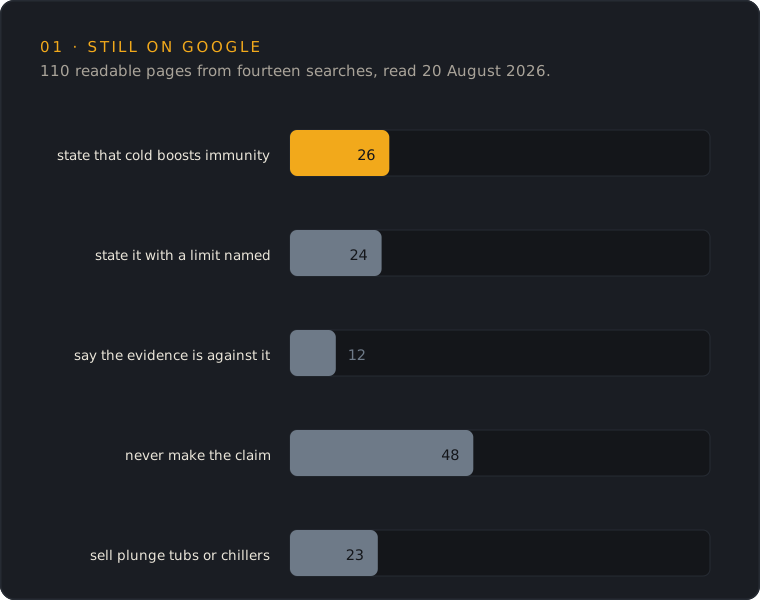
Then we checked who was talking. Twenty-three of the 110 pages sit on domains that sell cold-water equipment (chillers, barrels, plunge tubs), and one of them closes its article on immunity by recommending its own chiller and inflatable bath by name. Four more belong to gyms, sports clubs and a sauna studio, all of which sell access to the thing they are describing.
The split does not run neatly between commercial and editorial, which is why the twelve dissenting pages are worth describing. Two are public broadcasters’ health desks, one American and one Australian; one is a science magazine, one a pharmacy trade journal, one a British online GP practice, one a hospital newsroom. The rest are a sports site, two review blogs, a wellness-claims site, an independent analyst writing at length, and a 2014 trial of cold exposure during exercise that found no clear direction in the immune measures it reviewed. Meanwhile two hospital-branded blogs and a health insurer’s own page state the immunity claim flatly.
What to do with this instead
The shift: cold water is not one intervention with a list of benefits. It is several different exposures with different evidence, and the strongest results are about tolerance rather than health.
First move: separate the timing question from the practice. Cold after resistance training has a measured cost to strength and size. Cold at another time of day was not what those studies tested.
Second move: when a page says anti-inflammatory, check whether it means the acute response, which goes up, or a long-term baseline, which has not been measured in humans.
Third move: take the safety literature more seriously than the benefits literature, because it is older, larger and unanimous. The gasp reflex is at its worst in the first few immersions and habituates after about four.
None of this is medical guidance and none of it is a protocol: there are no temperatures or durations to follow here, and the arrhythmia literature is a reason to treat sudden cold immersion as something with a real risk profile rather than a wellness accessory. Anyone with a heart condition has a question for a doctor, not for an article. For the wider pattern of a physiological finding becoming a product, the piece on the self-improvement genre covers the same machinery.
The nitrogen-chamber version of the same promise rests on even less: whole-body cryotherapy’s evidence base is 64 men. Where the popular figure of 11 minutes of cold a week came from is traced in Protocols by Andrew Huberman, checked.
The boring bottom line
Cold water reliably does three things: it triggers a dangerous gasp reflex that fades with practice, it activates brown fat while you are cold, and it makes people report fewer days off work without making them less ill. It reliably fails to do two things it is sold for: raise testosterone, and help you build muscle when used after lifting. And it has never been tested at all for skin, pores, hair or sunburn.
Twenty-six of the 110 pages we read state the immunity claim as settled. Twenty-three of the 107 are selling the tub.
Sources
- Roberts, L. A., Raastad, T., Markworth, J. F., Figueiredo, V. C., & Egner, I. M., et al (2015). Post-exercise cold water immersion attenuates acute anabolic signalling and long-term adaptations in muscle to strength training. The Journal of Physiology. 593(18), 4285-4301. The study that made sports scientists stop recommending ice baths after lifting. Its conclusion says the practice should be reconsidered. doi:10.1113/JP270570
- Cain, T., Brinsley, J., Bennett, H., Nelson, M., & Maher, C., et al (2025). Effects of cold-water immersion on health and wellbeing: A systematic review and meta-analysis. PLOS ONE. 20(1), e0317615. The only pooled analysis of the wellbeing claims. Read the time points rather than the headline: most of them are null. doi:10.1371/journal.pone.0317615
- El-Ansary, M. R. M., El-Ansary, A. R., Said, S. M., & Abdel-Hakeem, M. A (2024). Regular cold shower exposure modulates humoral and cell-mediated immunity in healthy individuals. Journal of Thermal Biology. 125, 103971. The strongest single result for the immunity claim. It measured blood markers over 90 days and did not measure whether anybody got ill. doi:10.1016/j.jtherbio.2024.103971
- Buijze, G. A., Sierevelt, I. N., van der Heijden, B. C. J. M., Dijkgraaf, M. G., & Frings-Dresen, M. H. W (2016). The effect of cold showering on health and work: A randomized controlled trial. PLOS ONE. 11(9), e0161749. By far the largest trial in this area, and the source of the one number everybody quotes. What it did not move is as informative as what it did. doi:10.1371/journal.pone.0161749
- Shattock, M. J., & Tipton, M. J (2012). 'Autonomic conflict': A different way to die during cold water immersion?. The Journal of Physiology. 590(14), 3219-3230. The part of the cold-water literature that predates the wellness industry and has nothing to do with benefits. doi:10.1113/jphysiol.2012.229864
- Barwood, M. J., Eglin, C., Hills, S. P., Johnston, N., & Massey, H., et al (2024). Habituation of the cold shock response: A systematic review and meta-analysis. Journal of Thermal Biology. 119, 103775. The one adaptation in this field with a large, replicated effect size — and it is about not gasping, not about wellbeing. doi:10.1016/j.jtherbio.2023.103775
- van Marken Lichtenbelt, W. D., Vanhommerig, J. W., Smulders, N. M., Drossaerts, J. M. A. F. L., & Kemerink, G. J., et al (2009). Cold-activated brown adipose tissue in healthy men. The New England Journal of Medicine. 360(15), 1500-1508. The paper that put brown fat back into adult physiology. It measured activation at mild cold, and said nothing about weight loss. doi:10.1056/NEJMoa0808718
- Earp, J. E., Hatfield, D. L., Sherman, A., Lee, E. C., & Kraemer, W. J (2019). Cold-water immersion blunts and delays increases in circulating testosterone and cytokines post-resistance exercise. European Journal of Applied Physiology. 119(8), 1901-1907. Eleven men, one session each. The direction is the opposite of what the ice bath is sold for. doi:10.1007/s00421-019-04178-7
- Reed, E. L., Chapman, C. L., Whittman, E. K., Park, T. E., & Larson, E. A., et al (2024). Cardiovascular and mood responses to an acute bout of cold water immersion. Journal of Thermal Biology. 118, 103727. Small, but it measures the thing everyone assumes: the endorphin rush. It did not appear. doi:10.1016/j.jtherbio.2023.103727