TL;DR
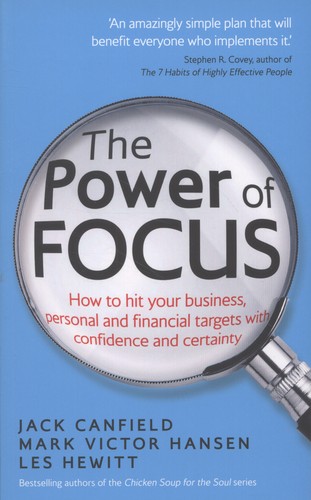
- «The Power of Focus» opens with a literal guarantee: implement the strategies and «you’ll not only hit your business, personal and financial targets consistently, you’ll far exceed the results you are currently experiencing». No behavioural method has ever been shown to do that.
- The signature statistic of this genre (3 per cent of a Yale or Harvard class had written goals and later out-earned the other 97 per cent combined) is fiction. Yale’s own library states that «no ‘goals study’ of the Class of 1953 actually occurred»; Harvard’s says the same about its version. We could not confirm that this book repeats it, and we do not claim it does.
- Goal setting itself is well supported. A meta-analysis of 141 papers and 384 effect sizes from randomised trials (N = 16,523) found a small real effect, d = 0.34. The book keeps the slogan and drops the conditions that make it work.
- «Habits are 90 per cent of what you do» has no source. The diary studies people reach for report 35 and 43 per cent of logged behaviours, in samples of 70 and 209 undergraduates.
- Mastermind groups are the book’s fifth strategy and have never been tested against a control group. Crossref and Europe PMC searches on 10 August 2026 found one descriptive report and no trial.
Verdict
Read the notes, not the book. Confidence: moderate. The trail is traced in was there ever a Harvard or Yale study on written goals.
Two of the ten strategies rest on evidence the authors never cite and which would have strengthened their case: setting specific difficult goals, and recording progress against them. The rest is anecdote with a guarantee attached, and the guarantee is the problem: a book that promises you will «far exceed» your current results, then offers celebrity endorsements as support, has made a claim it cannot cover.
The claim on trial
Stated so it can be tested: adopting a defined set of ten focusing strategies (successful habits, working to strengths, written goals, balance, mastermind relationships, confidence, asking, consistent persistence, decisive action and purpose) reliably produces better business, personal and financial outcomes.
The strategy list is not in dispute. The publisher’s reading sample reproduces the contents page and the guarantee quoted above, under the heading «Here’s Our GUARANTEE». «The Power of No» sits under strategy two, «Mastermind Groups» under strategy five, «Consistent Persistence» is strategy eight, «Make a Stop List» closes strategy ten. It has never been tested as a package. A Crossref search for the book and for its associated Achievers Coaching Program on 10 August 2026, and a Europe PMC search for «power of focus» with «Canfield», returned nothing. That is a checked negative, not a refutation: untested is not the same as disproved. But a guarantee is a strong word for an untested product.
The three per cent that never existed
Any book about written goals inherits one statistic. In 1953, so the story goes, Yale researchers asked graduating seniors whether they had written goals; 3 per cent said yes; twenty years on, that 3 per cent was worth more than the other 97 combined. It never happened. Yale University Library’s reference answer is blunt: «It has been determined that no ‘goals study’ of the Class of 1953 actually occurred.» The librarians checked the keeper of the class records, university administrators and office files, and found «no relevant record, nor did anyone recall the purported study». They trace it to a September 1991 article in Success magazine whose author credited a Zig Ziglar audio tape; Ziglar, asked, said he had only heard the numbers over the years and had no source.
Harvard University Library handles its variant the same way: «We have been asked repeatedly about this research, but we have never been able to find such a study.» Mark McCormack’s «What They Don’t Teach You at Harvard Business School», routinely named as the origin, contains no reference to it. Both institutions the myth names have checked their own records and found nothing. Harvard’s librarians also point to a 1996 Fast Company investigation by Lawrence Tabak; we could not reach it to re-check, so the case rests on the two library answers.
Now the honest part. We could not obtain the goals chapter of «The Power of Focus» from any source we fetched (the publisher’s sample stops after the opening of strategy one) and the chapter-level summaries we checked mention no Yale, no Harvard, no 3 per cent. So we treat the myth as a property of the genre, not as a quotation from this book. If you own a copy, strategy three is where it would be.
The sample does contain an unsourced statistic of its own: «more than 90 percent of people who attend short-term seminars see no improvement in their lives». No study is named. It is awkward arithmetic for a book sold on the promise that reading it changes things, given that two of its authors made their living from those seminars.
What goal setting buys you
Credit where it is owed. Goal-setting theory is one of the better-replicated results in applied psychology, and the book’s instinct here is right. Edwin Locke and Gary Latham built it inductively from roughly 400 laboratory and field studies, summarised in Locke and Latham, American Psychologist, 2002 and updated in Locke and Latham, Current Directions in Psychological Science, 2006. Specific, difficult goals beat vague ones and beat «do your best», by directing attention, raising effort and sustaining persistence.
Isolated from everything bundled with it, the effect is modest. Epton, Currie and Armitage, Journal of Consulting and Clinical Psychology, 2017 pooled 384 effect sizes from 141 papers using randomised designs, N = 16,523, and found d = 0.34 (95% CI 0.28 to 0.41). Goals worked better when difficult, when set publicly, and when set for a group.
Two conditions the book never mentions matter more than its slogans. First, the goal has to sit on a task you already know how to do. Locke and Latham are explicit that on a new, complex task a specific performance goal produces «tunnel vision» (attention goes to hitting the number rather than to acquiring the skill) and a learning goal beats it. Most of what a reader of this book wants is a new, complex task. Second, goals have documented failure modes.
Ordóñez, Schweitzer, Galinsky and Bazerman, Academy of Management Perspectives, 2009 catalogue them: narrowed focus, distorted risk taking, corroded culture, reduced intrinsic motivation and increased dishonesty. Sears set its auto-repair staff a goal of $147 per hour in the early 1990s and got company-wide overcharging and unnecessary repairs. Ford’s goal of a car «under 2000 pounds and under $2,000» by 1970 pushed safety checks past sign-off and produced the Pinto, with 53 deaths from fuel-tank fires. In the laboratory, Schweitzer, Ordóñez and Douma, Academy of Management Journal, 2004 found people with unmet goals misreported their performance more than people told to do their best, most strongly among those who fell just short.
Ordóñez and colleagues conclude that goal setting needs handling as «prescription-strength medication» with a warning label. «The Power of Focus» sells it as an over-the-counter tonic.
Writing it down, and who checked
The instruction to write goals down is the one thing this genre agrees on, and it has barely been tested. The study everyone cites is Gail Matthews’ «The Impact of Commitment, Accountability, and Written Goals on Goal Achievement». Its record at Dominican University of California lists it as a podium presentation at the 87th Convention of the Western Psychological Association, Vancouver, 2007 — a conference talk, not a peer-reviewed journal article. Harvard’s librarians note plainly that the results «have not been published». The record page we fetched states no sample size, so we do not repeat one. Matthews’ own abstract, to her credit, opens by calling the Yale story an urban myth. Treat her work as a promising unreplicated result, not as evidence.
There is real evidence adjacent to the advice, and it is better than the thing it is used to prop up. Harkin and colleagues, Psychological Bulletin, 2016 meta-analysed 138 studies (N = 19,951) that randomly assigned people to an intervention promoting monitoring of goal progress. Monitoring frequency rose sharply, d+ = 1.98, and goal attainment improved, d+ = 0.40 (95% CI 0.32 to 0.48). The effect was larger when progress was made public or physically recorded.
What has support is not writing the goal down once. It is writing the progress down repeatedly, where someone can see it — a point in the book’s favour that its authors never make.
The ninety per cent problem
Strategy one asserts that habits determine your future; the genre’s gloss is that habits are 90 or 95 per cent of what you do. That number has no source we can find. The measurement people reach for is Wood, Quinn and Kashy, Journal of Personality and Social Psychology, 2002. Two hourly diary studies, 70 undergraduates over one day and 209 over two days, all at Texas A&M. Participants wore a watch that chimed hourly and logged what they were doing. Behaviours performed just about every day and usually in the same location counted as habits: 35 per cent of logged behaviours in study one, 43 per cent in study two. A third to a half. Not ninety.
Nor is 43 per cent «43 per cent of your life» — it is the share of self-logged activities among undergraduates with unusually regular days. The honest summary is that a large minority of everyday action runs on context cues rather than deliberation, as Wood and Rünger, Annual Review of Psychology, 2016 set out. Context is the operative word, and the book barely touches it.
Timelines are worse. Lally, van Jaarsveld, Potts and Wardle, European Journal of Social Psychology, 2010 tracked 96 volunteers who performed a chosen behaviour daily in a fixed context for 12 weeks; 82 gave usable data. Time to reach 95 per cent of individual peak automaticity ranged from 18 to 254 days. Any book quoting one round number for habit formation is quoting a fiction.
Mastermind groups and persistence
Strategy five ends with mastermind groups, the book’s most confidently asserted mechanism and its least examined. We searched Crossref and Europe PMC on 10 August 2026 for «mastermind group», «mastermind groups» and «accountability partner». Europe PMC returned 14 records for the first phrase, almost all incidental. The only indexed paper describing the model is Paetow et al., Cureus, 2018, which reports two online mastermind sessions for health-professions educators and measures the result by asking participants how valuable they found it. No control group, no behavioural outcome. There is no randomised trial of mastermind groups. That is a checked negative rather than a refutation — but a practice promoted since 1937 with no controlled evaluation should be labelled untested, not proven.
Strategy eight is consistent persistence, which the modern version of this argument calls grit. Duckworth, Peterson, Matthews and Kelly, Journal of Personality and Social Psychology, 2007 introduced the construct and reported that it predicted retention where talent measures did not. The meta-analysis is less kind. Credé, Tynan and Harms, Journal of Personality and Social Psychology, 2017 pooled 584 effect sizes from 88 independent samples, N = 66,807. Grit correlated with conscientiousness at ρ = .84 — higher than two different measures of conscientiousness usually correlate with each other. Its relationship with academic performance was ρ = .18. Only the perseverance-of-effort half carried weight, adding about 4 per cent of variance in academic performance beyond conscientiousness; consistency of interests added essentially nothing. Credé, Educational Researcher, 2018 adds that there is no support for combining the halves into one construct, and little sign that grit responds to intervention. The claim that grit beats talent gets its own check in does grit predict success better than talent.
Persistence is real. It mostly already had a name, and it predicts less than the story requires.
Who should read it
- Read it if you have never met structured goal setting and you respond to motivational framing. The ten-strategy scaffold is a usable checklist and the writing is clear.
- Skip it if you have read Locke and Latham, or any book that cites them properly. Here you get the conclusions without the conditions.
- Skip it if unsourced numbers bother you. The one statistic in the pages we could verify carries no citation.
- Skip it if the guarantee reads to you as a promise. It is advertising copy.
For the system this book gestures at, see «Getting Things Done»; for the habit half done far better, «Atomic Habits». The 42 per cent that replaced the Harvard story is checked in are you 42% more likely to achieve a written goal.
One thing to try
Take one goal you already know how to pursue. Write the next step as an if-then sentence rather than an intention: «if it is Tuesday at 09:00, then I open the file and write for forty minutes». That format is the best-evidenced move in this area — Gollwitzer and Sheeran, Advances in Experimental Social Psychology, 2006 found d = 0.65 across 94 independent tests.
Then add the part about writing things down that the evidence supports: keep a physical record of whether you did it, and let one other person see the record weekly. That is the Harkin result, not the mastermind story.
Get the book
Find «The Power of Focus» on Amazon — as an Amazon Associate, The Boring Work earns from qualifying purchases (disclosure).
When to see a professional
This page is general information, not financial or medical advice. «The Power of Focus» devotes part of its ninth strategy to money, including a section it calls the habit of financial certainty. Certainty is not available. For debt, tax or retirement decisions, talk to a licensed fee-only financial adviser or an accountant with a duty to act in your interest; we make no investment recommendations. If persistent inability to act, low mood or exhaustion is the real obstacle, that is a matter for a doctor or a licensed clinical psychologist, not a focusing strategy.
The boring bottom line
The book is right that specific goals beat vague ones and that repeated behaviour in a stable context becomes automatic. Both were established before 2000, and both carry conditions the book removes. The three claims it leans on hardest (that habits are almost all of behaviour, that a mastermind group produces results, and that persistence is a separate engine of success) are respectively wrong by a factor of two, untested, and largely a relabelling of conscientiousness.
The guarantee on page one is the tell. Nothing in behavioural science guarantees anything, and the honest books say so. The same rule runs through our other reviews of the self-help shelf: the moment a method promises certainty, it has stopped describing the world.
Sources
- Canfield, Hansen and Hewitt, «The Power of Focus», publisher’s reading sample (Vermilion/Ebury edition) — contents page, foreword and opening of strategy one, source of all direct quotations from the book.
- Yale University Library, «Where can I find information on Yale’s 1953 goal study?»
- Harvard University Library, reference answer on the alleged Harvard written-goals study
- Gail Matthews, «The Impact of Commitment, Accountability, and Written Goals on Goal Achievement», Western Psychological Association, 2007 (conference presentation)
- Locke and Latham, American Psychologist, 2002
- Locke and Latham, Current Directions in Psychological Science, 2006
- Epton, Currie and Armitage, Journal of Consulting and Clinical Psychology, 2017
- Ordóñez, Schweitzer, Galinsky and Bazerman, Academy of Management Perspectives, 2009
- Schweitzer, Ordóñez and Douma, Academy of Management Journal, 2004
- Harkin et al., Psychological Bulletin, 2016
- Wood, Quinn and Kashy, Journal of Personality and Social Psychology, 2002
- Wood and Rünger, Annual Review of Psychology, 2016
- Lally, van Jaarsveld, Potts and Wardle, European Journal of Social Psychology, 2010
- Paetow et al., Cureus, 2018
- Duckworth, Peterson, Matthews and Kelly, Journal of Personality and Social Psychology, 2007
- Credé, Tynan and Harms, Journal of Personality and Social Psychology, 2017
- Credé, Educational Researcher, 2018
- Gollwitzer and Sheeran, Advances in Experimental Social Psychology, 2006