TL;DR
- «Making Time» claims you can widen time from the inside — that novelty, attention and altered states slow the passage of time as you live it. The strong version of that claim has been tested directly and it failed.
- Twenty people were dropped 31 metres in 2.49 seconds and could not read a fast-flickering display any better than on the ground, yet remembered the fall as 36% longer than they had predicted (Stetson, Fiesta & Eagleman, PLoS ONE, 2007). Fear does not buy temporal resolution. It buys a longer memory.
- The «time speeds up with age» premise is much weaker than the book implies. Across 1,865 adults aged 16 to 80 in two countries, age differences in the reported speed of time were very small on every interval except the last ten years (Friedman & Janssen, Acta Psychologica, 2010).
- What survives is a memory story, not a perception story. Real-life events are replayed in memory about eight times faster than they happened, and perceived duration tracks how many moments you can retrieve (Jeunehomme & D’Argembeau, Quarterly Journal of Experimental Psychology, 2018).
- Taylor’s fifth law (that time dissolves in higher states of consciousness) is transpersonal metaphysics presented in the same voice as the experiments. It should not be read as psychology.
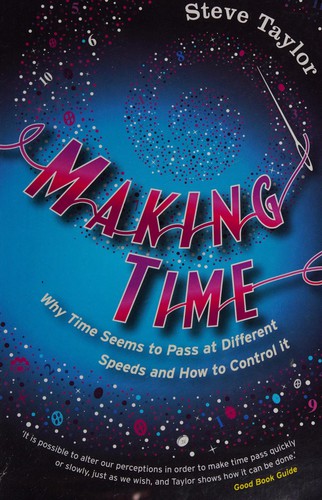
Verdict
Skip it. «Making Time» is a well-written tour of a interesting literature that then draws the one conclusion the literature does not support. Taylor is careful and readable when he is reporting findings. He is not careful about the difference between how long an interval felt and how long it reads in memory afterwards, and that difference is where the whole self-help promise lives.
The 2007 text also predates the cleanest tests. The free-fall experiment was published the same year; the large age-and-time surveys came in 2010 and 2013; the event-segmentation work came a decade later. A reader in 2026 taking the book at face value is working from a snapshot that has since been corrected in specific, checkable ways. See our other book notes for the same triage applied elsewhere.
The claim on trial
Taylor organises the book around five numbered «laws» of psychological time. Paraphrased rather than quoted, they run roughly: time slows in unfamiliar surroundings; time slows when you take in a lot of new information; time speeds up in states of absorption; time drags in states of non-absorption such as boredom and discomfort; and time can stop altogether in higher states of consciousness.
The falsifiable core is the practical inference. If novelty and attention expand time, then a person can deliberately «make» more time by changing what they attend to. That is the sentence on trial. It requires that the expansion happen as you live it, not only when you look back.
That requirement is not a technicality invented to be unfair to the book. Prospective and retrospective duration judgments have been meta-analysed as separate literatures across 20 experiments: prospective judgments come out longer and less variable, and the two are best explained by different models — attention for the first, memory for the second (Block & Zakay, Psychonomic Bulletin & Review, 1997). A third thing, the felt speed of time’s passage, is different again, and its relation to duration judgment remains unidentified (Wearden, Consciousness and Cognition, 2015). Taylor’s laws slide between all three.
The free-fall test
The book leans on the reports people give after car crashes and falls, where a few seconds are described as stretching out. Taylor treats these as evidence that perception dilated. This was tested the year the book came out.
Participants were winched 46 metres up a Suspended Catch Air Device tower in Dallas and released into a 31-metre free fall lasting 2.49 seconds. Each wore a wrist display alternating a digit with its negative image. Beforehand, each person’s threshold was measured — the alternation rate at which they could no longer read the number. Average threshold was 47.4 ± 13 ms in daylight. During the fall, the display ran 6 ms faster than each individual’s own threshold. If subjective time had slowed, the numbers should have become readable. They did not.
The same people then estimated their own fall at 2.96 ± 0.51 s against the 2.17 ± 0.24 s they had estimated beforehand — 36% longer. The authors’ conclusion is the cleanest sentence in this whole field: «Time-slowing is a function of recollection, not perception: a richer encoding of memory may cause a salient event to appear, retrospectively, as though it lasted longer» (Stetson, Fiesta & Eagleman, PLoS ONE, 2007).
The sample is 20 people, which is small, and nobody has repeated it with a bigger one. But it is the only experiment that puts a measurable perceptual task inside the frightening event, and it is direct. Everything else in this area is people describing what they remember.
The age premise
The book opens from the familiar observation that years get shorter as you get older, and reaches for the proportional idea — each year is a smaller fraction of the life you have already lived. The surveys are less obliging.
Across 499 people aged 14 to 94, age did predict both momentary passage judgments and retrospective judgments, but the effects were small to moderate and accounted for at most 10% of the variance (Wittmann & Lehnhoff, Psychological Reports, 2005). Larger samples then narrowed it further. In 1,865 adults aged 16 to 80 across two countries, respondents of all ages said time seemed to pass quickly, and age differences were very small on every interval except the question about the last ten years; the data fitted a theory based on experienced time pressure (Friedman & Janssen, Acta Psychologica, 2010).
A follow-up with 868 participants found no age effects at all on the week, month and year intervals — only on the ten-year one. People currently under time pressure said the short intervals were flying; people who recalled heavy pressure a decade ago said the last ten years had flown. Crucially, participants systematically underestimated how much pressure they had been under in the past, which produces the illusion of acceleration without any change in perception (Janssen, Naka & Friedman, Time & Society, 2013).
The most direct attack on the puzzle used 517 people aged 20 to 80. With age as the sole predictor, there was no age effect on the felt speed of current life at all. The effect appeared reliably only when participants were asked to compare life periods retrospectively. Perceived time pressure and the number of routines mattered in both current and past judgments; a declining rate of new experiences (Taylor’s mechanism) explained only the retrospective effect (Winkler et al., Timing & Time Perception, 2017).
That is the pattern in one line. Time does not measurably speed up. The comparison you make when you look back does.
What Taylor got right
The novelty observation is real, and it deserves the same citation standard as the refutations. An unexpected stimulus in a repeated series is judged to last longer than an identical repeated one, the distortion peaks about 225 ms after onset, it works in vision and hearing alike, and semantic novelty alone is enough to trigger it (Tse et al., Perception & Psychophysics, 2004). Novelty stretches a judged duration.
What it does not do is slow time in general. When an unexpected visual stimulus dilates, the pitch of a simultaneous sound and the frequency of a simultaneous flicker are unaffected — duration judgment moves while every other timing judgment stays put, and the effect tracks prediction violation rather than salience (Pariyadath & Eagleman, PLoS ONE, 2007). You do not get extra processing. You get one dial nudged.
The holiday paradox (a fortnight that passes quickly and then reads as long) is the strongest thing in the book, and the modern account is memory density, essentially Ornstein’s storage-size intuition made measurable. Using wearable cameras, real-life events were mentally replayed about eight times faster than they took, and perceived duration rose with the density of moments a person could retrieve (Jeunehomme & D’Argembeau, Quarterly Journal of Experimental Psychology, 2018). The compression rate is set by how finely the experience was carved into events: boundaries were more than five times more likely to be remembered than other parts, and goal-directed episodes were compressed four to five times less than things like walking between places (Jeunehomme & D’Argembeau, Psychological Research, 2018). In the lab the same structure holds: with clock duration held constant, animations perceived as having more sub-events, and less similar ones, produced longer duration judgments and longer mental replays (Faber & Gennari, Cognition, 2015).
So the book’s practical advice (seek novelty, vary routine, pay attention) does something. It builds a fatter record. It does not lengthen the afternoon.
Flow, meditation and the fifth law
Taylor borrows heavily from flow, and here his third law points the wrong way for his own thesis. When 100 people played the rhythm game Thumper for 25 minutes in VR or on a screen, the more flow they reported, the less they thought about time and the faster time passed subjectively (Rutrecht et al., Timing & Time Perception, 2021). Absorption contracts felt time. It is a correlational design, so direction is not established, but it is the opposite sign from «expansion». Our rewritten review of «Flow» covers how little of that book’s own mechanism survived testing.
Meditation is the other lever the book reaches for, and controlled work is thin and mixed. Twenty-two experienced mindfulness meditators with at least three years of practice were compared with 22 matched controls on reproducing 8, 14 and 20-second intervals. There was no group difference in either modality — auditory F(1,42) = 0.4, p = 0.514; visual F(1,42) = 0.9, p = 0.345 (Otten et al., Frontiers in Psychology, 2015). Where something does move is the felt passage: in 32 non-meditators run through focused-attention and open-monitoring sessions against a control, retrospective passage of time was reported as slower after both meditation conditions and unchanged after the control, while duration estimates during meditation were shorter than control (Chiarella et al., Mindfulness, 2025). Small sample, single session, and the two measures disagree — which is exactly Wearden’s point about keeping passage judgments and duration judgments apart.
The fifth law is a different kind of writing. Taylor is a transpersonal psychologist, and the closing move (that time disappears in higher states of consciousness, and that this reveals something about consciousness rather than about memory) is a metaphysical position, not a measured result. He is entitled to argue it. The problem is presentational: it arrives in the same register, with the same confident numbering, as the four laws built on experiments. A reader cannot tell from the prose where the evidence stops.
Who should read it
- Readers who want a well-written popular introduction to time perception and are willing to check the 2007 claims against the later work themselves.
- Readers who are specifically interested in transpersonal psychology and want a clear statement of that position applied to time.
- Not readers who want to gain hours. The book’s own evidence does not support that, and the free-fall experiment argues directly against it.
The concept this book borrows is examined in «Flow», and «Catching the Big Fish» makes a similar claim for meditation specifically.
One thing to try
Test the part that survived, on its own terms. For two weeks, add one unfamiliar 30-minute episode per week (a route you have never walked, a task with a goal structure you have not done before) and that evening write three lines about what happened in it. Goal-directed episodes are compressed four to five times less in memory than transitions, and retrievable moments are what perceived duration tracks (Jeunehomme & D’Argembeau, Psychological Research, 2018).
Then rate how long the fortnight felt, and compare it with the fortnight before. If the effect is real for you, it will show up in the retrospective rating and nowhere else. That is the honest version of the book’s promise: not more time, a longer record.
Get the book
Find «Making Time» on Amazon — as an Amazon Associate, The Boring Work earns from qualifying purchases (disclosure).
The boring bottom line
«Making Time» describes a real phenomenon and misidentifies its location. Novelty and attention do change how long an interval reads — afterwards. They do not hand you more seconds while you are in them. The clean test dropped 20 people off a tower and found no gain in temporal resolution at all, only a 36% inflation in what they remembered. The age premise the book opens from shrinks to almost nothing in samples of 868, 1,865 and 517 people, and what survives is better explained by remembering yourself as less busy than you were.
Keep the diary habit. Keep the appetite for unfamiliar routes. Drop the idea that either one is a way of making time.
When to see a professional
This page is general information about research on time perception, not medical or mental-health advice. Persistent distortions in the sense of time (hours vanishing, a feeling that the world has become unreal or slowed, or time dragging in a way that comes with low mood, anxiety or intrusive memories) are recognised features of several conditions and are worth raising with a GP or a clinical psychologist rather than treating with a self-help book. Intensive meditation retreats can also produce disorienting states in some people; if that happens, stop and speak to a clinician.
Sources
- Stetson, C., Fiesta, M. P. & Eagleman, D. M. Does time slow down during a frightening event? PLoS ONE, 2007
- Wittmann, M. & Lehnhoff, S. Age effects in perception of time. Psychological Reports, 2005
- Friedman, W. J. & Janssen, S. M. J. Aging and the speed of time. Acta Psychologica, 2010
- Janssen, S. M. J., Naka, M. & Friedman, W. J. Why does life appear to speed up as people get older? Time & Society, 2013
- Winkler, I., Fischer, K., Kliesow, K., Rudolph, T., Thiel, C. & Sedlmeier, P. Has it been that long? Why time seems to speed up with age. Timing & Time Perception, 2017
- Block, R. A. & Zakay, D. Prospective and retrospective duration judgments: a meta-analytic review. Psychonomic Bulletin & Review, 1997
- Wearden, J. Passage of time judgements. Consciousness and Cognition, 2015
- Tse, P. U., Intriligator, J., Rivest, J. & Cavanagh, P. Attention and the subjective expansion of time. Perception & Psychophysics, 2004
- Pariyadath, V. & Eagleman, D. The effect of predictability on subjective duration. PLoS ONE, 2007
- Jeunehomme, O. & D’Argembeau, A. The time to remember: temporal compression and duration judgements in memory for real-life events. Quarterly Journal of Experimental Psychology, 2018
- Jeunehomme, O. & D’Argembeau, A. Event segmentation and the temporal compression of experience in episodic memory. Psychological Research, 2018
- Faber, M. & Gennari, S. P. In search of lost time: reconstructing the unfolding of events from memory. Cognition, 2015
- Rutrecht, H., Wittmann, M., Khoshnoud, S. & Igarzábal, F. A. Time speeds up during flow states. Timing & Time Perception, 2021
- Otten, S., Schötz, E., Wittmann, M., Kohls, N., Schmidt, S. & Meissner, K. Psychophysiology of duration estimation in experienced mindfulness meditators and matched controls. Frontiers in Psychology, 2015
- Chiarella, S. G., Ortame, N., Simione, L., Pazzaglia, M. & Di Pace, E. The effects of focused attention and open monitoring meditation on interval duration estimation and passage of time judgments in non-meditators. Mindfulness, 2025