TL;DR
- Tiny Experiments tells readers to swap goals for «pacts»: «I will [action] for [duration]», judged on whether you showed up, not on the result.
- The research on goals is kinder to goals than the book is. Specific, difficult goals reliably beat «do your best» on many tasks. The book’s real point is narrower and supported: on complex, unfamiliar tasks, a learning goal beat an outcome goal in an experiment with 114 business students.
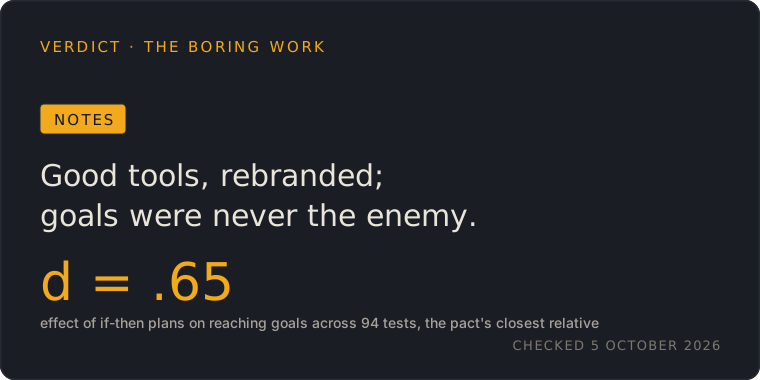
- The pact closely resembles an implementation intention, a plan of the form «when X, I will do Y», which improved goal attainment with a medium-to-large effect (d = .65) across 94 tests.
- The book’s line that procrastination is «a meaningful signal» fits the strongest predictors in a meta-analysis of 691 correlations: aversive tasks, distant deadlines and low confidence.
- What a personal experiment cannot do is tell you why something worked. With one person, no comparison and a hopeful experimenter, a fortnight of «data» mostly measures how you expected to feel.
Verdict
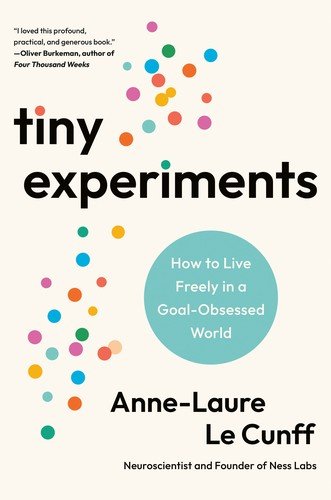
Read the notes. Tiny Experiments repackages several well-supported tools (time-boxed commitments, learning goals, weekly reviews, naming emotions) in a gentle and appealing frame. Its argument against goals overstates the case, and its promise that personal experiments produce knowledge about yourself needs a large asterisk. The tools are good; the philosophy around them is looser than the neuroscience on the cover suggests.
Pacts instead of goals
Anne-Laure Le Cunff, a former Google employee who went back to university for a PhD in neuroscience and founded the Ness Labs newsletter, published Tiny Experiments in March 2025. Its description frames the problem as linearity: «Life isn’t linear, and yet we constantly try to mold it around linear goals: four-year college degrees, ten-year career plans, thirty-year mortgages», and promises to replace «the old linear model of success with a circular model of growth» (Le Cunff, 2025).
The book’s main tool is the pact. «A pact is a simple and repeatable activity», in the format «I will [action] for [duration]». What makes it work, Le Cunff argues, is that «it focuses on your outputs» («publish 25 newsletters over the next 25 weeks») «rather than your outcomes» («get 5,000 newsletter subscribers in 25 weeks»), so that «there is no bad result or wrong choice. You just need to show up.» Pacts are tracked with a yes-or-no question, reviewed weekly in a «Plus Minus Next» journal, and kept or dropped at the end of their term.
| Claim | Status | Best evidence | |
|---|---|---|---|
| Linear goals are the problem | Overstated | [[Locke & Latham, 2002 | 10.1037/0003-066X.57.9.705]] |
| Focus on outputs and learning, not outcomes | Supported for complex tasks | [[Winters & Latham, 1996 | 10.1177/1059601196212007]] |
| A time-boxed, specific commitment helps you act | Supported (as implementation intentions) | [[Gollwitzer & Sheeran, 2006 | 10.1016/S0065-2601(06)38002-1]] |
| Daily tracking and weekly review help | Supported | [[Harkin et al., 2016 | 10.1037/bul0000025]] |
| Procrastination is a signal of a mismatch | Partly supported | [[Steel, 2007 | 10.1037/0033-2909.133.1.65]] |
| Personal experiments reveal what works for you | Weak as stated | Single-person trials without comparison cannot separate effect from expectation |
What goal research says
The book’s opponent, the specific and ambitious goal, is one of the most replicated findings in organisational psychology. Edwin Locke and Gary Latham summarised 35 years of work in which specific, difficult goals led to higher performance than vague exhortations to «do your best» across many tasks and settings (Locke & Latham, 2002). A reader who takes from Tiny Experiments that goals do not work has been told something the evidence contradicts.
There is a serious critical literature, and it supports part of Le Cunff’s case. Four business-school researchers argued in «Goals Gone Wild» that the benefits of goal setting «have been overstated» and listed side effects: «a narrow focus that neglects nongoal areas, distorted risk preferences, a rise in unethical behavior, inhibited learning, corrosion of organizational culture, and reduced intrinsic motivation» (Ordóñez et al., 2009). Their prescription was careful dosing, not abolition.
The most useful finding for the book comes from Latham himself. In an experiment with 114 business students, an outcome goal beat «do your best» on a simple scheduling task. On a complex one, a learning goal, aimed at discovering good strategies rather than hitting a number, produced better performance than either an outcome goal or «do your best», along with higher confidence and more effective strategies (Winters & Latham, 1996). That is close to Le Cunff’s argument for outputs and exploration when the path is unclear, and it is a better argument than the claim that linear goals are wrong in general. The two kinds of goal suit different problems: an outcome goal when you already know how to do the work, a learning goal when you are still working out how. Most of the situations Le Cunff describes, such as a career change or a first creative project, belong to the second kind.
The pact is an old tool with a good record
Stripped of its framing, a pact is a specific behaviour, a fixed duration and a yes-or-no check. Psychology has studied a close relative for three decades: the implementation intention, a plan that spells out when, where and how you will act. Peter Gollwitzer and Paschal Sheeran pooled 94 independent tests and found that forming one had «a positive effect of medium-to-large magnitude (d = .65) on goal attainment» (Gollwitzer & Sheeran, 2006). To translate d = .65: roughly three out of four people who made such a plan did better than the average person who did not.
A pact lacks the «if-then» trigger that defines an implementation intention, but it shares the specificity and the time box, and it adds a feature the research also supports: a defined end. Committing to «write 10 articles», rather than to «write regularly», makes it easier to start and easier to judge. It is reasonable to expect pacts to help, for the same reasons. The book does not need the critique of goals to justify them.
Procrastination as a signal
One of the book’s better reframings is about delay: «Procrastination is not an enemy to be conquered but a meaningful signal that something is amiss — a mismatch between your rational aspirations (head), your emotional needs (heart), and your practical skills (hand).»
The largest review of procrastination’s causes supports the spirit of that, though not the three-part scheme. A meta-analysis of 691 correlations found that personality traits such as neuroticism had only weak links to procrastination, while the «strong and consistent predictors» were task aversiveness, task delay, self-efficacy and impulsiveness, along with conscientiousness (Steel, 2007). An unpleasant task, a distant deadline and low confidence in your ability are signals about the task and the setup, which is roughly Le Cunff’s point. The head-heart-hand model is her own framework and has not been tested as such.
Tracking and the weekly review
The pact comes with a tracking habit: a yes-or-no tick each day, and a weekly «Plus Minus Next» review of what went well, what did not and what to try next. Of everything in the book, this has the strongest experimental support, though the research calls it progress monitoring.
A meta-analysis of 138 randomised studies with 19,951 participants found that interventions which got people to monitor their progress worked on two levels. They increased how often people checked their progress, and they improved goal attainment, d+ = 0.40, with changes in monitoring explaining the effect. Monitoring helped more when the results were reported to others or made public, and when people wrote the information down rather than keeping it in their heads (Harkin et al., 2016). An effect of 0.40 means that about two-thirds of people who monitored their progress did better than the average person who did not.
Two details connect to the book. Writing the result down mattered, which suits the daily tick and the journal. And making progress public mattered, which is the argument of the book’s final section on learning in public, the part that some reviewers describe as less practical than the rest. On this evidence it may be the most practical of all: telling a few people what your pact is, and reporting back, is one of the better-tested ways to keep it.
There is an irony here that the book does not dwell on. Progress monitoring is a tool of goal pursuit; the studies above measured how it helps people reach goals. The book’s most effective component works by doing the thing the book argues against.
Naming feelings
The book recommends writing down emotions as they arrive, and explains that «labeling our emotions relieves our brains of the burdensome task of processing them». There is research behind the practice. In a brain-imaging study, putting a word to the emotion in a picture, compared with other ways of processing it, reduced the response of the amygdala and nearby emotional regions to unpleasant images, with more activity in a region of the right prefrontal cortex (Lieberman et al., 2007).
The explanation is looser than the finding. The study shows that labelling dampens the brain’s alarm response to a negative image in a scanner; it does not show that labelling «relieves» the brain of «processing», which is itself a kind of processing. The practice is supported; the neuroscience gloss is decoration.
The limits of a tiny experiment
The book’s central promise is that you can learn what works for you by experimenting on yourself, and this is where the scientific framing works against it. A real experiment needs a comparison: a period without the change, or better, several alternations, and some protection against your own expectations. A pact typically has none of these. If you sleep better during a two-week experiment with an earlier bedtime, you cannot tell whether the bedtime did it, whether you were also less stressed that fortnight, or whether you expected to feel better and so reported that you did.
The book treats the pact as a way of learning by doing rather than a proof, and that is the right reading. There is also a statistical trap specific to self-experiments: people tend to start one when things are going badly, and bad patches tend to ease by themselves. An experiment begun at a low point will often look successful whatever it contained. But readers who take «experiment» literally should know that most of what a personal experiment yields is information about whether you can sustain a behaviour and whether you enjoy it, which is valuable. What it rarely yields is evidence about what the behaviour does.
Who should read it
Read it if goal-setting makes you anxious or rigid, or if you are at a point where you do not know what you want and a five-year plan feels absurd. The pact format, the weekly review and the permission to drop what is not working are useful and humane.
Do not read it as a case against goals, and do not read its neuroscience vocabulary as a sign that each tool was tested in a laboratory. Most were tested under other names, by other people, as tools for reaching goals. When you know what you want and the task is clear, a specific and difficult target still works, and the evidence for that is far stronger than the evidence for any of the book’s alternatives.
The written-goal statistic that made goal-setting famous is traced in the Harvard and Yale goal study that never happened, and the evidence on if-then planning is used in the check on habit stacking. Other productivity books, read against the evidence, are in the book reviews.
The boring bottom line
Tiny Experiments is right that rigid outcome goals can backfire, especially on complex and unfamiliar problems, and its pacts resemble implementation intentions, which improved goal attainment across 94 tests. Its reading of procrastination as a signal matches the strongest predictors in the research.
Its war on goals is overstated: specific, difficult goals remain one of psychology’s best-replicated findings. And a two-week pact with no comparison tells you whether you can keep doing something, not whether it works. Keep the pacts and the weekly review; keep your goals too.
Sources
- Le Cunff, A.-L (2025). Tiny Experiments: How to Live Freely in a Goal-Obsessed World. Avery / Penguin Random House. Publisher's description; quotations from the book checked against its text. Read on 5 October 2026. penguinrandomhouse.com
- Locke, E.A., Latham, G.P (2002). Building a practically useful theory of goal setting and task motivation: A 35-year odyssey.. American Psychologist. 57(9), 705-717. 35 years of goal-setting research: specific, difficult goals beat do-your-best instructions. doi:10.1037/0003-066X.57.9.705
- Ordóñez, L.D., Schweitzer, M.E., Galinsky, A.D., Bazerman, M.H (2009). Goals Gone Wild: The Systematic Side Effects of Overprescribing Goal Setting. Academy of Management Perspectives. 23(1), 6-16. Critique of goal setting: side effects including narrow focus, risk distortion, unethical behaviour and inhibited learning. doi:10.5465/amp.2009.37007999
- Winters, D., Latham, G.P (1996). The Effect of Learning versus Outcome Goals on a Simple versus a Complex Task. Group & Organization Management. 21(2), 236-250. 114 business students: outcome goal best on a simple task; learning goal best on a complex task. doi:10.1177/1059601196212007
- Gollwitzer, P.M., Sheeran, P (2006). Implementation Intentions and Goal Achievement: A Meta‐analysis of Effects and Processes. Advances in Experimental Social Psychology. , 69-119. Meta-analysis of 94 independent tests: implementation intentions d = .65 on goal attainment. doi:10.1016/S0065-2601(06)38002-1
- Steel, P (2007). The nature of procrastination: A meta-analytic and theoretical review of quintessential self-regulatory failure.. Psychological Bulletin. 133(1), 65-94. Meta-analysis, 691 correlations: task aversiveness, delay, self-efficacy and impulsiveness strongly predict procrastination. doi:10.1037/0033-2909.133.1.65
- Harkin, B., Webb, T.L., Chang, B.P.I., Prestwich, A., Conner, M., Kellar, I., et al (2016). Does monitoring goal progress promote goal attainment? A meta-analysis of the experimental evidence.. Psychological Bulletin. 142(2), 198-229. 138 randomised studies, N = 19,951: progress monitoring improved goal attainment, d+ = 0.40; larger when public and physically recorded. doi:10.1037/bul0000025
- Lieberman, M.D., Eisenberger, N.I., Crockett, M.J., Tom, S.M., Pfeifer, J.H., Way, B.M (2007). Putting Feelings Into Words. Psychological Science. 18(5), 421-428. fMRI study: affect labelling reduced amygdala response to negative images. doi:10.1111/j.1467-9280.2007.01916.x