TL;DR
- The Mountain Is You argues that self-sabotage is «not a way we hurt ourselves; it’s a way we try to protect ourselves», with habits «intelligently designed by your subconscious to meet an unfulfilled need».
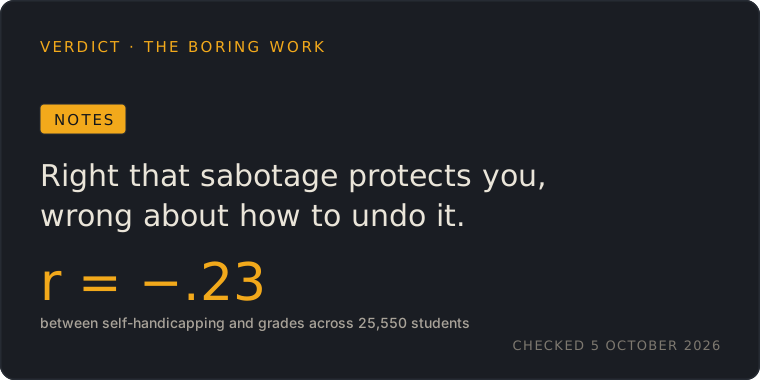
- The protective part has research behind it. Self-handicapping, creating obstacles that give you an excuse in advance, is a well-studied way of guarding self-esteem, and across 25,550 students it went with lower grades (r = −.23). Procrastination behaves like short-term mood repair at the expense of the future self.
- Other parts of the book’s model are much harder to test, and some have been tested and failed. «Core commitments» hidden in the subconscious can explain any behaviour after the fact, which is why they cannot be checked.
- The book’s prescription to «pinpoint the traumatic event» and «release unprocessed emotions» runs against the evidence on venting: in an experiment, people who vented anger while thinking about its source became angrier and more aggressive.
- Its plainest advice, that action builds motivation rather than waiting for it, matches behavioural activation, a treatment that did as well as cognitive therapy for depression across 16 trials.
Verdict
Read the notes. Wiest’s reframing of self-sabotage as protection rather than self-hatred is useful and partly supported, and it may take shame out of a familiar struggle. Her method, digging for a hidden subconscious need and releasing old emotion, rests on ideas that have either never been tested or have been tested and found wanting. Keep the diagnosis in its modest form, and take the cure from behavioural research.
A mountain made of needs
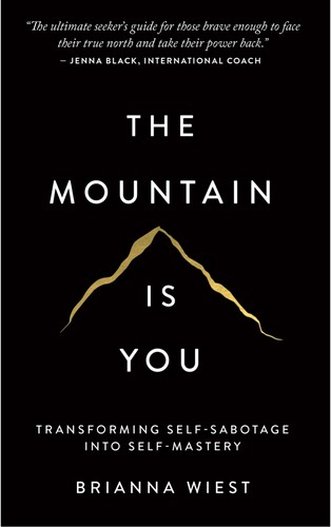
Brianna Wiest, an essayist whose work grew up on the Thought Catalog platform, published The Mountain Is You in 2020, and in 2026 it is still among Amazon’s top self-help sellers. Her definition of the problem opens the second chapter: «Self-sabotage is when you have two conflicting desires. One is conscious, one is unconscious.» Ongoing problems that seem easy to fix are «not big problems but big attachments», and the habits we cannot stop are «intelligently designed by your subconscious to meet an unfulfilled need, displaced emotion, or neglected desire». Hence the reframing that gives the book its warmth: «Self-sabotage is not a way we hurt ourselves; it’s a way we try to protect ourselves» (Wiest, 2020).
The cure follows. To overcome self-sabotage, the book says, «we must go through a process of deep psychological excavation. We must pinpoint the traumatic event, release unprocessed emotions, find healthier ways to meet our needs, reinvent our self-image, and develop principles such as emotional intelligence and resilience.» Elsewhere it says that self-sabotage «is ultimately just a product of low emotional intelligence».
That is a model with four testable parts: sabotage protects something; it is driven by a hidden need; the fix is to excavate and release; and emotional intelligence is the root. They fare differently.
| Claim | Status | Best evidence | ||
|---|---|---|---|---|
| Self-sabotage protects the self | Partly supported | [[Schwinger et al., 2014 | 10.1037/a0035832]]; [[Sirois & Pychyl, 2013 | 10.1111/spc3.12011]] |
| It meets a hidden subconscious need | Untestable as stated | No measure of a «core commitment» exists to test | ||
| Excavate the trauma and release emotion | Contradicted for venting | [[Bushman, 2002 | 10.1177/0146167202289002]] | |
| Action builds motivation | Supported | [[Cuijpers et al., 2007 | 10.1016/j.cpr.2006.11.001]] |
Protection is the right word
Psychologists have a name for one form of what Wiest describes: self-handicapping. A student who parties the night before an exam, or never quite starts the essay, has an excuse ready if the result is bad, and a bigger compliment to himself if it is good. The behaviour guards self-esteem against the threat of failing at something that matters. A meta-analysis of 36 field studies with 25,550 students found that self-handicapping went with lower academic achievement, r = −.23 (Schwinger et al., 2014). An r of −.23 means self-handicapping accounts for roughly 5% of the differences in grades between students: a clear pattern across a population, and a loose one for any individual. The authors described self-handicapping as a strategy «for regulating the threat to self-esteem elicited by the fear of failing».
Procrastination fits the same pattern. Fuschia Sirois and Timothy Pychyl, two of the field’s main researchers, argue that putting things off is largely «short-term mood repair»: the aversive task is swapped for something that feels better now, and the cost is passed to the future self (Sirois & Pychyl, 2013). Wiest’s line that «procrastinating puts you back in a place of comfort» is close to their account.
So the book’s central reframe has support, with a caveat about what is being protected. In the research, the protection is mostly of mood and self-esteem in the moment. That is a narrower and more ordinary mechanism than a subconscious that «intelligently» designs habits around a hidden purpose.
The pull of the familiar
One of the book’s better observations is about change itself. «Human beings experience a natural resistance to the unknown», Wiest writes, because the unknown feels like a complete loss of control, and she adds that «this is true even if what’s ‘unknown’ is benevolent or even beneficial to us». That is why, in her account, people pull back just as things start to improve.
Economists documented a version of this decades ago under a duller name. In a series of decision experiments, and in the real choices university staff made about health plans and retirement funds, William Samuelson and Richard Zeckhauser found that people stick with the existing option far more often than its merits would predict, a pattern they called status quo bias (Samuelson & Zeckhauser, 1988). The default wins, even when another choice would serve the chooser better.
The research supports the pull of the familiar without supporting the book’s explanation of it. Status quo bias shows up in choices that carry no emotional history at all, such as which retirement fund to hold, which suggests ordinary mechanisms (the effort of switching, the fear of regret, inertia) rather than a subconscious protecting a wound. A reader who keeps returning to an old pattern may be facing a hidden need, or may be facing the same inertia that keeps people in the wrong pension plan. The second explanation is the cheaper one to test, and the easier one to fix: make the new option the default, so that staying put now means doing the new thing.
The trouble with hidden needs
Wiest’s most distinctive idea is the «core commitment». Your subconscious, she writes, is committed to something you do not know about, such as staying in control or being needed, and «your core need is the opposite of your core commitment». If your commitment is control, your need is trust; if it is to be needed, your need is to know you are wanted.
This is where the model leaves testable ground. A core commitment is inferred from the behaviour it is meant to explain, so any pattern can be assigned one after the fact, and no outcome could show that a person had a different commitment or none. That does not make the idea useless; asking «what does this habit get me?» can be a productive question in therapy and in a notebook. It does mean that the book’s confident readings of other people’s motives are interpretations, not findings.
The model also leaves little room for the plainest explanations. Some people procrastinate because a task is boring and has a distant deadline, and some fail to start a business because they lack money or time. Wiest acknowledges in passing that sometimes we run on autopilot, but the book’s weight falls on hidden purpose.
Excavate and release?
The publisher’s description goes further, promising «releasing past experiences at a cellular level» and «excavating trauma». No study I could find measures experiences stored in cells, let alone releases them, and the phrase works as a metaphor dressed in biology. The book’s own prescription to «pinpoint the traumatic event» and «release unprocessed emotions» comes from a long tradition, the idea of catharsis, in which pent-up feeling is drained by expressing it. It has been tested directly for anger. Brad Bushman, a psychologist at Iowa State University, angered volunteers and then had some hit a punching bag while thinking about the person who had angered them. «People in the rumination group felt angrier than did people in the distraction or control groups», and they were also the most aggressive. «Doing nothing at all was more effective than venting anger» (Bushman, 2002).
One experiment on anger does not settle every kind of emotional processing, and structured therapies that revisit painful memories with a clinician are a different matter from the unguided release the book describes. But the general hydraulic picture, that emotion builds up and must be let out, is not supported, and digging alone for a single causal traumatic event is not a method with evidence behind it. If a reader does have trauma in their past, the right person to go looking with is a qualified therapist.
Emotional intelligence as the root
«Self-sabotage is ultimately just a product of low emotional intelligence», the book says. Emotional intelligence is a real research topic, and its measures do predict some outcomes. As this site found in does emotional intelligence predict success, much of that predictive power overlaps with ordinary personality traits and general cognitive ability once they are measured. Naming low emotional intelligence as the single root of self-sabotage asks one fuzzy construct to explain another.
Where the book is right without needing the theory
The best advice in the book is its plainest. Wiest writes that «action builds momentum and creates motivation. These feelings will not come to you spontaneously; you have to generate them», and that you can know a path is right for you and still «not feel like taking the action required».
That idea is the core of behavioural activation, a treatment for depression in which people schedule and carry out activities before they feel like it. A meta-analysis of 16 randomised studies with 780 participants found a large effect against control conditions, 0.87, and no meaningful difference from cognitive therapy across ten head-to-head comparisons, 0.02, with benefits holding at follow-up (Cuijpers et al., 2007). An effect of 0.87 means the average treated person ended up better off than about 80% of those in the control groups.
Notice what behavioural activation does not ask for. It does not require finding the hidden need or the original wound; it works on the behaviour directly, and the mood follows. That is the opposite emphasis from the book’s excavation method, and it has far more evidence behind it.
Who should read it
Read it if you are hard on yourself for repeating the same mistakes. The reframe, that the habit is doing a job for you and that shame will not fix it, is humane and partly backed by research on self-handicapping and procrastination. The book’s prose is gentle and many readers find it consoling.
Read the excavation chapters with caution. Searching your past for the one event that explains everything, and releasing it, is not a method the evidence supports. Start instead with the book’s own advice on action: act first, and let the motivation catch up.
Procrastination as mood repair is examined in the neurobiology of avoidance, and the wider evidence is gathered on the procrastination page. Other popular books on getting in your own way are reviewed in the book reviews.
The boring bottom line
The Mountain Is You is right that self-sabotage often protects something. Self-handicapping guards self-esteem at the cost of results, and procrastination trades the future self’s interests for relief now. Its hidden «core commitments» cannot be tested, and its prescription to dig up the original trauma and release the emotion runs into experiments showing that venting can feed anger.
The book’s quietest line is its best: action builds motivation, rather than the other way round. Behavioural activation, which works on that principle, matched cognitive therapy for depression across ten trials. Keep the compassion and the action, and leave the excavation to a professional.
Sources
- Wiest, B (2020). The Mountain Is You: Transforming Self-Sabotage Into Self-Mastery. Thought Catalog Books. Publisher's page (Thought Catalog Books) with the book description and sample; quotations checked against the book's text. shopcatalog.com
- Schwinger, M., Wirthwein, L., Lemmer, G., Steinmayr, R (2014). Academic self-handicapping and achievement: A meta-analysis.. Journal of Educational Psychology. 106(3), 744-761. Meta-analysis of 36 field studies, N = 25,550: self-handicapping and academic achievement r = -.23. doi:10.1037/a0035832
- Sirois, F., Pychyl, T (2013). Procrastination and the Priority of Short‐Term Mood Regulation: Consequences for Future Self. Social and Personality Psychology Compass. 7(2), 115-127. Theoretical review: procrastination as short-term mood repair at the expense of the future self. doi:10.1111/spc3.12011
- Samuelson, W., Zeckhauser, R (1988). Status quo bias in decision making. Journal of Risk and Uncertainty. 1(1), 7-59. Decision experiments plus health-plan and retirement-fund choices of university staff: status quo bias. doi:10.1007/BF00055564
- Bushman, B.J (2002). Does Venting Anger Feed or Extinguish the Flame? Catharsis, Rumination, Distraction, Anger, and Aggressive Responding. Personality and Social Psychology Bulletin. 28(6), 724-731. Experiment: venting anger while ruminating increased anger and aggression; doing nothing beat venting. doi:10.1177/0146167202289002
- Cuijpers, P., van Straten, A., Warmerdam, L (2007). Behavioral activation treatments of depression: A meta-analysis. Clinical Psychology Review. 27(3), 318-326. Meta-analysis of 16 randomised studies, 780 participants: activity scheduling effect 0.87 vs control; 0.02 vs cognitive therapy. doi:10.1016/j.cpr.2006.11.001