TL;DR
- Two different things share the name. Ability tests score you against correct answers; self-report questionnaires ask how good you think you are at emotions, mixed in with items about motivation and wellbeing. They behave differently in every analysis below.
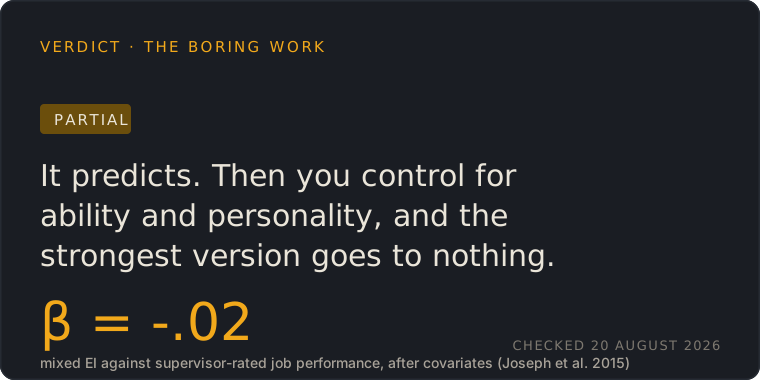
- The strongest published claim did not survive being checked. Self-reported emotional intelligence correlated rho = .29 with supervisor-rated job performance, and the relationship fell to beta = -.02 once ability and personality were controlled.
- Across 42,529 students and 1,246 effect sizes, EI correlated rho = .20 with academic performance and added between 0.7% and 2.3% of variance beyond intelligence and the Big Five, ranking third behind intelligence and conscientiousness.
- The overlap is not a rounding error. A model of what mixed EI questionnaires contain (ability EI, self-efficacy, self-rated performance, conscientiousness, emotional stability, extraversion and mental ability) reached multiple R = .79.
- Where it does predict is specific: in high emotional labour jobs the association is positive, and in low emotional labour jobs the same measure predicts performance negatively.
The claim that emotional intelligence matters more than IQ has had thirty years of unusually good publicity, and it is one of the few popular psychology claims where the specialist literature contains a clean, quantitative answer. That answer is not a dismissal. Most of what the popular measures capture is already measured by things psychology has had names for since the 1980s.
Two constructs, one label
Dana Joseph and Daniel Newman set out the problem in 2010, and their framing is still the one the field uses. Ability-based emotional intelligence is measured like a test: you are shown a face or a scenario and your answer is scored against a criterion. Mixed-based emotional intelligence is measured like a personality inventory: you rate your own emotional skills, alongside items about motivation, wellbeing and social confidence.
Their paper names the three problems that had stalled the field: which facets of the ability version explain job performance, how far the whole thing is redundant with cognitive ability and the Big Five, and the application of one label to two distinct sets of constructs. Their model treats emotion perception as preceding emotion understanding, which precedes conscious emotion regulation and then performance, with those stages reflecting conscientiousness, cognitive ability and neuroticism respectively.
The moderation buried in that paper is the finding most worth carrying: EI positively predicts performance for high emotional labor jobs and negatively predicts performance for low emotional labor jobs. The same measure changes sign depending on the work. Any statement of the form “emotional intelligence predicts performance” with no job attached is averaging over that.
That cascade is worth reading as a claim about what the label covers. If emotion perception reflects conscientiousness, emotion understanding reflects cognitive ability and emotion regulation reflects neuroticism, then the construct is not a fourth thing sitting alongside intelligence and personality. It is a route through them, arranged in an order, with job performance at the end. The redundancy question is not an objection to the model — it is part of it.
How much it adds
The largest count in this field comes from Carolyn MacCann and colleagues: 1,246 effect sizes from 158 citations, N = 42,529, on emotional intelligence and academic performance, analysed with robust variance estimation and separated by stream.
Overall the association was rho = .20. By stream: ability EI .24, mixed EI .19, self-rated EI .12. Those are real, positive, and modest. The number that answers the popular claim is the next one: Ability, self-rated, and mixed EI explained an additional 1.7%, 0.7%, and 2.3% of the variance, respectively, after controlling for intelligence and big five personality.
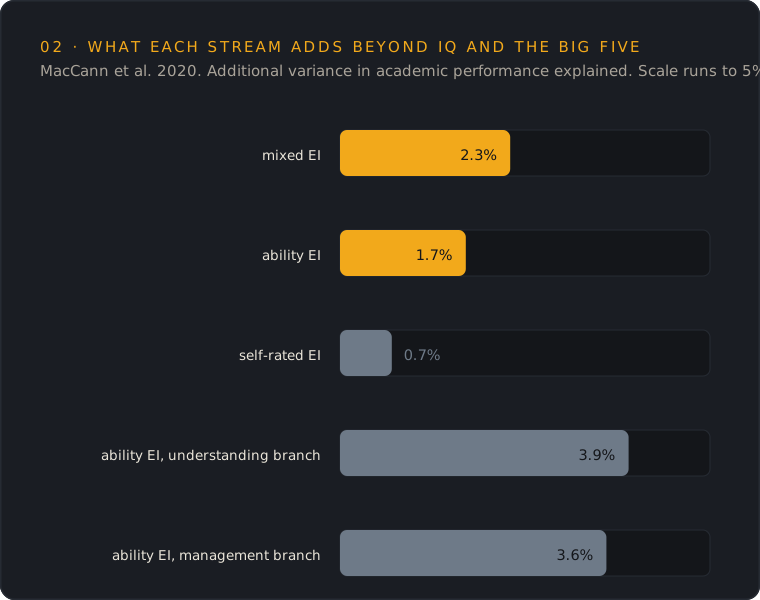
Two subscales of the ability version did better (understanding at 3.9% and management at 3.6%) which is a hint about where the useful signal sits. And the relative importance analysis put EI third among predictors, behind intelligence and conscientiousness. Third of three named predictors is a defensible place to be. It is not the place the popular claim puts it.
The authors also name the limitation that applies to every number on this page, including their own: there is no evidence for a causal direction. These are correlations between two things measured in the same students.
What happened to the strongest number
For a while the field had a striking result: self-reported emotional intelligence correlated with job performance at around rho = .47, which would make it one of the best predictors in personnel selection, and it appeared to work beyond cognitive ability and personality.
In 2015 four authors (including two who had produced the earlier estimates) went back and asked what the questionnaires are made of. Their model of the content overlap included ability EI, self-efficacy, self-rated performance, conscientiousness, emotional stability, extraversion and general mental ability, and it reached multiple R = .79. That is most of the instrument accounted for by things with older names.
Their updated estimate of the correlation with supervisor-rated performance was rho = .29 rather than .47. And then the result that gives this article its verdict: the mixed EI-job performance relationship becomes nil (β = -.02) after controlling for the set of covariates listed above.
A beta of -.02 is zero with a rounding error attached. The reading the authors offer concerns the instrument rather than the construct: mixed EI questionnaires assess a combination of ability EI and self-perceptions alongside personality and cognitive ability — which explains the uncommonly high correlation and also why it disappears when those components are held constant.
Worth noting how this happened, because it is the good version of how science is meant to go. The correction came from inside, from the people whose earlier numbers were being revised, published in the same journal.
The case on the other side
The self-report tradition has its own meta-analysis, and it should be read alongside the collapse above. Federica Andrei and colleagues (including the author of the questionnaire under test) reviewed 24 articles reporting 114 incremental validity analyses of one widely used trait EI instrument, and pooled 105 effect sizes from 18 studies.
Their result: The pooled effect size was relatively small, but statistically and practically significant (ΔR(2) = .06, SE = .0116; 95% CI [.03, .08]). Six per cent of additional variance beyond higher-order personality dimensions and other emotion-related variables, and the effect did not shrink as more covariates were added.
The detail that complicates it comes from the same abstract: the incremental contribution was mainly due to the wellbeing and self-control factors of the questionnaire. Wellbeing and self-control are not obviously about reading other people’s emotions, which is what the phrase emotional intelligence promises. The instrument adds something; what it adds may not be what its name says.
Where the sign changes
Averaged across everything, these effects are small. Split by context, they move around a great deal, and the pattern is the useful part of the literature.
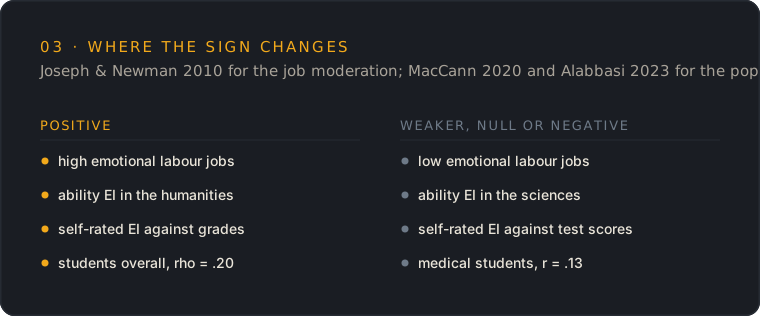
Emotional labour is the strongest moderator anyone has found. In jobs that require managing your own and other people’s feelings as part of the work, the association is positive; in jobs that do not, the same measure predicts performance negatively. That second half is rarely mentioned and is the more interesting claim, since it suggests attention spent on emotional regulation can be attention taken from the task.
Population matters too. In undergraduate medical programmes, a multilevel meta-analysis of 20 studies with 4,227 participants found r = .13, and the mean effect varied significantly by which test and which subscales were used. Their own summary is the phrase to keep: EI is significantly, albeit weakly, related to academic success in MD programs. In a group already selected for cognitive ability and conscientiousness, there is less room for a third factor to explain anything.
That study also reports how unstable the estimate is. Between-study variance accounted for 29.5% of the variability in the mean effect and within-study variance for 33.5% — meaning most of what moves the number is not the construct but which study you are looking at and which measure it happened to use. When an association of .13 is that heterogeneous, an average is a weak summary of it.
MacCann’s moderators point the same way. Ability EI predicted performance more strongly in the humanities than in the sciences, and self-rated EI predicted grades better than it predicted standardised test scores — which is the pattern you would expect if part of the effect runs through how a person is perceived rather than what they know.
Can it be trained
A large industry sells emotional intelligence training, so the state of that evidence belongs here. A pre-registered systematic review and meta-analysis covered 17 longitudinal studies of EI training in healthcare workers, a sector where the construct is taken seriously enough to fund programmes.
Every study reported an increase in emotional intelligence after the intervention. Every one. That uniformity is itself informative, and the reviewers say so: the potential overestimation of effects due to methodological flaws necessitates caution. They call for research into optimal duration and delivery, which is a polite way of saying nobody yet knows what dose of what does anything.
There is also a structural problem specific to this outcome. When training aims to raise a self-reported score, and the score is self-reported after the training, an increase is compatible with people having learned what the questionnaire wants.
Still on Google
On 20 August 2026 we ran ten searches and read 123 pages across 93 sites. The claim counted here is the popular one: that emotional intelligence predicts success, often as mattering more than cognitive ability, stated without the overlap or the incremental variance.
Eighty-eight of the 123 state it — the highest share of any claim in this registry. A project-management site writes that emotional intelligence is four times more reliable than IQ in determining success in your field; a consultancy calls it the single most reliable predictor of whether a leader will succeed. Seventy-three of the 88 sell something on the same page: an assessment, a certification, a training programme, a hiring tool.
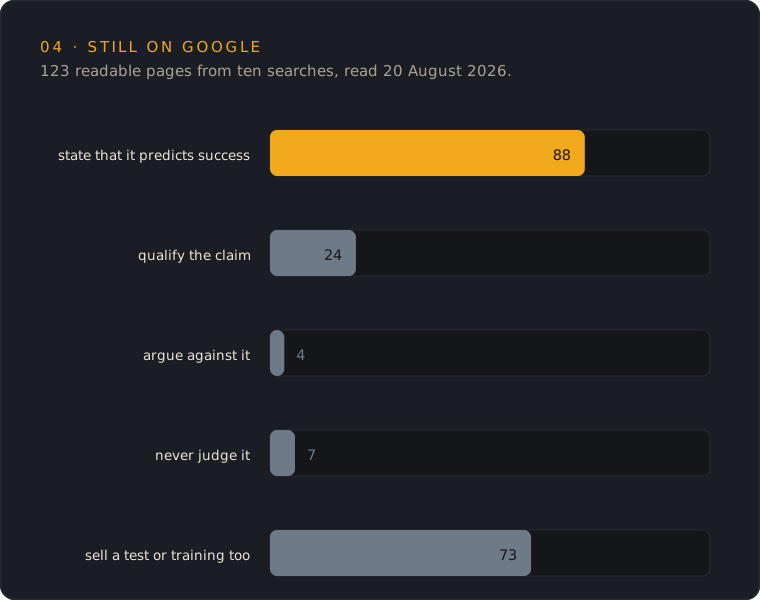
Twenty-four qualify it, mostly by naming the overlap with personality — one notes that emotional intelligence explains only small incremental variance beyond IQ for most outcomes. Four argue against the claim outright. Across the whole pile, 14 of the 123 pages mention the overlap with the Big Five or the incremental variance at all, and two of the 88 assertion pages name any of the researchers who measured it.
Two numbers do most of the work: the 58% of job performance and the 90% of top performers. Thirteen pages repeat one or both. Both trace to a single company’s in-house data, and that company holds ten of the 88 pages in this sample under its own domain — the assessment vendor, the statistic and the search result are the same organisation.
Stating the answer carefully
Partial, and the size of the partial matters. Emotional intelligence correlates with academic performance at rho = .20 across more than forty thousand students, and with job performance at rho = .29 in the self-report version. Both are real associations that would be respectable if the claim attached to them were modest.
The claim attached to them is not modest. Once cognitive ability and personality are controlled, the academic effect is worth between 0.7 and 2.3 per cent of variance and the job performance effect is worth nothing measurable. The one instrument with a defended incremental effect gets it from wellbeing and self-control subscales. And the direction of the association flips depending on how much emotional labour the job involves.
None of this argues that emotions are unimportant at work, which nobody has tested and which these papers do not address. The argument is about measurement: the questionnaires that carry the name are substantially made of other things, and after those other things are accounted for, what remains is small.
What would settle the remaining question is not hard to describe. Take an ability-based measure rather than a self-report one, administer it before anyone is hired or graded, wait, and then check performance against a criterion collected by someone who has not seen the score — with cognitive ability and the Big Five measured at the same time and entered first. Predictive rather than concurrent, ability-based rather than self-reported, criterion collected blind. The literature summarised above is largely the other kind, which is why the causal reading keeps failing.
What to do with this instead
The shift: ask which of the two things is being measured before reading any number. An ability test and a self-report questionnaire produce different effect sizes in every analysis here, and the popular claim is built on the self-report one.
First move: ask what was controlled. An uncontrolled correlation of .29 and a controlled beta of -.02 come from the same data and the same authors.
Second move: attach the job. The association is positive in high emotional labour work and negative in low emotional labour work, so a claim with no occupation named is an average of two opposite findings.
Third move: treat a training result measured by self-report with the caution its own reviewers recommend, given that all seventeen studies in the meta-analysis were positive.
Nothing here is guidance on hiring, and selection decisions carry legal and fairness obligations that no article can cover. For the wider pattern of a construct being sold on the strength of a number its own authors later revised, the piece on the self-improvement genre covers the same machinery, and the method page explains how effect sizes are read here.
Two more claims about non-cognitive predictors get the same treatment: does growth mindset work, and the founding text of the whole genre, in our notes on «How to Win Friends and Influence People». Goleman’s 1995 bestseller also made the marshmallow study famous; what survived it is in does the marshmallow test predict anything.
The boring bottom line
Emotional intelligence predicts things, weakly. Across 42,529 students it correlated .20 with academic performance and added between 0.7 and 2.3 per cent of variance beyond intelligence and personality, ranking third behind those two. In the workplace, the self-report version correlated .29 with supervisor ratings and fell to a beta of -.02 once ability and personality were controlled.
The reason is measurement rather than mystery: a model of what those questionnaires contain reached multiple R = .79 against constructs that already had names. The one durable finding underneath the noise is that the association is positive in jobs made of emotional labour and negative in jobs that are not.
Sources
- Joseph, D. L., Jin, J., Newman, D. A., & O'Boyle, E. H (2015). Why does self-reported emotional intelligence predict job performance? A meta-analytic investigation of mixed EI. Journal of Applied Psychology. 100(2), 298-342. The paper that dismantles the strongest claim in the field, written partly by the authors of the earlier estimate it revises. doi:10.1037/a0037681
- MacCann, C., Jiang, Y., Brown, L. E. R., Double, K. S., & Bucich, M., et al (2020). Emotional intelligence predicts academic performance: A meta-analysis. Psychological Bulletin. 146(2), 150-186. The largest count in the field, and the source of the number that answers the question people are asking: how much does it add on top of what we already measure. doi:10.1037/bul0000219
- Joseph, D. L., & Newman, D. A (2010). Emotional intelligence: An integrative meta-analysis and cascading model. Journal of Applied Psychology. 95(1), 54-78. The paper that named the two-constructs-one-label problem, and the source of the moderation everybody skips: the sign of the effect depends on the job. doi:10.1037/a0017286
- Andrei, F., Siegling, A. B., Aloe, A. M., Baldaro, B., & Petrides, K. V (2016). The incremental validity of the Trait Emotional Intelligence Questionnaire (TEIQue): A systematic review and meta-analysis. Journal of Personality Assessment. 98(3), 261-276. The strongest case for the self-report side, from authors who built the instrument. Six per cent, and most of it comes from two subscales. doi:10.1080/00223891.2015.1084630
- Alabbasi, A. M. A., Alabbasi, F. A., AlSaleh, A., & Alansari, A. M., et al (2023). Emotional intelligence weakly predicts academic success in medical programs: A multilevel meta-analysis and systematic review. BMC Medical Education. 23, 425. A test in a population selected for cognitive ability, where the association is weaker and the instrument matters more than the construct. doi:10.1186/s12909-023-04417-8
- Powell, C., Brown, T., Yap, Y., Hallam, K., & Takac, M., et al (2024). Emotional intelligence training among the healthcare workforce: A systematic review and meta-analysis. Frontiers in Psychology. 15, 1437035. Seventeen studies, all positive, with the authors themselves naming the reason to distrust that. doi:10.3389/fpsyg.2024.1437035