TL;DR
- Cal Newport’s three principles, «Do Fewer Things. Work at a Natural Pace. Obsess over Quality», answer a real problem: knowledge work that treats busyness as «a proxy for useful effort».
- The first principle has the best support. Switching between unfinished tasks leaves «attention residue» that lowers performance on the next one, and adults told to check email three times a day reported lower daily stress than when checking freely.
- Long hours do not buy proportional output: in historical data on munition workers, output rose more slowly once hours passed a threshold.
- The second principle is the least tested. Vacations measurably restore well-being, but the effect fades soon after work resumes, which is an argument for building slack into ordinary weeks rather than for seasons.
- The book’s evidence is mostly historical portraits of Galileo, Newton, Jane Austen and others. They illustrate the principles; they cannot test them, and most readers do not control their workload as those figures did.
Verdict
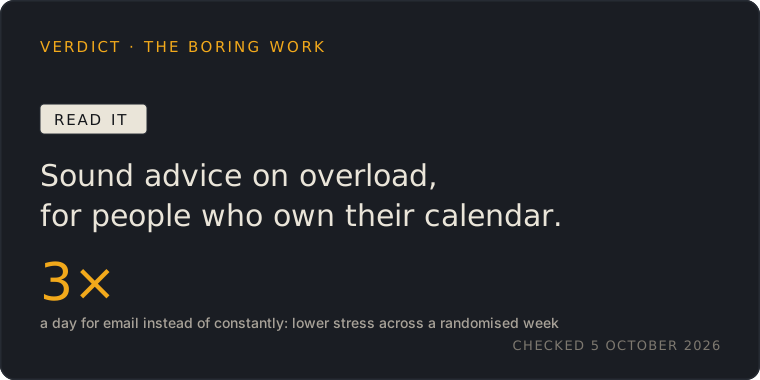
Read it, especially if you have some control over what you agree to. Slow Productivity is a short, practical argument whose main recommendations match research on task switching, interruptions, long hours and burnout. Its weaknesses are a reliance on famous lives as evidence and a blind spot about who gets to work this way.
The argument
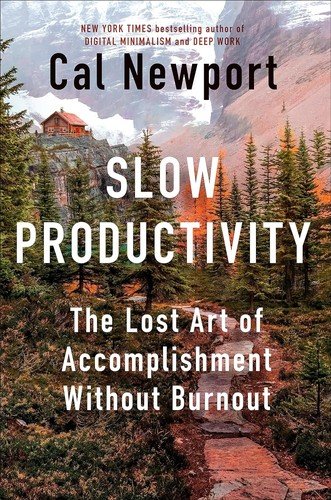
Cal Newport, a computer scientist at Georgetown University and the author of Deep Work and Digital Minimalism, published Slow Productivity in March 2024. Its publisher states the problem bluntly: «Our current definition of “productivity” is broken. It pushes us to treat busyness as a proxy for useful effort, leading to impossibly lengthy task lists and ceaseless meetings.» Newport calls this pseudo-productivity, and offers three principles in its place: «Do Fewer Things. Work at a Natural Pace. Obsess over Quality.» The book draws on «a varied cast of storied thinkers – from Galileo and Isaac Newton, to Jane Austen and Georgia O’Keefe», and promises an «aggressive rethinking of workload management» and «introducing seasonal variation» (Penguin Random House, 2024).
This review takes the three principles in turn and asks what research says about each. The historical portraits, which take up much of the book, are covered at the end.
| Principle | Status | Key evidence | ||
|---|---|---|---|---|
| Do fewer things at once | Supported | [[Leroy, 2009 | 10.1016/j.obhdp.2009.04.002]]; [[Kushlev & Dunn, 2015 | 10.1016/j.chb.2014.11.005]] |
| Work at a natural pace, with seasons | Partly supported | [[de Bloom et al., 2009 | 10.1539/joh.K8004]] | |
| Obsess over quality | Untested as a productivity strategy | No direct study located | ||
| Overload drives burnout | Supported | [[Alarcon, 2011 | 10.1016/j.jvb.2011.03.007]] | |
| Organisations can cut workload and keep people well | Early support | [[Fan et al., 2025 | 10.1038/s41562-025-02259-6]] |
Why busyness looks good
Newport’s diagnosis begins with a question: why would anyone choose a system that treats activity as output? Part of his answer is that knowledge work is hard to measure, so people fall back on what is visible, such as fast replies, full calendars and long hours. Research on status adds a second reason. Across a series of studies, consumer researchers found that a busy, overworked lifestyle had become «an aspirational status symbol», because people infer that a busy person is competent, ambitious and «scarce and in demand in the job market» (Bellezza et al., 2016). The effect was stronger in North America than in Europe.
If looking busy signals value, then pseudo-productivity is not a misunderstanding that a book can correct; it is a rational response to how people are judged. That is a useful point for readers, and it explains why the book’s advice is easier for the self-employed than for employees: dropping visible busyness costs status unless the people doing the judging change what they reward.
Do fewer things
Newport’s core argument is that every commitment brings an overhead of meetings, messages and mental bookkeeping, so that too many concurrent projects drown the work itself. The most direct evidence concerns what happens when attention moves between tasks.
In two experiments, the organisational psychologist Sophie Leroy found that «people need to stop thinking about one task in order to fully transition their attention and perform well on another», and that it was «difficult for people to transition their attention away from an unfinished task», so that performance on the next task suffered. Finishing the first task was not enough by itself; doing it under some time pressure helped people let go of it (Leroy, 2009). She called the leftover thinking «attention residue». A workday cut into dozens of half-finished fragments is a day full of it.
The cost of switching itself has been measured in the laboratory. In a series of experiments on executive control, Joshua Rubinstein, David Meyer and Jeffrey Evans showed that switching between tasks takes extra time, and that the cost grows with the complexity of the tasks and the rules involved (Rubinstein et al., 2001). These are costs of seconds per switch, but a knowledge worker switches hundreds of times a day.
Interruptions by email are the most familiar version. In a two-week study, 124 adults spent one randomly assigned week checking email only three times a day, with notifications off, and the other week checking as often as they liked. During the limited week they reported «significantly lower daily stress», and lower stress went with higher well-being on a range of measures (Kushlev & Dunn, 2015). Participants were people who received a lot of email and had some flexibility over it, which is exactly the audience Newport writes for.
Put together, these studies explain why the first principle works by arithmetic as much as by psychology. Each active project generates its own trickle of messages, check-ins and small decisions, and each of those is a switch with a cost. Halving the number of things in progress does more than halve the overhead, because it also cuts the switches between them and the residue each switch leaves. Newport’s practical suggestions, such as a cap on concurrent projects and a holding list for everything else, are a way of making that arithmetic visible, so that saying no becomes a matter of counting rather than of willpower.
Overload and burnout
The book’s diagnosis is that overload leads to burnout, and that link is among the best established in occupational psychology. A meta-analysis of job demands, resources and attitudes found that «higher demands, lower resources, and lower adaptive organizational attitudes are associated with burnout», with stronger relationships than an earlier review had suggested (Alarcon, 2011). Most of the studies were cross-sectional, so tired people may also perceive their demands as higher, but the direction is consistent across many samples.
Long hours are a related trap. An economist, John Pencavel, reanalysed records of British munition workers during the First World War and found that output and hours were proportional only up to a threshold; beyond it, «output rises at a decreasing rate as hours increase» (Pencavel, 2014). Those were factory shifts a century ago, and knowledge work may behave differently, but the shape of the curve, diminishing returns at the top, is what Newport argues for.
Work at a natural pace
The second principle asks readers to stop working at a uniform maximum and introduce variation: slower periods, seasons, deliberately unhurried timelines. This is the least directly tested part of the book.
The nearest evidence comes from research on holidays. A meta-analysis of seven studies found that vacations had positive effects on health and well-being, d = +0.43, «but that these effects soon fade out after work resumption», d = −0.38 (de Bloom et al., 2009). Rest helps, and the help is brief when the old workload returns. Read one way, that supports Newport: a single annual break cannot offset a year of overload, so the pace of ordinary weeks must change. It also suggests a limit to his seasonal idea, since a slow season followed by a frantic one may reset the same fade.
Obsess over quality
The third principle holds that caring intensely about the quality of what you produce will, over time, force you to drop lesser commitments and give you leverage to negotiate your workload. It is a strategic argument, plausible for people whose work is judged on quality and who can trade a reputation for autonomy. I could not find research that tests quality obsession as a productivity strategy, and it is best read as advice from a successful author about how he and his examples arranged their careers.
Galileo and Jane Austen as evidence
Much of the book is told through historical figures: Galileo, Newton, Jane Austen, Georgia O’Keeffe and others, whose slow, deep output Newport contrasts with modern busyness. These are good stories and they make the principles vivid.
They are also the weakest evidence in the book. People are remembered because their work lasted, and the many slow, careful workers whose work did not last are not in the history books. A portrait of a famous life cannot show that the habits caused the achievement. Newport is not making a causal claim from them so much as offering inspiration, but readers should not mistake the gallery for data.
Who can work this way
The book’s biggest limit is who it is for. A professor, writer or freelancer can decline projects, batch email and plan a slow season. A nurse on shifts, a junior employee with an anxious manager or a parent juggling care cannot, at least not alone. Newport acknowledges this and offers advice for negotiating workload inside organisations, but the principles fit best where the reader controls the calendar.
That limit is not a flaw in the evidence. The research on switching, email and burnout applies to everyone; what varies is who has the power to act on it. Managers may get more from the book than individual workers, because they are the ones who set how many projects a team runs at once.
The strongest recent evidence for organisational change in this direction comes from trials of the four-day week. In 141 organisations across six countries, 2,896 employees moved to a four-day week with no cut in pay after a period of reorganising their work, and over a six-month trial they reported improvements in burnout, job satisfaction, mental health and physical health, «a pattern not observed in 12 control companies»; larger personal reductions in hours went with larger gains (Fan et al., 2025). The companies volunteered and the comparison group was small, so the design falls short of a randomised test. It does show something close to Newport’s argument working at the level where it is easiest to apply: an employer deciding to do fewer things and protect time, rather than an employee trying to do so alone.
Who should read it
Read it if you are drowning in tasks and meetings and have some say over what you take on. It is short, readable, and its central advice (fewer concurrent projects, fewer interruptions, more time per piece of work) has more research behind it than most productivity books can claim.
Read it as a strong argument, not a proven system. The seasonal pacing and the quality obsession are reasonable ideas without much direct testing, and the historical portraits are inspiration rather than evidence.
The productivity classic that made the endless task list respectable is checked in Getting Things Done, and the evidence on interruptions and focus is gathered on the attention page. More books on work and focus, each checked against its sources, are gathered in the book reviews.
The boring bottom line
Slow Productivity is right about the main thing. Unfinished tasks leave attention residue, every switch costs time, checking email three times a day lowered stress in a randomised week, and high demands go with burnout across many studies. Long hours bring diminishing returns.
Its second and third principles are less tested, and its historical lives illustrate rather than prove. Read it, cut the number of things you are doing at once, and remember that the people best placed to apply it are often the ones who set other people’s workloads.
Sources
- Newport, C (2024). Slow Productivity: The Lost Art of Accomplishment Without Burnout. Portfolio / Penguin Random House. Publisher's description of the book's argument and three principles; read on 5 October 2026. penguinrandomhouse.com
- Bellezza, S., Paharia, N., Keinan, A (2016). Conspicuous Consumption of Time: When Busyness and Lack of Leisure Time Become a Status Symbol. Journal of Consumer Research. 44(1), 118-138. Series of studies: busyness and lack of leisure act as a status signal, more in North America than Europe. doi:10.1093/jcr/ucw076
- Leroy, S (2009). Why is it so hard to do my work? The challenge of attention residue when switching between work tasks. Organizational Behavior and Human Decision Processes. 109(2), 168-181. Two experiments: attention residue from unfinished tasks lowers performance on the next task. doi:10.1016/j.obhdp.2009.04.002
- Rubinstein, J.S., Meyer, D.E., Evans, J.E (2001). Executive control of cognitive processes in task switching.. Journal of Experimental Psychology: Human Perception and Performance. 27(4), 763-797. Laboratory experiments on the time costs of switching between tasks. doi:10.1037/0096-1523.27.4.763
- Kushlev, K., Dunn, E.W (2015). Checking email less frequently reduces stress. Computers in Human Behavior. 43, 220-228. Within-subjects, 124 adults: a week of checking email three times a day lowered daily stress compared with unlimited checking. doi:10.1016/j.chb.2014.11.005
- Alarcon, G.M (2011). A meta-analysis of burnout with job demands, resources, and attitudes. Journal of Vocational Behavior. 79(2), 549-562. Meta-analysis: higher job demands and lower resources associated with burnout. doi:10.1016/j.jvb.2011.03.007
- Pencavel, J (2014). The Productivity of Working Hours. The Economic Journal. 125(589), 2052-2076. British munition workers: output proportional to hours below a threshold, rising at a decreasing rate above it. doi:10.1111/ecoj.12166
- de Bloom, J., Kompier, M., Geurts, S., de Weerth, C., Taris, T., Sonnentag, S (2009). Do We Recover from Vacation? Meta‐analysis of Vacation Effects on Health and Well‐being. Journal of Occupational Health. 51(1), 13-25. Meta-analysis of 7 studies: vacation effects on health and well-being d = +0.43, fading after return to work (d = -0.38). doi:10.1539/joh.K8004
- Fan, W., Schor, J.B., Kelly, O., Gu, G (2025). Work time reduction via a 4-day workweek finds improvements in workers’ well-being. Nature Human Behaviour. 9(10), 2153-2168. 2,896 employees in 141 organisations, 6-month four-day week trials with no pay cut: improvements in burnout and health not seen in 12 control companies. Not randomised. doi:10.1038/s41562-025-02259-6