TL;DR
- Flow has three entry conditions: a challenge slightly above your skill, a clear goal, and immediate feedback. Miss one and no amount of willpower produces it.
- What ends flow is rarely mysterious. External interruptions and “attention residue” from unfinished tasks do most of the damage.
- You cannot summon the feeling on command. You can build 90-minute containers where it reliably shows up.
- Boredom and anxiety are tuning signals, not character flaws: too easy, raise the challenge; too hard, shrink the step.
- Flow is a byproduct of setup. Chase the setup, not the state.
Why does flow keep slipping away?
You already know the state. Three hours pass like twenty minutes, the work seems to do itself, and you look up to find it dark outside. It arrives unplanned — in a game, a side project, an argument on the internet you had no business joining. The wider evidence on attention — what has actually been measured, and what has only been asserted — is collected on how to improve your attention span. What it refuses to do is show up on demand, on a Tuesday, for the report. Most working days oscillate between two failure states instead: understimulated (bored, procrastinating, suddenly very interested in the fridge) and overstimulated (frazzled, seventeen tabs deep, answering everything and finishing nothing). The standard advice — just focus harder — treats flow as a matter of effort. It is not. It is a state with known entry conditions, and modern work is accidentally engineered to violate all of them at once.
What is actually happening when you drop into flow?
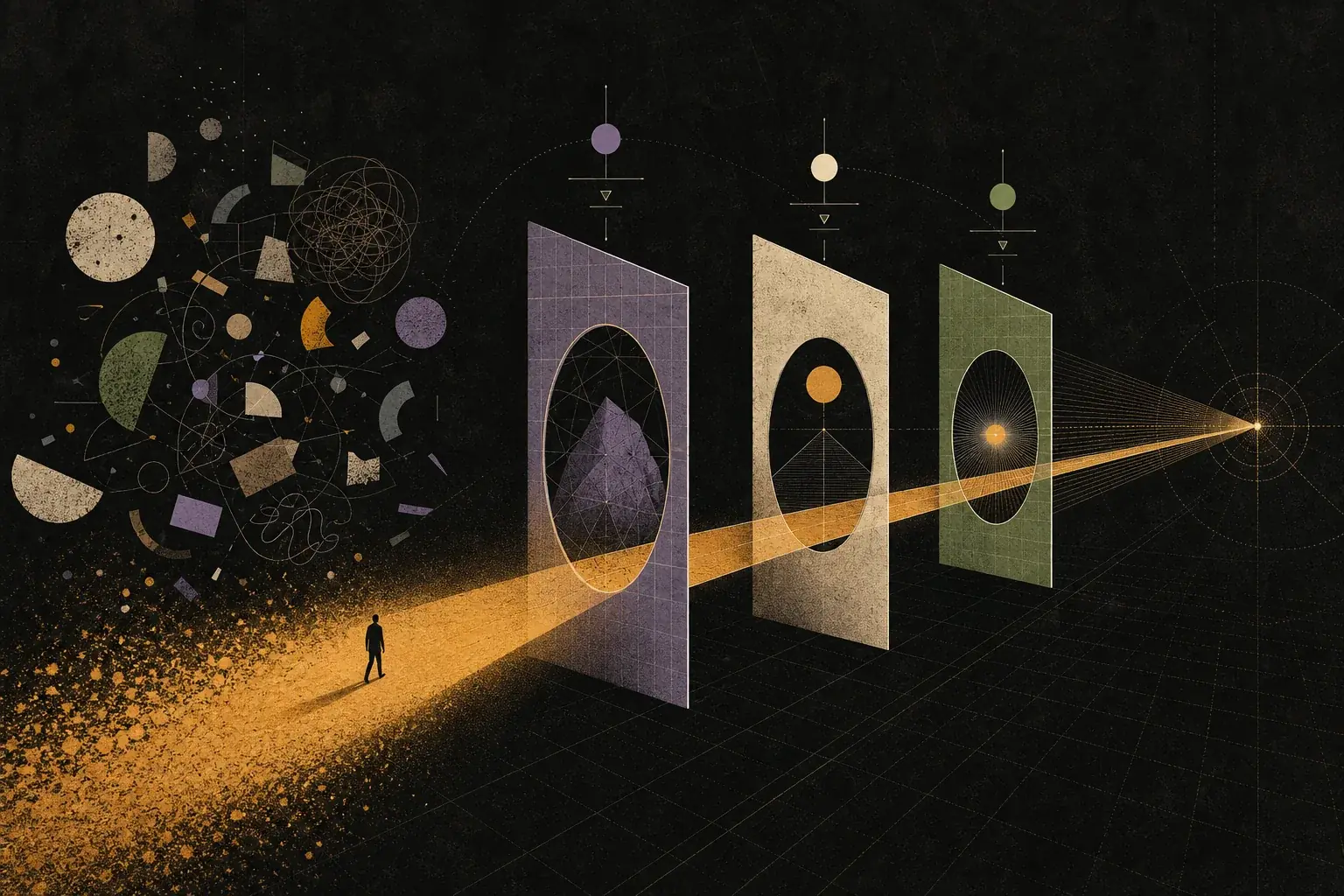
The vocabulary comes from psychologist Mihaly Csikszentmihalyi, who spent decades studying people at their most absorbed — the model is laid out in his book Flow: The Psychology of Optimal Experience and compressed into his 2004 TED talk. Flow, in his account, has three entry conditions. First, a challenge slightly above your current skill. Well below your ability, you get boredom; well above, anxiety. Flow lives in the narrow channel between them, which is partly why it visits experienced people more often than beginners. Second, clear goals: at every moment you know what the next move is. Third, immediate feedback: you can tell whether the last move worked. Chess, surgery, and video games supply all three by default. A vague strategy document supplies none.
The rest of the famous package — time distortion, loss of self-consciousness, effortlessness — are consequences, not levers. You get them by meeting the conditions, not by concentrating on having them. Then there is the problem of staying in. Field research is blunt about what ejects you. Observing knowledge workers, Gloria Mark and colleagues found they averaged about eleven minutes on a project before switching or being interrupted, and when they resumed the same day it took on average over 25 minutes to get back — usually via a detour through two other tasks. In a follow-up experiment, interrupted people compensated by working faster, at the price of more stress, frustration, time pressure, and effort. Even without outside interruptions, switching carries its own tax. Sophie Leroy’s experiments show that moving between tasks leaves “attention residue”: part of your mind keeps processing the previous task, and performance on the current one measurably drops. Residue is worst when the previous task was left unfinished — which describes roughly every task you paused in order to start this one. Finishing under time pressure, counterintuitively, is what Leroy found helps attention let go. So the mechanism is simple and slightly deflating. Entry is a design problem (conditions), staying is a defense problem (interruptions and residue), and neither is a willpower problem. That is good news, because design and defense can be built.
Flow is not only “being focused.” The Flow-Kurz-Skala separates two sensations: fluency (the work feels smooth) and absorption (attention is fully occupied). Worry is the spoiler. You can be absorbed and still perform badly if part of your mind is monitoring the score, the clock, or how you look.
That is why the useful question is not “Do I feel flow yet?” It is “Is my attention on the next move, and can I tell whether it worked?” A clear finish line and fast feedback pull attention back to the task.
This is also where the working environment matters: protect the channel from interruptions, but do not turn a calm room into another performance test. The case for focus soundtracks such as brown noise is thinner than the apps imply.

The system
1. Calibrate the challenge
Match the task to the channel before you blame yourself. When you stall, diagnose first: is this boring or is it scary? The shift: treat boredom and anxiety as calibration data about the task, not verdicts about you. First move: next time you stall, ask “too hard or too easy?” If too hard, split off a smaller step you fully understand. If too easy, add a constraint — a tighter deadline, a higher quality bar, doing it without the template.
2. Give the session a finish line and a scoreboard
Flow needs to know what winning looks like this hour. Most knowledge work has no natural feedback loop, so you build a proxy: an outline with boxes to tick, tests turning green, a word count that moves. The shift: never start a session without a definition of done. First move: before opening the file, write one sentence — “This session is done when X” — where X could be verified by a stranger.
3. Build the container
This is where the interruption numbers above become policy. Sixty to ninety minutes, one task, notifications off, phone in another room, colleagues told when you resurface. Shorter blocks get eaten by the entry cost before any deep stretch begins. The shift: interruptions are an environment setting you configure, not weather that happens to you. First move: book one 90-minute block tomorrow morning and put the phone physically elsewhere — a silenced phone on the desk is still a decision you have to keep re-making.
4. Clear the residue at the border
Leroy’s later work found a cheap fix for residue: a “ready-to-resume” plan. Before switching, spend a minute noting where you stopped on the old task and what its next step is; people who did this performed notably better on the task that followed. The mind releases what it knows is parked. The shift: closing open loops is part of the work, not overhead before the work. First move: keep a “parking lot” note beside you during sessions. Every intruding thought — the email to send, the thing to look up — goes onto paper, not into a new tab.
5. Practice re-entry
You will fall out. That is normal, and what matters is the price of getting back — so have a protocol for each exit direction. Knocked out and frazzled (overstimulated): do not reach for the phone; it pushes stimulation further up. Note where you were, stand, take five minutes of walking or slow breathing, then restart from the easiest concrete action on your parking-lot note. Drifted out flat (understimulated): raise the stakes instead. Move your body for two minutes, then make the task harder or the deadline closer — step 1 again, from the other side. The shift: re-entry is a skill you rehearse, not luck you wait for. First move: write your two protocols — one for frazzled, one for flat — on a sticky note where you work.
The research files you supplied sharpen the classic model. In experience-sampling studies, flow appears when both challenge and skill are above your personal average, not when a task is merely easy. Think of it as a moving channel, not a fixed sweet spot: your skill grows, so the task has to grow with it.
Use boredom and anxiety as calibration data. If anxiety rises, reduce the task to one visible step you can complete. If boredom rises, add a constraint: a shorter time box, a higher quality bar, or a new route through the problem. The aim is not comfort. It is a challenge that keeps your attention inside the work.
How do the pieces fit together?
The five moves are one machine. Calibration and a finish line (steps 1-2) satisfy Csikszentmihalyi’s entry conditions. The container and the border ritual (steps 3-4) handle the two documented flow killers, interruption and residue. The re-entry protocol (step 5) accepts that defense sometimes fails and makes failure cheap. Notice what is missing: any technique for producing the feeling itself. That is deliberate. You do not make flow happen any more than a farmer makes crops grow; you prepare conditions and protect them. The parts also compound — fewer interruptions mean less residue, less residue means cheaper re-entry, and repeated sessions teach your attention what the container is for. Underneath all of it sits energy: a tired brain calibrates nothing.
| Entry condition | Target state | You control it by |
|---|---|---|
| Challenge / skill ratio | Slightly above current skill | Right-sizing the task before you start |
| Clear goal | You know the next concrete move | Defining “done” for this session |
| Fast feedback | Progress visible in minutes | Shortening the loop: draft, test, tick |
| Distraction shield | Zero interrupts for the block | Phone away, one tab, door closed |
When will this not work?
When the job is fragmentation. Support rotations, incident response, managing nine people — some roles are interruption by design. Aim for two protected blocks a week, negotiated explicitly, rather than a daily practice you will fail at. When the work is supposed to feel bad. Early-stage learning and first drafts sit outside the flow channel by definition: the challenge exceeds your skill until skill catches up. Demand flow daily and you will quietly drift away from exactly the work that grows you. For that stretch, willpower research is more useful than flow theory. When you start chasing the feeling. Flow is morally neutral, and entire industries know it. Gambling researchers document “dark flow” — absorbed, time-blind play on multiline slot machines, reported most strongly by players with more depressive symptoms. Feeds and games are engineered flow; if you optimize for the sensation, they will always outbid your actual work. When you expect it to guarantee output. Much of the evidence is self-reported and correlational. A 2021 systematic review and meta-analysis found a moderate association between flow and performance but could not establish which causes which — flow may follow good execution rather than produce it. Build sessions for output; treat the state as a bonus. One more line, because this borders on health: if anxiety or flatness follows you across every context for weeks, that is not a focus problem — this is not medical advice, and it is worth talking to a doctor.
The four-phase cycle
Flow is a cycle, not a permanent operating mode. The evidence-informed version has four phases:
- Struggle. You gather information, make mistakes, and feel friction. This is the effort phase, not proof that you are failing.
- Release. Step away briefly: walk, breathe slowly, or switch to a low-demand physical action. Release is a change of state, not a new stream of notifications.
- Flow. Challenge, skill, goal, and feedback line up. Work becomes fluent and self-conscious monitoring quiets down.
- Recovery. Stop before the block turns into depletion. Food, sleep, movement, and a device-free pause consolidate the gains.
Some neuroscience models describe the flow experience as reduced top-down monitoring, sometimes called transient hypofrontality. Treat that as a useful model, not a settled explanation of every brain in every task. The practical conclusion is sturdier: do not spend the state monitoring the state.
A 90-minute flow protocol

Use one repeatable container rather than waiting for a perfect mood. Reserve 90 minutes for one task, then protect 20 minutes for recovery. The first 10–15 minutes may feel like struggle; that is part of the cycle.
- Close unrelated tabs, mute notifications, and put the phone in another room.
- Write one micro-goal: “This session is done when X,” where X can be checked by someone else.
- Rate the challenge from 1 to 10. If it is above 8, shrink the first step. If it is below 4, add a constraint.
- Start with one atomic action and keep a paper parking lot for every intrusive thought.
- When you stop, write the next step before leaving. Then recover without replacing the block with another feed.
Your energy sets the ceiling. Our page on telling tiredness, sleepiness and burnout apart covers the sleep, movement, and arousal basics that make calibration possible. For a deeper look at starting friction, compare this protocol with the site’s willpower research notes.
The boring bottom line
Flow is a real, useful state, but it is not a switch and it is not a reliable measure of good work. You create the odds by matching a slightly demanding task with a visible finish line, fast feedback, and a protected block of attention.
Start by calibrating the challenge: shrink the first step when anxiety rises, add a constraint when boredom rises, and write down the next move before you leave. Protect the block from interruptions, then recover instead of trying to chain one peak session into the next.
The boring test is simple: did the session move the work forward? Flow is a welcome by-product. The system has to keep working on the days the feeling does not arrive.
Sources
- Csikszentmihalyi, M. (1990). Flow: The Psychology of Optimal Experience. Harper & Row. harpercollins.ca
- Csikszentmihalyi, M. (2004). Flow, the secret to happiness. TED. ted.com
- Leroy, S. (2009). Why is it so hard to do my work? The challenge of attention residue when switching between work tasks. Organizational Behavior and Human Decision Processes. doi:10.1016/j.obhdp.2009.04.002
- Sophie Leroy, Theresa M. Glomb, — Organization Science, 2018. doi:10.1287/orsc.2017.1184
- Mark, G.; Gonzalez, V. M.; Harris, J. (2005). No Task Left Behind? Examining the Nature of Fragmented Work. Proceedings of the SIGCHI Conference on Human Factors in Computing Systems. doi:10.1145/1054972.1055017
- Mark, G.; Gudith, D.; Klocke, U. (2008). The Cost of Interrupted Work: More Speed and Stress. Proceedings of the SIGCHI Conference on Human Factors in Computing Systems. doi:10.1145/1357054.1357072
- Mike J. Dixon et al., — Journal of Gambling Studies, 2018. doi:10.1007/s10899-017-9695-1
- David J. Harris et al., — International Review of Sport and Exercise Psychology, 2021. doi:10.1080/1750984X.2021.1929402