TL;DR
- «The Willpower Instinct» sells one mechanism: self-control is a single physiological reserve that drains with use and is refilled by glucose. Twenty-three labs, then thirty-six labs, could not find the draining.
- The 2016 multilab replication got d = 0.04, 95% CI [-0.07, 0.15], N = 2,141. The 2021 follow-up, using a paradigm chosen by depletion proponents, got a confirmatory d = 0.06 across 36 labs and N = 3,531.
- The sugar prescription is worse off than the core claim: a carbohydrate rinse that is spat out works as well as a swallowed drink, which is not how fuel behaves.
- The «it’s all in your mindset» escape hatch, which the book leans on hard, failed its own preregistered replication at three times the original sample.
- The exercises (noticing the moment of choice, the ten-minute pause, dropping the self-attack after a lapse, precommitting) do not need the resource model to be worth doing. They also have not been tested as a package.
Verdict
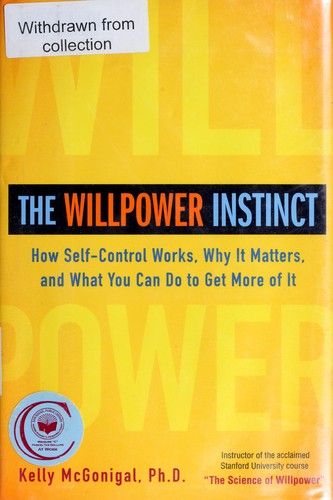
Read our notes instead. This is a rare shape for a book. The exercises in «The Willpower Instinct» are among the best in the self-help genre: concrete, weekly, testable against your own behaviour, and largely free of the guru posture. The theory used to justify them is dead. Kelly McGonigal built the book from her Stanford «Science of Willpower» course in 2011, when the strength model of self-control was the most quoted finding in social psychology and there was no public reason to doubt it. Fifteen years later the mechanism has been through the largest coordinated replication effort psychology has run on any single effect, and it did not come out the other side.
Separate the two layers and the book remains a usable ten-week workbook. Keep them fused and you spend ten weeks rehearsing a physiological story about your own brain that thousands of participants across dozens of laboratories failed to produce.
The claim on trial
The claim is specific enough to test, which is to its credit. Self-control draws on one limited resource shared across unrelated domains. Resisting cookies, suppressing an emotion, and forcing yourself through a boring proofreading task all withdraw from the same account. Spend on task A and you measurably have less for task B, even when B has nothing to do with A. Because the resource is metabolic, and specifically because it runs on blood glucose, a sugary drink restores it. The muscle analogy follows: willpower fatigues in the short run and strengthens with training in the long run.
That architecture comes from Baumeister et al., Journal of Personality and Social Psychology, 1998, the paper that established the sequential-task paradigm — do one self-control task, then measure persistence on a second, unrelated one. By the time McGonigal was teaching the course, Hagger et al., Psychological Bulletin, 2010 had pooled 198 experiments and reported a medium effect, d around 0.6. That number is the load-bearing beam of the book. Almost every chapter’s framing (the willpower muscle, the daily budget, the glucose top-up, the training regimen) rests on it.
McGonigal did not misreport the science available to her. She reported the consensus accurately. The consensus was wrong.
What did not survive
The first crack was statistical rather than empirical. Carter and McCullough, Frontiers in Psychology, 2014 applied bias-detection methods to the same literature the 2010 meta-analysis had summarised and found it severely distorted by publication bias — the pattern you get when null results stay in file drawers. Their conclusion was that the pooled effect had been substantially overestimated. The following year, Carter et al., Journal of Experimental Psychology: General, 2015 ran a series of bias-corrected meta-analytic tests and reported very little evidence that the depletion effect exists at all.
Then came the direct tests. Hagger et al., Perspectives on Psychological Science, 2016 (the same lead author as the 2010 meta-analysis, which matters) coordinated 23 laboratories on a single preregistered protocol with N = 2,141. The result was d = 0.04, 95% CI [-0.07, 0.15]. An interval that straddles zero and excludes anything you could notice in a life.
Depletion researchers objected that the chosen task was a poor operationalisation. So the next attempt handed paradigm selection to the proponents. Vohs et al., Psychological Science, 2021 ran 36 laboratories, N = 3,531, on a paradigm picked by people who believed in the effect. Confirmatory d = 0.06, nonsignificant, with the data roughly four times more likely under the null hypothesis than under the depletion hypothesis. The same paper tested the two most popular rescue variables (willpower beliefs and trait self-control) and found no moderation by either.
Meta-analysis run by a depletion-sympathetic author lands in the same neighbourhood. Dang, Psychological Research, 2018 reported g = 0.38 uncorrected, falling to 0.24 after trim-and-fill, and stated plainly that this is not adequate to draw a strong conclusion that the effect exists.
For fairness: the original authors have not conceded. Baumeister et al., Current Opinion in Psychology, 2024 argue that replicability is well established and that the theory has been refined from exhaustion toward conservation — the mind husbands its capacity rather than running out of it. Read that piece for what it is: a narrative review written by the theory’s own proponents, not a new preregistered test. It is an argument about interpretation, offered by the side with the most invested. It does not produce the missing effect, and «conservation» is a considerably softer claim than the one the book is built on.
The fixes that also failed
Two patches were supposed to save the model. Both failed, and the second failure is badly under-reported.
The glucose fix. The book’s most quotable prescription is that low blood sugar undermines self-control and that a sugary drink restores it. The metabolic premise was already shaky when the book appeared: Kurzban, Evolutionary Psychology, 2010 pointed out that the brain’s energy consumption does not meaningfully rise during self-control tasks. The brain is a roughly constant-draw organ; effortful control is not a measurable additional metabolic expense. Then Molden et al., Psychological Science, 2012 ran the decisive test: participants rinsed their mouths with a carbohydrate solution and spat it out, never swallowing it. Performance recovered. Nothing entered the bloodstream. Whatever happened there was a reward or motivation signal detected in the mouth, not fuel delivered to neurons. And when researchers tested the swallowed version directly, Lange and Eggert, Appetite, 2014 found glucose drinks failed to counteract depletion. Their title, «Sweet delusion», is not subtle.
The mindset fix. This is the one worth dwelling on, because it is Dweck-lineage, it is still repeated in talks and articles, and McGonigal presents it as the escape hatch — if you believe willpower is unlimited, you are not depleted by using it. The source is Job, Dweck and Walton, Psychological Science, 2010, a small and elegant study reporting that depletion appeared only in people who held a limited-resource theory of willpower. It is a satisfying twist: the theory is true for you only if you believe it.
The preregistered replication does not support it. Carruth, Ramos and Miyake, PLOS ONE, 2023 ran N = 187 against the original’s N = 60 and found neither a significant main effect of depletion nor moderation by willpower mindset. Combine that with the 2021 multisite finding that willpower beliefs did not moderate anything either, and the escape hatch is closed from both sides. This matters more than the glucose story because the mindset claim is the one that survives in the popular retelling. People who know depletion failed still say «but it depends on your beliefs about willpower». That specific rescue has been tested and did not hold.
What survived
The practices. And they survive precisely because they never depended on the mechanism.
Noticing the exact moment a choice occurs (the point at which you reach for the phone, open the tab, say yes to the meeting) is an attention exercise. Its value does not require a reserve to be draining. The ten-minute pause before giving in to a want, or before abandoning a task, restructures the decision without any claim about metabolism. Treating a lapse as information rather than an occasion for self-attack is a framing move; it is also the single most useful chapter in the book for anyone who has ever abandoned a plan on day four because day three went badly. Precommitment (arranging your environment now so that the later choice is narrower) works by removing the decision, not by conserving fuel for it. Tracking one behaviour for a week before changing it is plain measurement.
Be honest about the epistemic status here: this bundle has not been tested as a package. There is no trial of «the ten-week Willpower Instinct programme» with an outcome measure and a control group. What can be said is narrower and still worth something — these exercises make no claim that the replication record has falsified, they are cheap, they are reversible, and they fail visibly if they do not work for you. That is a different category from «validated». Treat the book as a structured set of experiments on yourself rather than as an application of established mechanism, and it holds up better than most of what we cover in our self-help shelf.
One more thing survives, unintentionally: the book is a clean case study in how a field’s flagship finding can be simultaneously well-taught, well-written, honestly reported, and false.
Who should read it
Read the full book if you want a ten-week structure with weekly assignments and you are willing to mentally strike out every physiological explanation as you go. Some people need the scaffolding of a course, and this is a well-built course.
Skip it if you are the kind of reader who absorbs the explanation along with the exercise. The book’s mechanism is stated with confidence and repeated in every chapter; it is hard to extract the practice without importing the theory. If you catch yourself explaining your afternoon to yourself in terms of a depleted reserve, the book has cost you accuracy.
Do not read it for the sugar advice at all. Eating in response to the belief that self-control burns glucose is the one recommendation here that can make things actively worse.
Coaches, managers and anyone who repeats the willpower-muscle metaphor professionally should read the 2016 and 2021 multilab papers instead of the book. Those two papers take an hour and will change what you tell people.
The same dead mechanism holds up a management book: «Your Brain at Work» runs on the identical limited-fuel model. For the self-control problem most people have, «The Now Habit» is the better diagnosis.
One thing to try
Use the ten-minute rule, in the direction the book gets right. When you want something you have decided you do not want (the scroll, the snack, the purchase) set a ten-minute delay and hold the thing you want physically visible during the wait. When you do not want something you have decided you do want (the run, the draft, the call) commit to ten minutes of it with explicit permission to stop at the end.
The point is not that ten minutes recharges anything. It is that the delay converts an automatic action into a decision you observe yourself making, and that most abandoned tasks are abandoned at minute zero rather than minute eleven. Run it for two weeks and count. If your count does not move, drop it. That is the correct relationship to have with every claim in this book.
Get the book
Find «The Willpower Instinct» on Amazon — as an Amazon Associate, The Boring Work earns from qualifying purchases (disclosure).
The glucose half of the prescription has its own audit, because it failed for a separate and more interesting reason: does eating sugar restore your willpower. A psychiatrist’s version of the same territory, built on a balance of pleasure and pain, is «Dopamine Nation».
The boring bottom line
«The Willpower Instinct» is a good workbook wrapped around a failed theory. The theory failed in the most decisive way available to psychology: preregistered, coordinated, adversarially designed, at 23 labs and then 36, with the second attempt using a paradigm the believers picked themselves. Effects of 0.04 and 0.06 are not weak versions of the original claim; they are the absence of it. The glucose prescription failed separately and for an independent reason — a rinse you spit out works, which rules out fuel. The mindset rescue failed in its own preregistered replication. The theory’s authors still defend it, in a review they wrote, without new data of the required kind.
None of that touches the ten-minute pause, the moment of choice, the lapse without self-attack, or precommitment. Those were never resource-model predictions; they were behavioural suggestions that happened to be printed next to one. Take the suggestions, test them on your own count, and leave the mechanism where the replication record left it.
Sources
- the founding paper: sequential-task paradigm and the limited-resource claim. Journal of Personality and Social Psychology. doi:10.1037/0022-3514.74.5.1252
- meta-analysis, d about 0.6, the number the book was written from. Psychological Bulletin. doi:10.1037/a0019486
- brain glucose consumption does not meaningfully rise during self-control tasks. Evolutionary Psychology. doi:10.1177/147470491000800208
- the original willpower-mindset moderation finding. Psychological Science. doi:10.1177/0956797610384745
- carbohydrate mouth rinse, never swallowed, restores self-control. Psychological Science. doi:10.1177/0956797612439069
- glucose drinks fail to counteract depletion. Appetite. doi:10.1016/j.appet.2013.12.020
- severe publication bias; the meta-analytic effect was overestimated. Frontiers in Psychology. doi:10.3389/fpsyg.2014.00823
- after bias correction, very little evidence the effect is real. Journal of Experimental Psychology: General. doi:10.1037/xge0000083
- 23 labs, N = 2,141, d = 0.04, 95% CI [-0.07, 0.15]. Perspectives on Psychological Science. doi:10.1177/1745691616652873
- g = 0.38 uncorrected, 0.24 after trim-and-fill; not adequate for a strong conclusion. Psychological Research. doi:10.1007/s00426-017-0862-x
- 36 labs, N = 3,531, confirmatory d = 0.06, data about four times more likely under the null, no moderation by willpower beliefs or trait self-control. Psychological Science. doi:10.1177/0956797621989733
- preregistered replication, N = 187 vs original N = 60: no depletion main effect, no mindset moderation. PLOS ONE. doi:10.1371/journal.pone.0287911
- narrative review by the theory's own proponents defending replicability and reframing toward conservation. Current Opinion in Psychology. doi:10.1016/j.copsyc.2024.101882