TL;DR
- Covey’s thesis is that every person has an inner «voice» (the overlap of talent, passion, need and conscience) and that organizations underperform because people cannot express it. The soft version of that claim is well supported. The book’s own evidence for it is not.
- The famous numbers come from FranklinCovey’s own xQ survey. The book describes «a poll of 23,000 U.S. residents employed full time». FranklinCovey’s own press releases describe two separate waves: 11,045 workers in autumn 2002 and 12,182 in November 2003. Those sum to 23,227.
- Searched PubMed, Crossref and OpenAlex on 10 August 2026 for the xQ instrument: no published items, no reliability coefficients, no factor structure, no peer review. Untested is not the same as refuted — but the company selling the cure ran the survey that diagnosed the disease.
- The serious version of Covey’s idea already exists and has numbers: self-determination theory, a meaningful-work meta-analysis of 44 samples and 23,144 people, and a leader-autonomy-support meta-analysis of 83 samples and 32,870 people.
- Interventions closest to «find your voice» (job crafting, work engagement programmes) work, weakly. Pooled effects of g = 0.26 and g = 0.29. Covey’s own programme has never been through a controlled trial.
Verdict
Skip it. Confidence: high.
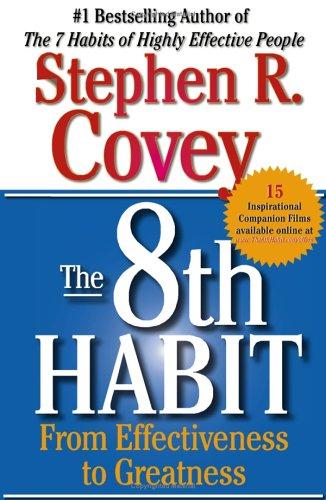
«The 8th Habit» has one idea, and the idea is defensible: people work better when the work engages what they are good at and care about. Covey did not invent that idea and does not test it. He asserts it across roughly 400 pages, decorates it with a proprietary vocabulary (voice, four intelligences, spiritual intelligence, the Whole-Person Paradigm) and backs it with a survey his own company commissioned and never published.
Everything true in the book is available in better condition elsewhere, with sample sizes attached. Everything unique to the book is unverifiable. That combination is what «skip it» means on this site.
The claim on trial
Stated so it can fail: people possess an innate «voice» at the intersection of talent, passion, conscience and need; organizations underperform primarily because they suppress it; and the scale of that suppression is measurable — most employees do not understand or care about what their organization is trying to do.
Covey puts a number on the last part. In the book he reports that «only 37 percent said they have a clear understanding of what their organization is trying to achieve», that «only 1 in 5 was enthusiastic about their team’s and organization’s goals», and that «only 15 percent felt that their organization fully enables them to execute key goals». Then the image everyone remembers:
«If, say, a soccer team had these same scores, only four of the eleven players on the field would know which goal is theirs. Only two of the eleven would care. Only two of the eleven would know what position they play and know exactly what they are supposed to do. And all but two players would, in some way, be competing against their own team members rather than the opponent.»
It is a good image. Whether the scores behind it are real is another matter.
What the xQ survey is
The xQ — «execution quotient» — was a questionnaire commissioned by FranklinCovey and fielded by Harris Interactive. FranklinCovey then sold xQ as a diagnostic product. The vendor measured the problem its own product was built to fix. That is not automatically fatal, but it raises the bar for publishing the instrument, and the instrument was never published.
Three things do not reconcile. A note on sourcing first. The wave details below come from FranklinCovey’s own investor-relations announcements of the xQ results, which I read while researching this piece. Those pages stopped resolving before publication and I could not reach a stable archived copy to re-check them, so I am not linking them. The book’s own figure is in the book and anyone can check it; the announcement wording is reported here at one remove.
The sample. The book presents a single poll of 23,000 U.S. residents employed full time. FranklinCovey announced its xQ waves separately, and the two announced wave sizes were 11,045 workers in autumn 2002 and 12,182 in November 2003. Those sum to 23,227. The book’s «23,000» is not a third study anyone has produced; it matches the arithmetic of two separately announced waves, presented as one poll.
The questions move under the numbers. The 2003 announcement attached its 37 per cent to whether workers understood the reason for their organization’s strategic direction; the book renders the same 37 per cent as a clear understanding of «what their organization is trying to achieve». The 2003 announcement attached 15 per cent to workers who could identify their organization’s top three goals; in the book, 15 per cent is the share who «felt that their organization fully enables them to execute key goals». Same figures, different questions.
The precision claim outruns the design. The 2003 announcement reported results accurate to within one percentage point at 95 per cent confidence. A margin of error is a property of probability sampling. An opt-in online panel of self-selected workers does not license one, at any sample size.
As for validation: on 10 August 2026 I searched PubMed for the exact phrase «execution quotient» (0 records) and for «FranklinCovey» (0 records), searched Crossref by title and by full bibliographic query, and searched OpenAlex. There is no peer-reviewed paper reporting xQ’s items, its internal consistency, its factor structure, or its relationship to any behavioural outcome. Nor is there a controlled evaluation of Covey’s training programmes: PubMed returns ten records mentioning Covey’s habits, all commentary, review or interview, none a trial.
Untested is not refuted. The xQ figures may well be roughly right about American workplaces in 2003. But a number you cannot audit is not evidence, and this book rests most of its diagnosis on numbers nobody outside FranklinCovey has ever been able to check.
What the engagement literature shows
Compare the standard of proof next door. Gallup’s Q12 sits on Harter, Schmidt and Hayes, Journal of Applied Psychology, 2002: 7,939 business units, 36 companies, 198,514 respondents, with the items printed and the true-score correlations reported — .33 with customer loyalty, .25 with productivity, .17 with profitability, −.30 with turnover, −.32 with safety incidents, and .38 with a composite performance measure. The same group later addressed direction of causality in Harter et al., Perspectives on Psychological Science, 2010, finding employee perceptions predict later financial outcomes more strongly than the reverse, though the relationship runs both ways.
That is what a published instrument looks like: you can read the questions, replicate the analysis and attack the result. And people have. Macey and Schneider, Industrial and Organizational Psychology, 2008 showed «engagement» had been used to mean at least four different things. Cole, Walter, Bedeian and O’Boyle, Journal of Management, 2012 pooled 50 samples from 37 studies and found engagement and burnout largely redundant: controlling for burnout substantially shrank engagement’s apparent effects. Christian, Garza and Slaughter, Personnel Psychology, 2011 came out the other way.
An unresolved argument with numbers on both sides beats an unpublished questionnaire with none. Covey’s diagnosis was directionally consistent with this literature. His evidence was in a different category from it.
The serious version: Deci and Ryan
Where the book is right, it is right because it is gesturing at self-determination theory without saying so. Ryan and Deci, American Psychologist, 2000 set out three basic needs (autonomy, competence, relatedness) whose satisfaction predicts internalized motivation and wellbeing. Van den Broeck and colleagues, Journal of Management, 2016 reviewed the workplace evidence for those needs, and Deci, Olafsen and Ryan, Annual Review of Organizational Psychology, 2017 summarised the state of the field. The single most Covey-adjacent finding is Slemp et al., Motivation and Emotion, 2018: 754 correlations, 72 studies, 83 samples, N = 32,870, showing that leader autonomy support tracks autonomous motivation, need satisfaction and wellbeing, and is unrelated to controlled motivation.
Meaning is the other half. Allan, Batz-Barbarich, Sterling and Tay, Journal of Management Studies, 2019 pooled 44 articles, N = 23,144: meaningful work correlates .74 with work engagement (k = 18), .75 with commitment (k = 11), .74 with job satisfaction (k = 11), and .47 with life satisfaction (k = 5). These are cross-sectional correlations, not causal effects, and part of that .74 is measures overlapping — though meaningful work did not collapse into engagement or satisfaction when modelled as one factor.
Note also what the serious literature does that Covey does not: publish the items. Steger, Dik and Duffy, Journal of Career Assessment, 2012 built the Work and Meaning Inventory in the open — items, factor structure, validity evidence, free to use. That is the direct contrast with xQ.
And the literature is honest about the cost. Bunderson and Thompson, Administrative Science Quarterly, 2009, studying 982 zookeepers, found a calling to be double-edged: it produced meaning and duty, and also willingness to accept poor pay and personal sacrifice. Duffy and Dik, Journal of Vocational Behavior, 2013 made the same point reviewing the calling literature. Covey’s book has no equivalent chapter on what happens when an employer learns that you would do this work anyway.
Trial evidence for finding your voice
Two intervention families come closest. Job crafting (reshaping your own role toward strengths and interests) is the operational version of finding your voice inside an existing job. Oprea et al., European Journal of Work and Organizational Psychology, 2019 meta-analysed 14 eligible studies: g = 0.26 on job crafting behaviour, 0.31 on work engagement, 0.39 on contextual performance, and effects on performance fully mediated by engagement. Work engagement interventions generally fare the same: Knight, Patterson and Dawson, Journal of Organizational Behavior, 2017 found 20 controlled studies and a pooled effect of g = 0.29 (95% CI 0.12–0.46), with high heterogeneity.
Meaning interventions outside work show the same shape once you control properly. Manco and Hamby, American Journal of Health Promotion, 2021 pooled 33 randomised trials: SMD = 0.85 against passive controls, but only 0.32 (95% CI 0.09–0.55) against active controls. Most of the apparent benefit of thinking hard about purpose is the benefit of doing anything structured.
So: small, real, and nowhere near the scale Covey implies. Nothing in this evidence base tests his framework. It tests the nearest measurable relatives.
The method problem
The critique is durable and it predates this book. Jackson, Journal of Management Studies, 1999 — «The Goose that Laid the Golden Egg?» — analysed Covey’s effectiveness movement as rhetoric rather than research, identifying the fantasy themes that carry the appeal and locating them in existential and spiritual needs rather than in evidence. McCabe, Management Learning, 2011 then studied a Covey-derived programme in a UK bank and found the ideas neither translated cleanly into practice nor survived contact with employees’ own interpretations.
«The 8th Habit» also imports «spiritual intelligence» as one of four intelligences. That construct was examined and rejected on its merits by Gardner, International Journal for the Psychology of Religion, 2000 — the person who invented multiple intelligences declining to admit this one, because the phenomena it covers do not behave like an intelligence.
The pattern is consistent: assertion framed as principle, anecdote framed as demonstration, proprietary vocabulary in place of a construct, and no reference list a reader can pull on.
Who should read it
Two groups. People who already run FranklinCovey programmes and need the source text. And people studying management gurus as a phenomenon, for whom this book is an unusually clean specimen — read alongside Jackson 1999 and McCabe 2011, it is instructive.
Managers who want the working content should read Deci, Olafsen and Ryan 2017 first, then Oprea et al. 2019 for what an implementation with a measured effect size looks like. Both are shorter than the book and both say where they are uncertain. Our other self-help books, reviewed honestly apply the same test.
Two books make claims about management that can be checked: «Managing» by observation, and «Matsushita’s Principles of Success» by a randomized trial.
One thing to try
Run a job-crafting conversation, in the form that was tested. With one person you manage, for one hour: list the tasks in their job, mark which two they would take more of and which two they would trade away, then change one task in each direction for one quarter and write down the swap. Oprea et al. found that plans combining organizational and personal objectives were the ones that moved engagement.
Expect g ≈ 0.3. That is a modest, real shift, not a change of character. Do it four times a year rather than once, dramatically.
Get the book
Find «The 8th Habit» on Amazon — as an Amazon Associate, The Boring Work earns from qualifying purchases (disclosure).
The boring bottom line
Covey’s central claim survives in its weak form: autonomy, competence and meaningful work predict engagement and performance, and there are tens of thousands of workers behind that statement. His strong form — that an innate «voice» is the primary thing organizations suppress, that suppression is the primary cause of underperformance, and that 400 pages of vocabulary are the remedy — has never been tested, by him or by anyone.
The evidence he offered for it is a survey his own company commissioned, whose sample size in the book equals the sum of two separately announced waves, whose headline percentages migrate between questions, and whose questionnaire has never appeared in a peer-reviewed journal. Twenty-two years on, that has not changed.
Sources
- Harter, Schmidt and Hayes, Journal of Applied Psychology, 2002
- Harter, Schmidt, Asplund, Killham and Agrawal, Perspectives on Psychological Science, 2010
- Macey and Schneider, Industrial and Organizational Psychology, 2008
- Cole, Walter, Bedeian and O’Boyle, Journal of Management, 2012
- Christian, Garza and Slaughter, Personnel Psychology, 2011
- Ryan and Deci, American Psychologist, 2000
- Van den Broeck, Ferris, Chang and Rosen, Journal of Management, 2016
- Deci, Olafsen and Ryan, Annual Review of Organizational Psychology and Organizational Behavior, 2017
- Slemp, Kern, Patrick and Ryan, Motivation and Emotion, 2018
- Allan, Batz-Barbarich, Sterling and Tay, Journal of Management Studies, 2019
- Steger, Dik and Duffy, Journal of Career Assessment, 2012
- Bunderson and Thompson, Administrative Science Quarterly, 2009
- Duffy and Dik, Journal of Vocational Behavior, 2013
- Oprea, Barzin, Vîrgă, Iliescu and Rusu, European Journal of Work and Organizational Psychology, 2019
- Knight, Patterson and Dawson, Journal of Organizational Behavior, 2017
- Manco and Hamby, American Journal of Health Promotion, 2021
- Jackson, Journal of Management Studies, 1999
- McCabe, Management Learning, 2011
- Gardner, International Journal for the Psychology of Religion, 2000