TL;DR
- Maxwell’s thesis is that «connecting» is a separate, learnable skill from communicating, and that it is what turns talk into influence. Half of that survives testing. The behaviours are trainable. The promised payoff is not the one you get.
- The book is one of the popular carriers of the Mehrabian myth — words 7 per cent, tone 38 per cent, what people see 55 per cent. Those numbers come from two 1967 experiments in which 30 and 17 judges rated single spoken words and black-and-white photographs of three women’s faces (Mehrabian and Wiener, Journal of Personality and Social Psychology, 1967; Mehrabian and Ferris, Journal of Consulting Psychology, 1967).
- Mehrabian himself published a disclaimer: unless a communicator is talking about their feelings or attitudes, «these equations are not applicable».
- The sharpest test of «connect first, then influence» ran in 2025 and went against the book. In a preregistered field experiment with 1,485 US participants, high-quality nonjudgmental listening improved how the persuader was seen and increased message processing — and did not increase persuasion at all (Santoro et al., PNAS, 2025).
- Where the book is right, it is right about the small stuff: perceived listening tracks work outcomes at r̄ = .39 across 664 effect sizes and 400,020 observations, with 75 per cent of that literature self-reported (Kluger et al., Journal of Business and Psychology, 2023).
Verdict
Skip it. Confidence: high on the factual errors, moderate on the advice. «Everyone Communicates, Few Connect» has a defensible core idea, a set of practices that are mostly harmless and sometimes useful, and at least two numerical claims that are not true. One of them (the 55/38/7 split) is the single most-repeated false statistic in the communication-skills genre, and this book helped keep it in circulation for a corporate audience.
That combination is what earns the tag. The usable content fits on an index card and is below. The rest is seminar anecdote wrapped around figures that fall apart the moment you read the papers they came from. Our other reviewed titles apply the same triage.
The claim on trial
Maxwell defines his term precisely enough to test. In the wording reproduced by a graduate course summary of the book, «connecting is the ability to identify with people and relate to them in a way that increases your influence». Three claims follow. Connecting is distinct from communicating. It is learnable rather than innate. And it is the main lever on influence and career outcomes, produced by the specific practices he lists: find common ground, keep it simple, create an enjoyable experience, inspire, live what you say.
Each of those is checkable. Is there a measured construct behind «connection»? Does training move it? And when it moves, does influence follow? The book tests none of this. Its evidence is conference halls, golf games, pastors and executives — narrative that persuades in exactly the way that bypasses verification. That is not a rhetorical complaint. It is the reason the two hard numbers in the book went unchecked.
The 55-38-7 problem
Maxwell’s chapter on connecting beyond words carries the standard version of the ratio. A chapter-by-chapter summary of the book records the wording as «what we say accounts for only 7 percent of what is communicated; the way we say it accounts for 38 percent; what others see accounts for 55 percent», and the course summary above attributes the figures in the book to «a study conducted with UCLA psychologist Albert Mehrabian». We could not obtain the printed page directly, so treat the exact typography as unconfirmed; the substance of the claim in this book is corroborated by two independent summaries that read it.
Here is what those figures rest on. In the first study, 30 participants split into three groups of 10 listened to two women reading nine single words — «dear», «thanks», «honey», «maybe», «oh», «really», «brute», «don’t», «terrible» — each spoken in a positive, neutral or negative tone, and rated the speaker’s attitude (Mehrabian and Wiener, 1967). In the second, 17 female judges heard three women say the single word «maybe» in three tones and viewed photographs of three female models’ faces (Mehrabian and Ferris, 1967). Tone beat word in the first. Face beat tone in the second. The word channel was not even present in the second study.
The 7/38/55 weights come from stitching those two experiments together into one weighted sum. A review of the ratio’s history puts it plainly: the coefficients were «arbitrary without being supported by a study», and the design was artificial, the judges knew they were in an experiment, and the amount of speech involved was one word at a time (Amsel, European Polygraph, 2019). Mehrabian has said the same thing himself for decades, in writing, on his own publisher page: the equations were derived from experiments on communications of feelings and attitudes, and «unless a communicator is talking about their feelings or attitudes, these equations are not applicable».
None of this means nonverbal behaviour is irrelevant. It means the number is invented. When you measure what visible behaviour adds to understanding, you get a moderate effect, not a controlling one: across 83 independent samples, gesture accompanying speech improved comprehension with a mean unbiased effect size of .61, and only 68 per cent of samples reached significance (Dargue et al., Psychological Bulletin, 2019). Rapport does have real nonverbal correlates — mutual attention, positivity, coordination (Tickle-Degnen and Rosenthal, Psychological Inquiry, 1990). Real, measurable, and nowhere near 93 per cent of the message.
Connection does not automatically become influence
This is the load-bearing claim, and it now has a direct test. Trained professional canvassers held roughly ten-minute video conversations with 1,485 US participants about unauthorised immigration. Two things were randomised independently: whether the canvasser shared a persuasive narrative about an undocumented immigrant, and whether the canvasser practised high-quality nonjudgmental listening. Outcomes were measured immediately and again five weeks later (Santoro et al., PNAS, 2025).
The listening manipulation worked as a manipulation. Participants saw the canvasser more favourably and processed the message more. The narrative produced durable reductions in prejudice and shifts in policy attitudes. But listening added nothing to persuasion. Sharing the story was exactly as effective without it. The mechanism Maxwell describes (build connection, and influence follows) did not appear, in a well-powered preregistered design on the kind of hard disagreement where it should matter most.
That is one experiment on one topic, and it does not show listening is useless. It shows that the causal arrow the book asserts is not automatic, and that content still does the persuading. Read alongside the meta-analytic picture, the shape becomes clear: perceived listening is strongly tied to relationship quality (r̄ = .51) and less so to performance (r̄ = .36), which is what you would expect if it buys goodwill rather than agreement (Kluger et al., 2023).
What is trainable
Maxwell’s most useful line is that connecting is a skill, not a gift. On that he has support he never cites. Two experiments trained the specific tactics associated with charismatic leadership. In a field experiment, 34 middle-level managers were randomly assigned to training or control and reassessed three months later by coworkers (343 raters at Time 1, 321 at Time 2). In a within-subjects laboratory study, 41 MBA participants gave a filmed four-minute speech, were trained, and redelivered the same speech six weeks later to 135 independent assessors. Mean effect of training on rated charisma was D = .62 (Antonakis et al., Academy of Management Learning and Education, 2011).
Note the composition of what was trained: nine verbal tactics (metaphors, stories, contrasts, three-part lists, rhetorical questions, moral conviction, expressing the sentiment of the group, ambitious goals, confidence they can be met) and three nonverbal ones: voice, facial expression, gesture. Three to nine, in favour of words. That ratio is the practical answer to 55/38/7.
Listening training also moves things. In two quasi-field experiments, employees assigned to group listening training reported higher relatedness to colleagues, lower burnout and lower turnover intentions, both immediately and three weeks later (Itzchakov et al., Human Resource Management, 2022). And four experiments manipulating listening quality (one video vignette, three live interactions) found that high-quality listening reduced speakers’ attitude extremity during disagreements, through feeling socially connected and reflecting less defensively (Itzchakov et al., Journal of Personality and Social Psychology, 2024).
Two of the book’s other practices also check out. Perceived similarity — Maxwell’s «common ground» — predicts attraction in no-interaction, short-interaction and existing relationships, while actual similarity stops predicting once a relationship exists, across 460 effect sizes from 313 investigations (Montoya et al., Journal of Social and Personal Relationships, 2008). Source credibility, his «live what you communicate», raises persuasion across most conditions, with expertise and trustworthiness carrying it (Pornpitakpan, Journal of Applied Social Psychology, 2004). And his instinct to argue by story is well founded — narrative transportation predicts belief and intention change (van Laer et al., Journal of Consumer Research, 2014), which is also why his own method should make you cautious.
One practice is oversold. «Create an experience everyone enjoys» leans on humour. A meta-analysis of humour in advertising found it improves attention and liking but does not reliably improve persuasion or recall of the point (Eisend, Journal of the Academy of Marketing Science, 2009).
The sourcing problem
The Mehrabian figure is not an isolated slip. Maxwell’s own organisation publishes a post «adapted from Dr. John Maxwell’s communication resource, Everyone Communicates, Few Connect» that states, attributed to Sonya Hamlin: «As a species, we remember 85 to 90 percent of what we see, but less than 15 percent of what we hear.» Third-party summaries of the book record the same statistic. It belongs to the family of learning-retention percentages that has been traced back and refuted — the numbers were never produced by any study and were retrofitted onto Edgar Dale’s cone of experience decades after he drew it (Stice, ASEE Annual Conference Proceedings, 2009).
Two invented percentages in one book, both flattering the same thesis, both uncited. That is the pattern to hold on to.
There is a deeper measurement problem underneath. «Connection» in the book is a feeling, and feelings are measurable — but nobody has validated a «connection» construct of the kind Maxwell describes, and the nearest well-built ones belong to other literatures. Perceived partner responsiveness (believing someone cares for, appreciates and understands you) predicted increases in eudaimonic well-being a decade later in more than 2,000 married adults (Selcuk et al., Journal of Marriage and Family, 2016). Interpersonal chemistry has only recently been given a formal model at all (Reis et al., Perspectives on Psychological Science, 2021). The adjacent concept the business world studied, charisma, was described after fifty years of work as «ill-defined and ill-measured», confounded with transformational leadership and dependent on questionnaires (Antonakis et al., Annual Review of Organizational Psychology and Organizational Behavior, 2016).
The career claim fares no better. Searching Crossref and PubMed on 10 August 2026, we found no study testing «connecting», as Maxwell defines it, as a determinant of career success. The closest meta-analysis sorted predictors into human capital, organisational sponsorship, sociodemographic status and stable individual differences, and found human capital and sociodemographic variables more strongly related to salary and promotion, with the relationship-flavoured predictors tracking career satisfaction instead (Ng et al., Personnel Psychology, 2005). Untested is not refuted. But a book that asserts a career mechanism owes you at least one number that survives being looked up.
A last piece of context Maxwell’s framing gets backwards. «Few connect» implies most people are failing at this. In lab conversations, among first-year students meeting dorm mates, and among strangers at a workshop, people systematically underestimated how much their partners liked them, an effect that persisted for months (Boothby et al., Psychological Science, 2018). The average reader is likely connecting better than they think.
Who should read it
Read the full book if you present or teach for a living, you respond to warm storytelling, and you want encouragement more than instruction. It is pleasant and it will not hurt you, provided you strike the percentages out in pen as you go.
Skip it if you have read Carnegie, if you want the practices without the padding, or if you are going to repeat its statistics in a slide deck. That last group is the reason this page exists. The 55/38/7 line has been quoted at millions of employees by trainers who read it in a book like this one, and it is false.
The 1936 book this one descends from is «How to Win Friends and Influence People», and «Just Listen» makes the same neural claims with the same sourcing.
One thing to try
Take the ratio the evidence supports, not the one the book prints. Before your next talk or difficult meeting, spend your preparation on three verbal tactics from the trained set: one concrete story with a named person in it, one contrast that frames the choice, and one three-part list. Then spend the last two minutes on delivery, not the other way round.
For the conversation half, use listening for what it is good at. It reliably improves how you are perceived and how carefully you are heard. It will not, on its own, change anyone’s mind — so bring the argument too.
Get the book
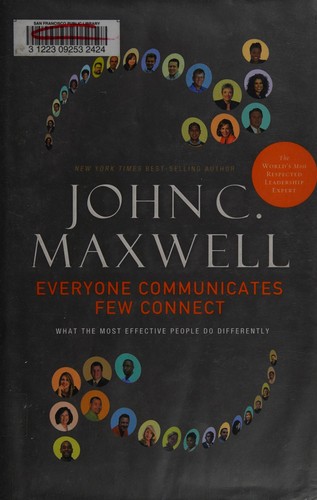
Find «Everyone Communicates, Few Connect» on Amazon — as an Amazon Associate, The Boring Work earns from qualifying purchases (disclosure).
The boring bottom line
Maxwell is right that attention paid outward beats attention paid inward, and right that the relevant behaviours can be trained. He is wrong that words are 7 per cent of the message, wrong that we retain 85 to 90 per cent of what we see, and unsupported in the claim that connection is what converts talk into influence — which is the claim the title is selling. The practices are worth keeping. The arithmetic is worth deleting. Take the index card above and let the book go.
Sources
- Mehrabian, A., and Wiener, M (1967). Decoding of inconsistent communications. Journal of Personality and Social Psychology. 6(1), 109-114 doi:10.1037/h0024532
- Mehrabian, A., and Ferris, S. R (1967). Inference of attitudes from nonverbal communication in two channels. Journal of Consulting Psychology. 31(3), 248-252 doi:10.1037/h0024648
- Mehrabian, A. «Silent Messages» — author's own note on the applicability of the equations. kaaj.com
- Amsel, T (2019). An urban legend called: «The 7/38/55 ratio rule». European Polygraph , 13(2). European Polygraph. doi:10.2478/ep-2019-0007
- Santoro, E., Broockman, D. E., Kalla, J. L., and Porat, R (2025). Listen for a change? A longitudinal field experiment on listening's potential to enhance persuasion. PNAS. 122(8) doi:10.1073/pnas.2421982122
- Kluger, A. N., Lehmann, M., Aguinis, H., Itzchakov, G., and Gordoni, G (2023). A meta-analytic systematic review and theory of the effects of perceived listening on work outcomes. Journal of Business and Psychology. 39, 295-344 doi:10.1007/s10869-023-09897-5
- Itzchakov, G., Weinstein, N., Leary, M., Saluk, D., and Amar, M (2024). Listening to understand. Journal of Personality and Social Psychology. 126(2), 213-239 doi:10.1037/pspa0000366
- Itzchakov, G., Weinstein, N., and Cheshin, A (2022). Learning to listen: downstream effects of listening training on employees' relatedness, burnout, and turnover intentions. Human Resource Management. doi:10.1002/hrm.22103
- Antonakis, J., Fenley, M., and Liechti, S (2011). Can charisma be taught? Tests of two interventions. Academy of Management Learning and Education. 10(3), 374-396 doi:10.5465/amle.2010.0012
- Antonakis, J., Bastardoz, N., Jacquart, P., and Shamir, B (2016). Charisma: an ill-defined and ill-measured gift. Annual Review of Organizational Psychology and Organizational Behavior. 3, 293-319 doi:10.1146/annurev-orgpsych-041015-062305
- Dargue, N., Sweller, N., and Jones, M. P (2019). When our hands help us understand: a meta-analysis into the effects of gesture on comprehension. Psychological Bulletin. 145(8), 765-784 doi:10.1037/bul0000202
- Tickle-Degnen, L., and Rosenthal, R (1990). The nature of rapport and its nonverbal correlates. Psychological Inquiry. 1(4), 285-293 doi:10.1207/s15327965pli0104_1
- Montoya, R. M., Horton, R. S., and Kirchner, J (2008). Is actual similarity necessary for attraction? Journal of Social and Personal Relationships , 25(6), 889-922. Journal of Social and Personal Relationships. doi:10.1177/0265407508096700
- Pornpitakpan, C (2004). The persuasiveness of source credibility. Journal of Applied Social Psychology. 34(2), 243-281 doi:10.1111/j.1559-1816.2004.tb02547.x
- van Laer, T., de Ruyter, K., Visconti, L. M., and Wetzels, M (2014). The extended transportation-imagery model. Journal of Consumer Research. 40(5), 797-817 doi:10.1086/673383
- Eisend, M (2009). A meta-analysis of humor in advertising. Journal of the Academy of Marketing Science. 37, 191-203 doi:10.1007/s11747-008-0096-y
- Stice, J (2009). A refutation of the percentages often associated with Edgar Dale's «cone of learning». ASEE Annual Conference and Exposition Proceedings. ASEE Annual Conference and Exposition Proceedings. doi:10.18260/1-2–5410
- Selcuk, E., Gunaydin, G., Ong, A. D., and Almeida, D. M (2016). Does partner responsiveness predict hedonic and eudaimonic well-being? Journal of Marriage and Family , 78(2), 311-325. Journal of Marriage and Family. doi:10.1111/jomf.12272
- Reis, H. T., Regan, A., and Lyubomirsky, S (2021). Interpersonal chemistry: what is it, how does it emerge, and how does it operate? Perspectives on Psychological Science , 17(2). Perspectives on Psychological Science. doi:10.1177/1745691621994241
- Ng, T. W. H., Eby, L. T., Sorensen, K. L., and Feldman, D. C (2005). Predictors of objective and subjective career success: a meta-analysis. Personnel Psychology. 58(2), 367-408 doi:10.1111/j.1744-6570.2005.00515.x
- Boothby, E. J., Cooney, G., Sandstrom, G. M., and Clark, M. S (2018). The liking gap in conversations. Psychological Science. 29(11), 1742-1756 doi:10.1177/0956797618783714
- Maxwell Leadership. Connecting visually: how to communicate more effectively without changing what you say — post adapted from «Everyone Communicates, Few Connect» maxwellleadership.com
- EADM 835 course summary of «Everyone Communicates, Few Connect» (2017). recording the book's Mehrabian citation. static1.squarespace.com
- 4squareviews. «Everyone Communicates, Few Connect: Connecting Beyond Words» — chapter summary recording the 7/38/55 wording 4squareviews.com