TL;DR
- «Rework» is unusually falsifiable for a business book, and most of what can be tested has survived. The chapters on hours, meetings and remote work are better supported now than in 2010.
- Long hours: 55 hours or more a week carries a 33% higher stroke risk and a 13% higher coronary heart disease risk across 603,838 people, and the WHO and ILO attribute 745,000 deaths in 2016 to that exposure. The book was right and understated.
- Meetings: in a five-day diary of 37 employees, the number of meetings predicted fatigue and workload. The hours spent in them did not. That is a sharper instruction than a blanket ban.
- «Planning is guessing» is half right. Thirty-three students predicted 33.9 days to finish a thesis and took 55.5. The repair that works is reference-class forecasting, not working without a plan.
- The evidence for the central claim is one company of about 60 people. Roughly half of US private-sector establishments survive five years, a third survive ten — and venture-backed firms fail less often than matched non-venture-backed firms.
Verdict
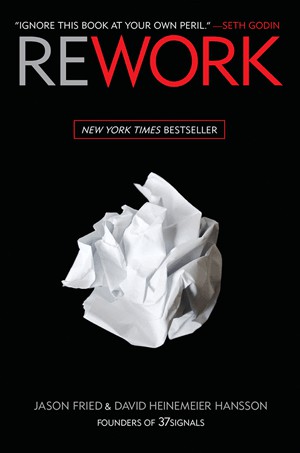
Read it. Not a verdict we hand out often, and «Rework» earns it on a technicality that matters: Jason Fried and David Heinemeier Hansson wrote a business book made of claims that can be checked. Sixteen years later, most of the checkable ones have gone their way. The literature on working hours, meeting load and remote work has moved toward the book, not away from it.
The caveat is structural. Every prescription in «Rework» derives from one company (37signals, later Basecamp) which sells project-management software, has never raised outside capital, and employed roughly 60 people. That is a sample of one, selected on the outcome. The book presents it as a general law of business. It is a well-observed case study written in the imperative mood.
The claim on trial
Stated plainly: a small, profitable, self-funded company that refuses to grow produces better outcomes for the people inside it than the venture-funded growth model, and that model’s standard practices (long hours, frequent meetings, long-range planning, outside investment, fast hiring) are not merely inefficient but harmful.
That splits into two testable halves. One is about practices — whether long hours, heavy meeting loads and detailed forecasting damage people and output. The other is about the business model — whether staying small and self-funded beats taking money and scaling. The first has been tested extensively and «Rework» wins most of it. The second has barely been tested, and the fragments that exist do not point where the book points.
A checked negative first. Searching Crossref on 10 August 2026 for studies testing «Rework»’s bundle of practices against a comparison group returned nothing. No one has run the experiment. Untested is not refuted — it means the package rests on the plausibility of its parts, which is why the parts are worth checking one at a time.
What held up
Long hours. The book’s strongest chapter, and the evidence has only hardened. A meta-analysis of 25 studies pooling 603,838 people for coronary heart disease and 528,908 for stroke found that working 55 hours or more per week, against a 35 to 40 hour baseline, raised coronary heart disease risk by 13% (RR 1.13, 95% CI 1.02–1.26) and stroke risk by 33% (RR 1.33, 95% CI 1.11–1.61), with a dose-response gradient for stroke from RR 1.10 at 41–48 hours to RR 1.27 at 49–54 (Kivimäki et al., The Lancet, 2015). The WHO/ILO joint estimates put 745,000 deaths in 2016 down to the same exposure — 398,000 from stroke, 347,000 from ischaemic heart disease, a 29% rise since 2000, with about 9% of the world’s population working those hours (Pega et al., Environment International, 2021; figures summarised in the WHO release of 17 May 2021).
On output rather than health, the cleanest evidence is a century old. Among British munitions workers observed by the Health of Munition Workers Committee during the First World War, output rose proportionally with hours up to roughly 49 hours a week, rose at a decreasing rate above that, peaked near 63, and fell beyond it — and removing the weekly rest day cut output about 10% at constant hours (Pencavel, The Economic Journal, 2015).
Workaholism as a disposition, distinct from hours worked, is associated in meta-analysis with burnout, job stress, work-life conflict and worse physical and mental health, and is best modelled as an addiction rather than a virtue (Clark et al., Journal of Management, 2016). The reverse direction also works: a six-month income-preserving four-day week across 141 organisations and 2,896 employees in six countries improved burnout, job satisfaction, mental and physical health, with no such pattern in 12 control companies (Fan et al., Nature Human Behaviour, 2025).
Remote work. Fried and Hansson were early and loud, and the randomised evidence arrived after them. In a nine-month lottery-randomised experiment at the Chinese travel agency Ctrip, 249 call-centre staff split into 131 home workers and 118 office controls: performance rose 13%, decomposing into 9.2% more minutes worked per shift and 3.3% more calls per minute, and attrition fell from 35% to 17% (Bloom et al., The Quarterly Journal of Economics, 2015). A larger trial at the same firm gave 1,612 employees two work-from-home days for six months: quit rates fell 33% (7.2% to 4.8%), satisfaction rose, and reviews, promotions and lines of code showed no difference over two years (Bloom et al., Nature, 2024).
Interruption. The book’s claim that the working day gets shredded into «work moments» holds. In a controlled experiment with 48 participants interrupted every two minutes, interrupted work finished faster than uninterrupted work (20.3 and 20.6 minutes versus 22.8) but at higher stress (9.5 and 9.1 versus 6.9), frustration, time pressure and effort (Mark et al., CHI ’08, 2008). People absorb interruption by compressing, and pay for it somewhere other than the clock.
Planning is guessing — half right
The diagnosis is solid. Asked how long an honours thesis would take, 33 students averaged a 33.9-day prediction against 55.5 actual days, and fewer than a third (29.7%) finished inside their own best estimate. Even their deliberately pessimistic «everything goes wrong» estimate of 48.6 days was beaten by only 48.7% of them (Buehler, Griffin & Ross, Journal of Personality and Social Psychology, 1994). At industrial scale the same bias shows up as money: across 258 transport infrastructure projects in 20 countries, 9 out of 10 ran over budget, by an average of 44.7% for rail, 33.8% for bridges and tunnels and 20.4% for roads, and estimates did not improve over the 70 years studied (Flyvbjerg, Holm & Buhl, Journal of the American Planning Association, 2002).
The prescription is where «Rework» stops early. The remedy the forecasting literature converged on is not «stop planning». It is reference-class forecasting: ignore the inside view of your project and anchor the estimate on recorded outcomes from a class of comparable past projects. The method was endorsed by the American Planning Association and first used in practice on UK transport costings including the Edinburgh Tram and Crossrail (Flyvbjerg, European Planning Studies, 2008). «Planning is guessing» is true of one kind of planning. Replacing the guess with a base rate is still planning, and it works.
Where it overshoots
Meetings are toxic — but the dose matters, and not the way the book says. In a five-day diary of 37 full-time employees producing 185 observations, the number of meetings per day predicted end-of-day fatigue (β = .088) and subjective workload (β = .060), while total time spent in meetings predicted neither (Luong & Rogelberg, Group Dynamics, 2005). Meetings act as interruptions, and interruptions are counted, not weighed. The advice that falls out is «fewer, longer, batched», not «none».
Meetings also do work. In 92 videotaped team meetings coded for interaction quality, teams with more problem-solving and action-planning talk were more satisfied and more productive, and their organisations performed better 2.5 years later; dysfunctional talk predicted the reverse (Kauffeld & Lehmann-Willenbrock, Small Group Research, 2012). «Meetings are toxic» treats a variable as a constant. «Meeting recovery», the popular term, does exist in the peer-reviewed record — meeting outcomes relate to the recovery time people need afterwards, moderated by the meeting’s relevance to them (Allen et al., Journal of Occupational & Environmental Medicine, 2022) — but that study is a cross-sectional survey of people’s last meeting, not an experiment. The phrase has travelled further than its evidence.
Remote work as an absolute is weaker than remote work as an option. The two randomised wins above are hybrid designs — one office day at Ctrip, two home days at Trip.com. Where the comparison is fully remote against on-site, the picture darkens. At a Fortune 500 firm, remote workers answered 12% fewer calls per hour than on-site workers before COVID; even after everyone went remote an 8% gap persisted, which is selection, not treatment (Emanuel & Harrington, American Economic Journal: Applied Economics, 2024). Among more than 10,000 skilled professionals at an Indian technology company pushed into full remote work, hours rose, output fell slightly and productivity fell 8–19%, driven by coordination costs: more time in meetings and much less uninterrupted work (Gibbs, Mengel & Siemroth, Journal of Political Economy Microeconomics, 2023). That is awkward for «Rework» specifically, because its two favourite prescriptions can fight each other: going remote without redesigning communication produces the meeting load the book despises.
The one-company problem
«Rework» is written from inside a survivor. The right comparison is not Basecamp against a failed startup; it is Basecamp against the distribution of companies that ran the same playbook — and most of that distribution does not write books. Official establishment-survival series exist and show the attrition plainly, but the primary table we wanted to cite would not load for us, so we are describing the shape rather than quoting figures we could not verify at source. The structural point does not need the number: a book by one of the non-survivors would carry different advice with equal confidence, and nobody would have printed it.
The funding claim fares worse. Comparing venture-financed firms with matched non-venture-financed firms over 25 years, the venture-backed reached larger scale, were not more profitable at exit, and had lower cumulative failure rates, the gap driven by the first years after investment (Puri & Zarutskie, The Journal of Finance, 2012). That half-vindicates the book (outside money does not buy profitability) and contradicts the implication that it buys fragility.
The strongest general evidence for the book’s worldview sits in the part it argues least: autonomy. Self-employed people report higher work satisfaction than the organisationally employed regardless of income earned or hours worked — procedural utility, valuing the process and not only the outcome (Benz & Frey, Economica, 2008). «Rework» sells that as a strategy. It is better read as a preference, and preferences are not universal.
One more data point belongs here. In April 2021, Fried announced that Basecamp employees could no longer hold societal and political discussions at work and disbanded an employee-led diversity programme; roughly a third of the 60-person staff took buyouts and left within days, including the heads of design, marketing and customer support and the entire iOS team (TechCrunch, 30 April 2021). Small and self-funded removes investor pressure. It does not remove management risk; it concentrates it in two people with no board.
Who should read it
Founders and freelancers in service or software businesses with low capital intensity and no network effects — the domain the book was written from and the one where its advice transfers. Also anyone at a company where meeting load and hours have become moral signals rather than working choices. The book is a compact permission slip and the evidence backs it.
Skip it if you run anything capital-intensive, regulated, or dependent on winning a market before someone else does; «start with no» loses when the market has a deadline. Skip it too if you want mechanism: it is short aphoristic essays that never distinguish contexts where the rules help from contexts where they end you. We hold the rest of our reviewed shelf to the same standard, and this one clears it by a wider margin than most business bestsellers.
For what managers do all day, see «Managing». For the same anti-planning instinct sold as life advice, see «Screw It, Let’s Do It».
One thing to try
Cut the count of your recurring meetings, not their length. Fatigue tracked meeting frequency and not meeting hours, so merge four 30-minute standing meetings into one 90-minute block on a single day, keeping the same agenda. Run it six weeks and log two numbers weekly: hours of uninterrupted work, and end-of-day fatigue on a 1–10 scale. If neither moves, put the meetings back. If they move, you have replaced a slogan with a measurement — the whole difference between «Rework» and its evidence base.
Get the book
Find «Rework» on Amazon — as an Amazon Associate, The Boring Work earns from qualifying purchases (disclosure).
When to see a professional
This is general information, not medical or financial advice. Chest pain, persistent breathlessness, sudden weakness or speech difficulty are emergencies — call emergency services. If long hours have become chronic exhaustion, insomnia or an inability to stop working, that is a matter for a doctor or a licensed mental health professional, not a business book. Decisions about company financing, equity and debt belong with a qualified accountant or licensed financial adviser who has seen your actual numbers. We recommend no specific investment or funding structure.
The boring bottom line
«Rework» made contrarian bets in 2010 and won most of them. Output flattens above about 49 hours and health suffers above 55. Meeting load costs something real. Remote work does not destroy performance and cuts attrition. Forecasts of your own project run systematically optimistic. Those are not opinions any more.
What it did not win is the frame. It reasons from one profitable 60-person software company to a universal rule, while the base rates say two-thirds of businesses are gone in ten years, venture-backed firms fail less rather than more, and the satisfaction of running your own thing is a preference rather than a competitive advantage. Read it for the practices. Do not read it as a survival strategy, because the one company it describes is the only evidence offered that it is one.
Sources
- Kivimäki et al., «Long working hours and risk of coronary heart disease and stroke», The Lancet, 2015
- Pega et al., «Global, regional, and national burdens of ischemic heart disease and stroke attributable to exposure to long working hours», Environment International, 2021
- World Health Organization, «Long working hours increasing deaths from heart disease and stroke», news release, 17 May 2021
- Pencavel, «The Productivity of Working Hours», The Economic Journal, 2015
- Clark et al., «All Work and No Play? A Meta-Analytic Examination of the Correlates and Outcomes of Workaholism», Journal of Management, 2016
- Fan et al., «Work time reduction via a 4-day workweek finds improvements in workers’ well-being», Nature Human Behaviour, 2025
- Bloom et al., «Does Working from Home Work? Evidence from a Chinese Experiment», The Quarterly Journal of Economics, 2015
- Bloom et al., «Hybrid working from home improves retention without damaging performance», Nature, 2024
- Emanuel & Harrington, «Working Remotely? Selection, Treatment, and the Market for Remote Work», American Economic Journal: Applied Economics, 2024
- Gibbs, Mengel & Siemroth, «Work from Home and Productivity», Journal of Political Economy Microeconomics, 2023
- Mark, Gudith & Klocke, «The cost of interrupted work: more speed and stress», CHI ’08, 2008
- Luong & Rogelberg, «Meetings and More Meetings: The Relationship Between Meeting Load and the Daily Well-Being of Employees», Group Dynamics, 2005
- Kauffeld & Lehmann-Willenbrock, «Meetings Matter», Small Group Research, 2012
- Allen et al., «Why Am I So Exhausted?», Journal of Occupational & Environmental Medicine, 2022
- Buehler, Griffin & Ross, «Exploring the “planning fallacy”», Journal of Personality and Social Psychology, 1994
- Flyvbjerg, Holm & Buhl, «Underestimating Costs in Public Works Projects: Error or Lie?», Journal of the American Planning Association, 2002
- Flyvbjerg, «Curbing Optimism Bias and Strategic Misrepresentation in Planning: Reference Class Forecasting in Practice», European Planning Studies, 2008
- Puri & Zarutskie, «On the Life Cycle Dynamics of Venture-Capital- and Non-Venture-Capital-Financed Firms», The Journal of Finance, 2012
- Benz & Frey, «Being Independent is a Great Thing: Subjective Evaluations of Self-Employment and Hierarchy», Economica, 2008
- Taylor Hatmaker, «Basecamp sees mass employee exodus after CEO bans political discussions», TechCrunch, 30 April 2021