Every claim on this site gets a grade, a date and a list of the papers behind it. This one sits in the registry of checked claims.
TL;DR
- Two different practices share the name. Writing about a value you hold has a research literature going back decades. Repeating compliments to yourself in a mirror has almost none, and what exists is not flattering.
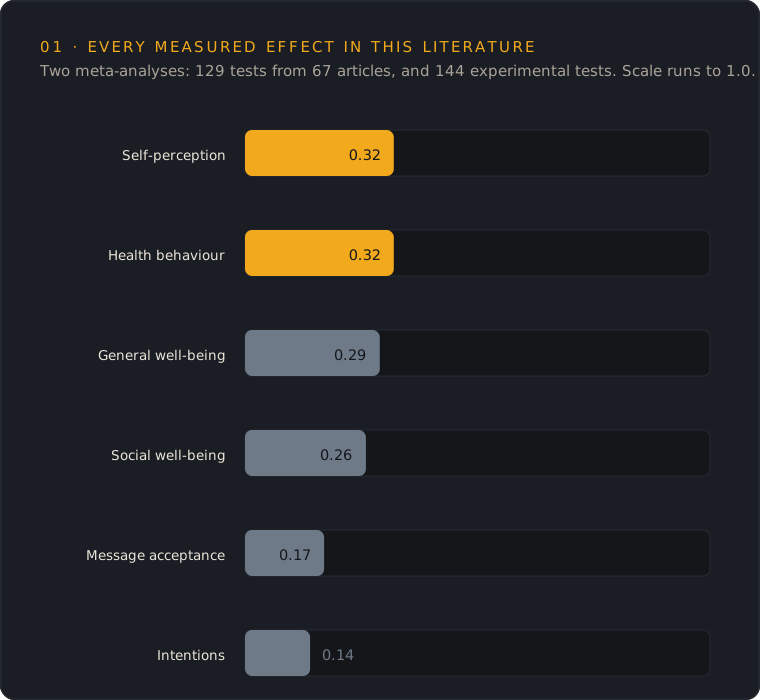
- The literature that exists produces small numbers. The newest meta-analysis pools 129 tests from 67 articles and reports effect sizes of .32, .29, .26 and −.22. An earlier one across 144 experimental tests gives .17 for message acceptance, .14 for intentions and .32 for behaviour.
- The classic warning still stands with a caveat of its own: people with low self-esteem who repeated “I’m a lovable person” felt worse than those who did not. Later work has not cleanly replicated it, and a pre-registered trial of 222 people found no group differences at all.
- One brain-imaging study is doing all the work in the “rewire” articles, and it measured activity during a task, not structural change from repetition.
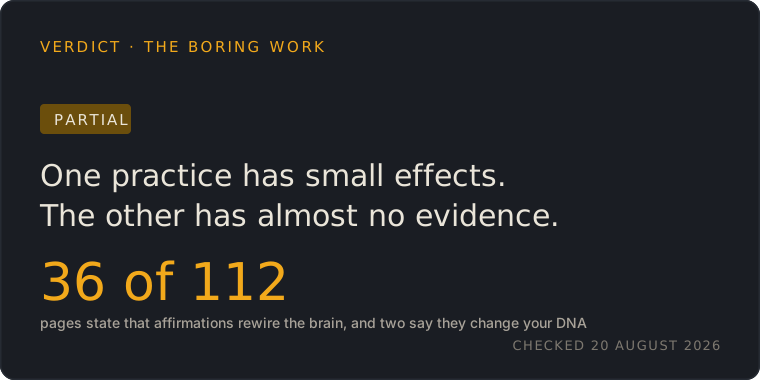
- Of the 112 pages we read on 20 August 2026, thirty-six state that affirmations rewire the brain. Two say they change your DNA. Not one page in the set contradicts the DNA claim.
Picture two people «doing affirmations». The first sits in a psychology lab, spending five quiet minutes writing about why her family matters to her, before being shown a smoking warning. The second stands at his bathroom mirror announcing «I am a magnet for abundance». Science has studied the first person for decades. It has barely met the second. And yet the two share one word, which is how a modest finding about writing exercises became a claim about rewiring your nervous system, and, on several pages we read, about editing your own DNA.
The first has a few hundred experiments behind it. The second has almost none. The word travels between them freely, which is how a modest finding about writing exercises before health warnings became a claim about rewiring your nervous system, and, on a quarter of the pages we read, about editing your genome.
Two practices, one word
| Values affirmation | Mirror affirmation | |
|---|---|---|
| What you do | Write for a few minutes about a value you hold, usually before something threatening | Repeat a positive statement about yourself, often daily, often aloud |
| What it is for | Reducing defensive resistance to information about yourself | Changing how you feel about yourself over time |
| Evidence base | Hundreds of experiments, two meta-analyses, small effects | One well-known experiment, several nulls, no meta-analysis of its own |
| Best measured effect | d+ = .32 on health behaviour across 46 tests | Mood worsened in people with low self-esteem |
Keeping those two people separate is the entire job of this page, because nearly every viral claim works by draping the lab person’s evidence over the mirror person’s ritual.
What the values version measures
Small, replicated, and specific to being under threat. Tracy Epton and colleagues at the University of Sheffield pooled 144 experimental tests of self-affirmation applied alongside health information. Across 34 tests of message acceptance (N = 3,433), 64 of intentions (N = 5,564) and 46 of subsequent behaviour (N = 2,715), the effects were d+ = .17, .14 and .32 respectively (Epton et al., 2015). The authors put the size in context themselves: the effects are small, and comparable to other health-behaviour interventions.
The newest synthesis widens the outcome to well-being generally. Yang Zhang and colleagues coded 129 independent tests from 67 published articles in non-clinical populations and found “small but significant positive effects on self-perception (ES = .32), general well-being (ES = 0.29), social well-being (ES = 0.26), and reduction of psychological barriers (ES = -.22)” (Zhang et al., 2026). Two details in it are worth carrying: the delayed effects on psychological barriers were larger than the immediate ones, and older participants gained more on self-perception than adolescents did.
What ties all these results together is when the trick works. In two careful pre-registered experiments, affirming a value made people less impatient about money, but only among poorer participants, or people made to feel poor (Moeini-Jazani et al., 2019). The pattern across the whole field: affirmation is a shield you raise when something is attacking your sense of self. Held up on a calm day, it does roughly nothing.
The mirror version, and the study everybody cites
Now the mirror person, and the famous experiment about him. Researchers at Waterloo had participants repeat «I’m a lovable person» to themselves. Those who already had high self-esteem felt slightly better. Those with low self-esteem, the very people the practice is marketed to, felt worse than people who repeated nothing (Wood, Perunovic & Lee, 2009). The mind, it seems, argues back: say «I am lovable» while believing otherwise, and the inner prosecutor stands up with a list of counterexamples. The paper’s title says it all: power for some, peril for others.
That result is nearly two decades old and it deserves the same scrutiny as anything else here. Later attempts have not cleanly reproduced it, and a pre-registered factorial trial randomising 222 adults across six conditions found a change over time and “no evidence of time-by-group interactions”; nobody’s affirmation condition beat anybody else’s (Lakuta, 2022). Its author draws the conclusion out loud: these interventions “should be more thoroughly investigated and optimized before they can be broadly implemented in real-life contexts, especially to prevent backfiring and negative-enhancing effects”.
So the honest state of the mirror version is not “it makes you feel worse”. It is: one well-known experiment found harm in the low self-esteem group, replication has been patchy, a good trial found nothing, and there is no meta-analysis of the practice as most people do it. Somebody claiming certainty in either direction is ahead of the evidence.
What “rewire” is standing on
Trace the neuroscience claim back and it lands on one paper. Emily Falk and colleagues at the University of Pennsylvania scanned sedentary adults while showing them health messages about physical activity, having first put half of them through a values-affirmation exercise. The affirmed group “produced more activity in VMPFC during exposure to health messages and went on to increase their objectively measured activity levels more” (Falk et al., 2015).
That is a good study, and it still does not say what the headlines say. It measured brain activity during a task, minutes after a writing exercise, the way a speedometer shows how fast you are going right now. «Rewiring» promises something else entirely: lasting structural change from weeks of repetition, a rebuilt engine. The study delivers the speedometer reading; the genre sells the engine. The gap between those two is where every «neuroscience of affirmations» article lives.
And a golden rule for reading any wellness page: «neuroplasticity» is real and proves nothing. Every experience rewires your brain somewhat; that is what learning is. Reading this sentence rewired your brain. So «this practice rewires your brain» is as informative as «this food contains atoms». The real questions are how much, in which direction, for how long, and the measured answers above run from 0.14 to 0.32: real, and small.
What the first page of Google says about it
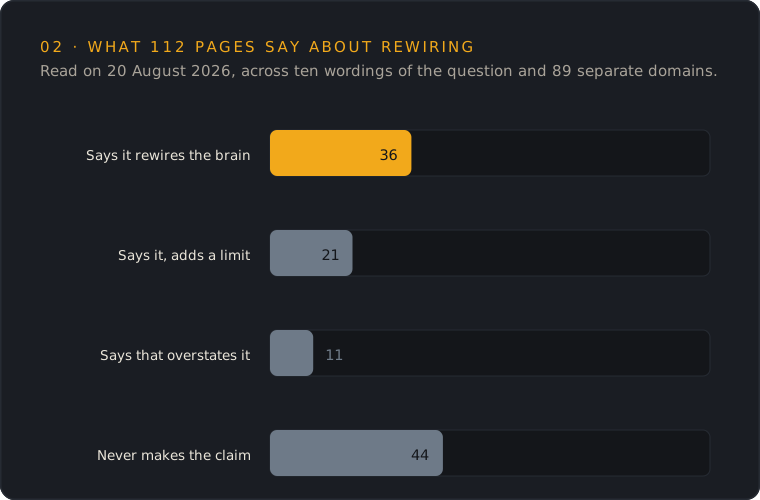
On 20 August 2026 we ran ten wordings of the question (do affirmations rewire your brain neuroscience, do positive affirmations actually work research, do affirmations change your DNA and six more) and read every page they returned: 112 pages across 89 domains.
Thirty-six of the 112 state that repeating affirmations rewires the brain. Twenty-one make the claim and add a real limit, most often that the imaging studies measured activity during a task, or that what was tested is values-based self-affirmation rather than repeated self-praise. Eleven take the position that this overstates what has been shown. Forty-four never make the claim, offering affirmations to use without a mechanism attached. And separately: two pages say affirmations reprogram your DNA and two more say positive thinking switches genes on and off, and not one page in the set contradicts them.
The DNA claim, and why it is two errors deep
The DNA version is where the story tips into comedy. We searched PubMed, the index that carries genetics and psychology alike, for anything linking affirmations to DNA, gene expression or epigenetics. Nineteen records matched the words. Read them by name and none is about the claim; one is about preserving RNA in dental pulp. The scientific literature on «affirmations change your DNA» is not thin. It is vacant.
The claim also fails before you look for studies, because it contains a category error the pages carrying it usually import from a page that gets it right. Epigenetic regulation is the switching of gene expression (which genes are read and how often), and by definition it does not alter the sequence of DNA. One of the pages we read states this correctly and then the neighbouring pages, citing the same concept, describe “reprogramming” and “rewriting” the code. Changing which genes are expressed and changing your DNA are not the same event, and the second one is what the popular version promises.
Dig under the DNA pages and you find the same legend repeated nearly word for word: Russian researchers who supposedly proved DNA listens to spoken language and laser beams, and that «junk DNA» follows the grammar of human speech. It is told as settled research. It appears nowhere in the literature, and the pages telling it cite only each other, a perfect closed loop of confidence.

Where the limits are
The meta-analyses cover the values-affirmation manipulation, mostly in laboratory or health-message settings, with outcomes measured over days rather than years. The one that widens to well-being notes that the effects vary by continent and by age, which is a sign that what is being measured is not one stable thing. The brain-imaging study is a single sample of sedentary adults and reports a region chosen in advance rather than a whole-brain search.
And the practice most readers are asking about, a sentence repeated to yourself every morning, has been tested least of all. The PubMed search for its most common description, mirror work, returns nothing at all. That is a fact about the state of the literature and not about whether the habit is worthwhile.
What to do with this instead
The shift: the version with evidence is about values, not compliments, and it is used before something difficult rather than every morning.
First move: if you want the thing that has been measured, the manipulation is specific: a few minutes writing about why something you value matters to you, done shortly before a situation you expect to be threatening. That is what produced .32 on behaviour across 46 experimental tests, and it is not a statement about yourself at all.
Second move: treat “rewires your brain” as a phrase that carries no information. Every learned thing rewires the brain. The sentence is compatible with an effect of any size, including none, which is why it is popular.
Third move: if a page tells you affirmations change your DNA, you have learned something reliable about the page. The claim rests on a category error and on a story with no presence in the scientific literature.
Nothing here is advice about mental health, and the low self-esteem finding in particular is a description of one experiment rather than a warning aimed at anyone. If low mood or self-criticism is persistent, that is a conversation with a clinician. For the wider pattern of how the self-improvement genre borrows laboratory findings, the piece on the genre itself covers the same machinery.
The DNA version borrows from the same playbook as the book that says thoughts have a measurable frequency: physics vocabulary lent to a wish.
The boring bottom line
Writing about a value you hold, shortly before something that threatens how you see yourself, has a real and small effect, between .14 and .32 depending on what is measured, across a few hundred experiments. Repeating a compliment to yourself in a mirror has one famous experiment finding harm in the people most likely to try it, a patchy replication record, and a good trial finding nothing.
Neither of those is rewiring, and neither of them touches your DNA. Thirty-three pages in ninety-nine said the first thing. Two said the second. Nobody said otherwise.
Sources
- Wood, J. V., Perunovic, W. Q. E., & Lee, J. W (2009). Positive self-statements: Power for some, peril for others. Psychological Science. 20(7), 860-866. The study behind every article saying affirmations can backfire. Its finding is about repeating a compliment to yourself, not about affirming a value. doi:10.1111/j.1467-9280.2009.02370.x
- Zhang, Y., Chen, B., Hu, X., Wang, M. (2026). The impact of self-affirmation interventions on well-being: A meta-analysis. American Psychologist. The newest and largest synthesis. Every one of its four effect sizes is small, and it calls for a theoretical reconceptualisation of what self-affirmation is. doi:10.1037/amp0001591
- Epton, T., Harris, P. R., Kane, R., van Koningsbruggen, G. M., & Sheeran, P (2015). The impact of self-affirmation on health-behavior change: A meta-analysis. Health Psychology. 34(3), 187-196. The evidence base for the other thing called affirmation: writing about a value you hold before you are told something you would rather not hear. doi:10.1037/hea0000116
- Falk, E. B., O'Donnell, M. B., Cascio, C. N., Tinney, F., & Kang, Y., et al (2015). Self-affirmation alters the brain's response to health messages and subsequent behavior change. Proceedings of the National Academy of Sciences. 112(7), 1977-1982. The only brain-imaging result that belongs in this conversation, and it is about affirming values before a threatening message, not about compliments in a mirror. doi:10.1073/pnas.1500247112
- Lakuta, P (2022). A factorial randomized controlled trial of implementation-intention-based self-affirmation interventions: Findings on depression, anxiety, and well-being in adults with psoriasis. Frontiers in Psychiatry. 13, 795055. A well-designed null. Its discussion is unusually direct about what that means for the field. doi:10.3389/fpsyt.2022.795055
- Moeini-Jazani, M., Albalooshi, S., & Seljeseth, I. M (2019). Self-affirmation reduces delay discounting of the financially deprived. Frontiers in Psychology. 10, 1729. Pre-registered, well-powered, and specific about the population where it worked. The pattern across this literature is that the effect appears under threat and not in general. doi:10.3389/fpsyg.2019.01729