TL;DR
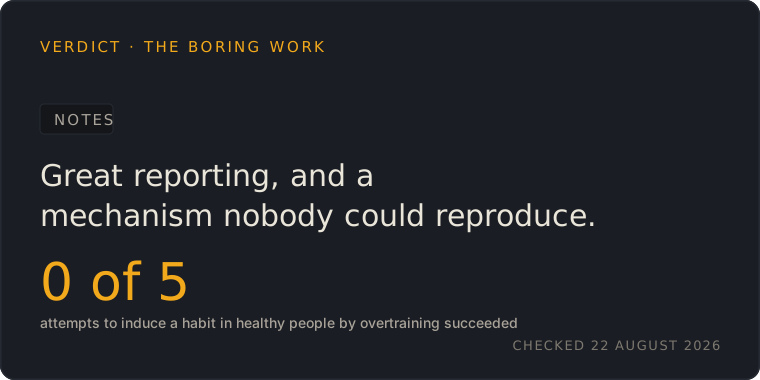
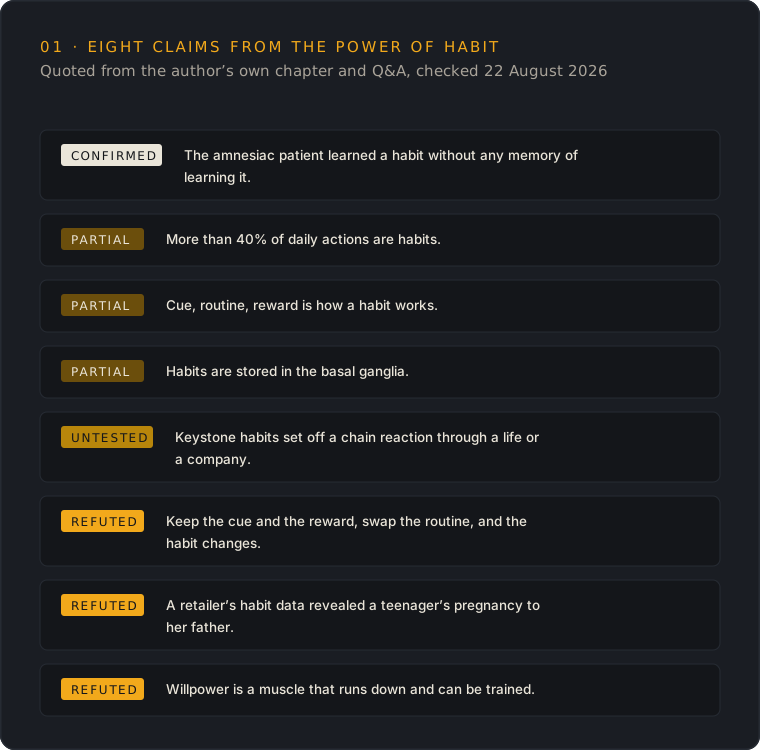
- The book presents cue, routine and reward as settled neuroscience. In 2018 a team reported five failed attempts to produce rigid habits in people with the overtraining method that reliably works in rats.
- Its central instruction is to keep the old cue and the old reward and swap the routine. A field experiment that paid people to exercise in a fixed daily window got fewer gym visits than flexible timing, during the programme and after it ended.
- The basal-ganglia passage is built on rats learning a maze. The amnesic patients behind the opening story did learn without awareness, over many weeks, and their learning collapsed when the task changed format.
- Keystone habits have never been tested directly. In the nearest evidence, 69 trials with 73,873 people, cutting smoking went with smaller gains on diet and exercise, not a cascade.
- The pregnant-teenager scene at Target is, by the account of the man who hosted the talk it grew from, anonymous and unsubstantiated. The prediction project itself was real.
Verdict
Read it as reporting, and keep the notes, not the recipe. The stories are excellent journalism; the mechanism they were hung on, and the rule derived from it, did not survive the decade after publication.
Three parts and a golden rule
Charles Duhigg, then an investigative reporter at The New York Times, published the book in 2012, and its first chapter, which he hosts on his own site, describes a machine with three parts: a cue that switches the brain to autopilot, a routine that runs, and a reward that teaches the brain to keep the loop going (Duhigg, 2012). Millions of readers came away believing this was how the brain works, full stop.
The practical rule follows, and the author states it plainly in the publisher’s question-and-answer document: «to insert a new routine, it should be triggered by the old cue, and deliver the old reward. That’s the rule: If you use the same cue, and provide the same reward, you can shift the routine» (Duhigg, Q&A, 2012). Every claim tested below is quoted from those two documents, not from summaries. That matters for a book this widely paraphrased, since several versions circulating online are firmer than anything the author wrote.
Five attempts to grow a habit in people
In rats, building a habit on demand is a solved laboratory problem. Train an animal to press a lever for food long enough, then make the food worthless, and the rat keeps pressing anyway: the behaviour has detached from its goal. That procedure is the empirical backbone of the loop. In 2018 a team led by the Amsterdam psychologist Sanne de Wit tried to do the same thing to people.
It would not work. The paper reports «five failed attempts to demonstrate that overtraining instrumental behavior leads to the development of inflexible habits in humans», across four previously published task designs, including two attempts to replicate the original human demonstration (de Wit et al., 2018). The manipulation that manufactures habits in rats produced nothing in healthy adults, five times running.
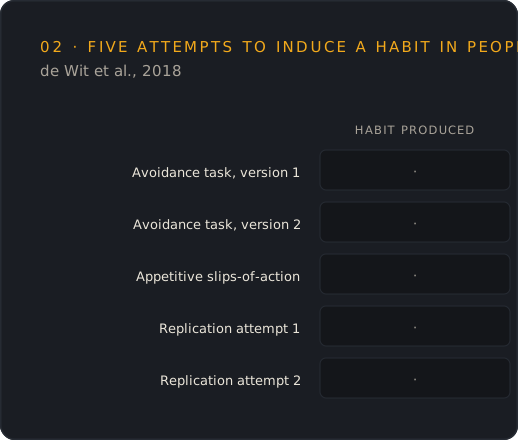
Read carefully, the result is narrower than «habits do not exist». The laboratory operation the theory leans on could not be performed on demand in people, which makes the confident mechanism of chapter one an extrapolation from animals. The authors draw a further conclusion that cuts against the book’s picture of a habit system strong enough to take the wheel: when people with compulsions fail these tests, the failure may sit in goal-directed control, not in overactive habit learning.
Rats in a T-maze, and two patients
The book’s neurological centrepiece says the basal ganglia «stored habits even while the rest of the brain went to sleep». The sentence sits in a passage about rats, and the study behind it is about rats too: recordings from groups of neurons in the striatum, a structure inside the basal ganglia, as rats learned to run a T-shaped maze for a reward (Jog et al., 1999). The firing patterns reorganised as the run became automatic, which is a fine result about rats.
The human story that opens the book comes from the memory researcher Larry Squire’s group in San Diego, and their published work is more interesting than its retelling. In one study, two patients with large lesions in the medial temporal lobe and no ability to form new conscious memories gradually learned which object in each of eight pairs was correct. It took many weeks, and at the start of every session neither patient could describe the task, the instructions or the objects. Then the catch: «The acquired knowledge was rigidly organized, and performance collapsed when the task format was altered» (Bayley et al., 2005).
Both halves matter. Learning without awareness is demonstrated. What was learned was slow to build and brittle the moment conditions shifted, which is a poor advertisement for running your life on that machinery.
Half a second of veto
The current account of habit is humbler than a loop. A major review describes habits as forming when people repeat the same responses in a recurring context, running alongside deliberate goals as the efficient default, and notes that «people tend to infer from the frequency of habit performance that the behavior must have been intended» (Wood & Rünger, 2016). We do something often, then tell ourselves we meant to.
The sharpest measurement came in 2019. Participants practised a visual-to-movement mapping for four days, then the mapping was changed. They learned the new one easily, but when forced to respond very fast, they «habitually expressed the original association when forced to respond rapidly (~300-600 ms)»; more practice made the old response ready earlier (Hardwick et al., 2019).
So a habit, as measured, is a response your brain gets ready in advance, which you can still override if you have about half a second. That is real and useful to know. It is also far from a loop in which a reward decides what you do: the autopilot drafts the action, and you keep the veto.
Same time every day, tested in a gym
The golden rule has an unusually direct field test. Researchers paid one group of gym members for each visit made inside a planned two-hour window every day, and another group for any visit at any time, then kept tracking both groups after the payments stopped.
The result: «Routine incentives generated fewer gym visits than flexible incentives, both during our intervention and after incentives were removed» (Beshears et al., 2021). People tied to a fixed slot went to the gym less while being paid, and dropped off more once the money ended.
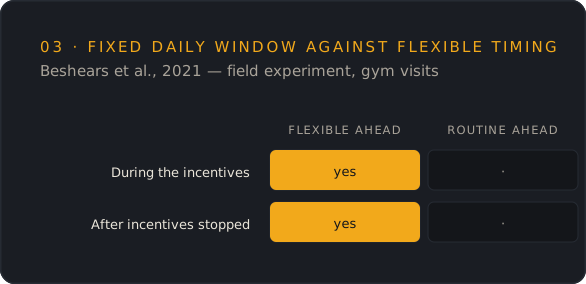
One field experiment does not settle the question, and gym attendance is not the same thing as habit strength. A fixed two-hour window every day is also a demanding condition, and part of the result may be about that burden rather than about cues in general; the authors frame it as a trade-off between flexibility and routine. What the study does remove is the assumption that a rigid cue is the safe default. Whether attaching a new behaviour to an existing one helps at all is examined in the check on habit stacking.
Keystone habits
«There are some habits — called “keystone habits” — that can cause a chain reaction through someone’s life or an organization. A great example of a keystone habit is exercise.» That is the author’s own summary in the publisher’s document, and it is the idea most readers carry away.
I could not find a study that tests it directly. The nearest evidence comes from interventions aimed at several risk behaviours at once: 69 trials and 73,873 adults, with modest improvements in most behaviours, and reductions in smoking that «appeared to be negatively associated with improvement in other behaviors (such as diet and physical activity)» (Meader et al., 2017).
Look at the direction. Where smoking fell more, diet and exercise improved less, which is the reverse of a chain reaction. It falls short of a formal refutation, since nobody designed these trials to test keystone habits. But fourteen years on, the book’s most quoted concept still has no measurement under it, and the accurate label is untested.
The Target story, traced back
The anecdote everyone repeats: a father discovers his teenage daughter is pregnant because a retailer’s coupons worked it out first. Eric Siegel, a data scientist who chaired the 2010 Predictive Analytics World conference where Target’s statistician Andrew Pole first presented the project, and whom the author later interviewed, describes the story as «an anonymous story of a man discovering his teenage daughter is pregnant only by seeing Target’s marketing offers to her, with the unsubstantiated but tacit implication that this resulted specifically from Target’s PA project» (Siegel, 2016).
The project itself is not in doubt: a marketing team estimated which customers were likely to be expecting, from changes in what they bought. What has no support is the scene the book is remembered for, and that scene was carrying an argument: that habit data hands companies uncanny power over individuals. Without it, what remains is a marketing department estimating probabilities across millions of shoppers, which is mildly unsettling and entirely ordinary.
Two numbers worth checking
In the publisher’s document the author writes: «One paper published by a Duke University researcher found that more than 40 percent of our daily actions are habits.» The paper behind that figure defines habitual behaviour as «behavior that had been performed almost daily in stable contexts» (Wood et al., 2002). So the 40 per cent counts things done nearly every day in the same setting, reported hour by hour in diaries. That is a real and interesting quantity, and narrower than «most of your life runs on autopilot».
The willpower chapter leans on ego depletion, which has been checked to exhaustion: a preregistered replication in 23 laboratories with 2,141 participants found the effect close to zero (Hagger et al., 2016). The full account is in does willpower run out like a muscle and does sugar restore willpower.
One chapter comes out well. The book profiles Alcoholics Anonymous, and a Cochrane review of 27 studies with 10,565 participants later found that manualised twelve-step facilitation improved continuous abstinence at 12 months compared with other clinical treatments, RR 1.21 [1.03, 1.42], rated high-certainty evidence (Kelly et al., 2020). An RR of 1.21 means about a fifth more people stayed fully abstinent for a year. Nothing on this page is treatment advice; if alcohol is why you are reading, that conversation belongs with a clinician.
Who should read it
Read it for the reporting. The chapters on how a company’s routines shape what its people do, and on the twelve-step programme, are strong journalism that keeps its shape whatever happens to the psychology.
Do not lift the recipe. Keeping the cue and the reward while swapping the routine is the one instruction the book gives, and the closest field test of anything like it went the other way. The later and better-known book in this genre makes overlapping promises, and the overlap is where both are weakest.
That later book is checked in six myths Atomic Habits created. How long a new behaviour takes to become automatic is in how long it takes to form a habit, the habits page collects everything else we have checked on the subject, and the other books we have put through the same test are in the book reviews.
The boring bottom line
Cue, routine, reward is a memorable description of learning that reads as a description of mechanism. Five well-powered attempts to induce rigid habits in people by the standard animal method produced nothing. The neuroscience passage describes rats in a maze, and the patients’ learning took weeks and collapsed when the task changed.
The golden rule lost a field experiment to flexible timing, both during the programme and after it. Keystone habits have never been tested, and the Target scene has no source behind it. What remains is a good book of reporting about routines in people and organisations, attached to a mechanism that deserves a much looser grip than the prose suggests.
Sources
- Duhigg, C (2012). The Power of Habit: Why We Do What We Do in Life and Business — chapter one, official excerpt. Random House. ISBN 9781400069286. Read from the author's own PDF on 22 August 2026, so the claims under test are his wording rather than a summary. charlesduhigg.com
- Duhigg, C (2012). A conversation with Charles Duhigg — official author Q&A. Random House. Read on 22 August 2026. The practical instruction the book is best known for is in this document, in one sentence. charlesduhigg.com
- de Wit, S., Kindt, M., Knot, S. L., Verhoeven, A. A. C., Robbins, T. W., Gasull-Camós, J., et al (2018). Shifting the balance between goals and habits: Five failures in experimental habit induction. Journal of Experimental Psychology: General. 147(7), 1043-1065. The central paper for this review: the mechanism the book describes as established could not be produced on demand in people. doi:10.1037/xge0000402
- Jog, M. S., Kubota, Y., Connolly, C. I., Hillegaart, V., & Graybiel, A. M (1999). Building neural representations of habits. Science. 286(5445), 1745-1749. The primary source of the book's basal-ganglia passage, included as the object of examination. doi:10.1126/science.286.5445.1745
- Bayley, P. J., Frascino, J. C., & Squire, L. R (2005). Robust habit learning in the absence of awareness and independent of the medial temporal lobe. Nature. 436(7050), 550-553. From the research group behind the case in the book's opening chapter, with the two details the chapter does not dwell on: weeks of training, and collapse when the task format changed. doi:10.1038/nature03857
- Wood, W., & Rünger, D (2016). Psychology of habit. Annual Review of Psychology. 67, 289-314. The current framing: a habit is a context-response association, which is a narrower object than a three-part loop. doi:10.1146/annurev-psych-122414-033417
- Hardwick, R. M., Forrence, A. D., Krakauer, J. W., & Haith, A. M (2019). Time-dependent competition between goal-directed and habitual response preparation. Nature Human Behaviour. 3, 1252-1262. Habits in humans are real and measurable — as a prepared response that a few hundred milliseconds of deliberation can override. doi:10.1038/s41562-019-0725-0
- Beshears, J., Lee, H. N., Milkman, K. L., Mislavsky, R., & Wisdom, J (2021). Creating exercise habits using incentives: The trade-off between flexibility and routinization. Management Science. 67(7), 4139-4171. A direct field test of «attach the routine to a fixed cue», and it came out the other way. doi:10.1287/mnsc.2020.3706
- Meader, N., King, K., Wright, K., Graham, H. M., Petticrew, M., Power, C., et al (2017). Multiple risk behavior interventions: Meta-analyses of RCTs. American Journal of Preventive Medicine. 53(1), e19-e30. The nearest available test of a cascade between behaviours, and it does not show one. doi:10.1016/j.amepre.2017.01.032
- Siegel, E (2016). Did Target really predict a teen's pregnancy? The inside story. The Machine Learning Times / Predictive Analytics World. Not a scientific source, and used only to check the provenance of an anecdote. Read on 22 August 2026. predictiveanalyticsworld.com
- Wood, W., Quinn, J. M., & Kashy, D. A (2002). Habits in everyday life: Thought, emotion, and action. Journal of Personality and Social Psychology. 83(6), 1281-1297. This is the Duke work behind the 40-percent figure, and its definition of a habit is what the figure counts. doi:10.1037/0022-3514.83.6.1281
- Hagger, M. S., Chatzisarantis, N. L. D., Alberts, H., Anggono, C. O., Batailler, C., Birt, A. R., et al (2016). A multilab preregistered replication of the ego-depletion effect. Perspectives on Psychological Science. 11(4), 546-573. Cited in one line for the book's willpower chapter; the full check has its own page on this site. doi:10.1177/1745691616652873
- Kelly, J. F., Humphreys, K., & Ferri, M (2020). Alcoholics Anonymous and other 12-step programs for alcohol use disorder. Cochrane Database of Systematic Reviews. CD012880.pub2. The book's chapter on this topic points at a real effect. Nothing on this page is treatment advice. doi:10.1002/14651858.CD012880.pub2