TL;DR
- The Secret is a spiritual book. Its «magnetism» of thoughts and its Law of Attraction are articles of faith about how the universe answers a person, and no experiment can confirm or refute a faith. This page does not try.
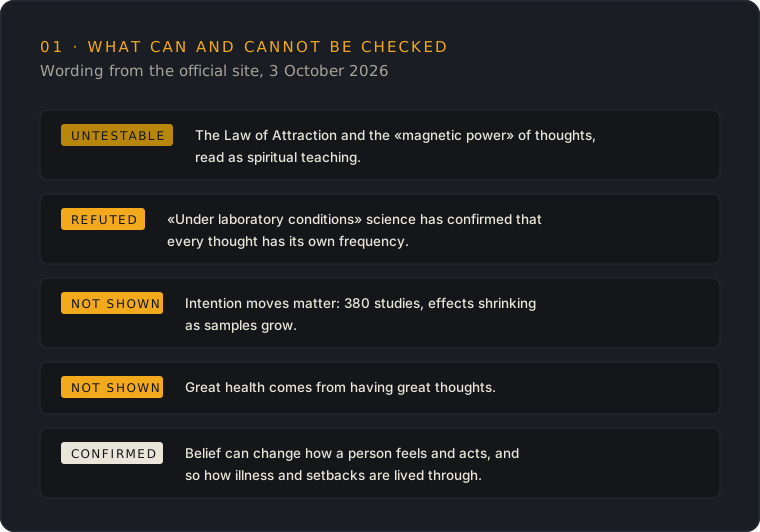
- What it does check are the places where the book’s official site steps out of faith and into claims about the world: that science has confirmed thoughts have a frequency «under laboratory conditions», and that «great health comes from having great thoughts». It also looks at the nearest test of intention moving matter.
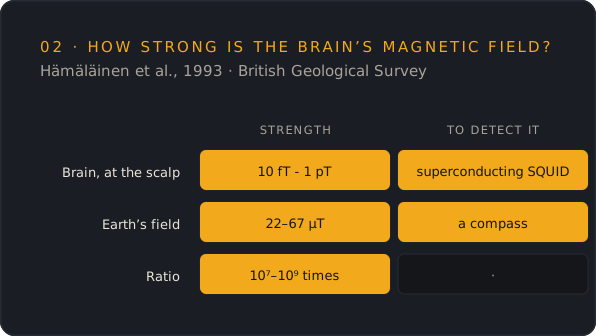
- No laboratory has confirmed the first. What MEG laboratories do measure is the brain’s magnetic field, 10 femtotesla to 1 picotesla at the scalp, and it says nothing about the content of a thought.
- Intention acting on matter has been meta-analysed across 380 studies by sympathetic researchers: the bigger the study, the smaller the effect. Coping style showed little consistent link with cancer survival.
- The one place research locates a measurable risk is where conventional treatment is refused. This page gives no medical advice of any kind.

This page discusses research on cancer survival because the book makes claims about health. Nothing here is medical advice or guidance about anyone’s treatment. Decisions about illness belong with a doctor.
Verdict
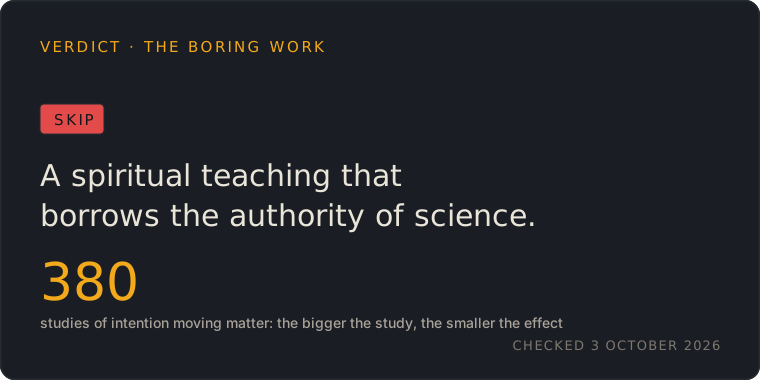
Skip it as a guide to how anything works. Read as spiritual writing, it is a book of hope and consolation, and a reader’s faith is not this site’s business. The trouble is that the book’s official site borrows the authority of science and medicine to sell that faith, and those borrowed claims can be checked. They do not hold.
What kind of book this is
The Secret, a 2006 book and film by the Australian television producer Rhonda Byrne, teaches that the universe answers a person’s inner state. Thoughts, in the book’s language, have a «magnetic power»: hold the feeling of already having something, and the universe arranges for you to have it. The magnetism is spiritual. Nobody claims a compass needle would twitch near a hopeful person.
The idea is older than the book. Gizmodo’s history of Napoleon Hill argues that the concepts of The Secret were «essentially plagiarized» from Hill’s 1937 Think and Grow Rich, and that the big idea in both is that «the material universe is governed quite directly by our thoughts» (Novak, 2016).
As a statement of faith, that can be held or rejected, and no measurement settles it. A reader who takes the Law of Attraction the way another reader takes prayer is not making a scientific error, and this page does not grade belief. It grades the sentences in which the book’s own official site says that laboratories or health outcomes back the teaching. Those are claims about the world, and the world can be asked.
Where the site leaves the spiritual register
To argue with the book and not a cartoon of it, every claim below is quoted from the rights-holder’s own website.
The teaching itself: «Under the Law of Attraction, the complete order of the Universe is determined, including everything that comes into your life and everything that you experience. It does so through the magnetic power of your thoughts. Through the Law of Attraction like attracts like» (The Secret official site). That is a spiritual claim, and it is left alone here.
The appeal to science: «Under laboratory conditions, cutting edge science has confirmed that every thought is made up of energy and has its own unique frequency. And when this energy and frequency of a single thought radiates out into the Universe, it naturally interacts with the material world.»
And the appeal to medicine, on the same site: «Great health comes from having great thoughts.»
The first passage asks for faith. The second and third tell the reader that laboratories and bodies have already confirmed the faith, and that is where a fact-check has standing.
«Under laboratory conditions»
I could not find any laboratory study showing that a thought has «its own unique frequency» that radiates into the universe, and the site names none. What laboratories do measure is smaller and stranger.
Neurons work by moving charged particles, moving charge creates a magnetic field, and so a thinking brain does have a measurable magnetic signature. Physicists record it with a technique called magnetoencephalography, or MEG. The standard review of the method: «In MEG studies, the weak 10 fT-1 pT magnetic fields produced by electric currents flowing in neurons are measured with multichannel SQUID (superconducting quantum interference device) gradiometers» (Hämäläinen et al., 1993).
For scale, the Earth’s own field at the surface runs from about 22,000 to 67,000 nanotesla (British Geological Survey), somewhere between ten million and a few billion times stronger than the brain’s. Brain rhythms do have frequencies, visible on an EEG as slow and fast waves, but those rhythms belong to large populations of neurons firing together. They do not encode what a thought is about, and nothing in the measurement literature assigns a frequency to wanting a car.
None of this touches the spiritual teaching, which never needed a laboratory. It answers one sentence: the site’s statement that science has already confirmed thought-frequencies under laboratory conditions. If the book’s magnetism is spiritual, the laboratory reference is decoration, and it is decoration that tells readers something untrue about what science has found.
Intention and matter: 380 studies
The book’s promise that a held intention draws things to you has a measurable cousin. For decades, parapsychology researchers asked volunteers to influence random number generators by intention alone, on the logic that a machine producing pure randomness is the most sensitive detector of a mental push anyone could build.
The funding cuts in an unusual direction here. The meta-analysis below was supported by the Institute for Border Areas of Psychology and Mental Hygiene in Freiburg and by the Samueli Institute, organisations with an open interest in such effects being real. This is the friendly case, made by friendly people.
«The meta-analysis combined 380 studies that assessed whether RNG output correlated with human intention and found a significant but very small overall effect size. The study effect sizes were strongly and inversely related to sample size and were extremely heterogeneous. A Monte Carlo simulation revealed that the small effect size, the relation between sample size and effect size, and the extreme effect size heterogeneity found could in principle be a result of publication bias» (Bösch et al., 2006).
The bigger and better the study, the smaller the effect, which is the fingerprint of a field where small studies with null results stayed in drawers, and the authors’ own simulation reproduced the whole pattern from publication bias alone. A believer can fairly reply that the universe does not answer to random number generators. That reply works for faith and fails for anyone told that intention moving matter has been demonstrated: three hundred and eighty attempts did not demonstrate it.
Thoughts and survival
«Great health comes from having great thoughts.» Spiritual traditions have long said that peace of mind helps a person bear illness, and some of that turns out to be measurable. The site’s sentence goes further, toward thoughts producing health, and that has been reviewed more than once.
A systematic review of prospective studies of people with cancer found that «most of the studies that investigated fighting spirit (10 studies) or helplessness/hopelessness (12 studies) found no significant associations with survival or recurrence», that «positive findings tended to be confined to small or methodologically flawed studies», and concluded: «There is little consistent evidence that psychological coping styles play an important part in survival from or recurrence of cancer» (Petticrew et al., 2002). The reviewers added: «People with cancer should not feel pressured into adopting particular coping styles to improve survival or reduce the risk of recurrence.»
A stronger test asks what happens when trained therapists deliver structured psychotherapy, which is far more than thinking positively. A critical review of that literature found: «No randomized clinical trial designed with survival as a primary endpoint and in which psychotherapy was not confounded with medical care has yielded a positive effect» (Coyne et al., 2007).
The most careful answer is more mixed. A Cochrane review of psychological support for women with metastatic breast cancer found ten randomised trials with 1,378 women. Pooling six of them, one-year survival favoured the intervention, «with an odds ratio (OR) of 1.46 (95% confidence interval (CI) 1.07 to 1.99)»; pooling four, there was no survival benefit at five years (OR 1.03, 95% CI 0.42 to 2.52). There was also «evidence of a short-term benefit for some psychological outcomes and improvement in pain scores», and the authors warned that the trials were few, varied and methodologically weak (Mustafa et al., 2013).
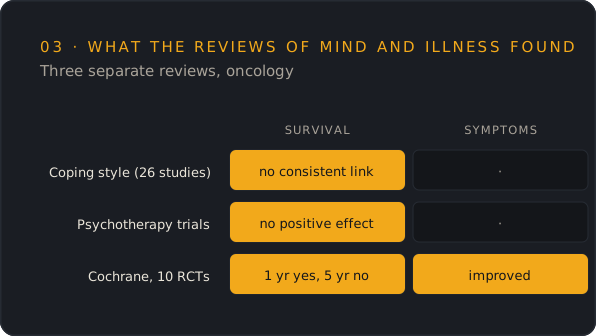
Put together, the reviews draw the line the site’s sentence erases. The state of a person’s mind measurably affects how an illness is lived through, its distress and its pain, which is close to what many spiritual traditions have always said. It has no established effect on how long a person lives, which is what «great health comes from having great thoughts» implies.
Where the measured risk sits
It would be wrong to say that holding this faith is dangerous. The supported statement is narrower, and one study located it precisely.
Working from the US National Cancer Database, which held 1,901,815 patients at the time, researchers matched 258 people who used unproven complementary treatments alongside conventional care with 1,032 similar patients who did not. The first group refused recommended treatment far more often: surgery 7.0% against 0.1%, chemotherapy 34.1% against 3.2%, radiotherapy 53.0% against 2.3%, hormone therapy 33.7% against 2.8%. Their risk of death was about twice as high, hazard ratio 2.08, in a model that left refusal out.
Then the sentence that changes the reading: «there was no significant association between CM and survival once treatment delay or refusal was included in the model (hazard ratio, 1.39; 95% CI, 0.83-2.33)». The added risk travelled through refusal of standard treatment (Johnson et al., 2018). An earlier study by the same group, of people who chose alternative medicine instead of conventional treatment, found a hazard ratio of 2.50, while noting that this choice is rare (Johnson et al., 2017).
These are observational studies about cancer treatment, not about any book, and nothing here is advice about anyone’s care. What they establish is where the measured risk lives: at the point where treatment is declined. Faith and medicine sit side by side for millions of people; the risk appears when a teaching is read as a replacement for treatment.
A teaching that cannot lose
One feature of the teaching deserves a plain description, without judging anyone who holds it. If «the complete order of the Universe is determined» by your thoughts, then nothing that happens to you is something you did not cause. Illness, poverty and accident all become evidence about the sufferer’s inner state, and that follows from the sentence on the site.
The same sentence makes the teaching impossible to fail. Got the job, and the law worked. Did not get it, and the law still worked, because your thoughts were not positive enough. For a spiritual teaching that may be acceptable, since many faiths are built to survive disappointment. For a claim presented as confirmed in laboratories it is disqualifying, because a claim that wins either way cannot be confirmed by anything.
What people get from it
Millions of readers say the book helped them, and there is no reason to doubt them. To someone sunk in helplessness it hands hope and a sense of agency, a feeling that something can be done from their side. Wanting that is reasonable, and a spiritual practice can supply it. What fails is only the science invoked to sell it.
One caution about the technique the book teaches. Repeating positive statements about yourself does not help everyone: in experiments, «among participants with low self-esteem, those who repeated a positive self-statement (“I’m a lovable person”) or who focused on how that statement was true felt worse than those who did not repeat the statement», while people with high self-esteem felt better, though only a little. So the technique misfires for exactly the readers most drawn to it (Wood et al., 2009).
Who this book is for
For a reader looking for a spiritual frame of hope, the book offers one, and that faith is the reader’s own. For a reader who wants to know how thoughts, matter and health are connected, its official site makes claims that were checkable when they were written and are checkable now, and the checks are above.
The book’s central promise comes from a 1937 bestseller: Think and Grow Rich, checked. For what research says about feeling good, see the happiness myths; for another body idea that travelled from a laboratory into popular language, is polyvagal theory evidence-based. Other bestsellers checked the same way are collected under book reviews.
The boring bottom line
The Secret is a spiritual book, and its magnetism is a spiritual metaphor; as faith, it is left to the reader. Its official site, though, tells readers that laboratories have confirmed thought-frequencies, and no laboratory has. Intention acting on matter has 380 studies behind it and a pattern its own sympathetic reviewers could reproduce from publication bias. Coping style showed little consistent link with cancer survival, while psychological support measurably eased distress and pain.
The defensible version of the book’s promise is smaller and still worth having: how you hold your situation changes how you live through it. What it does not change, on any evidence found so far, is the course of a disease.
Sources
- Novak, M (2016). The Untold Story of Napoleon Hill, the Greatest Self-Help Scammer of All Time. Gizmodo / Paleofuture, 6 December 2016. Cited for the lineage of the book's central idea: the article argues The Secret's concepts were «essentially plagiarized» from Think and Grow Rich. gizmodo.com
- The Secret (Rhonda Byrne / Prime Time Productions) (2026). What is The Secret? — the official statement of the Law of Attraction. thesecret.tv. The official statement of the Law of Attraction. The spiritual teaching is not graded; the page's statement that «under laboratory conditions» science has confirmed thought-frequencies is. thesecret.tv
- Hämäläinen, M; Hari, R; Ilmoniemi, R J; Knuutila, J; Lounasmaa, O V (1993). Magnetoencephalography — theory, instrumentation, and applications to noninvasive studies of the working human brain. Reviews of Modern Physics 65(2):413-497. 65(2), 413-497. The abstract gives the figures used here: fields of 10 fT to 1 pT, measured with superconducting SQUID gradiometers. doi:10.1103/RevModPhys.65.413
- British Geological Survey (2026). The Earth's magnetic field: an overview. BGS Geomagnetism. «At the Earth's surface the total intensity varies from 22,000 nanotesla (nT) to 67,000 nT.» Read on 3 October 2026. geomag.bgs.ac.uk
- Bösch, H; Steinkamp, F; Boller, E (2006). Examining psychokinesis: The interaction of human intention with random number generators — a meta-analysis. Psychological Bulletin 132(4):497-523. The funding is stated first rather than buried, because it strengthens rather than weakens the conclusion: the most sympathetic possible analysis of the friendliest possible literature ends in the smaller-studies-bigger-effects pattern. doi:10.1037/0033-2909.132.4.497
- Petticrew, M; Bell, R; Hunter, D (2002). Influence of psychological coping on survival and recurrence in people with cancer: systematic review. BMJ 325(7372):1066. The last sentence is the reviewers' own, and it is the reason this evidence belongs on a page about a book that tells readers their thoughts determine their health. doi:10.1136/bmj.325.7372.1066
- Coyne, J C; Stefanek, M; Palmer, S C (2007). Psychotherapy and survival in cancer: The conflict between hope and evidence. Psychological Bulletin 133(3):367-394. Structured therapy delivered by professionals is a far stronger intervention than thinking positively, and it does not move survival either. doi:10.1037/0033-2909.133.3.367
- Mustafa, M; Carson-Stevens, A; Gillespie, D; Edwards, A G K (2013). Psychological interventions for women with metastatic breast cancer. Cochrane Database of Systematic Reviews. More nuanced than the usual summary: a one-year signal, nothing at five years, and clearer benefits for symptoms and pain than for length of life. doi:10.1002/14651858.CD004253.pub4
- Johnson, S B; Park, H S; Gross, C P; Yu, J B (2018). Complementary Medicine, Refusal of Conventional Cancer Therapy, and Survival Among Patients With Curable Cancers. JAMA Oncology 4(10):1375-1381. The mediation analysis is the point: the measurable harm sat in the refusal, not in the belief. That is the only precise way to talk about risk here. doi:10.1001/jamaoncol.2018.2487
- Johnson, S B; Park, H S; Gross, C P; Yu, J B (2017). Use of Alternative Medicine for Cancer and Its Impact on Survival. JNCI: Journal of the National Cancer Institute 110(1):121-124. Note the authors' own qualifier — «although rare». Very few people do this, and the study is observational. doi:10.1093/jnci/djx145
- Wood, J V; Perunovic, W Q E; Lee, J W (2009). Positive Self-Statements: Power for Some, Peril for Others. Psychological Science 20(7):860-866. 20(7), 860-866. Cited for the direction of the effect, not as a survey of the affirmation literature. doi:10.1111/j.1467-9280.2009.02370.x