Every claim on this site gets a grade, a date and a list of the papers behind it. This one sits in the registry of checked claims.
TL;DR
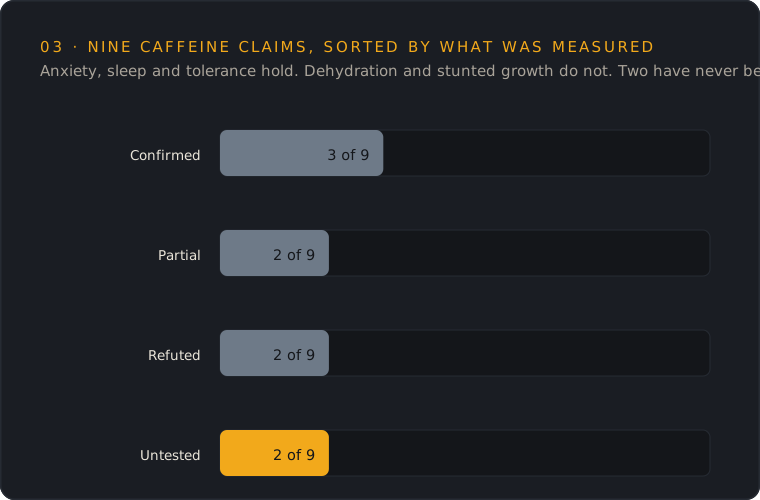
- Nine popular claims about caffeine, nine separate verdicts. Two hold, three fail, two hold in a narrower form than advertised, and two have never been tested on the population that repeats them.
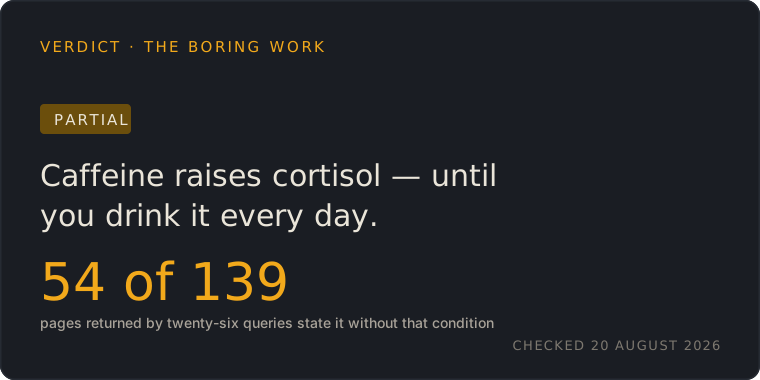
- The cortisol claim is the one people search for most, and it is half a finding. Five days of daily caffeine wiped out the morning cortisol response entirely in a crossover trial of 96 adults. Of the 139 pages we read on 20 August 2026, 54 state the claim with nothing said about that.
- There is no single figure for how long caffeine lasts. The largest assembled set of caffeine pharmacokinetic data covers 4,714 people, and it reports a distribution shaped by smoking, by oral contraceptive use and by a liver enzyme you inherit.
- Coffee does not dehydrate you: total body water came out at 51.5 kg on coffee and 51.4 kg on water in a 50-man crossover. The cleanest measurement we have on that question was paid for by a coffee-industry body, which belongs in the row alongside the result.
- Two claims sit at zero studies. Nobody has run a trial on caffeine making people sleepy, and the whole randomised evidence base for caffeine and attention deficit disorder was collected on 76 children.
Caffeine is the most-studied drug on the planet, taken daily by most of humanity, and yet the internet cannot agree whether your morning cup is a health tonic or a slow poison. There is a reason for the confusion: «does caffeine do X» is never one question. Each claim was tested on a different group of people, at a different dose, over a different stretch of time, and the answer changes completely depending on who «you» are, especially on whether you drink coffee every day or once a month. So this page answers nine caffeine questions separately, each with its number, its study, and whose body the number came from.
So here is the table first, and the reasoning after it. Nine claims, graded on the same four-point scale used across this site and defined on the method page: Confirmed, Partial, Refuted, Untested. Every number below is attached to the study that produced it and to the group of people it was measured on. Where a claim has been tested on one population and repeated about everybody, the table says so in the last column, because that gap is where most of the confusion lives.
Nine claims, nine verdicts
| Claim | Verdict | What was measured | Where the limit is |
|---|---|---|---|
| Caffeine raises cortisol | Partial | 96 adults, double-blind crossover: a robust rise after five days without caffeine, no morning rise after five days at 300 mg/day (Lovallo et al., 2005) | True of people who rarely drink it. The afternoon rise survives daily use; the morning one does not |
| Caffeine can trigger anxiety and panic | Confirmed, in a named group | Ten challenge studies: 51.1% of panic-disorder patients had an attack after caffeine, none after placebo (Klevebrant & Frick, 2022) | Every study used 400–750 mg, most used 480. Healthy controls: 1.7% |
| Caffeine late in the day costs you sleep | Confirmed | 400 mg taken 0, 3 and 6 hours before bed each disturbed sleep against placebo, all p<0.05 (Drake et al., 2013) | Twelve people. One author was affiliated with the maker of the sleep monitor used |
| Coffee dehydrates you | Refuted | 50 men, three days per arm: total body water 51.5 kg on coffee against 51.4 kg on water (Killer et al., 2014) | Habitual drinkers, all male. Funded by a coffee-industry body |
| Caffeine stunts your growth | Refuted | 81 girls followed from 12 to 18 with six years of diet records: no difference in bone mineral gain across intake groups (Lloyd et al., 1998) | One narrow cohort. The heaviest group averaged 77 mg a day |
| Coffee makes you go to the toilet | Partial, and not because of caffeine | 12 people, colonic manometry: caffeinated coffee similar to a 1000 kcal meal, 60% stronger than water (Rao et al., 1998) | Decaffeinated coffee was not statistically separable from either water or the caffeinated cup |
| You build tolerance | Confirmed | 32 adults, 300 mg three times a day for 18 days: afterwards a dose produced subjective effects in the placebo group and none in the caffeine group (Evans & Griffiths, 1992) | Measured on subjective effects, not on performance |
| Caffeine makes some people sleepy | Untested | No trial has tested the claim. The nearest measured finding: caffeine did not raise alertness in people who rarely drink it, and merely returned habitual drinkers to baseline (Rogers et al., 2010) | An explanation exists. A study of the claim itself does not |
| Caffeine helps attention deficit symptoms | Untested in adults | Four randomised trials pooled, 76 participants: standardised mean difference −0.12, 95% CI −0.44 to 0.20 (Perrotte et al., 2023) | Every participant in that evidence base was a child aged 5 to 15 |
Does caffeine raise cortisol?
Yes, and then it stops, and the pages telling you about it always stop before that part. The study everyone leans on, knowingly or not, is a 2005 trial by William Lovallo in Oklahoma. Ninety-six healthy adults spent four weeks in a double-blind crossover: five days at a time on capsules of nothing, 300 mg or 600 mg of caffeine a day, then a challenge dose with saliva sampled eight times through the day to trace cortisol, the body’s alarm hormone.
The result reads like a tolerance fable. After five caffeine-free days, the test dose sent cortisol up all day, the «spike» of internet fame. But after just five days of daily caffeine, the morning dose did precisely nothing. The body had filed caffeine under «old news» within a working week. The paper’s own summary: cortisol responses are «reduced, but not eliminated, in healthy young men and women who consume caffeine on a daily basis» (Lovallo et al., 2005).
Which means the scary sentence «your coffee is spiking your cortisol» is aimed at the wrong person. Say it to a daily drinker and you are describing a reflex their body switched off years ago. Say it to someone returning from a two-week break, and it is true. Same cup, opposite verdicts. One caveat survives for everyone: caffeine plus stress raised cortisol more than either alone (Lovallo et al., 2006), so the espresso before the exam is still doing something the espresso before breakfast is not.
What the first page of Google says about it
On 20 August 2026 we ran twenty-six wordings of the question (does caffeine raise cortisol, does coffee raise cortisol levels, does caffeine spike cortisol morning, caffeine increases cortisol tolerance regular drinkers no effect, coffee cortisol myth debunked evidence and twenty-one more) and read every page they returned: 139 pages across 110 domains.
Of those 139, 54 state that caffeine raises cortisol with no mention that the response fades in daily drinkers. Thirty state it and add the qualification. Four report a null result or a fall. Fifty-one turn out to be about something adjacent (when to drink your coffee, how to lower cortisol in general) and never make the claim at all. Only body text counted; headlines and search snippets were ignored.
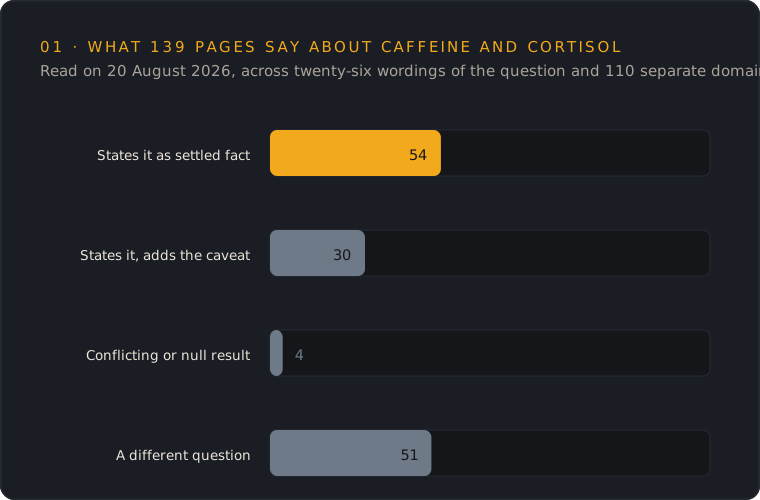
The 54 are not a uniform group of bad sources. They include hospital systems and clinic health blogs, two of them among the largest in the United States, which state the rise plainly before moving on to advice about timing, and shops selling a supplement or a coffee substitute on the same page. Among the 30 pages that do carry the qualification, eleven name the Lovallo trial by author, and several give the dose and the five-day figure, a standard that did not exist on this question a few years ago and now does.
Four words for the rest of this page
Half-life: how long your body takes to clear half a dose. It is a property of you as much as of the drink.
CYP1A2: the liver enzyme that does almost all of the clearing. The version you inherit differs between people.
Tolerance: the shrinking of an effect when the same dose is repeated daily.
Withdrawal: what happens when a tolerant body stops getting the dose. It is a separate thing from tolerance and it has its own timetable.
Why doesn’t it work on me?
Because «caffeine lasts 5 hours» is an average of wildly different people, and you are not average. A Berlin team assembled every published measurement of how bodies handle caffeine: 286 studies, 4,714 people, 24,571 data points. The clearance speed splits on ordinary facts of life: smokers burn caffeine roughly twice as fast, oral contraceptives slow it down sharply, and the pattern holds across fifty years of data (Grzegorzewski et al., 2022).
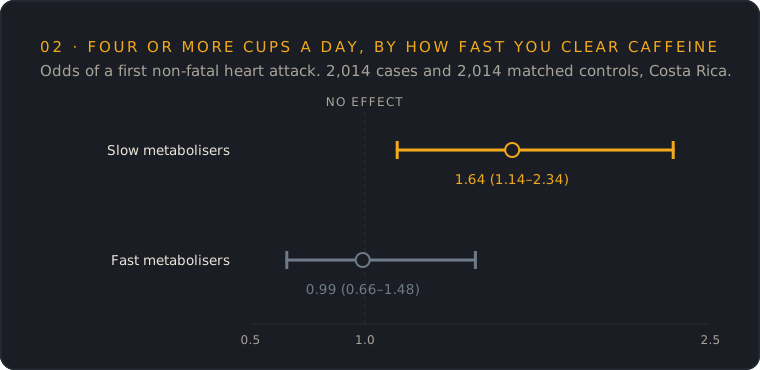
Beneath the habits sits a gene. One liver enzyme, CYP1A2, does almost all the caffeine-clearing, and it comes in fast and slow versions you inherit like eye colour. In a study of 2,014 heart-attack survivors in Costa Rica, slow metabolisers who drank four or more cups a day had 64% higher odds of a heart attack; fast metabolisers drinking the same showed no signal at all (Cornelis et al., 2006). About half of us carry the slow version, and without a genetic test you do not know which half you are in.
So three colleagues drinking identical flat whites are running three different experiments. One clears it by lunch. One will still be metabolising it at midnight. And the third, the veteran daily drinker, is mostly treating withdrawal: in a randomised study of 379 adults, caffeine gave habitual drinkers no lift above their true baseline, it merely undid the dip caused by not having had caffeine. The authors’ blunt line: «no net benefit for alertness is gained, as caffeine abstinence reduces alertness and consumption merely returns it to baseline» (Rogers et al., 2010). Your morning coffee may be paying off a debt your evening coffee created. A related account of how attention recovers after a disruption is in the piece on attention recovery.
Can caffeine cause anxiety?
For one group of people, dramatically yes. In pooled challenge studies, researchers gave big single doses of caffeine, around five cups’ worth at once, to patients with panic disorder: 51.1% had a full panic attack. On placebo: zero. Healthy volunteers given the same dose: 1.7% (Klevebrant & Frick, 2022). For a diagnosed panic disorder, caffeine at high doses is close to a panic button.
But watch the fine print, which the authors themselves flag: every study used 400 to 750 mg in one go, several cups’ worth, and the data cannot say what an ordinary cup does. The evidence sentence is «big doses trigger panic in people with panic disorder». The internet sentence, «caffeine causes anxiety», has been stretched to cover everyone at any dose, and that stretch is where the truth tore.
For people without the diagnosis, the Bristol study above found something more specific: susceptibility to caffeine-induced anxiety tracked one variant of an adenosine receptor gene, and the anxiety response was smaller in habitual consumers than in people who rarely drink it, whatever their genotype. Tolerance builds to the jittery part as well.
Does it wreck your sleep if you drink it early enough?
The famous six-hour rule comes from exactly one experiment. Detroit sleep researchers gave people 400 mg of caffeine, about two big coffees, at bedtime, three hours before, or six hours before, versus placebo, with a monitor recording sleep at home. All three timings damaged sleep, even the dose taken six hours out, at an hour when the drinker would swear the coffee had «worn off» (Drake et al., 2013).
Now the caveat that never travels with the rule: twelve people took part. Twelve. And one author was affiliated with the company that made the sleep monitor. The six-hour rule may well be right, but it is standard worldwide sleep advice balanced on a dozen Detroiters. If you want the longer argument about how confidently sleep findings get retold, the notes on Why We Sleep are about a book that made that mistake at scale.
Three claims where the first page of Google is already right
Dehydration. Sophie Killer and colleagues at the University of Birmingham gave 50 habitual coffee drinkers either four 200 mL coffees a day or the same volume of water, for three days each, with food and activity controlled, and measured total body water by deuterium oxide alongside a battery of blood and urine markers. Total body water finished at 51.5 kg on coffee and 51.4 kg on water. Twenty-four-hour urine volume was 2,409 mL against 2,428 mL. Sodium excretion was the single marker that differed (Killer et al., 2014). The trial was funded by the Institute for Scientific Information on Coffee, a coffee-industry body, and one author was employed by PepsiCo, both stated in the paper. Industry funding is a reason to want a replication, and it is also compatible with the result being correct, and the row keeps both facts.
Growth. Tom Lloyd and colleagues at Penn State College of Medicine followed 81 girls from age 12 to 18 with six years of prospective diet records and measured bone by dual energy x-ray absorptiometry. Split into groups averaging 14, 35 and 77 mg of caffeine a day, they showed no difference in total body bone mineral gain or in hip bone density at 18 (Lloyd et al., 1998). One cohort, one country, one decade, and a heaviest group whose daily intake was under a large modern coffee, so the finding is narrower than “caffeine does not affect growth”. What it does do is remove the mechanism the claim relies on, and no study has since put one back.
The toilet. Satish Rao and colleagues at the University of Iowa threaded a six-sensor manometry probe up to the mid-transverse colon in 12 people and gave them, in random order across ten hours, black coffee, decaffeinated coffee, water, and a 1,000 kcal meal. Caffeinated coffee stimulated the colon at a magnitude similar to the meal, 60% above water and 23% above decaf. The part that gets dropped in retelling is the next sentence of the abstract: the effects of decaffeinated coffee “were not significantly different from those of water or caffeinated coffee” (Rao et al., 1998). Twelve people is too few to separate decaf from either neighbour, so the honest reading is that coffee does something and the case for caffeine being the cause was never closed.
What nobody has measured
Why coffee makes some people sleepy has never been put to a trial. Search the phrase and you will be given adenosine receptors and rebound and blood sugar, told with confidence and without a study of the thing being explained. There are measured findings nearby. The Bristol result above says that for a habitual drinker, the alert feeling is largely the removal of a deficit rather than a gain, so a cup that fails to lift you is doing exactly what the trial predicted. Whether some people are made measurably drowsier by caffeine, and by what mechanism, is a question with a verdict of Untested, and that is a more useful thing to know than a mechanism nobody has checked. A comparable case, where one lab effect became an entire folk theory of energy, is the sugar-and-willpower story.
Attention deficit symptoms: the entire randomised evidence is 76 children. Giuliana Perrotte and colleagues, working at medical schools in Santo André and Maceió in Brazil, searched three databases for randomised trials of caffeine against placebo in attention deficit disorder. They found seven to review and four with data poolable, covering 76 participants aged 5 to 15. Pooled standardised mean difference: −0.12, confidence interval −0.44 to 0.20, p=0.45, heterogeneity zero. Their summary: “overall, the totality of the evidence suggests no significant benefit of caffeine over placebo in the treatment of children with ADHD” (Perrotte et al., 2023). Adults are not in that base at all, which makes every confident sentence about caffeine and adult attention deficit an extrapolation from children.
Resetting tolerance has a folk timetable and no measurement. How tolerance arrives is documented: Suzette Evans and Roland Griffiths at Johns Hopkins gave 32 adults 300 mg three times a day for 18 days with dietary caffeine excluded, and afterwards a dose produced clear subjective effects in the placebo group and none in the caffeine group, described by the authors as “the clearest evidence to date of complete tolerance development to a CNS effect of caffeine in humans” (Evans & Griffiths, 1992). What leaving looks like is documented too. Reviewing 57 experimental and 9 survey studies, Laura Juliano and Griffiths found ten symptom categories that met validity criteria, headache in half of participants, and a shape: “onset of symptoms occurred 12-24 h after abstinence, with peak intensity at 20-51 h, and for a duration of 2-9 days” (Juliano & Griffiths, 2004). Symptoms turned up after abstinence from as little as 100 mg a day.
Neither of those tells you how long sensitivity takes to come back, which is the number every tolerance-reset article states. The Lovallo trial is the closest thing to an answer and it points at days rather than weeks for cortisol specifically: five caffeine-free days were enough to restore a full response. One hormone, one endpoint, 96 people. That is what exists.
Where the limits are
Read the last column of the table again and a pattern shows up. The panic finding is about people with a diagnosis, at a dose several times a cup. The hydration finding is about men who already drank three to six cups a day. The growth finding is about one cohort of American girls in the 1990s whose heaviest caffeine group averaged less than a large coffee. The attention deficit finding is about children. Not one of those is a statement about you specifically, and a page that presents them as though they were is doing the thing this site exists to catch.
The other pattern is sample size. Two of the nine rows rest on twelve people each. Both findings are widely repeated as settled, the six-hour sleep rule especially, which has become standard sleep-hygiene advice on the strength of a dozen participants. Repetition is not replication, and a number does not get stronger by being quoted more often.
What to do with this instead
The shift: stop asking how much is safe and start asking which experiment you are currently running.
First move: note where you are on the tolerance curve before you judge any effect. A daily drinker and someone back after a week off are two different bodies meeting the same cup, and almost every claim on this page changes verdict between them. That is measured, not theoretical: five days of intake abolished one response entirely.
Second move: count from your last cup, not your first. The sleep trial found disturbance at six hours; the pharmacokinetic dataset says your personal clearance depends on smoking, on oral contraceptive use and on an inherited enzyme. If you are trying to work out whether caffeine is costing you sleep, the useful record is the time of the final cup against the time you fell asleep, kept for a fortnight. The wider argument for tracking that sort of thing rather than following rules is in the energy rules piece.
Third move: when a page gives you a single number for how long caffeine lasts, treat that as a sign of how carefully the rest of it was written. There is no such number, and the largest dataset assembled on the question says so plainly.
Nothing here is a recommendation about intake. Doses appear on this page only as the amount some study gave to some group, because that is the only form in which they mean anything. If caffeine is interacting with a diagnosis, a medication or a pregnancy, that is a conversation with a clinician, not with a table.
The boring bottom line
Caffeine is not one question with one answer. It is nine questions with nine answers, measured on nine different groups of people, and the popular version of each one has been widened until it covers everybody. The cortisol claim is true of the person who stopped for a fortnight and mostly false of the person who never stops. The panic finding is real and belongs to a diagnosed group at five cups in one go. The dehydration claim is dead. The growth claim is dead. Two of them have never been tested at all.
The most useful thing on this page is the last column, not the second. A verdict without a population is a rumour with a citation attached.
Sources
- Lovallo, W. R., Whitsett, T. L., al'Absi, M., Sung, B. H., Vincent, A. S., & Wilson, M. F (2005). Caffeine stimulation of cortisol secretion across the waking hours in relation to caffeine intake levels. Psychosomatic Medicine. 67(5), 734-739. Double-blind crossover in 96 healthy adults. Five days of daily intake abolished the morning cortisol response; the afternoon dose still raised it. doi:10.1097/01.psy.0000181270.20036.06
- Lovallo, W. R., Farag, N. H., Vincent, A. S., Thomas, T. L., & Wilson, M. F (2006). Cortisol responses to mental stress, exercise, and meals following caffeine intake in men and women. Pharmacology Biochemistry and Behavior. 83(3), 441-447. The cortisol response depends on the type of stressor and on sex, but repeated doses raised cortisol across the day regardless of either. doi:10.1016/j.pbb.2006.03.005
- Klevebrant, L., & Frick, A (2022). Effects of caffeine on anxiety and panic attacks in patients with panic disorder: A systematic review and meta-analysis. General Hospital Psychiatry. 74, 22-31. Every included study used 400-750 mg, and most used 480 mg, so the finding attaches to that dose range and to that population. doi:10.1016/j.genhosppsych.2021.11.005
- Killer, S. C., Blannin, A. K., & Jeukendrup, A. E (2014). No evidence of dehydration with moderate daily coffee intake: A counterbalanced cross-over study in a free-living population. PLoS ONE. 9(1), e84154. The result is the cleanest measurement available and it was paid for by the coffee industry. Both facts belong in the row. doi:10.1371/journal.pone.0084154
- Drake, C., Roehrs, T., Shambroom, J., & Roth, T (2013). Caffeine effects on sleep taken 0, 3, or 6 hours before going to bed. Journal of Clinical Sleep Medicine. 9(11), 1195-1200. Twelve people. The finding that caffeine six hours before bed still costs sleep rests on a very small sample. doi:10.5664/jcsm.3170
- Rao, S. S., Welcher, K., Zimmerman, B., & Stumbo, P (1998). Is coffee a colonic stimulant?. European Journal of Gastroenterology & Hepatology. 10(2), 113-118. The decaffeinated arm is the half that gets dropped in retelling: it was not statistically separable from either water or caffeinated coffee. doi:10.1097/00042737-199802000-00003
- Evans, S. M., & Griffiths, R. R (1992). Caffeine tolerance and choice in humans. Psychopharmacology. 108(1-2), 51-59. 300 mg three times a day. This is the study behind the word tolerance, and it measured subjective effects, not alertness performance. doi:10.1007/BF02245285
- Juliano, L. M., & Griffiths, R. R (2004). A critical review of caffeine withdrawal: Empirical validation of symptoms and signs, incidence, severity, and associated features. Psychopharmacology. 176(1), 1-29. Ten symptom categories met the validity criteria, headache and fatigue among them. doi:10.1007/s00213-004-2000-x
- Rogers, P. J., Hohoff, C., Heatherley, S. V., Mullings, E. L., Maxfield, P. J., Evershed, R. P., et al (2010). Association of the anxiogenic and alerting effects of caffeine with ADORA2A and ADORA1 polymorphisms and habitual level of caffeine consumption. Neuropsychopharmacology. 35(9), 1973-1983. The largest dose-controlled test of whether habitual caffeine produces a net gain in alertness. It does not. doi:10.1038/npp.2010.71
- Lloyd, T., Rollings, N. J., Kieselhorst, K., Eggli, D. F., & Mauger, E (1998). Dietary caffeine intake is not correlated with adolescent bone gain. Journal of the American College of Nutrition. 17(5), 454-457. The population is narrow and the highest group averaged 77 mg a day, which is under a large modern coffee. doi:10.1080/07315724.1998.10718793
- Cornelis, M. C., El-Sohemy, A., Kabagambe, E. K., & Campos, H (2006). Coffee, CYP1A2 genotype, and risk of myocardial infarction. JAMA. 295(10), 1135-1141. 55% of cases and 54% of controls carried the slow allele, so the split is close to even in that population. doi:10.1001/jama.295.10.1135
- Grzegorzewski, J., Bartsch, F., Koller, A., & Konig, M (2022). Pharmacokinetics of caffeine: A systematic analysis of reported data for application in metabolic phenotyping and liver function testing. Frontiers in Pharmacology. 12, 752826. The largest assembled set of caffeine pharmacokinetic data. It reports half-life as a distribution shaped by smoking and contraceptive use, not as one number. doi:10.3389/fphar.2021.752826
- Perrotte, G., Moreira, M. M. G., de Vargas Junior, A., Teixeira Filho, A., & Castaldelli-Maia, J. M (2023). Effects of caffeine on main symptoms in children with ADHD: A systematic review and meta-analysis of randomized trials. Brain Sciences. 13(9), 1304. Every participant in this evidence base was a child, so the result does not transfer to adults. doi:10.3390/brainsci13091304