TL;DR
- Three separate claims travel under one word: doing two demanding things at once, switching rapidly between them, and running something automatic in the background. They have different answers.
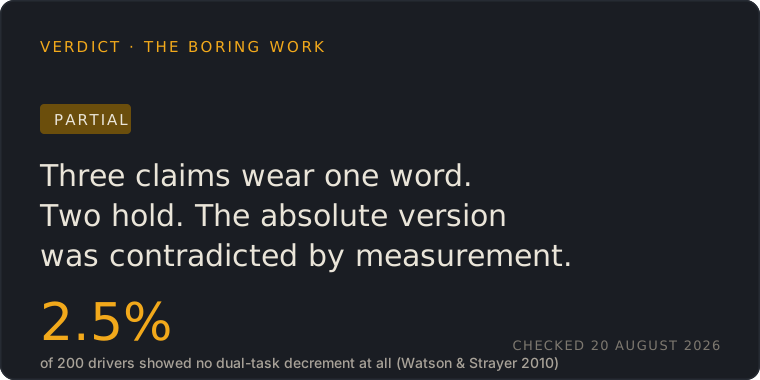
- The absolute version has been contradicted by measurement. Of 200 people tested in a driving simulator while doing a demanding memory task, 2.5% showed no decrement at all on either task.
- Switch costs are real and were measured in seconds, on tasks like classifying shapes and doing arithmetic. They grew with rule complexity and shrank when a cue announced the switch.
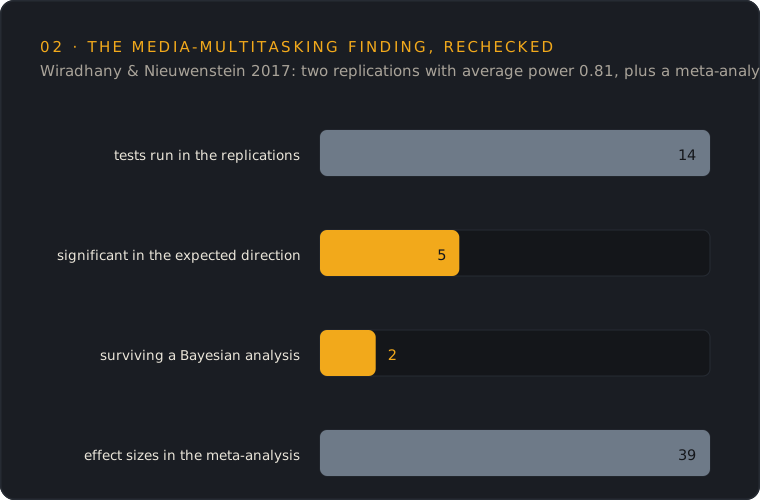
- The famous finding that heavy media multitaskers filter worse did not replicate cleanly. Of 14 tests in two well-powered replications, 5 were significant and 2 survived a Bayesian check; the meta-analysis of 39 effect sizes went non-significant after correcting for small-study effects.
- Two of the numbers everyone quotes do not match their sources. The published figure for resuming interrupted work is 25 minutes 26 seconds with a standard deviation of 54 minutes 48 seconds, and the IQ study was eight people, never published, whose author says the comparison with cannabis was not his.
Everyone now «knows» multitasking is a myth. The fact arrives pre-approved, usually with a brain diagram and a scary number: it costs 10 IQ points, worse than cannabis; it takes 23 minutes and 15 seconds to refocus. Here is what we found when we chased those numbers to their sources: one comes from eight employees of a PR firm in a study that was never published, and its own author has spent twenty years asking people to stop citing it. The other is not the number in the paper. The real science of multitasking is stranger and more interesting than the slogans, and it starts with noticing that «multitasking» is three different things wearing one name.
The three claims, separated
| Claim | Verdict | What was measured | Where the limit is |
|---|---|---|---|
| Nobody can do two demanding tasks at once | Refuted as stated | 200 people in a driving simulator plus a demanding auditory memory task; 2.5% showed no decrement on either, scoring in the top quartile on every single-task measure (Watson & Strayer, 2010) | The exception is 1 person in 40, identified by testing rather than by self-report. For the other 97.5% the decrement was significant |
| Switching between tasks has a cost | Confirmed | Four experiments alternating between classification rules or arithmetic operations; switching-time costs rose with rule complexity and fell when a cue signalled the switch (Rubinstein et al., 2001) | Measured in the seconds around a switch, on laboratory tasks. The paper models it as goal shifting plus rule activation, not as lost hours |
| Heavy media multitaskers filter worse | Partial | Heavy and light groups compared on cognitive control (Ophir et al., 2009); two replications with average power 0.81 found 5 of 14 tests significant, and a meta-analysis of 39 effect sizes turned non-significant after correction (Wiradhany & Nieuwenstein, 2017) | The original direction was the surprising one, and the association is weaker than a decade of citations implies |
| Media multitasking goes with forgetting | Partial | 80 adults with EEG and pupillometry during encoding and retrieval; attention lapses tracked memory failure, and trait lapsing mediated the link between media multitasking and memory (Madore et al., 2020) | Correlational at the trait level. The mechanism named is lapsing attention, not the multitasking itself |
| Multitasking costs 10 IQ points | Refuted | Eight employees of a public relations firm, tested twice, scores falling from 143.38 to 132.75; the only publication was a press release (Wilson, author’s note) | The author states the study was misrepresented and that the comparison with cannabis was drawn by others from unrelated work |
| It takes 23 minutes to refocus | Refuted as stated | 24 information workers observed directly; resuming interrupted work on the same day took an average of 25 min 26 sec, standard deviation 54 min 48 sec, after an average of 2.26 other activities (Mark et al., 2005) | The quoted figure is not the published one, and the published one has a standard deviation twice its mean |
Doing two things at once
Claim one, the absolute version: the brain cannot process two demanding streams at once, full stop, hardware limitation. Stated that way, it is the kind of claim one counterexample can demolish. So researchers went hunting for the counterexample.
Jason Watson and David Strayer put 200 people in a high-fidelity driving simulator, first driving alone, then driving while doing a brutal memory-and-math task out loud. Almost everyone got worse at both, as expected. Almost. Five people, 2.5% of the sample, showed «absolutely no performance decrements» on either task.
These five were not lucky; they were built different. In the solo tests they had already scored in the top quartile on everything, and a statistical simulation confirmed that five such people in 200 is not chance. The researchers gave them a comic-book name: supertaskers.
Before you feel seen: the odds you are one of them are one in forty, and the study found them by testing, not by asking, because asking is useless: people who believe they are great at multitasking tend to be the worst at it. The practical reading is grim enough: 39 out of 40 people got measurably worse at driving a car. But «almost nobody can» is a different sentence from «the brain cannot», and only the second one is a myth.
What a switch costs
Claim two, switching costs, has the cleanest evidence. Researchers had people alternate between tasks, sorting shapes by one rule, then another, or flipping between kinds of arithmetic, and timed the gears grinding.
Alternating was slower, and the pattern of slowing was informative: Task alternation yielded switching-time costs that increased with rule complexity but decreased with task cuing. Those two effects were additive, which supported a model in which switching involves a goal-shifting stage and a rule-activation stage running one after the other.
But mind the units before you apply this to your Tuesday. The costs were measured in seconds around each switch, on shape-sorting and arithmetic. And there was a loophole: when a cue warned that a switch was coming, the cost shrank. Planned alternation is cheaper than ambush by notification.
This modest paper is also the alleged source of the famous claim that task switching devours «40% of your productive time». Follow the citation and you find… reaction-time differences on shape-sorting, measured in seconds. Nobody has ever measured the leap from «half a second per switch in a lab» to «40% of your working week». The percentage is an urban legend wearing a lab coat.
The heavy media multitaskers
In 2009 Eyal Ophir, Clifford Nass and Anthony Wagner built an index of how much of a person’s media time is spent using more than one medium at once, took the heaviest and lightest users, and ran them through standard cognitive-control tasks. The result went the opposite way from the folk theory: heavy multitaskers were more susceptible to interference from irrelevant stimuli and from irrelevant material in memory. This led to the surprising result that heavy media multitaskers performed worse on a test of task-switching ability, likely due to reduced ability to filter out interference from the irrelevant task set.
Delicious irony: the people who multitask constantly were worse at the mental skills multitasking needs. The finding landed in a top journal in 2009 and got cited for a decade as settled fact.
Eight years later, Wisnu Wiradhany and Mark Nieuwenstein ran two replications with an average power of 0.81 (enough to find the effect four times in five if it were there at the original size) and then pooled every published study of the relationship. Of the 14 tests in their replications, 5 were significant in the expected direction, and only 2 of those held up under a more conservative Bayesian analysis. The meta-analysis of 39 effect sizes found a weak but significant association, which then went non-significant after correcting for small-study effects.
Their conclusion is the sentence to carry away: these findings lead us to question the existence of an association between media multitasking and distractibility in laboratory tasks of information processing. Not that the original authors did anything wrong (an underpowered first study finding a real-looking effect is the ordinary way this happens), but that a decade of confident citation was built on something thinner than it appeared.
What survived the recheck
The strongest recent evidence takes a different route. Kevin Madore and colleagues recorded electroencephalography and pupil diameter from 80 young adults during a task that required encoding material with a goal in mind and later retrieving it, and separately measured each person’s sustained attention by task and by questionnaire.
Lapses of attention in the moment before remembering, visible as posterior alpha power and pupil diameter, tracked weaker neural signals of goal coding and more forgetting. Trait-level lapsing then mediated the relationship between media multitasking and memory. Heavier media multitasking is associated with a propensity to have attention lapses and forget.
Worth being precise about what that supports. The within-person part is well controlled: attention lapses in the seconds before an item is remembered predict whether it is remembered. The media multitasking part is correlational, at the level of individual differences, in 80 people. It says the association runs through lapsing attention. It does not say that using two screens caused anything.
Where the ten IQ points came from
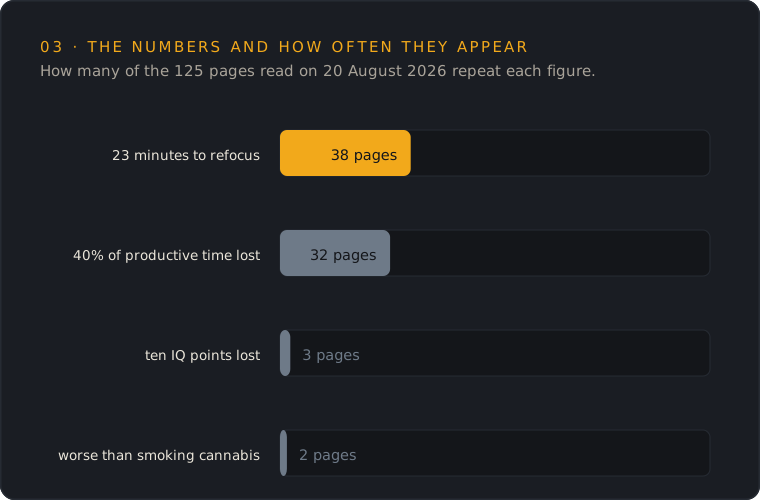
Three of the 125 pages read for this article repeat the claim that multitasking temporarily costs about ten IQ points, and two of them add that this is worse than smoking cannabis. The study behind it can be traced, because its author wrote down what happened.
Now the 10 IQ points. In 2005, psychologist Glenn Wilson was hired by the London PR agency of a computer company for a small demo: eight employees of the PR firm itself, tested twice on an IQ-type test, once in quiet and once amid ringing phones and arriving emails. Scores dropped from about 143 to 133. That is the entire study. Eight people. The only «publication» was a press release.
Wilson’s own account of what happened next: This study was widely misrepresented in the media, with the number of participants for the two aspects of the report being confused and the impression given that it was a published report (the only publication was a press release from Porter-Novelli). He adds that the comparisons with marijuana and sleep loss were based on other people’s published studies, not his, and that their legitimacy is doubtful, since the effect he measured is almost certainly temporary distraction while the others might be more fundamental.
Notice also what the numbers say on their own terms. A mean of 143 in quiet conditions is not a general population; eight people tested twice cannot separate an effect from practice, order or noise; and a drop to 133 is a long way from the version that circulates, in which multitasking reduces adults to the level of a young child.
Where the twenty-three minutes came from
Thirty-eight of the 125 pages say that recovering from an interruption takes 23 minutes, 28 of them to the second (23 minutes and 15 seconds), and most attribute it to Gloria Mark’s group at the University of California, Irvine. That group’s published observational study reports a different number.
Researchers shadowed 24 office workers, coding every task shift. Yes, interruptions were constant: 57% of work threads got interrupted. But the published resumption figure is 25 minutes 26 seconds, not 23:15, and it comes with a standard deviation of 54 minutes 48 seconds, more than double the average.
A spread twice the size of the average means there is no such thing as «the» refocusing time: some people snapped back instantly, some took hours, and the average is a summary of chaos. Quoting it to the second, with that «15 seconds» of false precision, is like saying the average family has 1.94 children and expecting to meet one. Recovery after a longer stretch of distraction is a separate question, with its own timeline and its own studies.
The same group ran a controlled experiment three years later, and its result is almost never quoted alongside the first. People were interrupted every two minutes while working, in contexts either related or unrelated to the main task. The context made no difference. What did happen was that people completed interrupted tasks in less time with no difference in quality, compensating by working faster, and paying for it with more stress, higher frustration, time pressure and effort.
Which is a stranger and more useful result than the folk version: the cost of interruption never showed up on the clock. It showed up in the workers’ bodies, as stress, and in how the work felt to do. You do not lose the 23 minutes. You pay for them in a different currency.
Still on Google
We ran twelve searches on 20 August 2026 and read 125 pages across 96 sites. The claim being counted is the absolute one: that the brain is incapable of processing two demanding tasks at the same time, stated with no exception named.
Forty-two of the 125 state it flat. A productivity guide puts it as your brain cannot process two attention-demanding tasks; a university news page concludes that The most important takeaway is that true multitasking is a myth. Forty-five state the switching cost and name a limit alongside it: the supertaskers, the automatic-plus-simple pairings, the separate sensory modalities. Thirteen report that simultaneous performance happens: a Georgetown release quoting its own author saying the circuitry actually changes so the brain can do two things at once, a National Geographic piece from 2010, a Scientific American report on two goals running concurrently, and nine papers and news items about sex differences in multitasking, which only make sense as a question if the thing exists. Twenty-five never judge the claim.
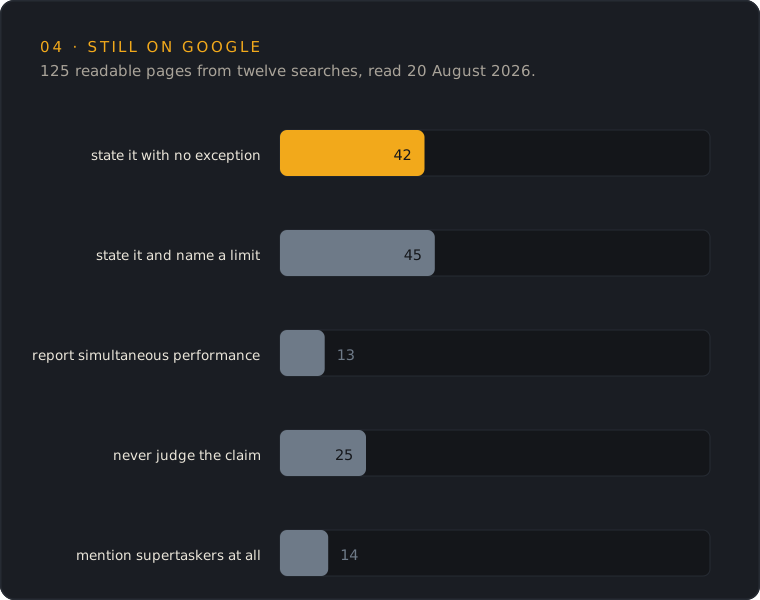
The exception is where the pile thins out. Fourteen of the 125 pages mention supertaskers or the 2.5% figure anywhere in their text. Among the 42 that state the impossibility as settled, three do.
Across the same 125 pages, 38 repeat the 23 minutes, 32 repeat the 40%, and three repeat the ten IQ points. The consistency is remarkable given that the underlying papers report different numbers, different units, or in one case were never published.
Stating the answer carefully
Multitasking exists as a category of behaviour and mostly fails as a strategy. Switch costs are measured and reproducible. The simultaneous version defeats about 97.5% of people on a demanding pair of tasks, which is a strong practical result and not the same as an architectural impossibility, since 2.5% of a two-hundred-person sample did it with no measurable cost.
The part that has weakened is the trait story: that habitual multitaskers have damaged their filtering. That finding did not replicate cleanly, and the pooled association did not survive correction. What replaced it is narrower: people who report more media multitasking also lapse more, and lapsing predicts forgetting.
And the numbers should be dropped. Not because the underlying work is bad (Mark’s observational study and Rubinstein’s experiments are careful pieces of research), but because the figures circulating are either the wrong number, the right number stripped of a standard deviation twice its size, or an unpublished result from eight people whose author has spent twenty years asking people to stop citing it.
What to do with this instead
The shift: stop arguing about whether multitasking is possible and start noticing which of the three things you are doing. Two demanding tasks at once has a large measured cost. Planned alternation has a smaller one. Something automatic in the background has barely been studied at all.
First move: make the switch predictable. Switching costs fell when a cue announced which task was coming, which is a reason to schedule alternation rather than let it arrive by notification.
Second move: watch for lapses rather than for switches. The mechanism that survived the strongest recent study was attention lapsing, and it was visible before the moment of remembering, not after the interruption.
Third move: if you interrupt yourself and finish anyway, check the cost somewhere other than the clock. In the controlled experiment, interrupted work was finished faster and felt considerably worse.
Nothing here is advice about driving, and the simulator result should not be read as one: 97.5% of the people tested got worse at both tasks, and the rare exception was found by measurement rather than by self-assessment. For the wider pattern of a real study becoming a detached number, see how the self-improvement genre treats its sources; the goldfish attention span is another figure that outlived its study, and the method page sets out how each number here was followed back.
The boring bottom line
Switching between demanding tasks costs you something, that cost has been measured in the seconds around each switch, and it gets smaller when you know the switch is coming. Doing two demanding things at once defeated 97.5% of a two-hundred-person sample: a strong reason not to try it, and not the same claim as neurological impossibility.
The three numbers everybody quotes are worse than the research they came from. Twenty-three minutes and fifteen seconds is not the published figure; the published one is 25 minutes 26 seconds with a standard deviation of 54 minutes 48 seconds. The ten IQ points come from eight people in a study that was never published. And when the same group ran a controlled experiment, interrupted work got finished faster, and felt far worse to do.
Sources
- Rubinstein, J. S., Meyer, D. E., & Evans, J. E (2001). Executive control of cognitive processes in task switching. Journal of Experimental Psychology: Human Perception and Performance. 27(4), 763-797. The measurement behind the phrase switch cost. Note the units: the cost is in the seconds around a switch, and it is smaller when you know the switch is coming. doi:10.1037/0096-1523.27.4.763
- Ophir, E., Nass, C., & Wagner, A. D (2009). Cognitive control in media multitaskers. Proceedings of the National Academy of Sciences. 106(37), 15583-15587. The study that started the genre, and the source of the finding that runs backwards from the intuition. doi:10.1073/pnas.0903620106
- Wiradhany, W., & Nieuwenstein, M. R (2017). Cognitive control in media multitaskers: Two replication studies and a meta-analysis. Attention, Perception, & Psychophysics. 79(8), 2620-2641. The check that the original result mostly failed. Included because it is the reason this page does not simply repeat the famous finding. doi:10.3758/s13414-017-1408-4
- Madore, K. P., Khazenzon, A. M., Backes, C. W., Jiang, J., & Uncapher, M. R., et al (2020). Memory failure predicted by attention lapsing and media multitasking. Nature. 587(7832), 87-91. The strongest recent evidence, and note what it says: the multitasking measure works through attention lapses, and the design is correlational at the trait level. doi:10.1038/s41586-020-2870-z
- Watson, J. M., & Strayer, D. L (2010). Supertaskers: Profiles in extraordinary multitasking ability. Psychonomic Bulletin & Review. 17(4), 479-485. Two point five per cent. The exception exists, is rare, and was identified by measurement rather than by asking people whether they were good at it. doi:10.3758/PBR.17.4.479
- Mark, G., Gonzalez, V. M., & Harris, J (2005). No task left behind? Examining the nature of fragmented work. Proceedings of the SIGCHI Conference on Human Factors in Computing Systems. 321-330. The paper behind the famous figure everybody quotes. The measured number is 25 minutes 26 seconds, and its standard deviation is twice its mean. doi:10.1145/1054972.1055017
- Mark, G., Gudith, D., & Klocke, U (2008). The cost of interrupted work: More speed and stress. Proceedings of the SIGCHI Conference on Human Factors in Computing Systems. 107-110. The result that gets left out of every article citing this group. People go faster when interrupted, and pay for it somewhere other than the clock. doi:10.1145/1357054.1357072
- Wilson, G (2005). Infomania experiment for HP (author's note on the study). drglennwilson.com. The author's own written account of the study behind the ten-IQ-points claim, including his statement that the comparison with marijuana was not his and that its legitimacy is doubtful. drglennwilson.com