TL;DR
- Goulston’s «Persuasion Cycle» says people move from resisting to listening to considering to willing to doing, and that listening is what unsticks the first step. The listening half is real. The persuasion payoff is the part that failed its best test.
- That test is a preregistered field experiment with 1,485 US participants in 2025. High-quality nonjudgmental listening improved how the persuader was seen and increased processing — and added exactly nothing to persuasion (Santoro et al., PNAS, 2025).
- The neuroscience chapter is wrong three times over: the «amygdala hijack», the reptile-mammal-primate brain, and Goulston’s own coinage «mirror neuron receptor deficit». Joseph LeDoux, whose lab built the fear-circuit literature, has published that there is no single «fear center» (LeDoux and Pine, American Journal of Psychiatry, 2016).
- Goulston names his own source in the book’s opening chapter: Prochaska and DiClemente’s stages of change, and Miller and Rollnick’s motivational interviewing. Motivational interviewing has 119 studies behind it and an average effect of g = 0.28 (Lundahl et al., Research on Social Work Practice, 2010). The Persuasion Cycle has none.
- Where he is right: high-quality listening measurably changes the speaker — less defensiveness, less extreme attitudes, more clarity about their own view. It just does not make them adopt yours.
Verdict
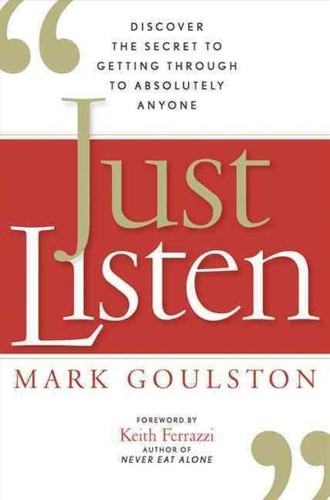
Read the notes. Confidence: high on the mechanism, high on the central claim, moderate on the techniques. «Just Listen» is a book whose behavioural instructions outrun its explanations by a wide margin. The scripts are usable. The brain chapter is a museum of popularizations that neuroscientists have spent fifteen years disowning. And the promise on the cover (getting through to absolutely anyone) is the specific thing the strongest experiment says listening does not deliver.
Take the two-page toolkit. Skip chapters 2 and 3. If you want the tested version of what Goulston is teaching, the author himself tells you where to find it, and we cover the same author’s «Get Out of Your Own Way at Work» among our other book reviews.
The claim on trial
Goulston states the model plainly in the book’s own text. In an excerpt from the 2015 paperback, he writes that «All persuasion moves through the steps of this cycle», and lists them: from resisting to listening, from listening to considering, from considering to willing to do, from willing to do to doing, from doing to glad they did and continuing to do. The lever is «buy-in», and the mechanism is that you get there not by what you tell people but by what you get them to tell you.
That is three testable claims. Resistant people become persuadable once they feel heard. Progress is sequential, so skipping a stage fails. And the named moves — the «oh f*** to OK» drill, the impossibility question, the magic paradox, mirroring, the empathy jolt — reliably produce that movement.
The same excerpt contains the most useful sentence in the book: «In developing the Persuasion Cycle, I was inspired by the ground-breaking work and ideas of James Prochaska and Carlo DiClemente in their “Transtheoretical Model of Change” and by William R. Miller and Stephen Rollnick in their creation of “Motivational Interviewing.”» Goulston hands you his own citation trail. Follow it and you find a clinical literature with thousands of randomized participants. The book then buries that under neuroscience it did not need.
The brain chapter is the weakest part
The amygdala hijack. Goulston has confirmed in his own writing that the term is Daniel Goleman’s coinage, not a finding. LeDoux, whose rat work is the foundation of the whole threat-conditioning literature, spent a decade arguing the popular version away. In 2012 he reframed the circuits as survival circuits whose functions are «not causally related to emotional feelings» (Neuron). In 2016 he and Daniel Pine wrote that the processes lumped under the word fear «reflect different mechanisms rather than operations of one “fear center” or “fear circuit”», and proposed replacing the language of fear centres with defensive circuits. The empirical blow came in 2013: three patients with bilateral amygdala damage inhaled 35 per cent carbon dioxide and had full panic attacks, showing the amygdala is not required for fear and panic at all (Feinstein et al., Nature Neuroscience, 2013).
The three brains. Goulston’s reptile-mammal-primate stack is MacLean’s triune brain. A 2020 review written to correct psychologists on precisely this point calls the layered model long discredited among neurobiologists and notes that specialists on nervous-system evolution are unanimous against it (Cesario, Johnson and Eisthen, Current Directions in Psychological Science, 2020).
Mirror neurons. Goulston’s «mirror neuron receptor deficit» is, by his own account, a theory his clinical findings support — a phrase that means it has never been measured. The scaffolding under it is contested too. Gregory Hickok’s review argued no monkey data directly tests the action-understanding theory and that human evidence makes a strong case against it (Hickok, Journal of Cognitive Neuroscience, 2009). An fMRI adaptation study designed as a clean test found no cross-modal adaptation from execution to observation, which the authors called incompatible with the core assumption of mirror neuron theory (Lingnau, Gesierich and Caramazza, PNAS, 2009). A meta-analysis of 125 fMRI studies found 14 clusters with mirror properties spread across nine Brodmann areas, including primary visual cortex, cerebellum and parts of the limbic system — not a tidy empathy module (Molenberghs, Cunnington and Mattingley, Neuroscience and Biobehavioral Reviews, 2012). And the related «broken mirror» account of autism did not survive systematic review (Hamilton, Developmental Cognitive Neuroscience, 2013).
To be fair to the biology: single neurons with mirror responses do exist in humans, found in medial frontal and medial temporal cortex — outside the classic mirror system, and not where the empathy story puts them (Mukamel et al., Current Biology, 2010). The cells are real. The explanation Goulston hangs on them is not.
What listening does
This is where the book earns its keep, and the credit should be specific. Across four laboratory experiments, speakers who got attentive, nonjudgmental listening reported lower social anxiety and lower defensiveness, became aware of more contradictions in their own position and held it less extremely. In the fourth study, 166 participants, the effects were d = 0.36 on objective attitude ambivalence and d = −0.32 on attitude extremity, with social anxiety down at d = −0.50 (Itzchakov, Kluger and Castro, Personality and Social Psychology Bulletin, 2017). Four further experiments found the same depolarizing effect inside actual disagreements (Itzchakov, Weinstein and Leary, Journal of Personality and Social Psychology, 2024).
Now the fine print that matters for Goulston’s thesis. Five experiments, one preregistered, found high-quality listening raised speakers’ attitude clarity but not attitude correctness, and raised their intention to express the attitude but not their intention to persuade others of it (Itzchakov, DeMarree, Kluger and Turjeman-Levi, Personality and Social Psychology Bulletin, 2018). Listening makes the other person clearer about what they think. It does not make them think you are right.
The workplace correlations are strong and softer than they look. A registered meta-analysis pooling 664 effect sizes and 400,020 observations put perceived listening at r̄ = .39 with work outcomes, .51 with relationship quality and .36 with performance — but 75 per cent of that literature is self-report, and stripping the pure self-report studies drops the listening-performance estimate to r̄ = .21 (Kluger et al., Journal of Business and Psychology, 2023). The best-supported downstream effect is relational: listening is the most direct route to being perceived as responsive (Itzchakov, Reis and Weinstein, Social and Personality Psychology Compass, 2021). As an intervention it has been trialled in organizations at small scale — three quasi-experiments with 31, 66 and 83 employees (Itzchakov and Kluger, Organizational Dynamics, 2017).
Then the head-on test. Trained professional canvassers ran roughly ten-minute video conversations about unauthorized immigration with 1,485 US participants, with two independently randomized factors: whether they shared a persuasive narrative, and whether they practised high-quality nonjudgmental listening. Sharing the narrative durably shifted policy attitudes and reduced prejudice at five weeks. The listening manipulation worked on its own terms (better perceptions of the persuader, more processing, less defensiveness) and did not increase persuasion by any amount. The narrative was just as effective without it (Santoro et al., PNAS, 2025). That is the Persuasion Cycle’s core mechanism, isolated and measured, coming out at zero.
The tested version has another name
Motivational interviewing is what Goulston is doing without the trial data. Across 119 studies it produced small but durable effects against weak comparison conditions, average g = 0.28, and non-significant effects against specific active treatments, g = 0.09 (Lundahl et al., 2010). In medical settings, 48 randomized trials with 9,618 participants gave an odds ratio of 1.55, 95% CI 1.40 to 1.71 (Lundahl et al., Patient Education and Counseling, 2013). Modest, real, replicated. That is what a tested version of «listen them out of resistance» actually looks like.
It also carries a warning Goulston does not. A meta-analysis of 36 primary studies and 3,025 participants tested why motivational interviewing works. Practitioner-consistent skills predicted client change talk at r = .55 — but also sustain talk at r = .40, and sustain talk predicted worse outcomes at r = .19. The relational hypothesis, that empathy and spirit carry the effect, was not supported (Magill et al., Journal of Consulting and Clinical Psychology, 2018). Skilful listening can also draw out more reasons to stay put. Goulston’s model has no term for that.
The other parent of the cycle fared worse. Robert West’s 2005 editorial argued the stages-of-change model should be retired outright, on the grounds that its stage boundaries are arbitrary and it adds nothing over simpler accounts (West, Addiction, 2005). Goulston inherited the staged structure from a model that was already under sustained attack when he wrote.
One technique does have a mechanism behind it. The «oh f*** to OK» drill is affect labelling. Putting feelings into words reduced amygdala and limbic response to negative images and raised right ventrolateral prefrontal activity, with the two inversely correlated (Lieberman et al., Psychological Science, 2007). The caveat is in the review’s own title: affect labelling is implicit emotion regulation, and unlike reappraisal it may not feel regulatory while it happens (Torre and Lieberman, Emotion Review, 2018). Goulston teaches it as a deliberate speed drill, which is not the condition under which it was studied.
The FBI credential and what it proves
Goulston’s marketing rests on training hostage negotiators. The published evidence for that training is thinner than the credential implies. The one efficacy study we found assessed 45 FBI special agents on a role-play test before and after the Bureau’s two-week National Crisis Negotiation Course. Nearly all active-listening skills improved and premature problem-solving attempts fell (Van Hasselt et al., Criminal Justice and Behavior, 2006). No control group, and the outcome is role-play behaviour, not resolution of real incidents. The field’s own reviews describe the approach as practitioner-derived rather than trial-derived (Vecchi, Van Hasselt and Romano, Aggression and Violent Behavior, 2005).
A checked negative, since this is the site’s job. Searching PubMed on 10 August 2026 for the exact phrases «persuasion cycle», «behavioral change stairway» and «empathy jolt» in titles and abstracts returned zero records each. A Crossref bibliographic search for the impossibility question and the empathy jolt returned nothing relevant. None of Goulston’s named techniques has a published trial under its own name. Untested is not the same as refuted — but it is not the same as demonstrated either, and the book presents case files as if they closed the gap.
Who should read it
- Managers and clinicians who learn from worked examples and want concrete phrasings for tense conversations. The scripts are the product.
- People whose default under conflict is to add more argument. The book will slow you down, and slowing down has measured effects on the other person’s defensiveness.
- Not for anyone who wants the neuroscience. Read Miller and Rollnick instead, or the motivational interviewing meta-analyses above.
- Not for anyone buying the cover promise. The best-powered test of that promise found no persuasion gain.
The companion Goulston book is «Get Out of Your Own Way at Work» — good diagnoses, untested cures. «Everyone Communicates, Few Connect» repeats the same misread statistics.
One thing to try
Separate the two goals the book fuses. In your next disagreement, decide in advance that the outcome you are buying with listening is a better relationship and a less defensive counterpart (the effects that replicate) and not their agreement. If you also want to move them, say your piece plainly as well. In the 2025 experiment the persuasive narrative did the persuading, whether or not listening preceded it. Do both, and stop expecting one to substitute for the other.
Get the book
Find «Just Listen» on Amazon — as an Amazon Associate, The Boring Work earns from qualifying purchases (disclosure).
When to see a professional
This page is general information about a communication book and the research behind it, not medical or mental-health advice. Goulston was a psychiatrist and several chapters involve people in crisis, including suicidal patients. If you or someone you are trying to reach is in that situation, the right move is not a script from a business book — contact a licensed clinician, a physician, or your local emergency or crisis line. For substance use or health behaviour change, motivational interviewing is delivered by trained clinicians, and asking for it by name is reasonable.
The boring bottom line
«Just Listen» is a competent behavioural manual with a fabricated engine bolted on. Everything it says about what attentive listening does to the person in front of you is broadly right and now well measured: less defensiveness, less extremity, more clarity, better relationships. Everything it says about why (the hijacked amygdala, the reptile brain, the mirror neuron deficit) is either retired or invented. And the one claim the title sells, that this is how you get through to anyone, is the claim that a preregistered experiment with 1,485 people put to the test and found nothing for. Keep the scripts. Drop the theory. Then go read the literature Goulston himself points at on page one.
Sources
- Goulston, M. «The Persuasion Cycle», edited excerpt from the 2015 paperback of «Just Listen», SmartBrief, 2015
- Goulston, M. «Mirror Neuron Receptor Deficit (MNRD)», Psychology Today, 2010
- Goulston, M. «The Debates: Your Brain on Vitriol», Psychology Today, 2012
- LeDoux and Pine, «Using Neuroscience to Help Understand Fear and Anxiety: A Two-System Framework», American Journal of Psychiatry, 2016
- LeDoux, «Rethinking the Emotional Brain», Neuron, 2012
- Feinstein et al., «Fear and panic in humans with bilateral amygdala damage», Nature Neuroscience, 2013
- Cesario, Johnson and Eisthen, «Your Brain Is Not an Onion With a Tiny Reptile Inside», Current Directions in Psychological Science, 2020
- Hickok, «Eight Problems for the Mirror Neuron Theory of Action Understanding in Monkeys and Humans», Journal of Cognitive Neuroscience, 2009
- Lingnau, Gesierich and Caramazza, «Asymmetric fMRI adaptation reveals no evidence for mirror neurons in humans», PNAS, 2009
- Molenberghs, Cunnington and Mattingley, «Brain regions with mirror properties: A meta-analysis of 125 human fMRI studies», Neuroscience and Biobehavioral Reviews, 2012
- Hamilton, «Reflecting on the mirror neuron system in autism: A systematic review of current theories», Developmental Cognitive Neuroscience, 2013
- Mukamel et al., «Single-Neuron Responses in Humans during Execution and Observation of Actions», Current Biology, 2010
- Itzchakov, Kluger and Castro, «I Am Aware of My Inconsistencies but Can Tolerate Them», Personality and Social Psychology Bulletin, 2017
- Itzchakov, DeMarree, Kluger and Turjeman-Levi, «The Listener Sets the Tone», Personality and Social Psychology Bulletin, 2018
- Itzchakov, Weinstein and Leary, «Listening to understand: The role of high-quality listening on speakers’ attitude depolarization during disagreements», Journal of Personality and Social Psychology, 2024
- Kluger et al., «A Meta-analytic Systematic Review and Theory of the Effects of Perceived Listening on Work Outcomes», Journal of Business and Psychology, 2023
- Itzchakov, Reis and Weinstein, «How to foster perceived partner responsiveness: High-quality listening is key», Social and Personality Psychology Compass, 2021
- Itzchakov and Kluger, «The Listening Circle», Organizational Dynamics, 2017
- Santoro et al., «Listen for a change? A longitudinal field experiment on listening’s potential to enhance persuasion», PNAS, 2025
- Lundahl et al., «A Meta-Analysis of Motivational Interviewing: Twenty-Five Years of Empirical Studies», Research on Social Work Practice, 2010
- Lundahl et al., «Motivational interviewing in medical care settings», Patient Education and Counseling, 2013
- Magill et al., «A meta-analysis of motivational interviewing process», Journal of Consulting and Clinical Psychology, 2018
- West, «Time for a change: putting the Transtheoretical (Stages of Change) Model to rest», Addiction, 2005
- Lieberman et al., «Putting Feelings Into Words», Psychological Science, 2007
- Torre and Lieberman, «Putting Feelings Into Words: Affect Labeling as Implicit Emotion Regulation», Emotion Review, 2018
- Van Hasselt et al., «Crisis (Hostage) Negotiation Training», Criminal Justice and Behavior, 2006
- Vecchi, Van Hasselt and Romano, «Crisis (hostage) negotiation: current strategies and issues in high-risk conflict resolution», Aggression and Violent Behavior, 2005