Every claim on this site gets a grade, a date and a list of the papers behind it. This one sits in the registry of checked claims.
TL;DR
- The famous result came from three laboratory experiments in 2014: students who typed notes on a laptop did worse on conceptual questions than students who wrote by hand.
- The direct replication, published in 2019 with two extra groups, found that performance did not consistently differ between any of the groups, including the group that took no notes at all.
- Pooling the direct replications gave a small effect favouring longhand that was not statistically significant. The replicating authors’ own conclusion: calling either method superior is premature.
- What did replicate is the description of the notes, not the learning. Laptop users write more words, more ideas and more verbatim strings; longhand users draw more and mark up more.
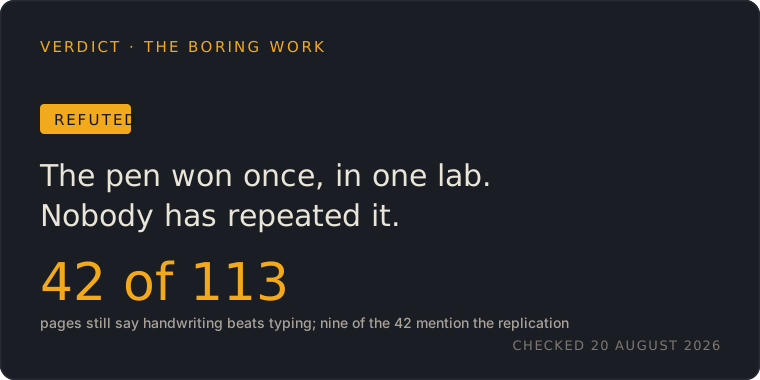
- Of the 113 pages we could read on 20 August 2026, forty-two say handwriting beats typing. Twenty-seven mention that the finding has been through direct replication, and only nine of those twenty-seven are among the forty-two.
Somewhere right now a professor is banning laptops from a lecture hall, citing science. Behind the citation sits one 2014 study with a slogan for a title, The Pen Is Mightier Than the Keyboard, and here is what the professor has not heard: when another lab repeated the experiment with the original materials, the pen’s advantage evaporated. Even the students who took no notes at all scored about the same. This page is the story of one quotable experiment, one unquotable correction, and a decade of classroom policy built on the first while ignoring the second.
The study that started it
In 2014 Pam Mueller, then at Princeton, and Daniel Oppenheimer, then at the University of California, Los Angeles, published three experiments in Psychological Science under a title that guaranteed its own travel: The Pen Is Mightier Than the Keyboard.
The setup was clean. Princeton and UCLA students watched recorded talks and took notes by hand or on laptops with the internet switched off, so distraction was ruled out by design. Then came a quiz. On factual questions, the groups tied. On conceptual «why» questions, the typists did worse.
The authors’ explanation was never about the magic of ink. It was about speed. Most people type fast enough to transcribe a lecture word for word, and transcription is stenography, not thinking. A hand is too slow to copy, so it must choose, compress, rephrase, and the choosing is where learning happens. That mechanism, note, is the one part of the paper that aged well.
The 2014 paper also has a correction attached to it, published in the same journal in 2018 and running to four pages. We note its existence because it is part of the record; its contents sit behind a paywall and we have not read them.
It is worth being exact about what the experiments measured, because the conditions are narrow. Students watched a recorded talk once, took notes, were distracted with an unrelated task, and were tested about half an hour later. No revision week, no course, no exam that mattered to them. A finding from that setup is a statement about one lecture and one short test, not about a degree.
What happened when it was repeated
In 2019 Kayla Morehead, John Dunlosky and Katherine Rawson at Kent State University published a direct replication in Educational Psychology Review, using the original materials and adding two groups the original did not have: students taking notes on eWriters, and students taking no notes at all.
The Kent State verdict, in the authors’ own words: some trends hinted at a longhand edge, but «performance did not consistently differ between any groups», including the group that wrote nothing whatsoever. Once students got to review their notes, even the trends faded. Pooling all the direct replications: a small, statistically non-significant lean toward the pen. Nothing a policy could stand on.
Their conclusion is a sentence worth reading twice: based on the present outcomes and other available evidence, concluding which method is superior seems premature.
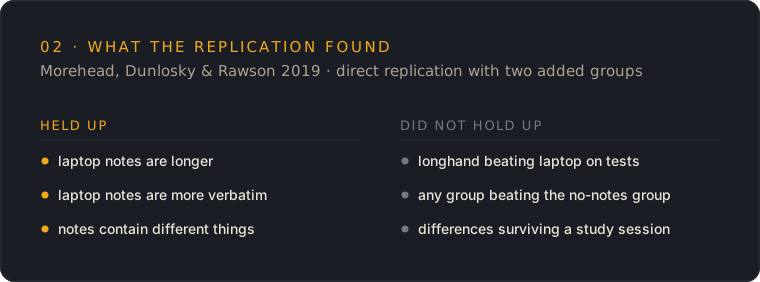
Pause on that no-notes group, because it detonates the whole debate. If students who stared at the lecture empty-handed scored about the same as both kinds of note-takers, then this test could not even detect the benefit of note-taking itself, never mind crown a superior stationery. The instrument was too blunt for the argument being waged with it.
Replication in this field is harder than it sounds, and the authors handled the usual objection in advance. They used the original materials and added their own questions, then reran the planned comparisons on the original questions alone to check that the new items were not driving the result. The conclusions came out the same either way.
A detail the replication states about itself
The replication was funded by a National Science Foundation grant titled STTR Phase II: Digital e-Writer for the Classroom, and one of the added conditions was note-taking on an eWriter. That is a funding interest in digital writing tools, disclosed in the paper.
We mention it because we would mention it if the result had gone the other way. What limits its weight here is the direction: the funding favoured the digital device, and the finding was that no method beat any other, including plain paper.
And one detail almost never survives the retelling: the laptops in the famous study had no internet. Every op-ed slides from «typing is shallow» into «laptops mean Instagram in lectures», but distraction was engineered out of the experiment. The distraction worry is real, and better evidenced, and it is a different claim wearing the same headline.
The notes do differ
Something did replicate, solidly, every time: the notes themselves are different animals. Nebraska researchers counted what lands on the page. Typists capture more: more words, more ideas, more exact quotes. Handwriters draw: arrows, underlines, diagrams, a map instead of a transcript. Same lecture, two different artefacts.
Laptop note takers recorded more idea units, more words and more verbatim strings from the lecture. Longhand note takers recorded more signals and images: arrows, underlines, diagrams. Two different objects come out of the same lecture.
What that study adds is the condition under which each wins. They separated two functions of note-taking: the process function, which is what happens while you write, and the product function, which is what happens when you read the notes later. With laptop notes, the process function did more work; with longhand notes, the product function did. Their conclusion is that the best medium depends on the kind of lecture and on whether the notes get reviewed at all.
That distinction, process against product, is older than the laptop argument and does more work than it. Notes have two jobs: they change what happens in your head while you write them, and they exist afterwards as a record to come back to. A medium can be good at one and bad at the other, which is exactly what the Nebraska data show. Typing captures more, so the record is better; handwriting forces selection, so the writing does more.
The part nobody argues about
Underneath the medium war there is a settled question with a number on it. Keiichi Kobayashi pooled 57 studies comparing note-taking with no note-taking, in conditions where nobody was allowed to review their notes afterwards: 131 independent samples, 306 effect sizes.
The mean weighted effect size was 0.22. Positive, modest, and about the act itself rather than the tool. That analysis also found that the benefit shows up more on recall tests than on recognition tests, and that visually presented material interferes with taking notes at all: you cannot watch a slide and write at the same time.
So the defensible version of the advice is: take notes, and review them. Both halves have better evidence behind them than the choice of instrument.
Put the two literatures together and the practical picture is clear enough. Taking notes helps a little. Reviewing them helps more. The medium changes what lands on the page, and whether that matters depends on what the lecture contained and whether you ever open the notes again. None of those three sentences is as quotable as the pen being mightier than the keyboard, which is precisely why the quotable version travelled.
Why this shape keeps happening
Step back and the 2014 study is a textbook specimen of the finding that travels too well: modest sample, big effect, a mechanism that flatters intuition, and a title that does the marketing by itself. Each of those features speeds a claim around the world. None of them makes it true.
The travel had consequences. Universities changed laptop policies, lecturers quoted the finding at the start of term, and a genre of articles about the neuroscience of handwriting grew on top of it. None of that machinery reversed when the replication arrived.
And the correction had a publicity problem the original never faced: a null result has no slogan. «The Pen Is Mightier Than the Keyboard» fits on a slide. «Four groups performed about the same» does not open anyone’s first lecture of term. The claim shipped with a title; the correction shipped with a table.
Still on Google
On 20 August 2026 we ran ten searches, among them is it better to take notes by hand or laptop research and “pen is mightier than the keyboard” replication failed Mueller Oppenheimer criticism, and read every page the results returned. We read 113 pages across 98 sites. Forty-two state that handwriting beats typing for learning without naming a limit. Twenty-three state it and add a condition. Eighteen say the advantage does not hold, and thirty give note-taking advice without judging the comparison.
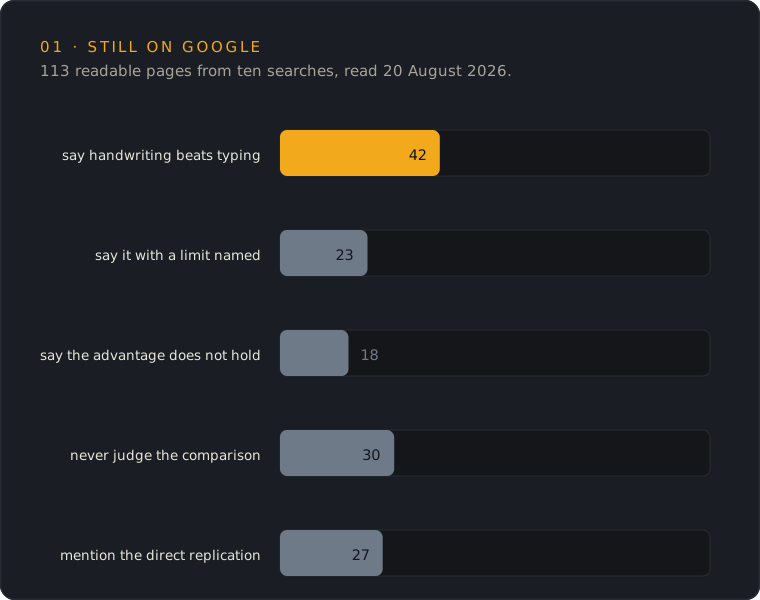
Then we checked the second thing. Twenty-seven of the 113 mention that the original finding has been through direct replication. Eighty-six do not, including a national broadcaster’s report, several universities’ own study-skills guidance, and most of the articles about the neuroscience of writing by hand. Among the 42 pages that assert the advantage, nine mention the replication at all: four fifths of the pages making the claim are written as though the check never happened.
The four dissenting pages are worth naming because of who they are: an education news outlet, a university science office, a psychologist writing in a popular magazine, and two schoolteachers who ran the comparison on their own seventh-graders and got the opposite result to the one they expected.
Lastly, the brain-scan articles now propping up the claim: yes, studies find «more widespread neural connectivity» during handwriting than typing. But brain activity is not learning, any more than a brightly lit office is productivity. More glow on the scan proves nothing about understanding until someone tests understanding, and when someone did, the groups came out level.
What to do with this instead
The shift: the instrument is not the variable. What you do with the instrument is, and that has been measured separately.
First move: stop transcribing. The mechanism in the original paper was verbatim capture, and it is available on paper too. Selecting and rephrasing is the behaviour worth copying, whichever device is in front of you.
Second move: plan to reread. In the replication, differences between methods shrank once students studied their notes; in the Nebraska work, whether notes were reviewed decided which medium came out ahead.
Third move: match the tool to the material. Diagrams, arrows and spatial layout are cheap by hand and expensive on a keyboard. Dense verbal content with no visuals is the opposite.
None of this applies to children learning to form letters, which is a different literature about a different question, and none of it is guidance for anyone whose handwriting or typing is affected by a disability, where the tool that reduces effort is the right tool. For the wider pattern of a single striking experiment becoming a rule, the piece on the self-improvement genre covers the same machinery.
Laptop bans are not the only classroom policy that outran its evidence. Teaching to learning styles is the better-known case: believed by most teachers surveyed, and never confirmed by the experiment that would settle it.
The boring bottom line
One lab found handwriting better in 2014. The direct replication found no consistent difference between longhand, laptop, an eWriter, or taking no notes at all, and the pooled replications produced a small non-significant edge for longhand. The replicating authors say calling a winner is premature, and they had funding that would have preferred a different answer.
What survives is duller and better evidenced: taking notes beats not taking them by about 0.22 of a standard deviation, transcribing word for word is the thing to avoid, and rereading them is where most of the value sits.
Sources
- Mueller, P. A., & Oppenheimer, D. M (2014). The pen is mightier than the keyboard: Advantages of longhand over laptop note taking. Psychological Science. 25(6), 1159-1168. The study behind every laptop ban. Its own explanation is about verbatim transcription, not about the pen. doi:10.1177/0956797614524581
- Mueller, P. A., & Oppenheimer, D. M (2018). Corrigendum: The pen is mightier than the keyboard: Advantages of longhand over laptop note taking. Psychological Science. 29(9), 1565-1568. Listed for the record: a correction to the 2014 paper exists, published in the same journal four years later. Its contents are behind a paywall and are not described here. doi:10.1177/0956797618781773
- Morehead, K., Dunlosky, J., & Rawson, K. A (2019). How much mightier is the pen than the keyboard for note-taking? A replication and extension of Mueller and Oppenheimer (2014). Educational Psychology Review. 31(3), 753-780. The direct replication. Its most uncomfortable result is not that longhand lost — it is that the no-notes group kept up. doi:10.1007/s10648-019-09468-2
- Kobayashi, K (2005). What limits the encoding effect of note-taking? A meta-analytic examination. Contemporary Educational Psychology. 30(2), 242-262. The number for the part of the question nobody argues about: taking notes at all, measured against not taking them. doi:10.1016/j.cedpsych.2004.10.001
- Luo, L., Kiewra, K. A., Flanigan, A. E., & Peteranetz, M. S (2018). Laptop versus longhand note taking: Effects on lecture notes and achievement. Instructional Science. 46(6), 947-971. The study that stops treating this as one question. The answer changes depending on the lecture and on whether anybody reads the notes again. doi:10.1007/s11251-018-9458-0