Every claim on this site gets a grade, a date and a list of the papers behind it. This one sits in the registry of checked claims.
TL;DR
- We counted the psychometric literature on four instruments in one index, using one query each, on 20 August 2026. Big Five inventories: 281 papers. Myers-Briggs: 20. Enneagram: 3. DISC: none; the eleven records the DISC query returns are about spinal discs, optic discs and a jaw joint.
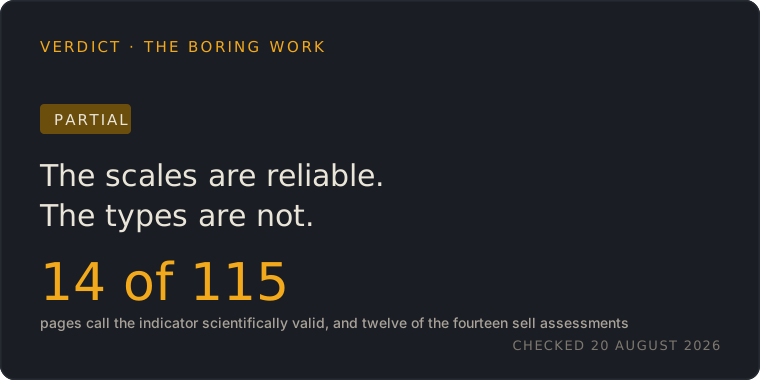
- Of the 115 pages we read on whether the Myers-Briggs indicator is scientifically valid, fourteen say it is. Twelve of those fourteen sell personality assessments or certification in them.
- The instrument’s scales are decently reliable and they map onto dimensions the trait model already measures. What fails is the step from scales to types: a study of 529 people found the link between type and leadership behaviour weak.
- The Enneagram’s central claim has never been recovered from data. A review of 104 samples reports that factor analyses typically find fewer than nine factors and that no study has derived the nine types by clustering.
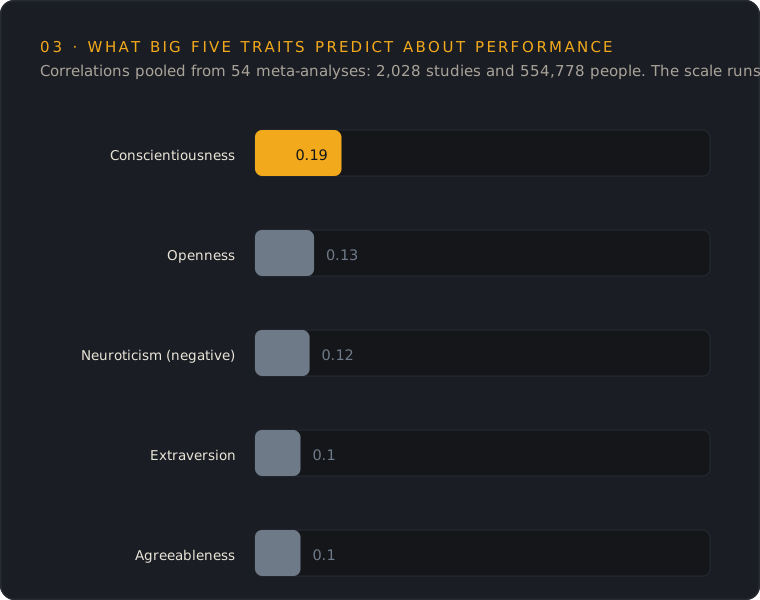
- The best-supported model is not powerful either. Across 54 meta-analyses covering 554,778 people, conscientiousness correlates with performance at 0.19 and the other four traits at around 0.10.
Every office has lived through it: the team-building day where everyone is sorted into four letters or nine numbers, and by lunch people are explaining their lateness with «I’m a P, we improvise». Which of these tests is the real one? Ask the internet and you get instant answers with charts. Ask where the answers come from and the trail dissolves into blogs citing blogs, plus the occasional «technical manual» published by the company selling the test. So we did the one thing that cannot be argued with: we counted.
The count
Four instruments, one index, one query each, run on 20 August 2026. The index is PubMed, which carries the medical and psychological journals. The queries are restricted to titles and abstracts and to psychometric words, and they are printed here so that anyone can repeat them:
"Myers-Briggs Type Indicator"[tiab] AND (validity[tiab] OR reliability[tiab] OR psychometric[tiab]): 20 records"Enneagram"[tiab] AND (validity[tiab] OR reliability[tiab] OR psychometric[tiab]): 3 records("DISC assessment"[tiab] OR "DISC personality"[tiab] OR "DISC model"[tiab] OR "DiSC profile"[tiab]) AND (validity[tiab] OR reliability[tiab] OR psychometric[tiab]): 11 records, none of them about the personality instrument("NEO-PI"[tiab] OR "NEO PI-R"[tiab] OR "Big Five Inventory"[tiab]) AND (validity[tiab] OR reliability[tiab] OR psychometric[tiab]): 281 records
The DISC result is the punchline of the whole page. Eleven records come back, and every single one is about a different kind of disc: spinal discs, optic discs in glaucoma, the cartilage disc in the jaw joint. The scientific literature on the DISC personality assessment, in the main biomedical index, consists entirely of anatomy. The test most used in corporate hiring has the ghostliest presence in the research, and the gap is not close.
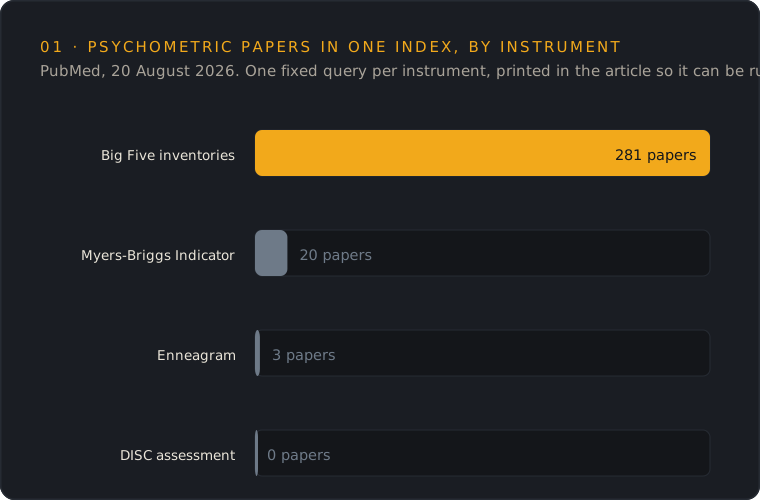
One more number fell out of the counting. Across all 304 records, not a single author listed an affiliation with a company that sells the test being studied. The vendors are not publishing in the scientific literature at all, which is worth holding next to the fact that their own sales manuals are the documents most often waved as proof.
What the count does not say: it gives no total for how many studies exist in the world. PubMed covers medicine and clinical psychology thoroughly and organisational psychology less so, so these are counts of how much of each instrument’s psychometric literature reaches the main biomedical index. That is a narrower claim than “how much evidence exists”, and it is the reason the queries are printed rather than summarised.
The four instruments side by side
| Instrument | What it produces | Who owns it | Papers in the index | Verdict |
|---|---|---|---|---|
| Big Five inventories (NEO-PI-R, Big Five Inventory) | Five continuous trait scores | NEO-PI-R sold by a test publisher; the Big Five Inventory is free to use | 281 | Confirmed as a measure, but a weak predictor |
| Myers-Briggs Type Indicator | One of 16 types from four either-or splits | The Myers-Briggs Company | 20 | Partial: the scales hold, the types do not |
| Enneagram | One of nine types, plus wings and movement | Competing commercial schools | 3 | Untested: the nine-type structure has never been recovered from data |
| DISC assessment | A four-letter behavioural style profile | Licensees including TTI Success Insights, Wiley and PeopleKeys | 0 | Untested in this index |
The Myers-Briggs: reliable scales, unreliable types
The Myers-Briggs’ problem is not the questionnaire; it is the sorting hat bolted onto it. The oldest paper in the pile, from 1977, is favourable: the scales are «adequately reliable». Note what that praises: the ruler, not the boxes. The trouble starts when a continuous score gets chopped at the middle into E-or-I, like sorting all of humanity into «tall» and «short» and insisting there are two kinds of people.
What the scales are measuring turns out to be familiar. Jerome Tobacyk and colleagues gave both the indicator and a Big Five questionnaire to 57 Polish university students and found the same pattern of correlations reported in American samples: the extraversion scale tracks trait extraversion, sensing-intuition and judging-perceiving track openness, and judging-perceiving also tracks conscientiousness (Tobacyk et al., 2008). Fifty-seven people, and the authors call the study preliminary. Taken with the wider literature it points somewhere specific: the four letters are a re-description of four of the five trait dimensions, with the fifth, neuroticism, missing.
Then comes the question the instrument is sold to answer. Rodrigo Zárate-Torres and Juan Correa, at business schools in Colombia, tested whether type predicts leadership behaviour in 529 graduate and undergraduate business students, running confirmatory factor models on both instruments under reproducible-research standards. The measurement models held. The prediction did not: “the relationship between MBTI and the leadership practices inventory proved to be weak” (Zárate-Torres & Correa, 2023).
What the first page of Google says about it
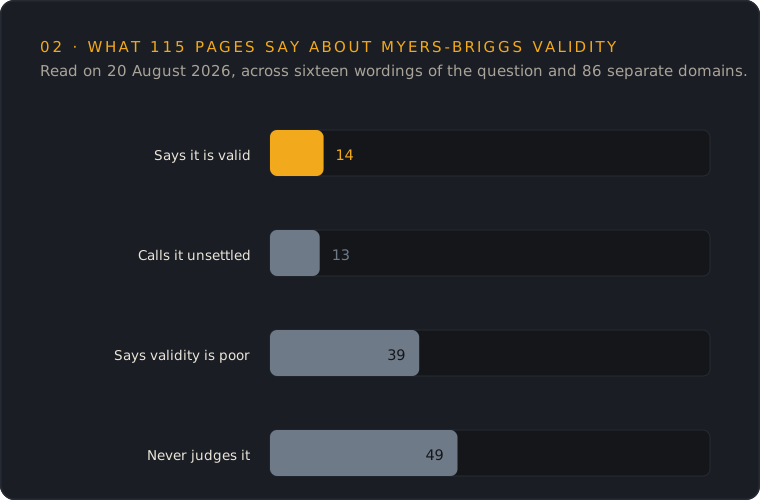
On 20 August 2026 we ran sixteen wordings of the question (is the Myers-Briggs test scientifically valid, is MBTI accurate reliable personality test, is Myers-Briggs pseudoscience criticism, which personality test has the most scientific evidence and twelve more) and read every page they returned: 115 pages across 86 domains.
Fourteen of the 115 state that the indicator is scientifically valid. Twelve of those fourteen sell personality assessments, certification in them, or both. Thirty-nine pages take the opposite position, thirteen present the question as unsettled or recommend the instrument while conceding weak validity, and forty-nine never judge it. The fourteen include the publisher’s own site, whose page on the subject is titled to answer the question before you read it, and a company page reporting that “each of the four preference scales has internal consistency reliability of .90 or greater”, a statement about scales, offered as an answer about types.
The Enneagram: nine types nobody has found
The structure is the claim, and the structure has never come out of the data. Joshua Hook and colleagues, psychologists at the University of North Texas and Biola University, reviewed the empirical literature across 104 independent samples. Their review is sympathetic in tone: it notes that subscales relate to Big Five traits in the directions theory predicts, and that several studies found the system useful for personal growth. It also reports the finding that matters: “factor analytic work has typically found fewer than nine factors, and no work has used clustering techniques to derive the nine types” (Hook et al., 2021). Support for wings and for movement between types under stress was thin as well.
Read that again, because it is the quiet scandal of the system: the nine Enneagram types were never discovered in anyone’s data. They were proposed first, from spiritual tradition, and questionnaires were then built to sort people into them. When statistics goes looking for the seams between the nine types, it keeps finding fewer than nine. The map was drawn before anyone surveyed the territory.
What the well-supported one predicts
Less than its reputation suggests. Ethan Zell and Tara Lesick at the University of North Carolina at Greensboro pooled 54 meta-analyses (2,028 studies, 554,778 people) to ask what Big Five traits predict about performance. Conscientiousness came out strongest at 0.19; extraversion, agreeableness, neuroticism and openness landed at 0.10, 0.10, −0.12 and 0.13 (Zell & Lesick, 2022). Broken down, conscientiousness with job performance is 0.20 and with academic performance 0.28.
A correlation of 0.19, measured on half a million people, is thoroughly real and disappointingly small: it leaves well over 90% of the differences in performance unexplained. Sit with that. The most scientifically decorated personality model in existence predicts who will do well at work about as well as a whisper predicts the weather. Everyone selling a stronger claim is overselling the best case, never mind the letters and numbers.
There is a further constraint underneath all of this, and it applies to every instrument on the page. Brent Roberts and Wendy DelVecchio compiled 3,217 test-retest correlations from 152 longitudinal studies and found that personality itself is only partly stable: consistency runs at .31 in childhood, .54 through the college years, .64 at age 30, and plateaus near .74 between 50 and 70 (Roberts & DelVecchio, 2000). The people most likely to be handed a personality test, students and new hires in their twenties, sit at the least stable end of that curve.
Why they feel accurate anyway
Then why does your type description feel so uncannily you? Psychology named this in 1949, when Bertram Forer gave his students a «personalised» personality sketch and asked them to rate its accuracy. They rated it superb. Every student had received the same text, stitched together from newspaper horoscopes (Forer, 1949). A description vague enough to fit almost anyone reads, to any one person, as a portrait.
Someone has since measured the two together. Jing Hua and Yu-Xin Zhou surveyed 308 Chinese high-school students on their use of type descriptions and on their susceptibility to generic personality statements, and found that “a higher level of MBTI use triggers a stronger Barnum effect” (Hua & Zhou, 2023). Their models also linked that effect to firmer identity and higher well-being. One age group, one country, and a cross-sectional design, so the arrows are modelled rather than observed. What it does establish is that the recognition people report is measurable, and that it tracks exposure to the system rather than accuracy of the description.
This is the same machinery that makes a strongly worded book about difficult colleagues feel like it was written about your office, which is the trouble with type-based advice books generally. It is also why a type description that flatters is more persuasive than one that does not, a pattern running through the wider self-improvement genre.
Where the limits are
The counts are counts in one index under one query each, and a different index or a looser query gives different numbers. That is why both are printed. The Polish comparison rests on 57 students and says so. The leadership test is 529 business students in one country, which is a narrow slice of the people who get typed at work. The Barnum measurement is one age group in one country. And the ceiling on all of it is that personality itself is only about three-quarters consistent even in the most stable decades of life.
And here is the market’s cruel joke: the instrument that wins on evidence is a plain set of five numbers, no letters, no archetypes, nothing to put in a dating profile. «Slightly above average in conscientiousness» is accurate and utterly unshareable. «INFJ, the rarest type, the Advocate» is a story. Stories travel; error bars do not, which may be the entire history of this industry in one sentence.
What to do with this instead
The shift: ask what a test predicts, not what it says about you.
First move: when a page tells you an instrument is scientifically validated, check what the sentence is about. Internal consistency of .90 describes whether the questions hang together. It says nothing about whether the resulting category predicts anything, and the two get quoted interchangeably.
Second move: check who is doing the telling. Twelve of the fourteen pages we read that answer yes sell assessments or certification. Selling something does not make the claim wrong, and it is a reason to want the claim from someone else too.
Third move: treat a type as a vocabulary, not a measurement. The four letters do track real trait dimensions, which is why they often feel apt. What they do not do is hold their value at the boundary between one letter and its opposite, and that boundary is where the whole system does its work.
The boring bottom line
One of these four instruments has 281 psychometric papers behind it in the index we searched, and the other three have 20, 3 and none. The one with the papers is free to use and predicts performance at a correlation of 0.19. The one with the certification programme produces categories that a study of 529 people found weakly related to the behaviour it is sold to inform. The one with nine types has never had those nine types recovered from data.
The tests are not measuring nothing. They are measuring four of five well-established dimensions, then cutting each in half and handing you the half. The cut is where the evidence stops and the merchandise begins.
Sources
- Zell, E., & Lesick, T. L (2022). Big five personality traits and performance: A quantitative synthesis of 50+ meta-analyses. Journal of Personality. 90(6), 1355-1370. The largest available estimate of what a personality trait predicts about performance, and the numbers are small even for the best-supported model. doi:10.1111/jopy.12683
- Roberts, B. W., & DelVecchio, W. F (2000). The rank-order consistency of personality traits from childhood to old age: A quantitative review of longitudinal studies. Psychological Bulletin. 126(1), 3-25. The ceiling any personality measure is working under: even the trait itself is only partly stable, and least stable in the young adults who take these tests most. doi:10.1037/0033-2909.126.1.3
- Hook, J. N., Hall, T. W., Davis, D. E., Van Tongeren, D. R., & Conner, M (2021). The Enneagram: A systematic review of the literature and directions for future research. Journal of Clinical Psychology. 77(4), 865-883. The review is sympathetic in tone and still reports that the central structural claim of the system has never been recovered from data. doi:10.1002/jclp.23097
- Zarate-Torres, R., & Correa, J. C (2023). How good is the Myers-Briggs Type Indicator for predicting leadership-related behaviors?. Frontiers in Psychology. 14, 940961. One of very few direct tests of whether the instrument predicts the behaviour it is sold to inform. doi:10.3389/fpsyg.2023.940961
- Carlyn, M (1977). An assessment of the Myers-Briggs Type Indicator. Journal of Personality Assessment. 41(5), 461-473. The case for the instrument, stated by a reviewer rather than by the publisher. Its own conclusion is about reliability, not about what the scores predict. doi:10.1207/s15327752jpa4105_2
- Tobacyk, J. J., Livingston, M. M., & Robbins, J. E (2008). Relationships between Myers-Briggs Type Indicator measure of psychological type and NEO measure of big five personality factors in Polish university students. Psychological Reports. 103(2), 588-590. Fifty-seven people, and the authors call it preliminary. It matters because it shows the type scales tracking the same underlying dimensions the trait model already measures. doi:10.2466/pr0.103.2.588-590
- Hua, J., & Zhou, Y. X (2023). Personality assessment usage and mental health among Chinese adolescents: A sequential mediation model of the Barnum effect and ego identity. Frontiers in Psychology. 14, 1097068. A measurement of the feeling of accuracy rather than of accuracy. The population is one age group in one country, and the design is cross-sectional, so the arrows are modelled rather than shown. doi:10.3389/fpsyg.2023.1097068
- Forer, B. R (1949). The fallacy of personal validation: A classroom demonstration of gullibility. The Journal of Abnormal and Social Psychology. 44(1), 118-123. The paper that named the phenomenon. Its title is the finding. doi:10.1037/h0059240