TL;DR
- In 2017, Nobel laureate Daniel Kahneman did something authors almost never do: he publicly admitted one chapter of his bestseller was built on studies too weak to trust. «I placed too much faith in underpowered studies» — his words, under his own name, in a blog comment.
- The bitter irony, which he pointed out himself: the very first paper he ever published, in 1971, was about exactly this mistake.
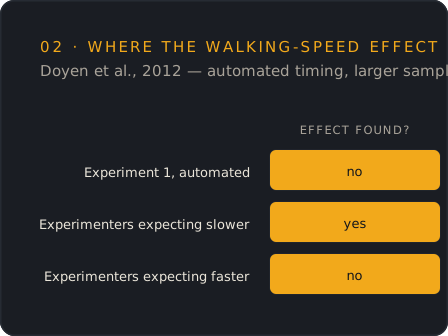
- The famous «read words about old age, walk slower» study? It only worked when the experimenters expected it to work.
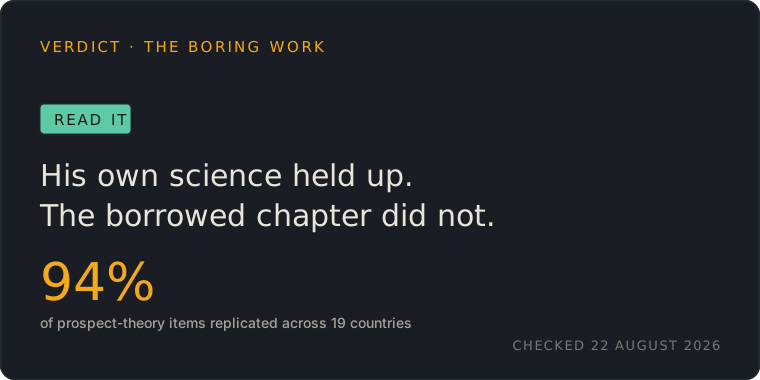
- But his own science held up beautifully: prospect theory was retested in 19 countries with 4,098 people and «replicated for 94% of items».
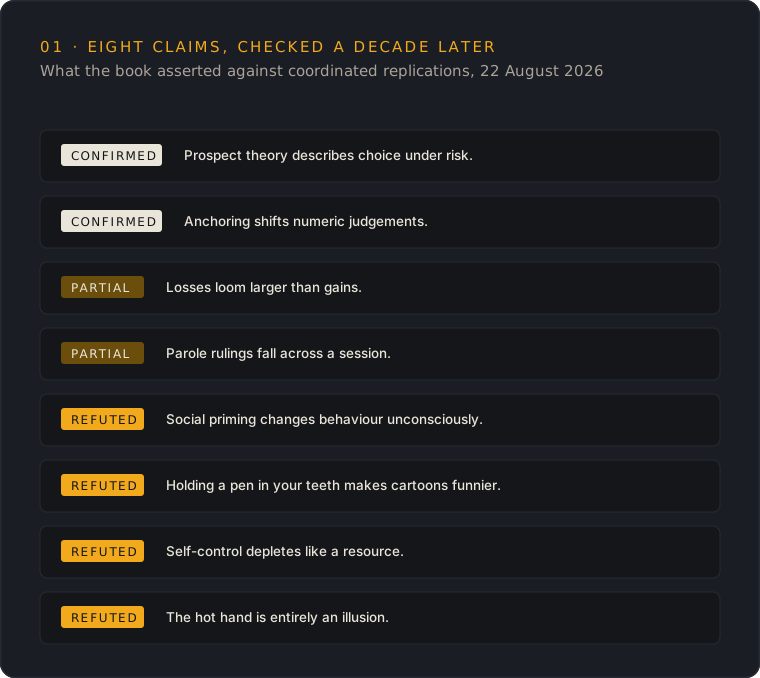
- And the «hot hand is an illusion» claim collapsed too — the illusion turned out to be a counting mistake.
Verdict
Read it — with one chapter mentally marked in red. The book is two books in one. The first is Kahneman’s own life’s work, which has since been retested on a massive scale and passed. The second is a thin layer of other researchers’ flashy experiments that he trusted too much — and which fell apart. What makes this story remarkable is that he admitted it himself, in public, unprompted. Almost nobody in this genre ever does.
What the author said in 2017
Picture the scene. You are the most famous living psychologist, a Nobel laureate, author of a book that sold millions. And one day a statistician publishes a detailed post showing that the studies in chapter 4 of your book — the chapter where you told readers that «disbelief is not an option» — are statistically too flimsy to believe.
Most authors would stay silent. Some would lawyer up. Kahneman went to the comments section. On 14 February 2017 he wrote, under his own name: «I accept the basic conclusions of this blog… What the blog gets absolutely right is that I placed too much faith in underpowered studies» (Kahneman, 2017).
«Underpowered» is statistics-speak for a simple thing: a study with too few participants to tell a real effect from luck. Flip a coin eight times, get six heads, and you might convince yourself the coin is rigged. Small studies fool researchers the same way.
Then Kahneman twisted the knife himself: «there is a special irony in my mistake because the first paper that Amos Tversky and I published was about the belief in the “law of small numbers,” which allows researchers to trust the results of underpowered studies with unreasonably small samples». The man who discovered the trap, forty years later, walked into it.
So this page is not an exposé — the author got there first. It is the inventory: what happened, in the years after publication, to each big claim in the book.
Chapter 4, and what happened to it
Chapter 4 is about «priming» — the idea that tiny cues secretly steer your behaviour. Its star exhibit was irresistible: students read words associated with old age (Florida, grey, wrinkle) and then, without noticing, walked more slowly down the corridor. Kahneman wrote that «you have no choice but to accept that the major conclusions of these studies are true».
In 2012 a Belgian team reran the experiment — with one upgrade. Instead of a student with a stopwatch, they used infrared sensors. The slow-walking effect vanished. Then they did something clever: they ran it again, but this time told half the experimenters to expect slow walking. The effect came back — only in that group (Doyen et al., 2012). The magic had been living in the stopwatch hand of a person who believed, not in the students’ legs.
The other priming stars fell one by one. «Money priming» (glimpse a dollar bill, become more selfish) produced nothing when four of its effects were rerun with big samples (Rohrer et al., 2015; Vadillo et al., 2016). And when an international consortium retested thirteen classic effects across 36 samples and 6,344 people, ten held up fine — and the two clearest failures were both priming effects (Klein et al., 2014; extended in Klein et al., 2018). A decade later, the field’s own post-mortem borrowed its title from that original blog post: a train wreck (Harris et al., 2021).
Two fairness notes before moving on. Failed replication does not mean fraud — small studies honestly produce unstable results, and an unchecked literature looks like this once someone finally checks. And the checking machinery itself (big, coordinated, multi-country reruns) barely existed in 2011. Kahneman read his field with the tools of his time; we judge it with tools that came later.
The 1971 paper about this exact error
The irony deserves its own moment, because it is the most instructive thing on this page. In 1971, Kahneman and Amos Tversky published their first joint paper, Belief in the law of small numbers (Tversky & Kahneman, 1971). Its topic: why even trained scientists trust results from samples too small to prove anything.
Forty years later, the same man filled a chapter with exactly such results and told readers disbelief was not an option. Sit with that. Knowing a bias, naming it, literally writing the founding paper on it — none of that protects you when a memorable result comes along. There is no better demonstration of the book’s own thesis than what happened to its fourth chapter.
The hot hand was a counting error
The book also retells a beloved finding: the «hot hand» in basketball (the feeling that a player on a streak is more likely to score) is an illusion. Fans see patterns in randomness. For thirty years this was the textbook example of human irrationality.
Then two economists checked the arithmetic. The standard way of counting streaks contains a hidden mathematical bias that understates a player’s real success rate after a run of hits. Correct the maths, reanalyse the original data, and the hot hand reappears. Their title says it all: Surprised by the Hot Hand Fallacy? A Truth in the Law of Small Numbers (Miller & Sanjurjo, 2018).
Note the phrase: law of small numbers. The claim that fans wrongly see streaks was itself undone by a small-numbers problem — the third time that idea appears on this page, and the second time it catches the book.
Hungry judges: contested, not demolished
Then there is the book’s most quoted story: Israeli judges granting parole generously in the morning, almost never right before lunch, and generously again after eating (Danziger et al., 2011). Tired brain, harsh justice — it is the perfect anecdote.
Too perfect, perhaps. Critics quickly pointed out that case order in those courts was not random (Weinshall-Margel & Shapard, 2011). Later, a simulation showed something subtler: granting parole takes longer than denying it, so a judge who avoids starting a long case right before a break would produce the same dramatic pattern — no hunger, no depleted willpower required (Glöckner, 2016). The whole trail, including nearly 100,000 later American rulings, is in do hungry judges deny parole.
Nobody denies the pattern is in the data. The point is that boring scheduling explains it as well as hungry judges do — so the story survives as an anecdote and dissolves as evidence. That is a more useful thing to know than a flat «debunked».
Two more that did not survive
The pen-in-the-teeth study (hold a pen with your teeth, forcing a smile, and cartoons seem funnier) was rerun in 17 laboratories under one agreed protocol. The original found a clear effect; the rerun found essentially nothing (Wagenmakers et al., 2016).
And «ego depletion» (the idea that willpower drains like a battery) went through two giant coordinated tests, the second designed together with the theory’s own defenders. Across 36 laboratories and 3,531 people: no effect (Vohs et al., 2021; see also Hagger et al., 2016). The full story of that collapse lives on its own pages here: does willpower run out and does sugar restore it.
What survived, and it is the important half
Here is the half of the story that retellings always skip — and it is the better half.
Prospect theory (the work the Nobel was for, the discovery that losses loom larger than gains and that we misjudge risk in predictable ways) was put through the same modern meat-grinder that destroyed chapter 4. Researchers reran the original 1979 experiments in 19 countries and 13 languages with 4,098 people. The result: «replicated for 94% of items… The empirical foundations for prospect theory replicate beyond any reasonable thresholds» (Ruggeri et al., 2020).
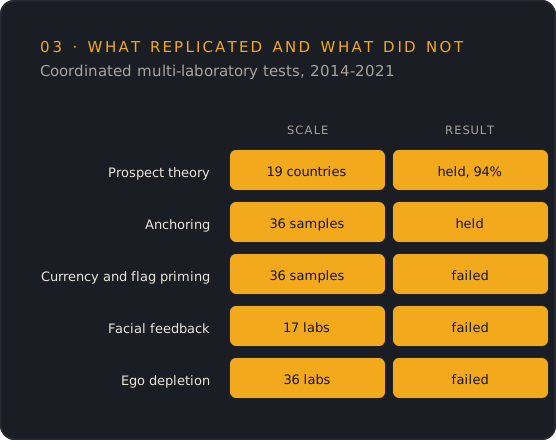
Anchoring (his discovery that a random number you just saw drags your next estimate toward it) also passed the coordinated tests, and later work found it «robust to differences in procedures, participant populations, and experimental settings» (Yoon et al., 2019).
One honest asterisk: loss aversion itself, the emotional heart of the book, is under live academic debate — one review argued losses may not be reliably more painful than gains after all (Gal & Rucker, 2018). That argument has serious people on both sides and is not settled. A reader should know it exists.
Who this book is for
Read it. Read chapter 4 too — but as a historical document about how a whole field fooled itself, not as a report on how your mind works. Everything Kahneman built with his own hands has been stress-tested at a scale unimaginable in 2011, and it stands. What fell was the borrowed material — the flashy studies everyone at the time wanted to believe.
And read his 2017 comment alongside the book. An author correcting himself in public, naming the exact chapter and the exact mistake, is nearly unheard of on this shelf. That one paragraph is worth more than most entire books in the genre.
Nearby on this site: how this genre is built, Atomic Habits, checked, Why We Sleep, and the happiness research.
The other bestseller of behavioural economics went through the same replication wave with less to show for it: Predictably Irrational, rerun.
The boring bottom line
A book about the errors of intuition contains one chapter that committed the error it describes — and its author was the first to say so. The mind-control studies collapsed. The hungry judges have a boring alternative explanation. The hot hand was real all along, hiding behind a counting mistake. And the theory at the book’s core travelled to 19 countries and came home with a 94% score.
The lesson is the one Kahneman drew himself: knowing about a bias (even being the person who discovered it) buys you nothing when a memorable result is looking you in the eye.
Sources
- Kahneman, D (2017). Public comment on «Reconstruction of a Train Wreck: How Priming Research Went off the Rails». replicationindex.com, comment dated 14 February 2017. Not peer-reviewed, and that is exactly why it matters: it is the author speaking for himself rather than anybody's summary of him. The same page reproduces the sentence from the book that prompted it — «disbelief is not an option. The results are not made up, nor are they statistical flukes. You have no choice but to accept that the major conclusions of these studies are true.» replicationindex.com
- Tversky, A; Kahneman, D (1971). Belief in the law of small numbers. Psychological Bulletin 76(2):105-110. Identifier verified in Crossref. Kahneman himself points to this paper as the source of the irony, quoting its phrase «law of small numbers» in his 2017 comment. doi:10.1037/h0031322
- Doyen, S; Klein, O; Pichon, C-L; Cleeremans, A (2012). Behavioral priming: it's all in the mind, but whose mind?. PLoS ONE 7(1):e29081. The effect appeared where the person with the stopwatch expected it. That is the finding that made the whole priming chapter unsafe. doi:10.1371/journal.pone.0029081
- Rohrer, D; Pashler, H; Harris, C R (2015). Do subtle reminders of money change people's political views?. Journal of Experimental Psychology: General 144(4):e73-e85. Two separate facts in one abstract: the replications came out at zero, and null results in the original line of work had not been published. doi:10.1037/xge0000058
- Vadillo, M A; Hardwicke, T E; Shanks, D R (2016). Selection bias, vote counting, and money-priming effects: A comment on Rohrer, Pashler, and Harris (2015) and Vohs (2015). Journal of Experimental Psychology: General 145(5):655-663. Identifier verified in Crossref and PubMed. Cited for the existence of the analysis, not for a number. doi:10.1037/xge0000157
- Klein, R A; Ratliff, K A; Vianello, M; Adams, R B Jr; et al. (2014). Investigating Variation in Replicability: A «Many Labs» Replication Project. Social Psychology 45(3):142-152. Both failures are priming effects. The last sentence also removes the usual escape hatch: you cannot blame the sample or the setting. doi:10.1027/1864-9335/a000178
- Klein, R A; Vianello, M; Hasselman, F; Adams, B G; et al. (2018). Many Labs 2: Investigating Variation in Replicability Across Samples and Settings. Advances in Methods and Practices in Psychological Science 1(4):443-490. Identifier verified in Crossref. Cited for the existence and scale of the follow-up programme. doi:10.1177/2515245918810225
- Yoon, S; Fong, N M; Dimoka, A (2019). The robustness of anchoring effects on preferential judgments. Judgment and Decision Making 14(4):470-487. Anchoring is one of the book's own contributions, and it is among the survivors. doi:10.1017/S1930297500006148
- Hagger, M S; Chatzisarantis, N L D; Alberts, H; Anggono, C O; et al. (2016). A Multilab Preregistered Replication of the Ego-Depletion Effect. Perspectives on Psychological Science 11(4):546-573. Cited as the subject of examination, not as support for the depletion idea. This site treats that literature as unreliable and does not build on it. doi:10.1177/1745691616652873
- Vohs, K D; Schmeichel, B J; Lohmann, S; Gronau, Q F; et al. (2021). A Multisite Preregistered Paradigmatic Test of the Ego-Depletion Effect. Psychological Science 32(10):1566-1581. Cited as the subject of examination. The design was agreed with proponents of the theory, which is what makes the null result decisive rather than disputable. doi:10.1177/0956797621989733
- Miller, J B; Sanjurjo, A (2018). Surprised by the Hot Hand Fallacy? A Truth in the Law of Small Numbers. Econometrica 86(6):2019-2047. Identifier verified in Crossref. The page reports the existence and nature of the correction, not numbers we could not read. doi:10.3982/ECTA14943
- Danziger, S; Levav, J; Avnaim-Pesso, L (2011). Extraneous factors in judicial decisions. PNAS 108(17):6889-6892. The source of the book's most quoted example. Cited as the original, with the two papers that followed it directly below. doi:10.1073/pnas.1018033108
- Weinshall-Margel, K; Shapard, J (2011). Overlooked factors in the analysis of parole decisions. PNAS 108(42). Identifier verified in Crossref and PubMed. Cited to show the finding was contested in the same journal within months. doi:10.1073/pnas.1110910108
- Glöckner, A (2016). The irrational hungry judge effect revisited: Simulations reveal that the magnitude of the effect is overestimated. Judgment and Decision Making 11(6):601-610. Note what this does and does not say: it offers an alternative account of the pattern, not a demonstration that the pattern is absent. doi:10.1017/S1930297500004812
- Wagenmakers, E-J; Beek, T; Dijkhoff, L; Gronau, Q F; et al. (2016). Registered Replication Report: Strack, Martin, & Stepper (1988). Perspectives on Psychological Science 11(6):917-928. The original of the pencil-in-the-teeth study is Strack, Martin & Stepper (1988), DOI 10.1037/0022-3514.54.5.768, identifier verified. doi:10.1177/1745691616674458
- Gal, D; Rucker, D D (2018). The Loss of Loss Aversion: Will It Loom Larger Than Its Gain?. Journal of Consumer Psychology 28(3):497-516. An argument with an active opposition, not a settled correction — and it concerns the theoretical core of the book rather than a borrowed chapter. doi:10.1002/jcpy.1047
- Ruggeri, K; Alí, S; Berge, M L; Bertoldo, G; et al. (2020). Replicating patterns of prospect theory for decision under risk. Nature Human Behaviour 4(6):622-633. The author's own science, tested by the same modern standard that dismantled the borrowed chapters, and it held. doi:10.1038/s41562-020-0886-x
- Harris, C R; Rohrer, D; Pashler, H (2021). A Train Wreck by Any Other Name. Psychological Inquiry 32(1):17-23. Identifier verified in Crossref. The title echoes the blog post Kahneman replied to, which is why it is listed. doi:10.1080/1047840X.2021.1889317