Every claim on this site gets a grade, a date and a list of the papers behind it. This one sits in the registry of checked claims.
TL;DR
- Burnout is in the World Health Organization’s classification, and the same page that put it there says in one sentence: “It is not classified as a medical condition.” It sits in the chapter for reasons people contact health services, alongside unemployment and shift-work problems.
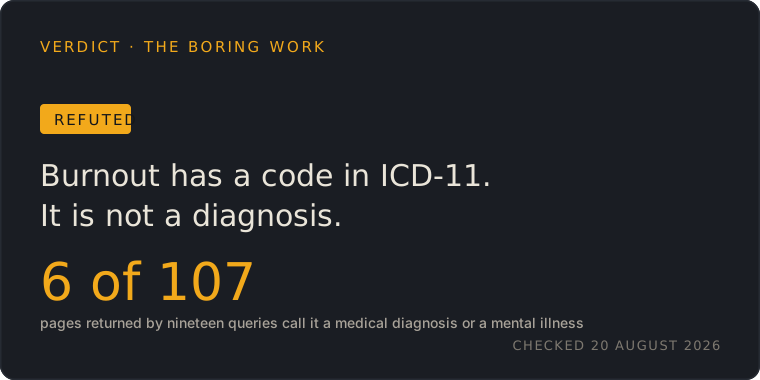
- Of the 107 pages we read on 20 August 2026, six state that burnout is a medical diagnosis or a mental illness. Forty say plainly that it is neither. The internet has largely got the status question right.
- Where it goes wrong is the number. A review of 182 studies covering 109,628 people found at least 142 different definitions of what counts as burnout, and reported prevalence anywhere from 0% to 80.5%.
- The thresholds behind most of those numbers were withdrawn by the instrument’s own publisher in 2016 for having no diagnostic validity. Its authors called publishing them a mistake. Burnout tests online still use them.
- Whether burnout is distinct from depression has two serious camps with real evidence each. A review of 92 studies calls the distinction conceptually fragile; a meta-analysis puts their correlation at .52 and concludes they are different constructs.
In May 2019 the World Health Organization released the eleventh revision of its International Classification of Diseases, and within about a day the story had travelled the world in the wrong shape. Burnout, the headlines said, was now an official medical diagnosis. Two weeks later a WHO spokesman was giving interviews to correct it. The correction did not travel nearly as far as the mistake, which is the usual pattern, and it left a question that people are still typing into search engines seven years later: is this thing real, or is it a word for being tired of your job?
Both halves of that question have answers, and they are not the same answer. The experience is documented, the consequences show up in studies that measured people before they got ill, and the category is a mess. This page separates the three layers that get collapsed into one: what the classification says, what the measurement can carry, and how much of it is depression by another name.
What the classification says
Burnout has an official code, QD85, and it is not a diagnosis. Look at its neighbours in the manual and the point makes itself: it sits in the chapter for «reasons people contact health services that are not themselves illnesses», alongside things like unemployment and trouble with shift work. The WHO’s own announcement draws the line in five words: «It is not classified as a medical condition» (World Health Organization, 2019).
And the official definition is far narrower than the word on the street. Three ingredients: exhaustion, growing cynicism about the job, and a sense of getting worse at it, all «resulting from chronic workplace stress that has not been successfully managed». Then a boundary sentence almost nobody quotes: the term «refers specifically to phenomena in the occupational context and should not be applied to describe experiences in other areas of life». Parental burnout, dating burnout, life burnout, by the book, none of those exist.
The practical consequences follow from where it sits rather than from how serious it is. A code in that chapter is not a diagnosis a clinician assigns as the cause of illness, so it does not by itself carry sick leave, insurance reimbursement or a treatment pathway. Burnout also does not appear in the DSM-5, the manual American clinicians work from at all.
What the first page of Google says about it
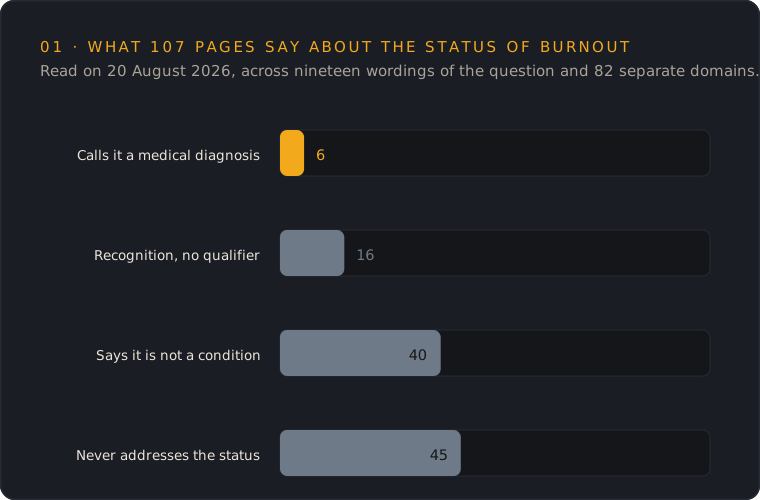
On 20 August 2026 we ran nineteen wordings of the question (is burnout a medical diagnosis, is burnout real condition, is burnout a mental illness recognized by doctors, burnout official diagnosis WHO ICD-11 recognized and fifteen more) and read every page they returned: 107 pages across 82 domains.
Six of the 107 state that burnout is a medical diagnosis or a mental illness. Forty state plainly that it is neither. Sixteen convey official recognition without saying what the classification excludes, and 45 never touch the status question at all. This is the rare case where the open web is mostly right and the correction has stuck. Among the six outliers are a hospital system’s own blog and a television news site, both still carrying 2019 posts whose headlines announce the diagnosis, a treatment centre, a corporate wellness vendor, and a symptom-checker service that describes doctors classifying burnout as a stand-alone medical condition.
The number nobody checks
So how many people have burnout? Somewhere between nobody and four out of five, and that is a direct quote from the data. A Harvard team set out to answer the question for one profession, doctors, by pulling every prevalence study from 1991 to 2018: 182 studies, 109,628 physicians, 45 countries. They planned to pool the numbers into one clean answer. They gave up, because the studies were not measuring the same thing.
Eighty-six per cent of those studies used some version of the same questionnaire. Even so, “studies used at least 142 unique definitions for meeting overall burnout or burnout subscale criteria, indicating substantial disagreement in the literature on what constituted burnout” (Rotenstein et al., 2018). Among the studies using that one questionnaire there were 47 distinct definitions of overall burnout alone. Reported prevalence ran from 0% to 80.5%.
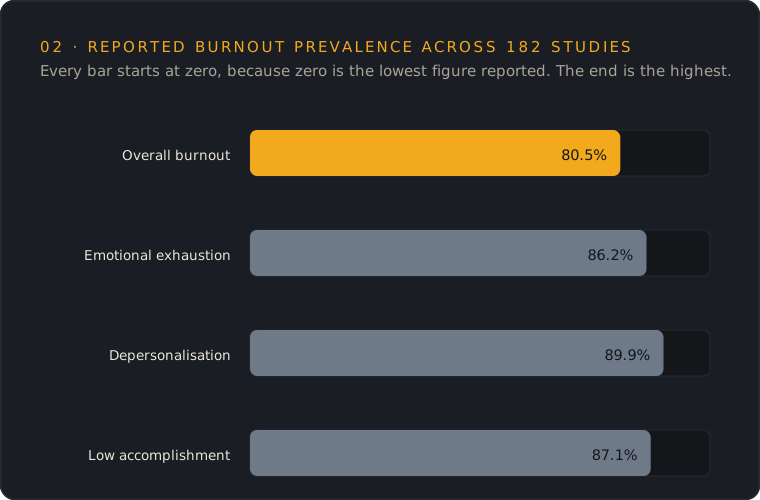
Remember that next time a headline announces «60% of workers are burned out». That number is not a discovery; it is a choice of where to draw the line, dressed up as a finding. Slide the line and the same survey produces a national crisis or a non-event. Any percentage that arrives without its definition attached is decoration.
The thresholds were withdrawn. The tests kept them
The company that publishes the questionnaire says its own cut-off scores never worked. The Maslach Burnout Inventory, built by the American social psychologist Christina Maslach and her colleagues from the early 1980s, is the instrument behind most of what anyone knows about burnout. Its publisher, Mind Garden, carries a statement about the thresholds that were printed in the manual up to the third edition in 1996: “In the 2016 publication of the MBI Manual 4th edition, the cut-off scores were removed due to having no diagnostic validity” (Mind Garden). The same page records that the previously published cut-offs were arbitrary, that the authors came to regard publishing them as a mistake, and that the questionnaire “is a research measure from which we can learn about the causes and outcomes of burnout, but it is not a clinical diagnostic tool”.
A decade later, the recalled parts are still on the road. Google «burnout test» and you will be scored against those same abandoned lines and sorted into a coloured band. The bands were made by splitting one old sample of respondents into thirds, which describes that sample, and says nothing about you.
The field’s response was to start again. Wilmar Schaufeli and colleagues at KU Leuven built a replacement, the Burnout Assessment Tool, by first interviewing 49 practitioners about what they meant by the word and then validating the result on 1,500 Flemish employees (Schaufeli et al., 2020). Note the order of operations: the definition was derived from asking people who use the term what they had in mind. Forty years after the construct entered the literature, that was still the available starting point.
Burnout or depression: two serious camps
This one is open, and both sides have done the work. Renzo Bianchi, then at the University of Franche-Comté in Besançon, with Irvin Schonfeld at the City College of New York and Eric Laurent, went through 92 studies bearing on whether burnout and depression can be told apart. Their finding: “evidence for the distinctiveness of the burnout phenomenon has been inconsistent, with the most recent studies casting doubt on that distinctiveness” (Bianchi, Schonfeld & Laurent, 2015). In a companion paper the same year they went further and argued against giving burnout diagnostic status at all, on the grounds that “the current state of science suggests that burnout is a form of depression rather than a differentiated type of pathology” (Bianchi et al., 2015).
Panagiota Koutsimani, Anthony Montgomery and Katerina Georganta, at the University of Macedonia in Thessaloniki, pooled the correlations instead. Across the studies they could include, burnout correlated with depression at r = 0.520, confidence interval 0.492 to 0.547, and with anxiety at r = 0.460, interval 0.421 to 0.497. A correlation of about .52 means the two share roughly a quarter of their variance and differ in the rest. And the moderation analysis pointed the opposite way from what the overlap argument predicts: studies rated higher in quality, and those using the Maslach questionnaire, produced smaller effect sizes, not larger. Their conclusion is a direct contradiction of Bianchi’s — the results indicate burnout and depression “are different and robust constructs” (Koutsimani et al., 2019).
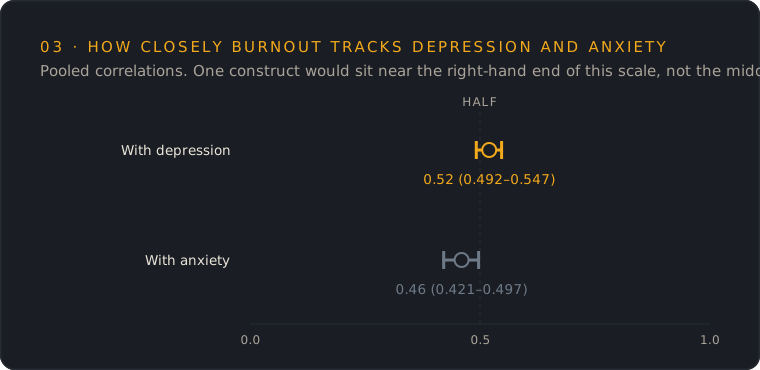
Two competent teams, the same pile of studies, opposite verdicts. The honest position is that «is burnout just depression?» is unresolved, and anyone answering it with confidence in either direction has outrun the evidence. Constructs measured for forty years before anyone agreed what they were tend to end up in exactly this kind of argument; willpower did the same, as the ego depletion story shows.
Brain fog, insomnia, physical illness: three separate verdicts
Brain fog: partial, and thinner than it looks. The phrase has no clinical definition, so the question that can be answered is narrower: do people scoring high on burnout measures perform worse on objective cognitive tests? Karin Riedrich, a clinician at a rehabilitation centre in Bad Hall, Austria, and colleagues at the University of Graz reviewed the studies that ran such tests and found sixteen. Their summary of the state of it: “The findings are partly contradictory, probably due to methodical differences” (Riedrich et al., 2017). Where the studies agree is a narrow band: executive function, vigilance, and the updating and monitoring of working memory. Sixteen studies is the entire objective evidence base for a symptom that has its own genre of article.
Insomnia: partial, and the arrow points the other way. Markus Jansson-Fröjmark, then at Örebro University in Sweden, and Karin Lindblom took a random sample of 1,812 people from the general population, kept the 1,258 who were employed, and measured insomnia and burnout twice a year apart, controlling for age, sex, anxiety and depression. The popular story is a vicious circle: burnout ruins sleep, bad sleep deepens burnout. The measurement says otherwise: “insomnia and burnout are not bidirectionally related in the working population” (Jansson-Fröjmark & Lindblom, 2010). Insomnia did not predict burnout appearing, and burnout did not predict insomnia appearing. What insomnia did predict was persistence: among people already exhausted, insomnia tripled the odds that the exhaustion was still there a year later, at an odds ratio of 3.02.
Physical illness: confirmed, with the caveat the authors themselves record. Denise Salvagioni and colleagues at institutions in Londrina, Brazil, restricted their review to prospective studies (burnout measured first, illness recorded later), which removes the obvious objection that sick people report more exhaustion. Of 993 articles screened, 61 qualified and 36 met all three criteria for prospective design. Burnout scores predicted hypercholesterolaemia, type 2 diabetes, coronary heart disease, hospitalisation for cardiovascular disorder, musculoskeletal pain, prolonged fatigue, headaches, gastrointestinal and respiratory problems, severe injuries, and mortality below the age of 45 (Salvagioni et al., 2017). The review also states, in three words of its own abstract: “Conflicting findings were observed.”
Assemble those three verdicts and the real shape of burnout appears. As a category, it is a mess: no agreed definition, no valid thresholds, a live dispute about whether it is depression in work clothes. As a signal, it works: people scoring high today are measurably more likely to be ill in the coming years. A fuzzy category can still carry real information, the way «feeling off» is not in any manual and still worth listening to.
Where the limits are
The prevalence review is about practising physicians, which is the profession that studies itself most and is not a stand-in for everyone. The prospective health findings lean heavily on Scandinavian and healthcare cohorts. The insomnia study is one country, one year of follow-up, and 1,258 people. The instrument that produced most of the underlying data was designed for research on groups, and its publisher has said in writing that it does not diagnose individuals.
The largest limit is the one written into the definition. The classification covers the workplace and says so explicitly, and the moment the word is used for parenting, caring or life in general, it has left the territory where any of these numbers were collected.
What to do with this instead
The shift: stop asking whether you have burnout and start asking what changed, where, and whether it lifts when the work stops.
First move: treat any score you get from an online burnout test as a description of a questionnaire, not of you. The thresholds those tests use were withdrawn by the publisher in 2016 for having no diagnostic validity, and no replacement threshold has taken their place.
Second move: watch the boundary the classification draws. The distinction that matters, the one every serious source keeps returning to, is whether the flatness is confined to work or follows you everywhere. That question is answerable from your own week and does not need a scale. If it follows you everywhere, the word burnout is the wrong tool for it.
Third move: take the exhaustion seriously without needing the label to be a diagnosis. The prospective evidence is that high scores predict later illness even though the category is contested. Nothing about the category being messy makes the tiredness less real, and the concrete signals worth watching at work are a more useful place to look than a score.
Where boundaries at work are the issue rather than the work itself, the twelve boundary rules covers what has and has not been measured there. And if exhaustion, low mood or sleep trouble persist regardless of what happens at work, that is a conversation for a clinician rather than for a questionnaire; this page is about how a category is defined, not about anyone’s health.
The boring bottom line
Burnout is real as an experience and unresolved as a category. It has a code, and that code sits in the chapter for things that bring people to a clinic without being illnesses. The internet has mostly absorbed that. What it has not absorbed is that the numbers underneath (the percentages, the thresholds, the tests) rest on definitions that 182 studies could not agree on and on cut-off scores their own publisher retracted a decade ago.
Two things can be true at once: nobody can tell you what fraction of workers are burned out, and a high score still predicts who ends up ill. The first is a failure of the category. The second is the reason people keep using it anyway.
Sources
- World Health Organization (2019). Burn-out an occupational phenomenon: International Classification of Diseases. WHO news release, 28 May 2019. The statement that settles the status question. Burn-out sits in ICD-11 as an occupational phenomenon in the chapter of factors influencing health status, not in the chapter of mental disorders. who.int
- Mind Garden, publisher of the Maslach Burnout Inventory (2026). Maslach Burnout Inventory (MBI): the invalidity of statistical cut-off scores. mindgarden.com, product and guidance page. The instrument's own publisher says the thresholds that most burnout statistics are built on were arbitrary, and calls their publication a mistake. mindgarden.com
- Rotenstein, L. S., Torre, M., Ramos, M. A., Rosales, R. C., Guille, C., et al (2018). Prevalence of burnout among physicians: A systematic review. JAMA. 320(11), 1131-1150. The clearest measurement of the measurement problem: one construct, 182 studies, 142 definitions, and a prevalence range covering almost the whole scale. doi:10.1001/jama.2018.12777
- Bianchi, R., Schonfeld, I. S., & Laurent, E (2015). Burnout-depression overlap: A review. Clinical Psychology Review. 36, 28-41. The strongest statement of the sceptical case: the distinction between the two is conceptually fragile, and it is unclear how the end state of burnout differs from depression. doi:10.1016/j.cpr.2015.01.004
- Bianchi, R., Schonfeld, I. S., & Laurent, E (2015). Is it time to consider the burnout syndrome a distinct illness?. Frontiers in Public Health. 3, 158. The same group's position paper. It argues against giving burnout diagnostic status, which is the position the classification bodies took anyway. doi:10.3389/fpubh.2015.00158
- Koutsimani, P., Montgomery, A., & Georganta, K (2019). The relationship between burnout, depression and anxiety: A systematic review and meta-analysis. Frontiers in Psychology. 10, 284. The counterweight to Bianchi. A correlation of about .52 leaves roughly three quarters of the variance unshared, and the better-quality studies found less overlap, not more. doi:10.3389/fpsyg.2019.00284
- Salvagioni, D. A. J., Melanda, F. N., Mesas, A. E., Gonzalez, A. D., Gabani, F. L., et al (2017). Physical, psychological and occupational consequences of job burnout: A systematic review of prospective studies. PLOS ONE. 12(10), e0185781. Whatever burnout is as a category, scores on it predict later illness in studies that measured the score first. The review also records conflicting findings. doi:10.1371/journal.pone.0185781
- Jansson-Frojmark, M., & Lindblom, K (2010). Is there a bidirectional link between insomnia and burnout? A prospective study in the Swedish workforce. International Journal of Behavioral Medicine. 18(4), 306-313. The one prospective test of the direction of travel between sleep and burnout, and it goes one way only, and only for persistence. doi:10.1007/s12529-010-9107-8
- Riedrich, K., Weiss, E. M., Dalkner, N., Reininghaus, E., & Papousek, I (2017). Cognitive impairments accompanying the burnout syndrome: a review. Neuropsychiatrie. 31(1), 24-31. Sixteen studies is the whole objective evidence base for the thing people call brain fog, and it does not agree with itself. doi:10.1007/s40211-017-0217-2
- Schaufeli, W. B., Desart, S., & De Witte, H (2020). Burnout Assessment Tool (BAT): Development, validity, and reliability. International Journal of Environmental Research and Public Health. 17(24), 9495. The instrument built after the field admitted the old one had no thresholds. Its definition was derived from asking practitioners what they meant by the word. doi:10.3390/ijerph17249495